2017 PEUGEOT PARTNER TEPEE ELECTRIC lock
[x] Cancel search: lockPage 72 of 252
34
When the vehicle moves off, as soon as you
reach approximately 6 mph (10 km/h), the
system locks the doors. The characteristic
central locking noise is heard. The LED in the
control switch on the dashboard central switch
panel comes on.
During the journey, opening a door results in
complete unlocking of the vehicle.
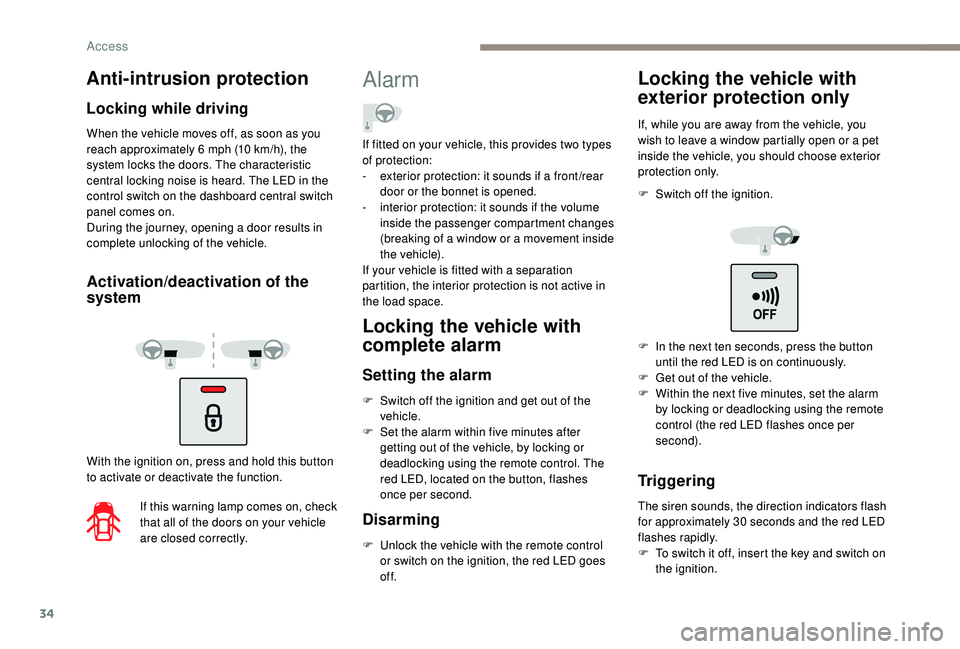
Activation/deactivation of the
system
With the ignition on, press and hold this button
to activate or deactivate the function.
If this warning lamp comes on, check
that all of the doors on your vehicle
are closed correctly.
Alarm
Locking the vehicle with
complete alarm
Setting the alarm
F Switch off the ignition and get out of the vehicle.
F
S
et the alarm within five minutes after
getting out of the vehicle, by locking or
deadlocking using the remote control. The
red LED, located on the button, flashes
once per second.
Disarming
F Unlock the vehicle with the remote control or switch on the ignition, the red LED goes
of f.
Locking the vehicle with
exterior protection only
If, while you are away from the vehicle, you
wish to leave a window partially open or a pet
inside the vehicle, you should choose exterior
protection only.
F
S
witch off the ignition.
Triggering
The siren sounds, the direction indicators flash
for approximately 30 seconds and the red LED
flashes rapidly.
F
T
o switch it off, insert the key and switch on
the ignition.
Anti-intrusion protection
Locking while driving
If fitted on your vehicle, this provides two types
of protection:
-
e
xterior protection: it sounds if a front /rear
door or the bonnet is opened.
-
i
nterior protection: it sounds if the volume
inside the passenger compartment changes
(breaking of a window or a movement inside
the vehicle).
If your vehicle is fitted with a separation
partition, the interior protection is not active in
the load space.
F
I
n the next ten seconds, press the button
until the red LED is on continuously.
F
G
et out of the vehicle.
F
W
ithin the next five minutes, set the alarm
by locking or deadlocking using the remote
control (the red LED flashes once per
second).
Access
Page 73 of 252
35
Locking the vehicle without
alarm
F Insert the key in the driver's door lock and lock it.
Do not set the alarm when washing your
vehicle.
Failure of the remote control
If the alarm is set but the remote control is not
working:
F
U
nlock the doors with the key and open the
door. The alarm is triggered.
F
S
witch on the ignition within ten seconds.
The alarm is disarmed.
Malfunction
When the ignition is switched on, if the red LED
remains on for ten seconds there is a fault in
the siren connection.
Contact a PEUGEOT dealer to have the system
checked.
Automatic setting of the alarm
Depending on the country in which the vehicle is
sold, the alarm is set automatically approximately
2
minutes after the last door is closed.
Do not make any modifications to the
alarm system as this could cause faults.
When the alarm has been triggered ten times
in succession (when triggered for the eleventh
time) it is deactivated. Repeat the procedure for
setting the alarm.
To prevent triggering of the alarm when a door
is opened, you must press the unlocking button
on the remote control again.
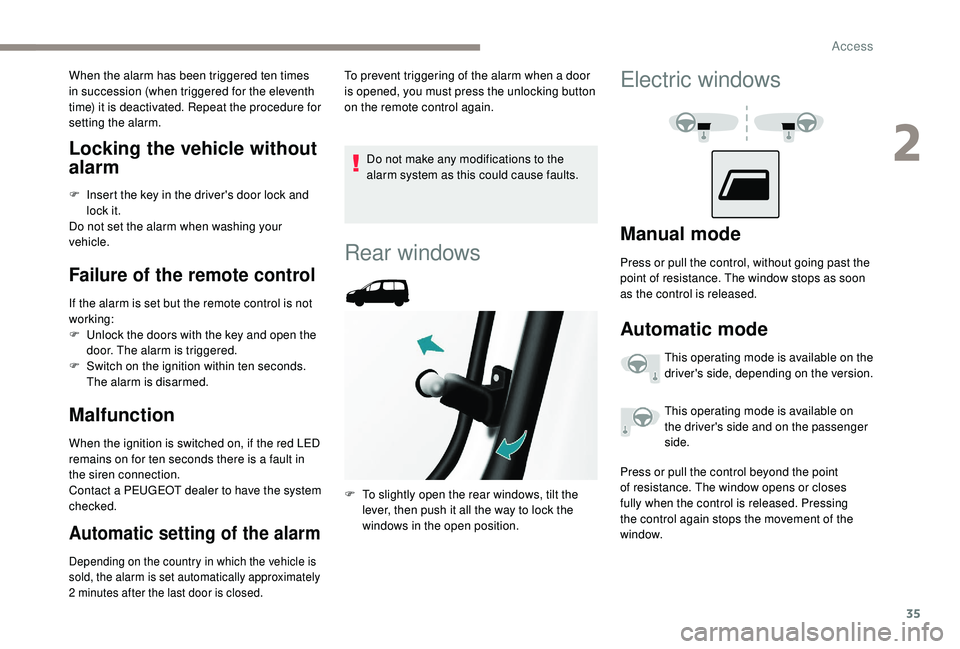
Rear windows
F To slightly open the rear windows, tilt the
lever, then push it all the way to lock the
windows in the open position.
Electric windows
Manual mode
Press or pull the control, without going past the
point of resistance. The window stops as soon
as the control is released.
Automatic mode
This operating mode is available on the
driver's side, depending on the version.
This operating mode is available on
the driver's side and on the passenger
side.
Press or pull the control beyond the point
of resistance. The window opens or closes
fully when the control is released. Pressing
the control again stops the movement of the
window.
2
Access
Page 75 of 252
37
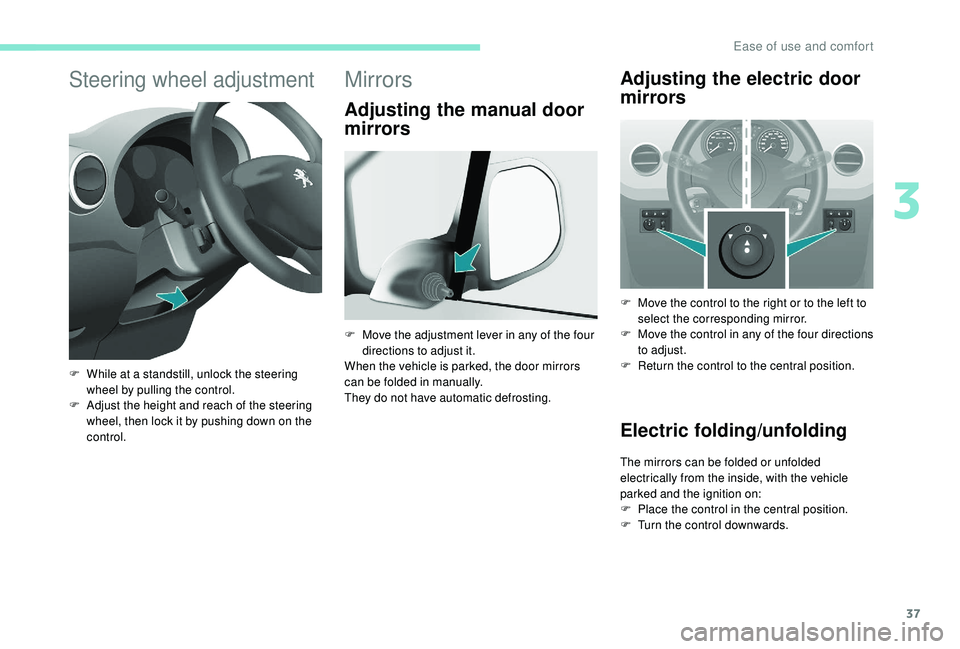
Steering wheel adjustment
F While at a standstill, unlock the steering wheel by pulling the control.
F
A
djust the height and reach of the steering
wheel, then lock it by pushing down on the
control.
Mirrors
Adjusting the manual door
mirrors Adjusting the electric door
mirrors
F Move the control to the right or to the left to
select the corresponding mirror.
F
M
ove the control in any of the four directions
to adjust.
F
R
eturn the control to the central position.
Electric folding/unfolding
The mirrors can be folded or unfolded
electrically from the inside, with the vehicle
parked and the ignition on:
F
P
lace the control in the central position.
F
T
urn the control downwards.
F
M
ove the adjustment lever in any of the four
directions to adjust it.
When the vehicle is parked, the door mirrors
can be folded in manually.
They do not have automatic defrosting.
3
Ease of use and comfort
Page 77 of 252
39
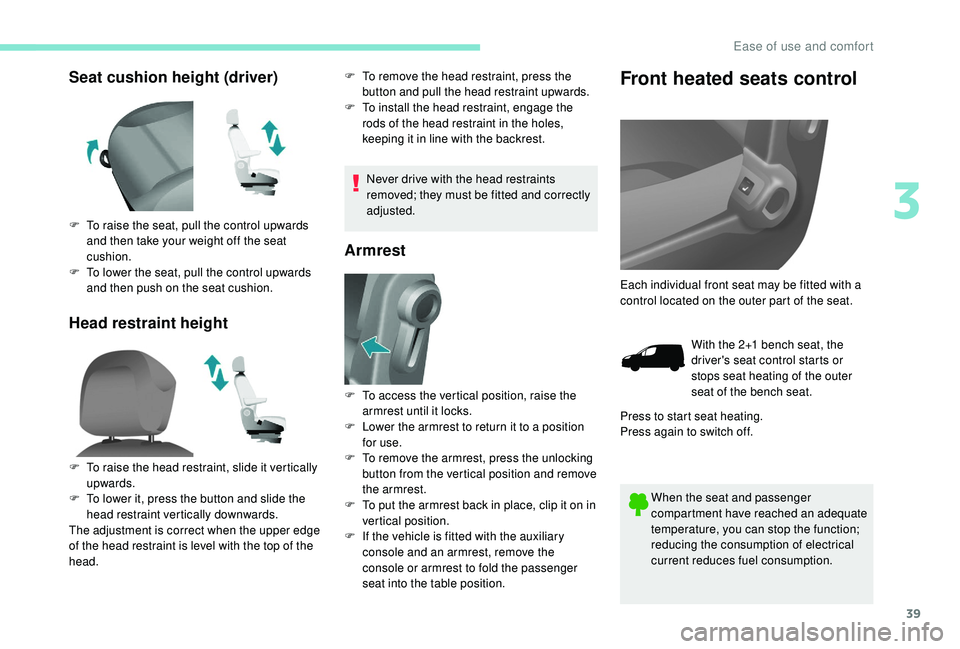
Seat cushion height (driver)
Head restraint heightF To remove the head restraint, press the button and pull the head restraint upwards.
F
T
o install the head restraint, engage the
rods of the head restraint in the holes,
keeping it in line with the backrest.
Never drive with the head restraints
removed; they must be fitted and correctly
adjusted.
Armrest
Front heated seats control
When the seat and passenger
compartment have reached an adequate
temperature, you can stop the function;
reducing the consumption of electrical
current reduces fuel consumption.
F
T
o raise the seat, pull the control upwards
and then take your weight off the seat
cushion.
F
T
o lower the seat, pull the control upwards
and then push on the seat cushion.
F
T
o raise the head restraint, slide it vertically
upwards.
F
T
o lower it, press the button and slide the
head restraint vertically downwards.
The adjustment is correct when the upper edge
of the head restraint is level with the top of the
head. F
T
o access the vertical position, raise the
armrest until it locks.
F
L
ower the armrest to return it to a position
for use.
F
T
o remove the armrest, press the unlocking
button from the vertical position and remove
the armrest.
F
T
o put the armrest back in place, clip it on in
vertical position.
F
I
f the vehicle is fitted with the auxiliary
console and an armrest, remove the
console or armrest to fold the passenger
seat into the table position. Each individual front seat may be fitted with a
control located on the outer part of the seat.
With the 2+1 bench seat, the
driver's seat control starts or
stops seat heating of the outer
seat of the bench seat.
Press to start seat heating.
Press again to switch off.
3
Ease of use and comfort
Page 78 of 252

40
Individual passenger seat Multi-Flex bench seat
Folding the backrest
Returning the backrest to
the sitting position
F Pull the lever for wards, then raise the backrest until it locks.
The backrest of the individual passenger seat
can be folded to enable very long equipment to
be transported.
F
P
ull the lever for wards, then tilt the
backrest.
Central seatIt is fitted with a 3 -point seat belt with the belt
return fixed to the load stop bars behind the
driver.
Mobile desk position
F Pull the tongue at the lower edge of the seat to lower the backrest, which incorporates a
writing tray fitted with a strap.
Do not use the function when the seat is
not occupied.
Prolonged use is not recommended for
those with sensitive skin.
There is a risk of burns for people whose
perception of heat is impaired (illness,
taking medication, etc.).
There is a risk of overheating the system if
material with insulating properties is used,
such as cushions or seat covers.
Do not use the system:
-
i
f wearing damp clothing,
-
i
f child seats are fitted.
To avoid breaking the heating element in
the seat:
-
d
o not place heavy objects on the seat,
-
d
o not kneel or stand on the seat,
-
d
o not place sharp objects on the seat,
-
d
o not spill liquids onto the seat.
To avoid the risk of short-circuit:
-
d
o not use liquid products for cleaning
the seat,
-
n
ever use the heating function when
the seat is damp.
Ease of use and comfort
Page 79 of 252
41
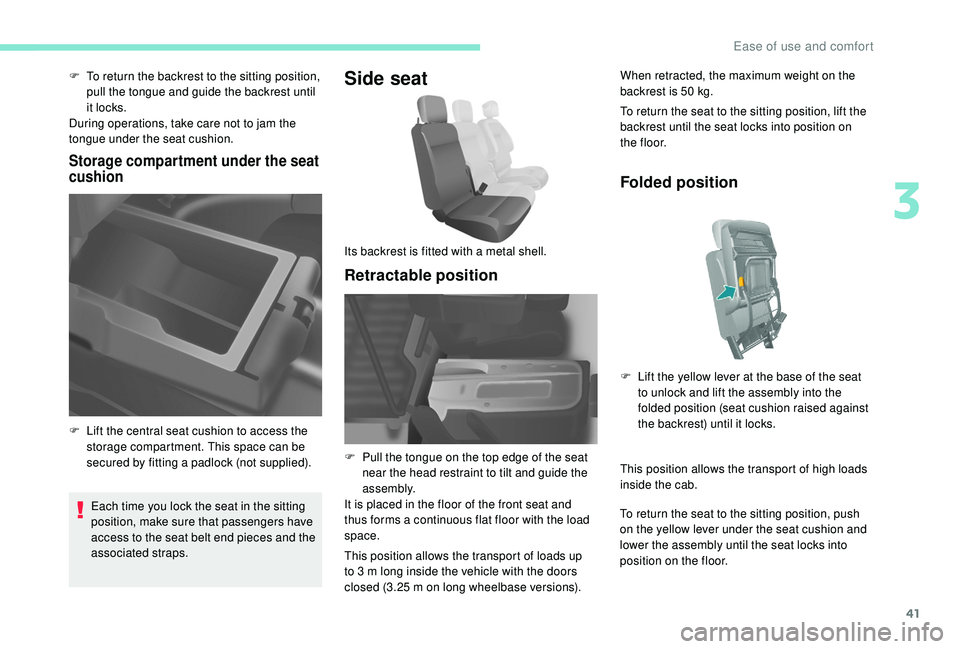
F To return the backrest to the sitting position, pull the tongue and guide the backrest until
it locks.
During operations, take care not to jam the
tongue under the seat cushion.
Storage compartment under the seat
cushion
Each time you lock the seat in the sitting
position, make sure that passengers have
access to the seat belt end pieces and the
associated straps.
Side seat
Retractable position
When retracted, the maximum weight on the
backrest is 50 kg.
To return the seat to the sitting position, lift the
backrest until the seat locks into position on
t h e f l o o r.
F
L
ift the central seat cushion to access the
storage compartment. This space can be
secured by fitting a padlock (not supplied). Its backrest is fitted with a metal shell.
F
P
ull the tongue on the top edge of the seat
near the head restraint to tilt and guide the
assembly.
It is placed in the floor of the front seat and
thus forms a continuous flat floor with the load
space.
This position allows the transport of loads up
to 3
m long inside the vehicle with the doors
closed (3.25
m on long wheelbase versions).
Folded position
This position allows the transport of high loads
inside the cab.
To return the seat to the sitting position, push
on the yellow lever under the seat cushion and
lower the assembly until the seat locks into
position on the floor. F
L
ift the yellow lever at the base of the seat
to unlock and lift the assembly into the
folded position (seat cushion raised against
the backrest) until it locks.
3
Ease of use and comfort
Page 81 of 252
43
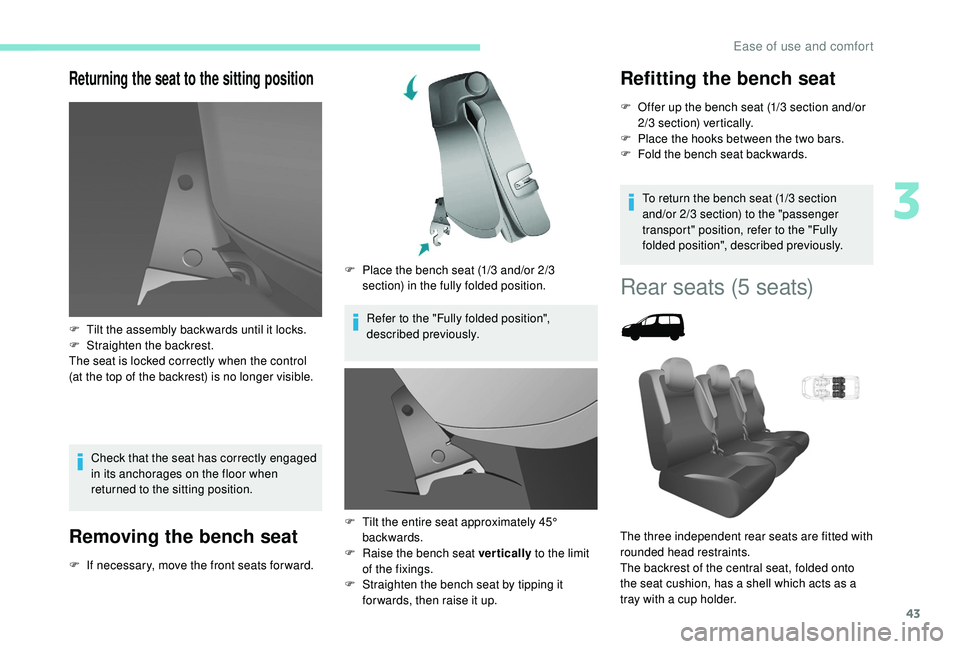
Returning the seat to the sitting position
Check that the seat has correctly engaged
in its anchorages on the floor when
returned to the sitting position.
Removing the bench seat
F If necessary, move the front seats for ward.F
P
lace the bench seat (1/3 and/or 2/3
section) in the fully folded position.
Refer to the "Fully folded position",
described previously.
F
T
ilt the assembly backwards until it locks.
F
S
traighten the backrest.
The seat is locked correctly when the control
(at the top of the backrest) is no longer visible.
F
T
ilt the entire seat approximately 45°
backwards.
F Ra ise the bench seat vertically
to the limit
of the fixings.
F
S
traighten the bench seat by tipping it
for wards, then raise it up.
Refitting the bench seat
F Offer up the bench seat (1/3 section and/or 2/3 section) vertically.
F
P
lace the hooks between the two bars.
F
F
old the bench seat backwards.
To return the bench seat (1/3 section
and/or 2/3 section) to the "passenger
transport" position, refer to the "Fully
folded position", described previously.
Rear seats (5 seats)
The three independent rear seats are fitted with
rounded head restraints.
The backrest of the central seat, folded onto
the seat cushion, has a shell which acts as a
tray with a cup holder.
3
Ease of use and comfort
Page 82 of 252
44
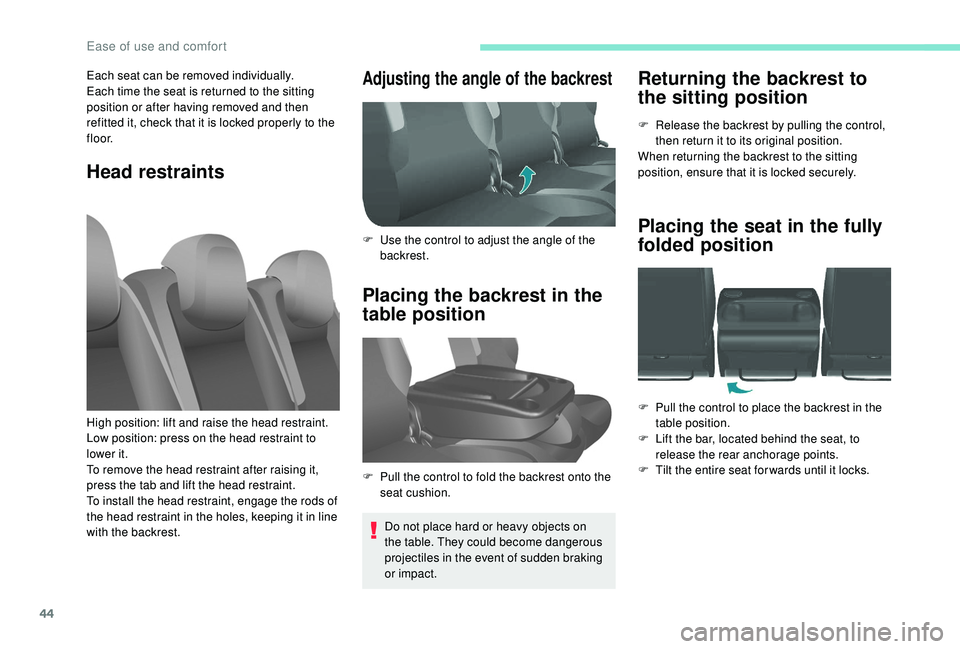
Returning the backrest to
the sitting position
F Release the backrest by pulling the control, then return it to its original position.
When returning the backrest to the sitting
position, ensure that it is locked securely.
Placing the seat in the fully
folded position
F Pull the control to place the backrest in the table position.
F
L
ift the bar, located behind the seat, to
release the rear anchorage points.
F
T
ilt the entire seat for wards until it locks.
Each seat can be removed individually.
Each time the seat is returned to the sitting
position or after having removed and then
refitted it, check that it is locked properly to the
f l o o r.
Head restraints
Adjusting the angle of the backrest
High position: lift and raise the head restraint.
Low position: press on the head restraint to
lower it.
To remove the head restraint after raising it,
press the tab and lift the head restraint.
To install the head restraint, engage the rods of
the head restraint in the holes, keeping it in line
with the backrest.
F
U
se the control to adjust the angle of the
backrest.
Placing the backrest in the
table position
F Pull the control to fold the backrest onto the seat cushion.
Do not place hard or heavy objects on
the table. They could become dangerous
projectiles in the event of sudden braking
or impact.
Ease of use and comfort