Page 14 of 252
12
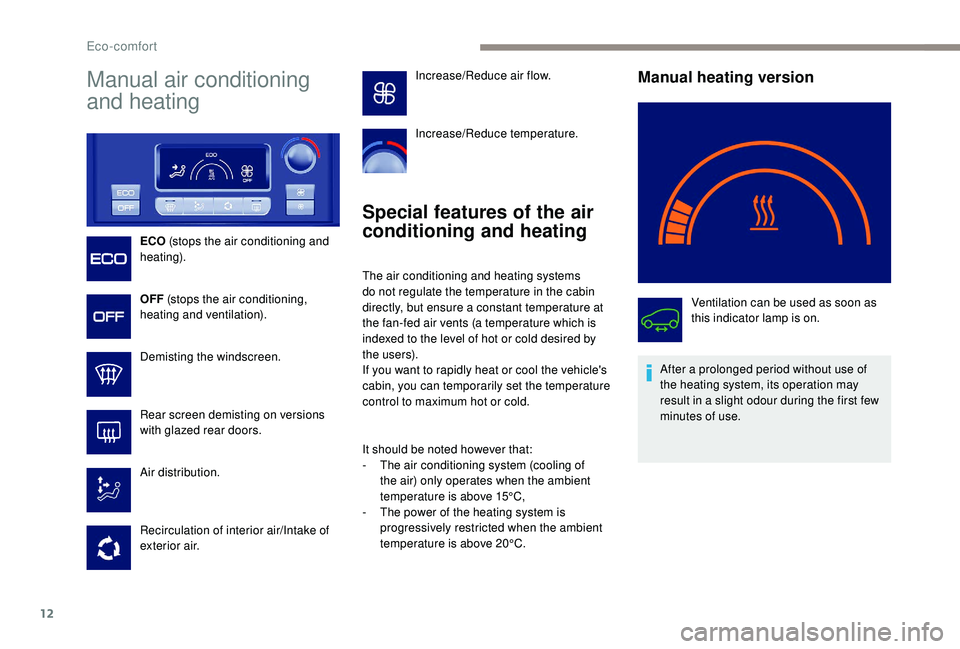
Manual air conditioning
and heating
ECO (stops the air conditioning and
heating).
OFF (stops the air conditioning,
heating and ventilation).
Demisting the windscreen.
Rear screen demisting on versions
with glazed rear doors.
Air distribution.
Recirculation of interior air/Intake of
exterior air.
Special features of the air
conditioning and heating
The air conditioning and heating systems
do not regulate the temperature in the cabin
directly, but ensure a constant temperature at
the fan-fed air vents (a temperature which is
indexed to the level of hot or cold desired by
the users).
If you want to rapidly heat or cool the vehicle's
cabin, you can temporarily set the temperature
control to maximum hot or cold.
It should be noted however that:
-
T
he air conditioning system (cooling of
the air) only operates when the ambient
temperature is above 15°C,
-
T
he power of the heating system is
progressively restricted when the ambient
temperature is above 20°C.
Manual heating version
Ventilation can be used as soon as
this indicator lamp is on.
After a prolonged period without use of
the heating system, its operation may
result in a slight odour during the first few
minutes of use.
Increase/Reduce air flow.
Increase/Reduce temperature.
Eco-comfort
Page 15 of 252
13
Practical advice
Heating and ventilation
In heating mode, try to use moderate
levels of ventilation, i.e. fewer than
3 blades. This will allow the system to
deliver air at a higher temperature.
Air distribution
In winter, air distribution towards the
footwells is recommended, allowing
a more uniform ambience to be
obtained in the cabin.
In summer, distribution towards the
face-level vents will increase the
effectiveness of the ventilation and
air conditioning.
2
Eco-comfort
Page 26 of 252
24
Other information
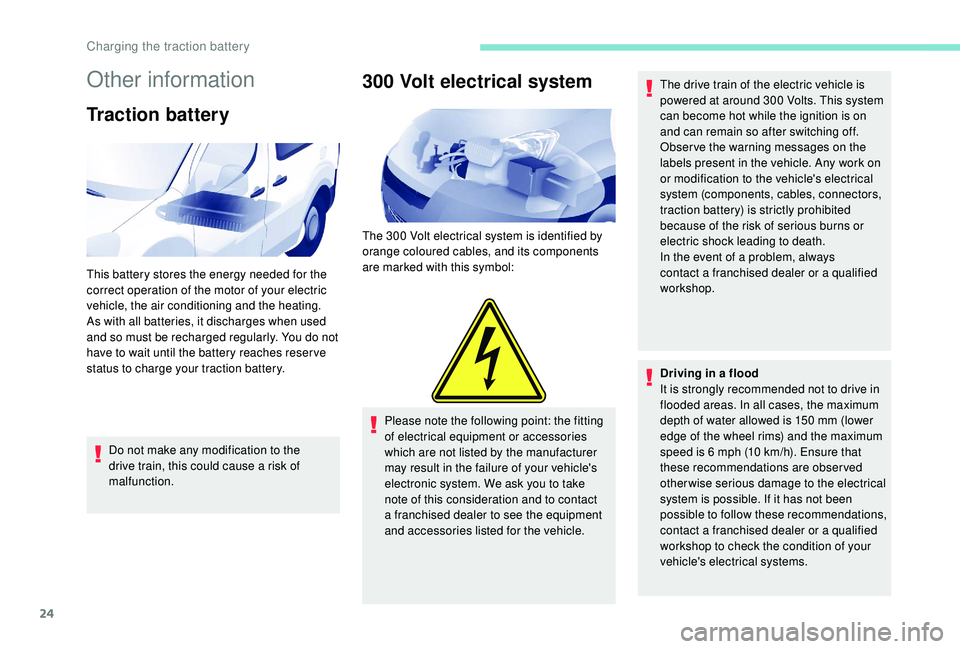
Traction battery
Do not make any modification to the
drive train, this could cause a risk of
malfunction.
300 Volt electrical system
The 300 Volt electrical system is identified by
o range coloured cables, and its components
are marked with this symbol:
Please note the following point: the fitting
of electrical equipment or accessories
which are not listed by the manufacturer
may result in the failure of your vehicle's
electronic system. We ask you to take
note of this consideration and to contact
a franchised dealer to see the equipment
and accessories listed for the vehicle. The drive train of the electric vehicle is
powered at around 300
Volts. This system
can become hot while the ignition is on
and can remain so after switching off.
Obser ve the warning messages on the
labels present in the vehicle. Any work on
or modification to the vehicle's electrical
system (components, cables, connectors,
traction battery) is strictly prohibited
because of the risk of serious burns or
electric shock leading to death.
In the event of a problem, always
contact a franchised dealer or a qualified
workshop.
Driving in a flood
It is strongly recommended not to drive in
flooded areas. In all cases, the maximum
depth of water allowed is 150
mm (lower
edge of the wheel rims) and the maximum
speed is 6
mph (10 km/h). Ensure that
these recommendations are observed
otherwise serious damage to the electrical
system is possible. If it has not been
possible to follow these recommendations,
contact a franchised dealer or a qualified
workshop to check the condition of your
vehicle's electrical systems.
This battery stores the energy needed for the
correct operation of the motor of your electric
vehicle, the air conditioning and the heating.
As with all batteries, it discharges when used
and so must be recharged regularly. You do not
have to wait until the battery reaches reser ve
status to charge your traction battery.
Charging the traction battery
Page 34 of 252
32
The range of the vehicle, approved on
the NEDC cycle, is 105 miles (170 km).
This range may vary according to various
factors, the main ones being the use of
the heating and air conditioning, the style
of driving, the type of route taken and the
ageing of the traction battery.
Ageing of the traction battery also depends
on various factors, such as the ambient
temperature, the mileage of the vehicle, the
frequency of fast charges, etc.Identification markings
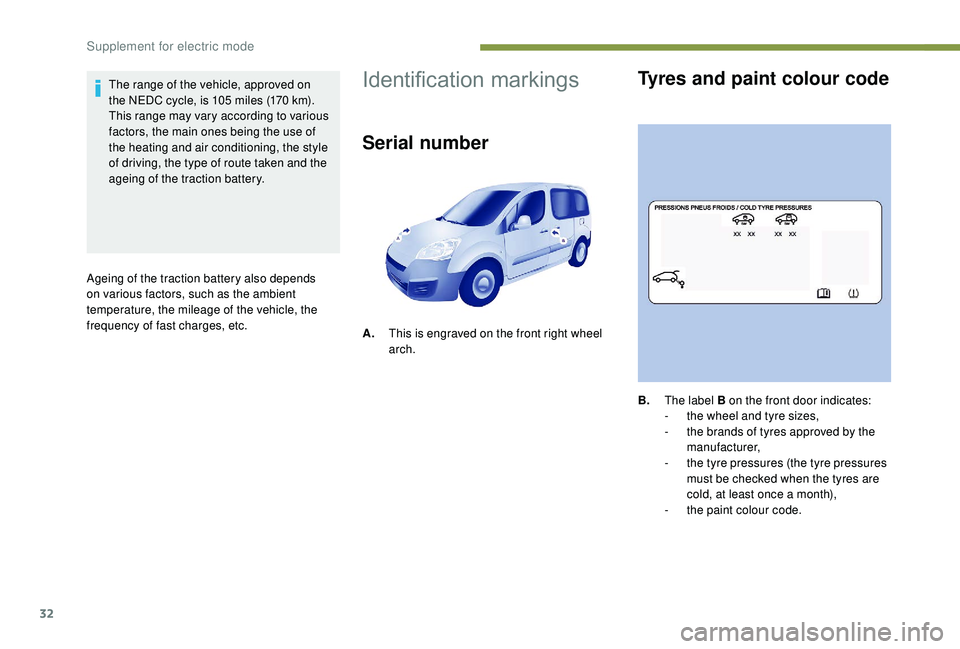
Serial number
A. This is engraved on the front right wheel
arch.
Tyres and paint colour code
B.The label B on the front door indicates:
-
t he wheel and tyre sizes,
-
t
he brands of tyres approved by the
manufacturer,
-
t
he tyre pressures (the tyre pressures
must be checked when the tyres are
cold, at least once a month),
-
t
he paint colour code.
Supplement for electric mode
Page 40 of 252

2
.
.
Instrument panel 7
W arning and indicator lamps 8
I
ndic ators
18
Lighting dimmer
2
2
Trip computer
2
2
Date and time setting
2
3
Instruments and controls
4
K
ey
25
Remote control
2
5
Front doors
2
8
Sliding side door(s)
2
8
Operation in the event of a battery failure
2
9
Tailgate
29
Side-hinged rear doors
3
0
Rear roof flap
3
2
Central locking
3
3
Alarm
34
Rear windows
3
5
Electric windows
3
5Steering wheel adjustment
3
7
Mirrors
37
Surveillance mirror
3
8
Front seats
3
8
Individual passenger seat
4
0
Multi-Flex bench seat
4
0
Rear bench seat
4
2
Rear seats (5 seats) 4 3
Rear seats (7 seats) 4 6
Crew cab
5
0
Seat modularity and configurations
5
2
Front fittings
5
4
Seating area fittings
5
5
Zenith
56
Fragrance diffuser
5
7
Courtesy lamps
5
9
Rear fittings (5 seats)
6
0
Rear fittings (7 seats)
6
1
Load space layout
6
4
Heating/Manual air conditioning
6
6
Dual-zone automatic air conditioning
6
7
Recommendations for ventilation
and air conditioning
6
9
Demisting and defrosting
7
0Lighting control stalk
7
1
Automatic illumination of headlamps
7
2
LED daytime running lamps
7
2
Guide-me-home lighting
7
2
Cornering lighting
7
3
Direction indicators
7
3
Headlamp beam
7
3
Wiper control stalk 7 3
General safety recommendations
7
6
Hazard warning lamps
7
7
Horn
77
Emergency or assistance call
7
7
Anti-lock braking system (ABS/EBFD)
7
9
Emergency braking assistance (EBA)
7
9
Anti-slip regulation (ASR) and electronic
stability control (ESC)
7
9
Grip control
8
0
Seat belts
8
2
Airbags
85
Child seats
8
9
Deactivating the passenger's front airbag
9
0
Reactivating the passenger's front airbag
9
1
Recommended child seats
9
4
Locations for child seats secured using
a seat belt
9
5
ISOFIX mountings and child seats
9
8
Instructions for child seats
1
01
Child lock
1
02
Over view
Instruments
Access Ease of use and comfort
Safety
Lighting and visibility
Eco-driving
Contents
Page 42 of 252
4
Instruments and controls1.Lighting and direction indicator control
stalk.
2. Instrument panel with display.
3. Wiper/screenwash/trip computer control
stalk.
4. Ignition.
5. Audio system controls.
6. Driver's front airbag/horn.
7. Steering wheel height and reach
adjustment.
8. Cruise control/speed limiter controls.
9. Control panel: parking sensors, headlamp
beam adjustment, ESC, Stop & Start,
alarm (depending on country of sale).
10. Bonnet release.
11. Electric door mirror adjustment controls.
12 . Front window controls.
13. Switch panel: hazard warning lamps,
central locking, child lock (depending on
ve r s i o n).
14 . Cigarette lighter.
15. Heating/ventilation controls.
16. Electronic gearbox or Grip control
control.
17. Touch screen.
18. USB port (with electronic gearbox).
19. USB port (with manual gearbox).
Over view
Page 55 of 252
17
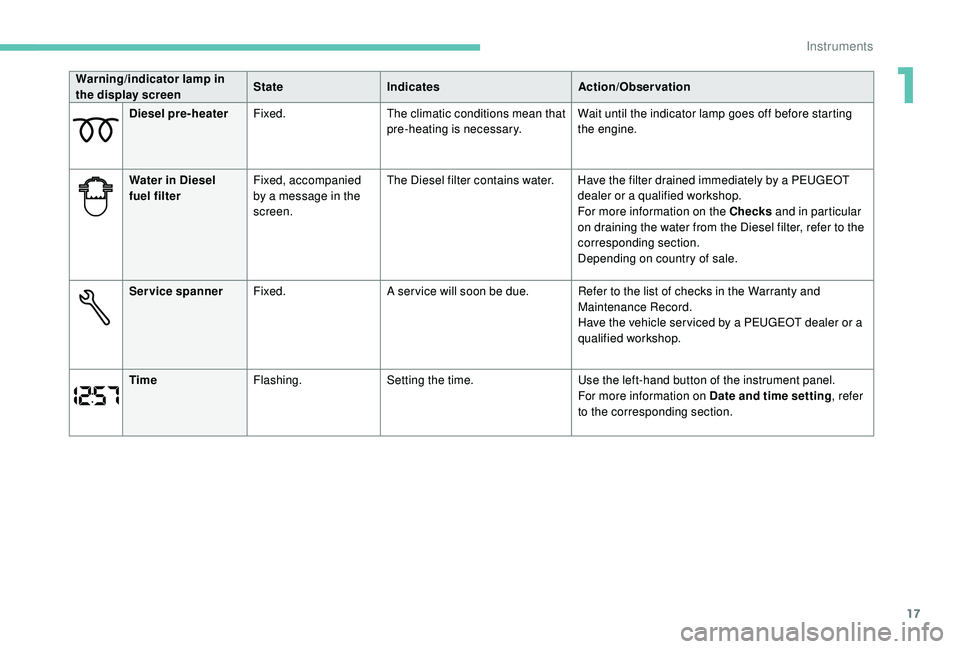
Diesel pre-heaterFixed. The climatic conditions mean that
pre-heating is necessary. Wait until the indicator lamp goes off before starting
the engine.
Water in Diesel
fuel filter Fixed, accompanied
by a message in the
screen. The Diesel filter contains water. Have the filter drained immediately by a PEUGEOT
dealer or a qualified workshop.
For more information on the Checks and in particular
on draining the water from the Diesel filter, refer to the
corresponding section.
Depending on country of sale.
Service spanner Fixed. A ser vice will soon be due. Refer to the list of checks in the Warranty and
Maintenance Record.
Have the vehicle ser viced by a PEUGEOT dealer or a
qualified workshop.
Time Flashing. Setting the time. Use the left-hand button of the instrument panel.
For more information on Date and time setting , refer
to the corresponding section.
Warning/indicator lamp in
the display screen
State
Indicates Action/Observation
1
Instruments
Page 77 of 252
39
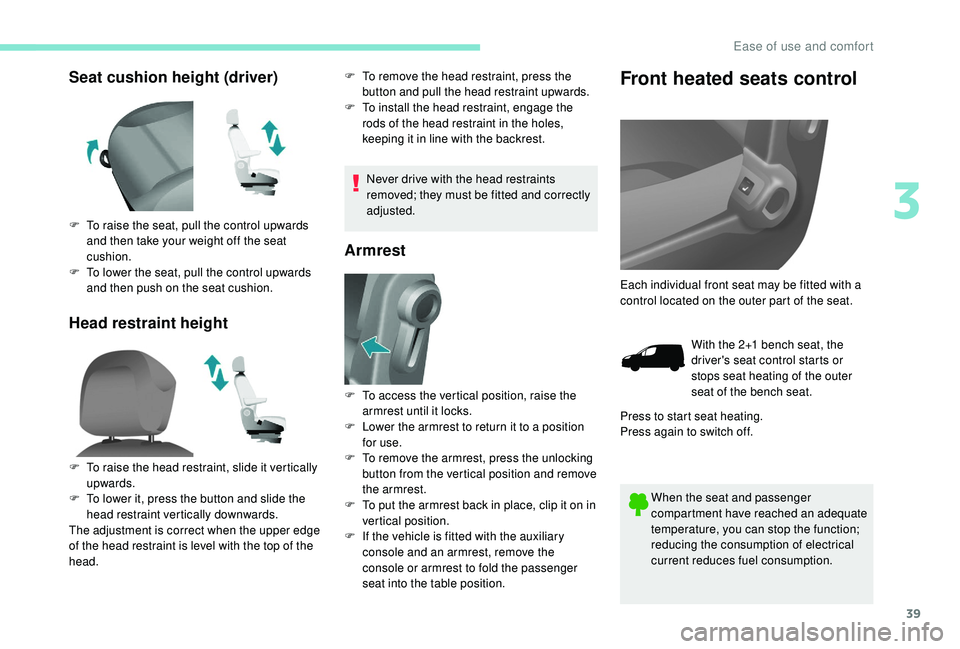
Seat cushion height (driver)
Head restraint heightF To remove the head restraint, press the button and pull the head restraint upwards.
F
T
o install the head restraint, engage the
rods of the head restraint in the holes,
keeping it in line with the backrest.
Never drive with the head restraints
removed; they must be fitted and correctly
adjusted.
Armrest
Front heated seats control
When the seat and passenger
compartment have reached an adequate
temperature, you can stop the function;
reducing the consumption of electrical
current reduces fuel consumption.
F
T
o raise the seat, pull the control upwards
and then take your weight off the seat
cushion.
F
T
o lower the seat, pull the control upwards
and then push on the seat cushion.
F
T
o raise the head restraint, slide it vertically
upwards.
F
T
o lower it, press the button and slide the
head restraint vertically downwards.
The adjustment is correct when the upper edge
of the head restraint is level with the top of the
head. F
T
o access the vertical position, raise the
armrest until it locks.
F
L
ower the armrest to return it to a position
for use.
F
T
o remove the armrest, press the unlocking
button from the vertical position and remove
the armrest.
F
T
o put the armrest back in place, clip it on in
vertical position.
F
I
f the vehicle is fitted with the auxiliary
console and an armrest, remove the
console or armrest to fold the passenger
seat into the table position. Each individual front seat may be fitted with a
control located on the outer part of the seat.
With the 2+1 bench seat, the
driver's seat control starts or
stops seat heating of the outer
seat of the bench seat.
Press to start seat heating.
Press again to switch off.
3
Ease of use and comfort