2017 PEUGEOT 4008 wheel
[x] Cancel search: wheelPage 122 of 368
120
4008_en_Chap04_conduite_ed01-2016
Cruise control
System which automatically maintains the vehicle speed at the value programmed by the driver, without any action on the accelerator pedal.
th
e cruise control is switched on manually:
the vehicle speed must be at least 25 mph
(40 km/h) and second gear or higher must be
engaged in the case of a manual gearbox.
th
e cruise control is switched off manually, by
an action on the brake or clutch pedal or if the
ASC system is triggered.
th
e programmed speed can be exceeded
temporarily by pressing the accelerator pedal.
th
e cruise control cannot, in any
circumstances, take the place of the
need to comply with speed limits or of
the vigilance of the driver.
th
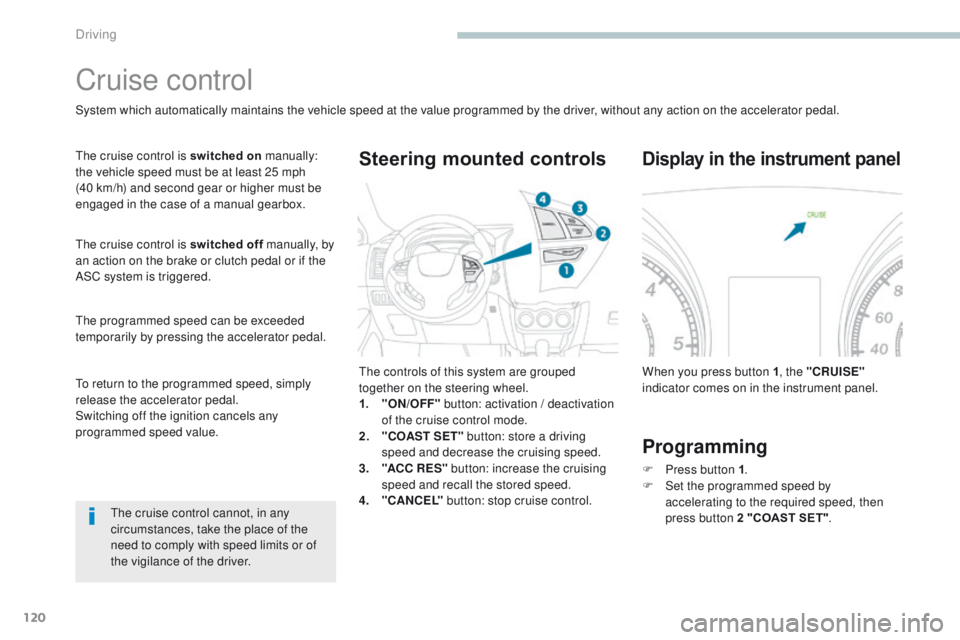
e controls of this system are grouped
together on the steering wheel.
1.
"
ON/OFF" button: activation / deactivation
of the cruise control mode.
2.
"
COAST SET" button: store a driving
speed and decrease the cruising speed.
3.
"A
CC R ES" button: increase the cruising
speed and recall the stored speed.
4.
"C
ANCEL" button: stop cruise control.
Steering mounted controls
When you press button 1 , the "CRUISE"
indicator comes on in the instrument panel.
Display in the instrument panel
Programming
F Press button 1 .
F S et the programmed speed by
accelerating
to the required speed, then
press button 2 "COAST SET" .
to r
eturn to the programmed speed, simply
release the accelerator pedal.
Switching off the ignition cancels any
programmed speed value.
Driving
Page 144 of 368
142
4008_en_Chap06_securite_ed01-2016
Direction indicators
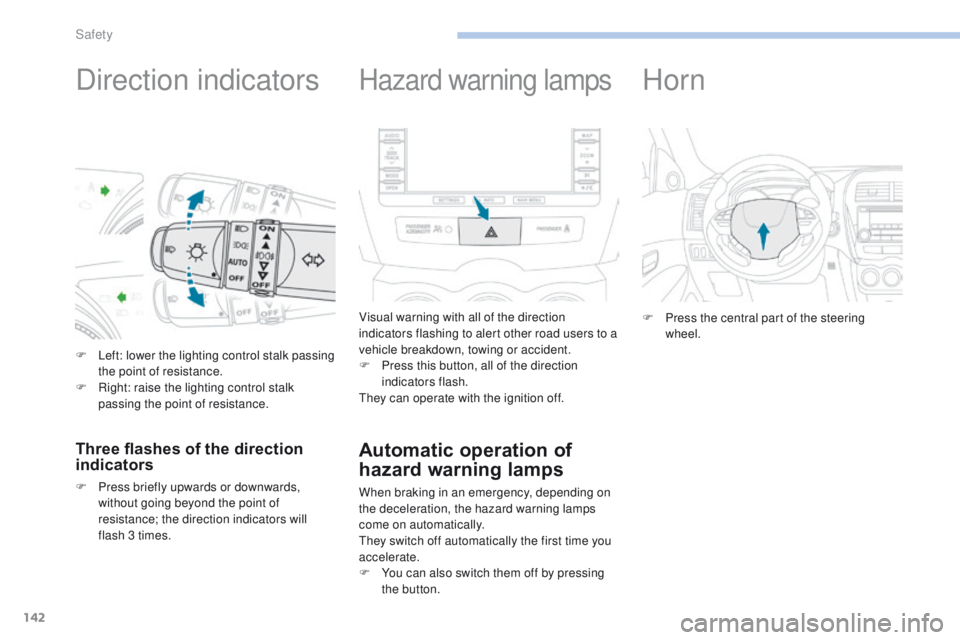
F Left: lower the lighting control stalk passing the point of resistance.
F
R
ight: raise the lighting control stalk
passing the point of resistance.
Three flashes of the direction
indicators
F Press briefly upwards or downwards, without going beyond the point of
resistance; the direction indicators will
flash 3 times.
Hazard warning lamps
Visual warning with all of the direction
indicators flashing to alert other road users to a
vehicle breakdown, towing or accident.
F
P
ress this button, all of the direction
indicators flash.
th
ey can operate with the ignition off.
Automatic operation of
hazard warning lamps
When braking in an emergency, depending on
the deceleration, the hazard warning lamps
come on automatically.
th
ey switch off automatically the first time you
accelerate.
F
Y
ou can also switch them off by pressing
the button.
Horn
F Press the central part of the steering wheel.
Safety
Page 145 of 368
143
4008_en_Chap06_securite_ed01-2016
group of supplementary systems which help
you to obtain optimum braking in complete
safety in emergency situations:
-
a
nti-lock braking system (ABS),
-
e
lectronic brake force distribution (
eB
FD).
Braking assistance systems
Anti-lock braking system
and electronic brake force
distribution
Linked systems which improve the stability and
manoeuvrability of your vehicle when braking,
in particular on poor or slippery sur faces.
Activation
the anti-lock braking system is active if the
vehicle speed is higher than 6 mph (10 km/h).
It is deactivated when the vehicle speed falls
below 3
mph (5 km/h).
th
e anti-lock braking system comes into
operation automatically when there is a risk of
wheel lock.
Normal operation of the ABS may make itself
felt by slight vibration of the brake pedal.
Operating fault
When the vehicle is stationary
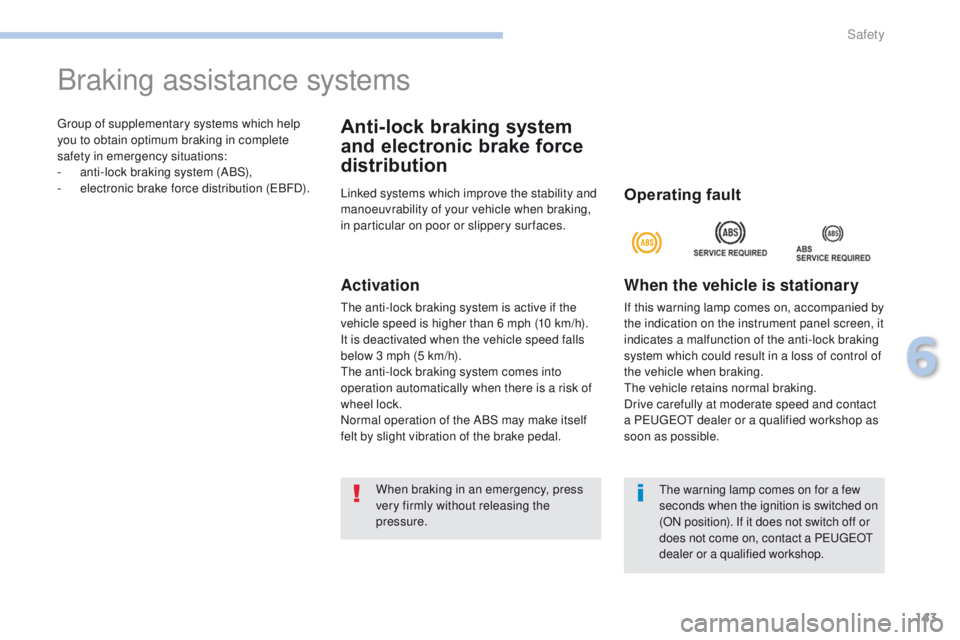
If this warning lamp comes on, accompanied by
the indication on the instrument panel screen, it
indicates a malfunction of the anti-lock braking
system which could result in a loss of control of
the vehicle when braking.
th
e vehicle retains normal braking.
Drive carefully at moderate speed and contact
a P
e
uge
Ot
dealer or a qualified workshop as
soon as possible.
When braking in an emergency, press
very firmly without releasing the
pressure.
th
e warning lamp comes on for a few
seconds when the ignition is switched on
(ON position). If it does not switch off or
does not come on, contact a P
e
uge
Ot
d
ealer or a qualified workshop.
6
Safety
Page 146 of 368
144
4008_en_Chap06_securite_ed01-2016
When the vehicle is moving
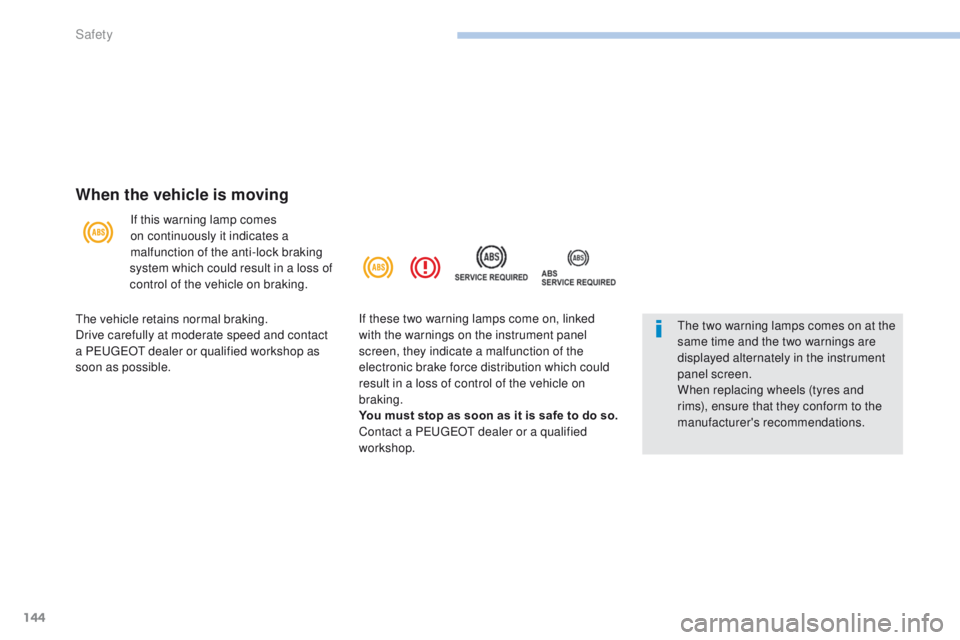
If this warning lamp comes
on continuously it indicates a
malfunction of the anti-lock braking
system which could result in a loss of
control of the vehicle on braking.
th
e two warning lamps comes on at the
same time and the two warnings are
displayed alternately in the instrument
panel screen.
When replacing wheels (tyres and
rims), ensure that they conform to the
manufacturer's recommendations.
th
e vehicle retains normal braking.
Drive carefully at moderate speed and contact
a P
e
uge
Ot
dealer or qualified workshop as
soon as possible. If these two warning lamps come on, linked
with the warnings on the instrument panel
screen, they indicate a malfunction of the
electronic brake force distribution which could
result in a loss of control of the vehicle on
braking.
You must stop as soon as it is safe to do so.
Contact a P
e
uge
Ot
dealer or a qualified
workshop.
Safety
Page 147 of 368
145
4008_en_Chap06_securite_ed01-2016
Associated systems which contribute to the directional stability of the vehicle within the limits of the laws of physics:
- t raction control (tC L),
-
a
ctive stability control (ASC).
Traction control and active stability control
traction control optimises traction to prevent
wheel spin, by acting on the brakes of the
driving wheels and on the engine.
Active stability control acts on the brake of one
or more wheels and on the engine to keep the
vehicle on the trajectory required by the driver.Activation
these systems are activated automatically
each time the vehicle is started.
th
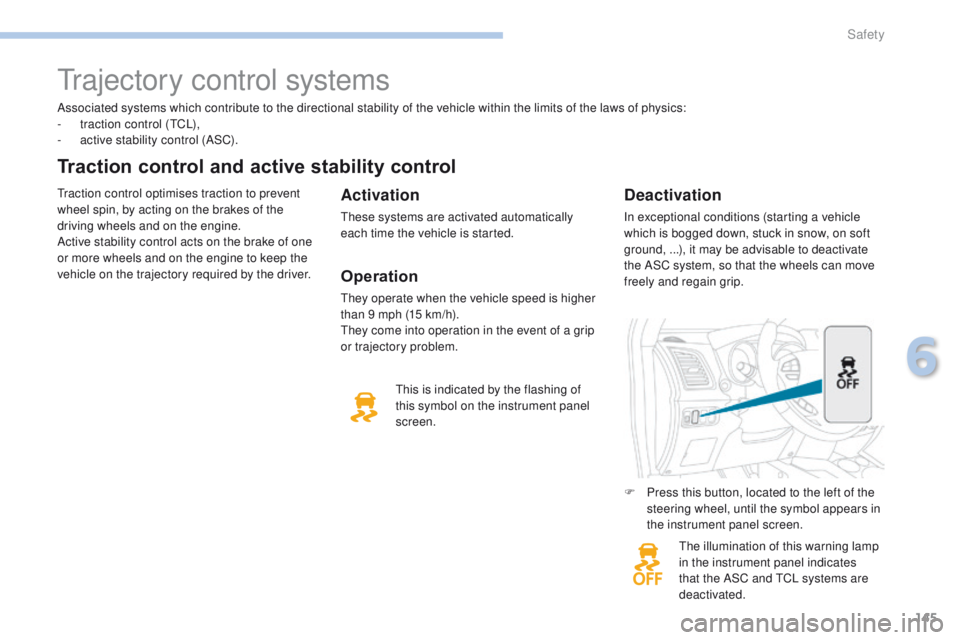
e illumination of this warning lamp
in the instrument panel indicates
that the ASC and
t
C
L systems are
deactivated.
Deactivation
In exceptional conditions (starting a vehicle
which is bogged down, stuck in snow, on soft
ground, ...), it may be advisable to deactivate
the ASC system, so that the wheels can move
freely and regain grip.
th
is is indicated by the flashing of
this symbol on the instrument panel
screen.
trajectory control systems
F Press this button, located to the left of the steering wheel, until the symbol appears in
the instrument panel screen.
Operation
they operate when the vehicle speed is higher
than 9 mph (15 km/h).
th
ey come into operation in the event of a grip
or trajectory problem.
6
Safety
Page 153 of 368
151
4008_en_Chap06_securite_ed01-2016
Airbags
General information
System designed to contribute towards
improving the safety of the occupants (with
the exception of the rear centre passenger)
in the event of violent collisions. t
h
e airbags
supplement the action of the seat belts fitted
with force limiters (all except the centre rear
passenger belt).
If a collision occurs, the electronic detectors
record and analyse the front and side impacts
sustained in the impact detection zones:
-
i
n the case of a serious impact, the airbags
are deployed instantly and contribute
towards better protection of the occupants
of the vehicle (with the exception of the
rear centre passenger); immediately after
the impact, the airbags deflate rapidly so
that they do not hinder visibility or the exit
of the occupants,
-
i
n the case of a minor or rear impact or in
certain roll-over conditions, the airbags
may not be deployed; the seat belt
alone contributes towards ensuring your
protection in these situations.
The airbags do not operate when the
ignition is switched off.
th
is equipment will only deploy once.
If a second impact occurs (during the
same or a subsequent accident), the
airbag will not be deployed again. Deployment of one or more of the
airbags is accompanied by a slight
emission of smoke and a noise, due
to the activation of the pyrotechnic
cartridge incorporated in the system.
th
is smoke is not harmful, but sensitive
individuals may experience slight
irritation.
th
e noise of detonation associated with
the deployment of one or more airbags
may result in a slight loss of hearing for
a short time.
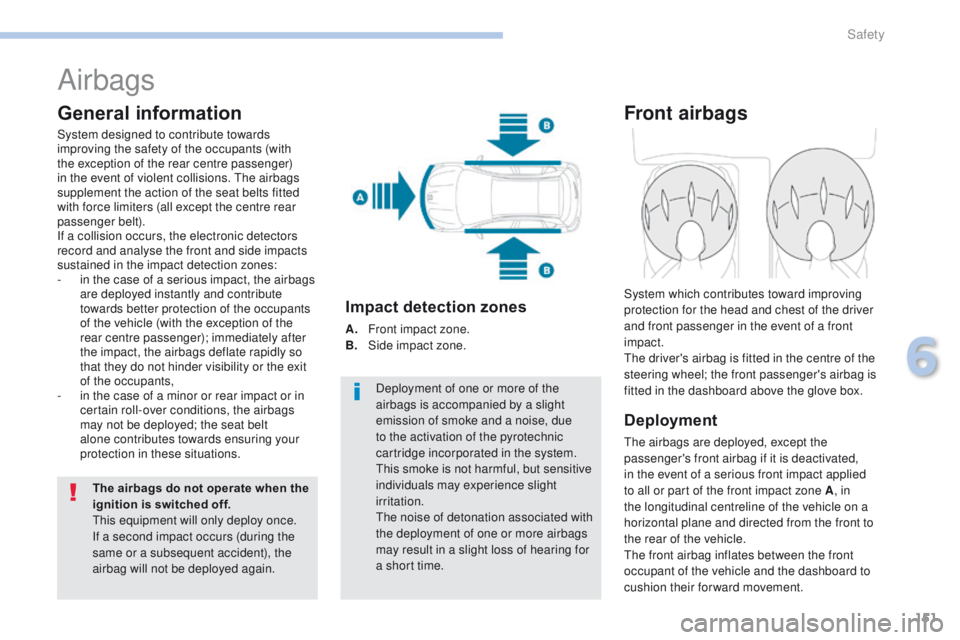
Impact detection zones
A. Front impact zone.
B. S ide impact zone.
Front airbags
Deployment
the airbags are deployed, except the
passenger's front airbag if it is deactivated,
in the event of a serious front impact applied
to all or part of the front impact zone A , in
the longitudinal centreline of the vehicle on a
horizontal plane and directed from the front to
the rear of the vehicle.
th
e front airbag inflates between the front
occupant of the vehicle and the dashboard to
cushion their forward movement. System which contributes toward improving
protection for the head and chest of the driver
and front passenger in the event of a front
impact.
th
e driver's airbag is fitted in the centre of the
steering wheel; the front passenger's airbag is
fitted in the dashboard above the glove box.
6
Safety
Page 157 of 368
155
4008_en_Chap06_securite_ed01-2016
For the airbags to be fully
effective, observe the safety
recommendations below:
Sit in a normal upright position.
Wear a correctly adjusted seat belt.
Do not leave anything between the
occupants and the airbags (a child, pet,
object...), nor fix or attach anything close to
the inflation trajectory of the airbags; this
could cause injuries during their deployment.
Never modify the original definition of your
vehicle, particularly in the area directly
around the airbags.
After an accident or if the vehicle has been
stolen or broken into, have the airbag
systems checked.
All work on the airbag system must be
carried out by a P
e
uge
Ot
dealer or a
qualified workshop.
ev
en if all of the precautions mentioned
are observed, a risk of injury or of minor
burns to the head, chest or arms when an
airbag is deployed cannot be ruled out.
t
h
e
bag inflates almost instantly (within a few
milliseconds) then deflates within the same
time discharging the hot gas via openings
provided for this purpose.
Knee airbag*
Do not sit with your knees any nearer to the
steering wheel than necessary.
Front airbags
Do not drive holding the steering wheel by its
spokes or resting your hands on the centre
part of the wheel.
Passengers must not place their feet on the
dashboard.
Do not smoke as deployment of the airbags
can cause burns or the risk of injury from a
cigarette or pipe.
Never remove or pierce the steering wheel or
hit it violently.
Do not fit or attach anything to the steering
wheel or dashboard, this could cause
injuries with deployment of the airbags.
Advice
Lateral airbags
use only approved covers on the seats,
compatible with the deployment the lateral
airbags. For information on the range of seat
covers suitable for your vehicle, you can
contact a P
e
uge
Ot
dealer.
Do not fix or attach anything to the seat
backs (clothing...).
t
h
is could cause injury
to the chest or arms if the lateral airbag is
deployed.
Do not sit with the upper part of the body any
nearer to the door than necessary.
* Depending on country of sale. Avoid attaching a heavy object to the key as
it could become a dangerous projectile if the
airbag were deployed.
Curtain airbags
Do not fix or attach anything to the roof. th is
could cause injury to the head if the curtain
airbag is deployed.
If fitted on your vehicle, do not remove the
grab handles installed on the roof, they play
a part in securing the curtain airbags.
6
Safety
Page 177 of 368
175
4008_en_Chap07_info-pratiques_ed01-2016
For more information on snow chains,
contact a PeugeOt dealer or a
qualified workshop.
Snow chains
In wintry conditions, snow chains improve traction as well as the behaviour of the vehicle when
braking.
Advice on installation
F If you have to fit the chains during a journey, stop the vehicle on a flat sur face
on the side of the road.
F
A
pply the parking brake and position any
wheel chocks to prevent movement of your
vehicle.
F
F
it the chains following the instructions
provided by the manufacturer.
F
M
ove off gently and drive for a few
moments, without exceeding 30 mph
(50 km/h).
F
S
top your vehicle and check that the snow
chains are correctly tightened.
th
e snow chains must be fitted only
to the front wheels.
th
ey must never
be fitted to "space-saver" type spare
wheels.
ta
ke account of the legislation in force
in your country on the use of snow
chains and the maximum running speed
authorised.
Avoid driving with snow chains on roads
that have been cleared of snow, to
avoid damaging your vehicle's tyres and
the road sur face. If your vehicle is fitted
with alloy wheels, check that no part of
the chain or its fixings is in contact with
the wheel rim.us e only chains designed for fitment to the type
of road wheels on your vehicle:
Original equipment tyre size Maximum link size
215/ 70 R16 12 mm
225/55 R18
It is strongly recommended that before
you leave, you practise fitting the snow
chains on a level and dry sur face.
7
Practical information