Page 24 of 368
22
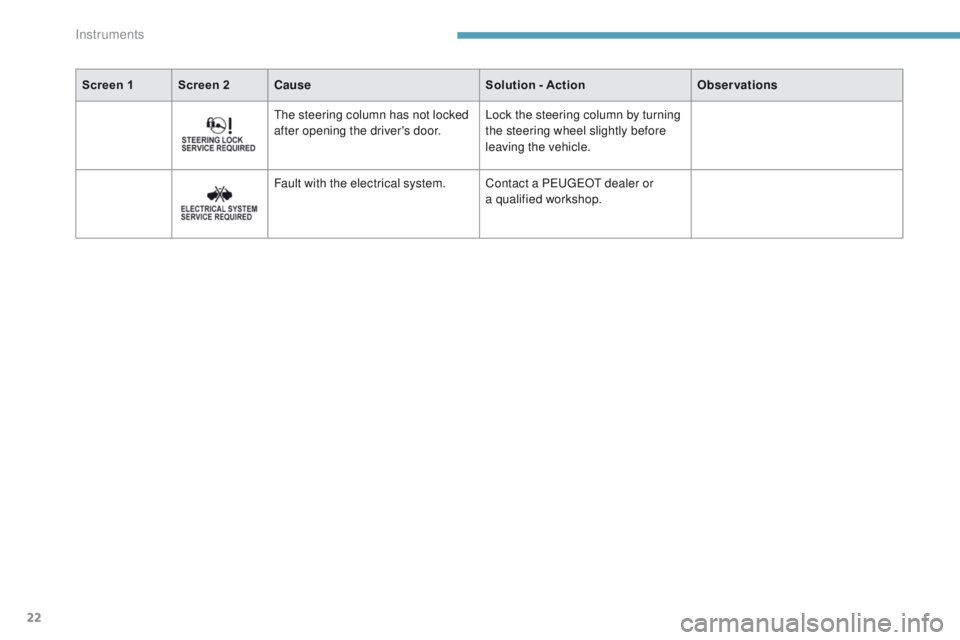
Screen 1 Screen 2Cause Solution - ActionObservations
th
e steering column has not locked
after opening the driver's door. Lock the steering column by turning
the steering wheel slightly before
leaving the vehicle.
Fault with the electrical system. Contact a P
e
uge
Ot
dealer or
a qualified workshop.
Instruments
Page 26 of 368
24
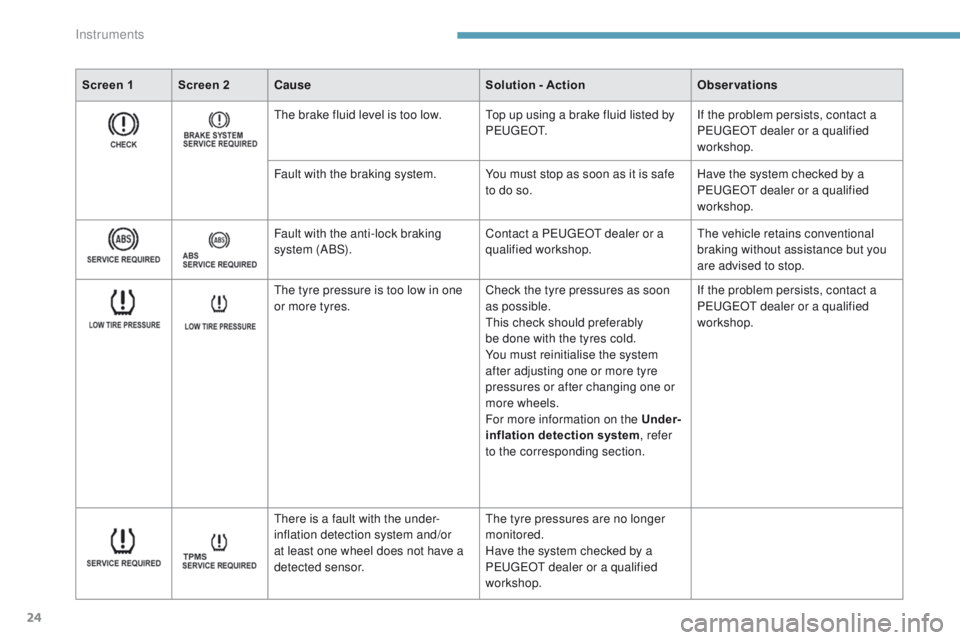
Screen 1 Screen 2Cause Solution - ActionObservations
th
e brake fluid level is too low.
to
p up using a brake fluid listed by
P
e
u g e
Ot
.If the problem persists, contact a
P
e
uge
Ot
dealer or a qualified
workshop.
Fault with the braking system. You must stop as soon as it is safe to do so.Have the system checked by a
P
e
uge
Ot
dealer or a qualified
workshop.
Fault with the anti-lock braking
system (ABS). Contact a P
e
uge
Ot
dealer or a
qualified workshop.
th
e vehicle retains conventional
braking without assistance but you
are advised to stop.
th
e tyre pressure is too low in one
or more tyres. Check the tyre pressures as soon
as possible.
th
is check should preferably
be done with the tyres cold.
You must reinitialise the system
after adjusting one or more tyre
pressures or after changing one or
more wheels.
For more information on the Under-
inflation detection system , refer
to the corresponding section. If the problem persists, contact a
Peuge
O
t dealer or a qualified
workshop.
th
ere is a fault with the under-
inflation detection system and/or
at least one wheel does not have a
detected sensor.
th
e tyre pressures are no longer
monitored.
Have the system checked by a
P
e
uge
Ot
dealer or a qualified
workshop.
Instruments
Page 29 of 368
27
4008_en_Chap01_Instruments-de-bord_ed01-2016
Screen 1 Screen 2Cause Solution - ActionObservations
You have moved off with the parking
brake not fully released. Release the parking brake.
th
e oil pressure is too low or there
is a fault with the engine lubrication
system. Stop the vehicle and contact
a P
e
uge
Ot
dealer or a qualified
workshop.
Battery charge fault. Stop the vehicle and contact
a P
e
uge
Ot
dealer or a qualified
workshop.
Airbag or pretensioner fault. Contact a P
e
uge
Ot
dealer or
a qualified workshop to have the
systems checked.
Fault with automatic headlamp
adjustment system. Contact a P
e
uge
Ot
dealer or
a qualified workshop. Only on vehicles fitted with xenon
headlamps.
Fault with the stability control
system (ASC). Contact a P
e
uge
Ot
dealer or
a qualified workshop.
Fault with the four wheel drive
transmission system. Contact a P
e
uge
Ot
dealer or
a qualified workshop.
1
Instruments
Page 30 of 368
28
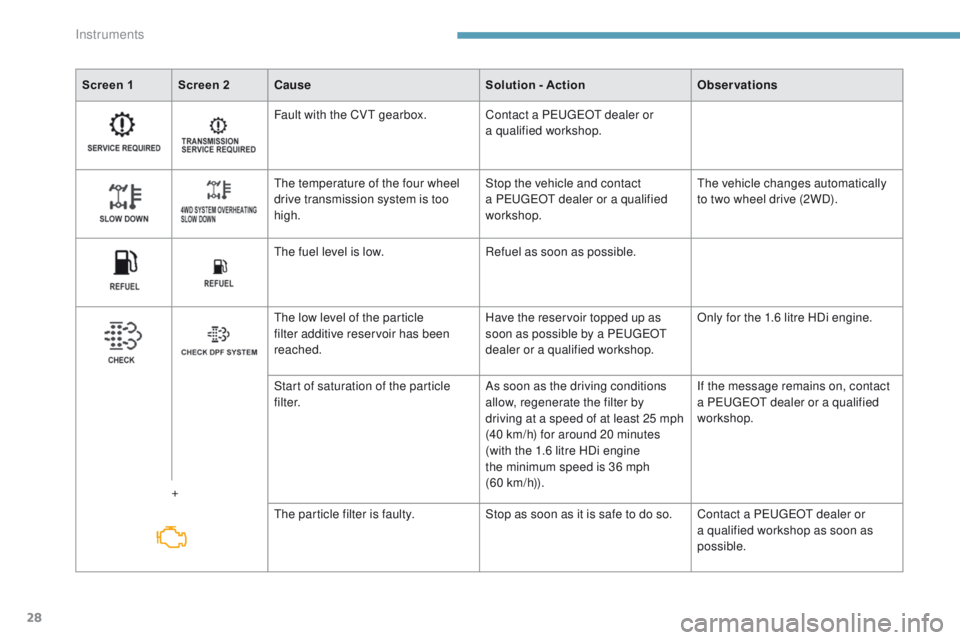
Screen 1 Screen 2Cause Solution - ActionObservations
Fault with the CV
t
gearbox. Contact a P
e
uge
Ot
dealer or
a qualified workshop.
th
e temperature of the four wheel
drive transmission system is too
high. Stop the vehicle and contact
a P
e
uge
Ot
dealer or a qualified
workshop.
th
e vehicle changes automatically
to two wheel drive (2WD).
th
e fuel level is low.Refuel as soon as possible.
th
e low level of the particle
filter additive reservoir has been
reached. Have the reservoir topped up as
soon as possible by a P
e
uge
Ot
dealer or a qualified workshop. Only for the 1.6 litre HDi engine.
+ Start of saturation of the particle
f i l t e r.
As soon as the driving conditions
allow, regenerate the filter by
driving
at a speed of at least 25 mph
(40 km/h) for around 20 minutes
(with the 1.6 litre HDi engine
the
minimum speed is 36 mph
(60 km/h)). If the message remains on, contact
a P
e
uge
Ot
dealer or a qualified
workshop.
th
e particle filter is faulty.Stop as soon as it is safe to do so. Contact a P
e
uge
Ot
dealer or
a qualified workshop as soon as
possible.
Instruments
Page 32 of 368
30
Screen 1 Screen 2SystemObservations
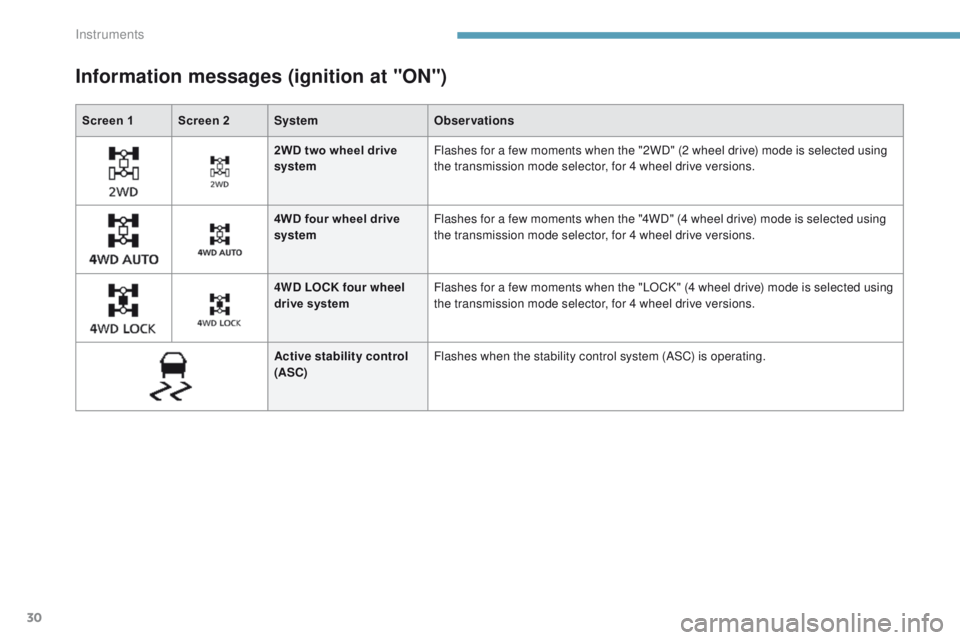
Information messages (ignition at "ON")
2WD two wheel drive
systemFlashes for a few moments when the "2WD" (2 wheel drive) mode is selected using
the transmission mode selector, for 4 wheel drive versions.
4WD four wheel drive
system Flashes for a few moments when the "4WD" (4 wheel drive) mode is selected using
the transmission mode selector, for 4 wheel drive versions.
4WD LOCK four wheel
drive system Flashes for a few moments when the "LOCK" (4 wheel drive) mode is selected using
the transmission mode selector, for 4 wheel drive versions.
Active stability control
(ASC) Flashes when the stability control system (ASC) is operating.
Instruments
Page 44 of 368
42
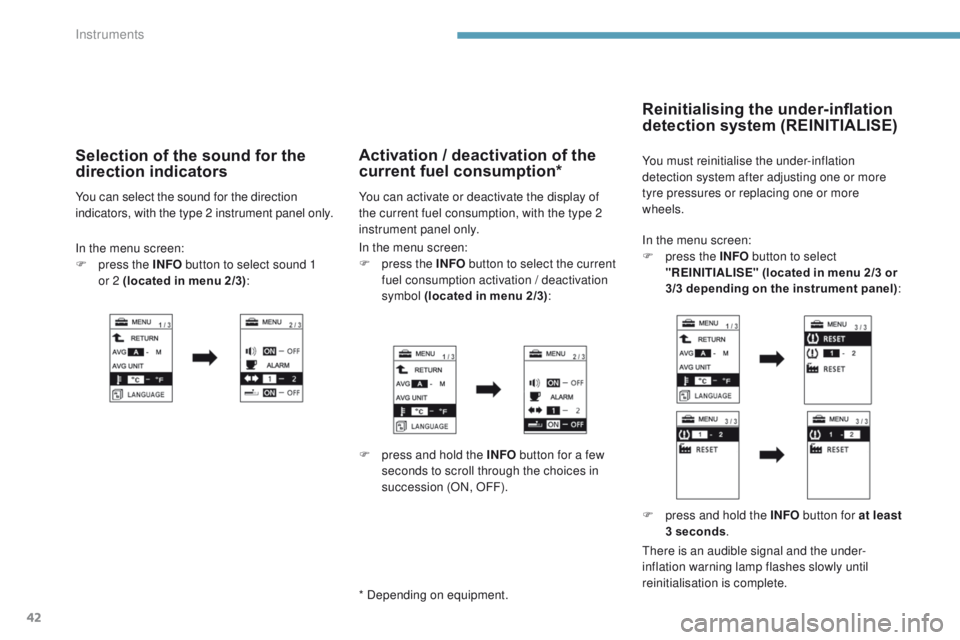
In the menu screen:
F p ress the INFO button to select
"REINITIALISE" (located in menu 2/3 or
3/3 depending on the instrument panel) :
Reinitialising the under-inflation
detection system (REINITIALISE)
You must reinitialise the under-inflation
detection system after adjusting one or more
tyre pressures or replacing one or more
wheels.
F
p
ress and hold the INFO button for at least
3 seconds .
ther
e is an audible signal and the under-
inflation warning lamp flashes slowly until
reinitialisation is complete.
In the menu screen:
F
p
ress the INFO button to select the current
fuel consumption activation / deactivation
symbol (located in menu 2/3) :Activation / deactivation of the
current fuel consumption*
You can activate or deactivate the display of
the current fuel consumption, with the type 2
instrument panel only.
F
p
ress and hold the INFO button for a few
seconds to scroll through the choices in
succession (ON, OFF).
* Depending on equipment.
In the menu screen:
F p ress the INFO button to select sound 1
or
2 (located in menu 2/3) :
Selection of the sound for the
direction indicators
You can select the sound for the direction
indicators, with the type 2 instrument panel only.
Instruments
Page 80 of 368

78
4008_en_Chap03_Ergonomie-et-confort_ed01-2016
Rear view mirror
equipped with an anti-dazzle system, which darkens the mirror glass and reduces the nuisance to
the driver caused by the sun, headlamps from other vehicles...
Manual model
Adjustment
F A djust the mirror so that the glass is
directed correctly in the "day" position.
In order to ensure optimum visibility
during your manoeuvres, the mirror
lightens automatically when reverse
gear is engaged.
Day / night position
F
P
ull the lever to change to the "night" anti-
dazzle position.
F
P
ush the lever to change to the normal
"day" position.
Automatic "electrochrome"
model
this system automatically and progressively
changes between the day and night uses by
means of a sensor, which measures the light
from the rear of the vehicle.
Steering wheel adjustment
F When stationary , lower the control lever
to release the steering wheel adjustment
mechanism.
F
A
djust the height and reach to suit your
driving position.
F
P
ull the control lever to lock the steering
wheel adjustment mechanism.
As a safety precaution, these
operations should only be carried out
while the vehicle is stationary.
Ease of use and comfort
Page 99 of 368
97
4008_en_Chap04_conduite_ed01-2016
Driving recommendations
Observe the driving regulations and remain
vigilant whatever the traffic conditions.
Pay close attention to the traffic and keep your
hands on the wheel so that you are ready to
react at any time to any eventuality.
On a long journey, a break every two hours is
strongly recommended.
In difficult weather, drive smoothly, anticipate
the need to brake and increase the distance
from other vehicles.Never drive with the parking brake
applied - Risk of overheating and
damage to the braking system!
Risk of fire!
As the exhaust system of your vehicle
is very hot, even several minutes after
switching off the engine, do not park
or run the engine over areas where
inflammable substances and materials
are present: grass, leaves, etc.
Never leave a vehicle unsupervised
with the engine running. If you have
to leave your vehicle with the engine
running, apply the parking brake
and put the gearbox into neutral or
position
N or P, depending on the type
of gearbox.
Driving on flooded roads
We strongly advise against driving on flooded
roads, as this could cause serious damage
to the engine or gearbox, as well as to the
electrical systems of your vehicle.
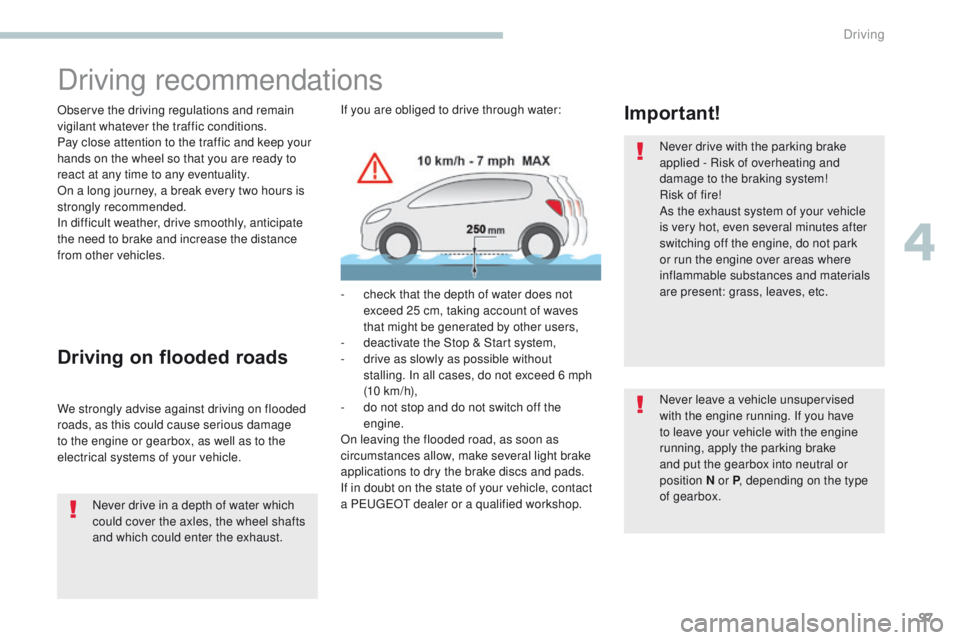
Important!If you are obliged to drive through water:
-
c
heck that the depth of water does not
exceed 25 cm, taking account of waves
that might be generated by other users,
-
d
eactivate the Stop & Start system,
-
d
rive as slowly as possible without
stalling. In all cases, do not exceed 6 mph
(10
km/h),
-
d
o not stop and do not switch off the
engine.
On leaving the flooded road, as soon as
circumstances allow, make several light brake
applications to dry the brake discs and pads.
If in doubt on the state of your vehicle, contact
a P
e
uge
Ot
dealer or a qualified workshop.
Never drive in a depth of water which
could cover the axles, the wheel shafts
and which could enter the exhaust.
4
Driving