2017 Peugeot 3008 Hybrid 4 headlamp
[x] Cancel search: headlampPage 150 of 578
148
3008-2_en_Chap04_eclairage-et-visibilite_ed01-2016
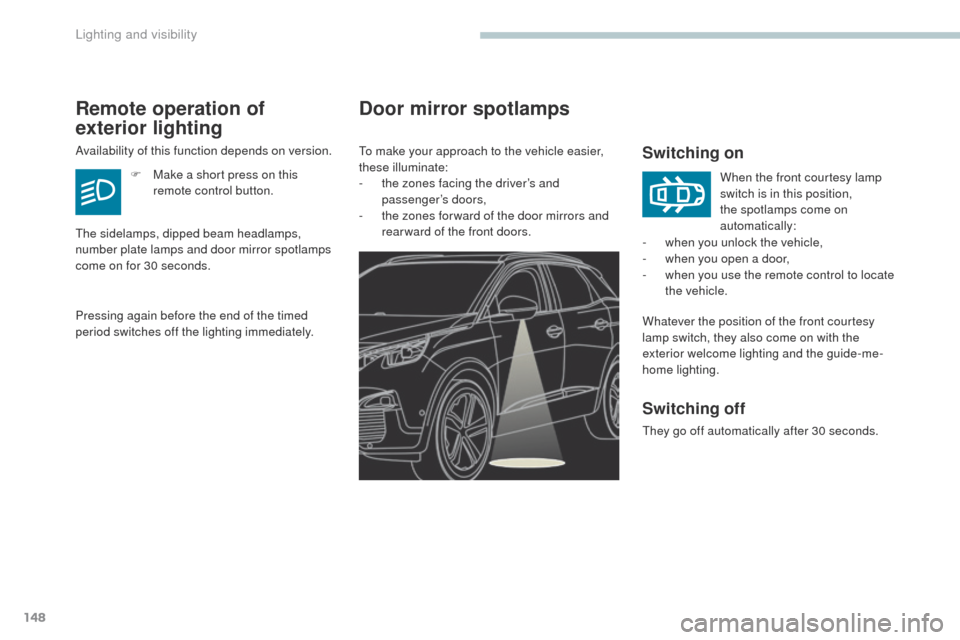
Door mirror spotlamps
Switching on
Whatever the position of the front courtesy
lamp switch, they also come on with the
exterior welcome lighting and the guide-me-
home lighting. -
w
hen you unlock the vehicle,
-
w
hen you open a door,
-
w
hen you use the remote control to locate
the vehicle. When the front courtesy lamp
switch is in this position,
the spotlamps come on
automatically:
To make your approach to the vehicle easier,
these illuminate:
-
t
he zones facing the driver’s and
passenger’s doors,
-
t
he zones for ward of the door mirrors and
rear ward of the front doors.
Remote operation of
exterior lighting
Availability of this function depends on version.
F
M
ake a short press on this
remote control button.
Pressing again before the end of the timed
period switches off the lighting immediately. The sidelamps, dipped beam headlamps,
number plate lamps and door mirror spotlamps
come on for 30 seconds.
Switching off
They go off automatically after 30 seconds.
Lighting and visibility
Page 151 of 578
149
3008-2_en_Chap04_eclairage-et-visibilite_ed01-2016
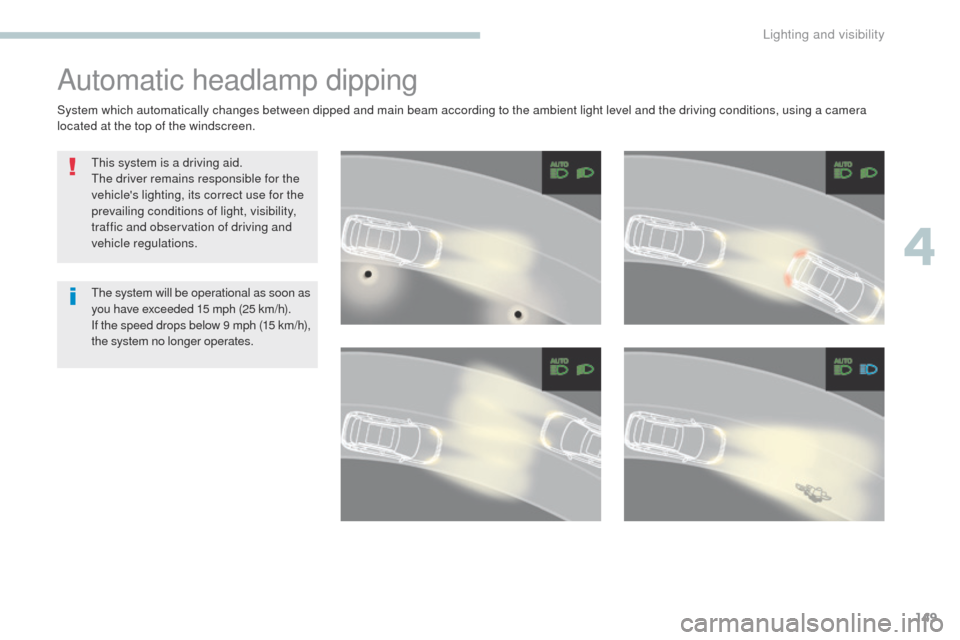
Automatic headlamp dipping
This system is a driving aid.
The driver remains responsible for the
vehicle's lighting, its correct use for the
prevailing conditions of light, visibility,
traffic and observation of driving and
vehicle regulations.
The system will be operational as soon as
you have exceeded 15 mph (25 km/h).
If the speed drops below 9 mph (15
km/h),
the system no longer operates.
System which automatically changes between dipped and main beam according to the ambient light level and the driving conditions, using a camera
located at the top of the windscreen.
4
Lighting and visibility
Page 152 of 578
150
3008-2_en_Chap04_eclairage-et-visibilite_ed01-2016
Activation
F Turn the lighting control stalk ring to the "AUTO " position.
Operation
Once the function is activated, the system
operates as follows:
If the ambient light level is sufficient and/or if
the traffic conditions do not allow illumination of
the main beam headlamps:
Pause
If the situation requires a change of headlamp
beam, the driver can take over at any time.
F
F
lashing the headlamps pauses the
function and the system changes to
"automatic illumination of headlamps"
mode:
-
i
f the "AUTO" and "Dipped beam"
indicator lamps are on, the system
changes to main beam,
-
i
f the "AUTO" and "Main beam" indicator
lamps are on, the system changes to
dipped beam.
To reactivate the system, flash the headlamps
again.
-
d
ipped beam is
maintained, this indicator
lamp comes on in the
instrument panel.
If the ambient light level is very low and the
traffic conditions permit: -
m
ain beam comes
on automatically: this
indicator lamp comes on
in the instrument panel.
Deactivation
The system may suffer interference or
not work correctly:
-
u
nder conditions of poor visibility
(falling snow, heavy rain or thick
fog, ...),
-
i
f the windscreen is dirty, misted or
obscured (by a sticker, ...) in front of
the camera,
-
i
f the vehicle is facing highly
reflective signs.
The system is not able to detect:
-
r
oad users that do not have their
own lighting, such as pedestrians,
-
v
ehicles whose lighting is obscured
(for example: vehicles running
behind a safety barrier on a
motorway),
-
v
ehicles at the top or bottom of a
steep slope, on twisty roads, on
crossroads.
F
I
n the Driving menu, select
" Driving assistance ", then
" Automatic headlamp dip ".
F
I
n the Driving menu, select the
" Driving assistance " tab, then
" Automatic headlamp dip "; the
system changes to "automatic
illumination headlamps" mode.
The state of the system stays in memory when
the ignition is switched off.
Lighting and visibility
Page 153 of 578
151
3008-2_en_Chap04_eclairage-et-visibilite_ed01-2016
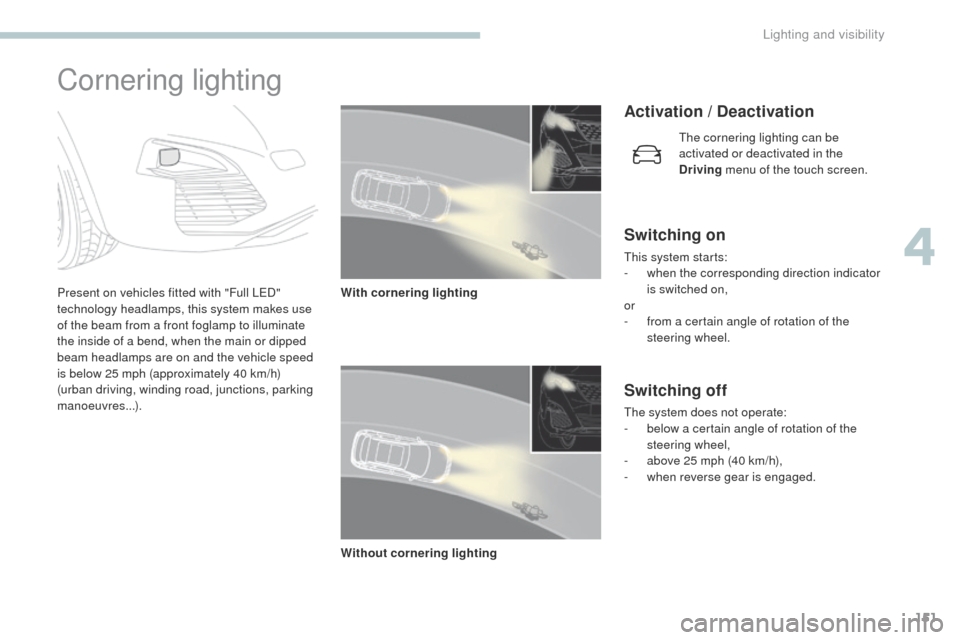
Cornering lighting
Present on vehicles fitted with "Full LED"
technology headlamps, this system makes use
of the beam from a front foglamp to illuminate
the inside of a bend, when the main or dipped
beam headlamps are on and the vehicle speed
is below 25 mph (approximately 40 km/h)
(urban driving, winding road, junctions, parking
manoeuvres...).With cornering lighting
Activation / Deactivation
Switching on
This system starts:
-
w hen the corresponding direction indicator
is switched on,
or
-
f
rom a certain angle of rotation of the
steering wheel.
Switching off
The system does not operate:
- b elow a certain angle of rotation of the
steering wheel,
-
a
bove 25 mph (40 km/h),
-
w
hen reverse gear is engaged.
Without cornering lighting The cornering lighting can be
activated or deactivated in the
Driving
menu of the touch screen.
4
Lighting and visibility
Page 198 of 578
196
3008-2_en_Chap06_conduite_ed01-2016
When towing
Distribution of loads
F Distribute the load in the trailer so that the heaviest items are as close as possible to
the axle and the nose weight approaches
the maximum permitted without
exceeding
it.
Air density decreases with altitude, thus
reducing engine performance. Above
1
000 metres, the maximum towed load must
be reduced by 10
% for every 1 000 metres of
altitude.
Side wind
F Take into account the increased sensitivity to side wind.
For more information on Weights
, refer to the
corresponding section. F
I
f the warning lamp and the
STOP warning lamp come on,
stop the vehicle and switch off
the engine as soon as possible.
Braking
Towing a trailer increases the braking distance.
To avoid overheating of the brakes, the use of
engine braking is recommended.
Ty r e s
F Check the tyre pressures of the towing vehicle and of the trailer, observing the
recommended pressures.
Lighting
F Check the electrical lighting and signalling on the trailer and the headlamp beam
height of your vehicle.
For more information on Adjusting the
headlamp beam height , refer to the
corresponding section.
The rear parking sensors will be
deactivated automatically to avoid the
audible signal if a genuine PEUGEOT
towbar is used.
Cooling
Towing a trailer on a slope increases the
temperature of the coolant.
As the fan is electrically controlled, its cooling
capacity is not dependent on the engine speed.
F
T
o lower the engine speed, reduce your
speed.
The maximum towed load on a long incline
depends on the gradient and the ambient
temperature.
In all cases, keep a check on the coolant
temperature.
Driving
Page 201 of 578
199
3008-2_en_Chap06_conduite_ed01-2016
Switching off the engine
Energy economy mode
After switching off the engine (position 1- Stop),
for a maximum of 30 minutes you can still use
functions such as the audio and telematic
system, the wipers, dipped beam headlamps,
courtesy lamps, ...
F
C
heck that the parking brake is correctly
applied, particularly on sloping ground.
Never switch off the ignition before the
vehicle is at a complete stop. With the
engine off, the braking and steering
assistance systems are also cut off: risk
of loss of control of the vehicle. To facilitate unlocking of the steering
column, it is recommended that the
wheels be returned to the straight ahead
position before switching off the engine.
When you leave the vehicle, keep the
key with you and lock the vehicle. For more information on Energy
economy mode
, refer to the
corresponding section.Key left in the "Ignition on"
position
If the key has been left in the ignition switch
at position 2 (Ignition on) , the ignition will
be switched off automatically after one hour.
To switch the ignition back on, turn the key
to position 1 (Stop) , then back to position 2
(Ignition on) .
F Stop the vehicle.
F
W ith the engine running at idle, turn the key
to position 1 .
F
R
emove the key from the ignition switch.
F
T
o lock the steering column, turn the
steering until it locks.
6
Driving
Page 253 of 578
251
3008-2_en_Chap06_conduite_ed01-2016
Deactivation / ActivationOperating fault
In the event of a fault, you are alerted
by the illumination of this warning
lamp, accompanied by the display of
a message and an audible signal.
Clean the windscreen regularly,
particularly the area in front of the
camera.
Do not allow snow to accumulate on
the bonnet or roof of the vehicle as this
could mask the camera's view.
Clean the front bumper, removing mud,
snow, ...
If the front bumper is to be repainted,
contact a PEUGEOT dealer or a
qualified workshop. Certain types of
paint could inter fere with the operation
of the radar.
Check that the sensors (camera and radar) are
not covered by dirt, mud, frost, snow...
If the problem persists, contact a PEUGEOT
dealer or a qualified workshop to have the
system checked.
By default, the system is automatically
activated at every engine start.
The system can be deactivated or activated in
the vehicle settings menu in the screen.
Deactivation of the system is
signalled by the illumination of this
indicator lamp, accompanied by the
display of a message. There may be interference in the
operation of the camera or it may not
work at all in the following situations:
-
p
oor visibility (inadequate street
lighting, falling snow, heavy rain,
dense fog, ...),
-
d
azzle (headlamps of an
approaching vehicle on the other
side of the road, low sun, reflection
on a wet road, leaving a tunnel,
alternating between light and
shade, ...),
-
c
amera or radar masked (mud,
frost, snow, ...).
In these situations, detection
performance may be reduced.
6
Driving
Page 255 of 578
253
3008-2_en_Chap06_conduite_ed01-2016
After three first level alerts, the system triggers
a new alert with the message "Take a break!",
accompanied by a more pronounced audible
signal.
In certain driving conditions (poor road
sur face or strong winds), the system
may give alerts independent of the
driver's level of vigilance. The following situations may inter fere
with the operation of the system or
prevent it working:
-
p
oor visibility (inadequate lighting
of the roadway, falling snow, heavy
rain, dense fog, ...),
-
d
azzle (headlamps of an oncoming
vehicle, low sun, reflections on
a damp road, leaving a tunnel,
alternating shade and light, ...),
-
w
indscreen area located in front
of the camera: dirty, misted, frost-
covered, snow-covered, damaged
or covered by a sticker,
-
l
ane markings absent, worn,
masked (snow, mud) or multiple
(roadworks, ...),
-
c
lose to the vehicle ahead (lane
markings not detected),
- r oads that are narrow, winding, ...
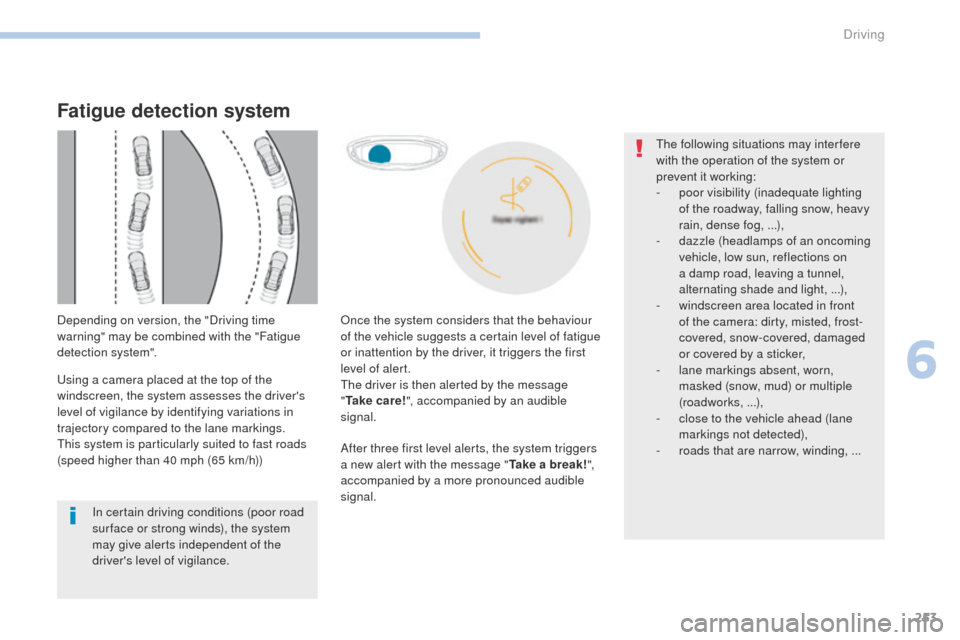
Once the system considers that the behaviour
of the vehicle suggests a certain level of fatigue
or inattention by the driver, it triggers the first
level of alert.
The driver is then alerted by the message
"
Ta k e c a r e ! ", accompanied by an audible
signal.
Fatigue detection system
Depending on version, the "Driving time
warning" may be combined with the "Fatigue
detection system".
Using a camera placed at the top of the
windscreen, the system assesses the driver's
level of vigilance by identifying variations in
trajectory compared to the lane markings.
This system is particularly suited to fast roads
(speed higher than 40 mph (65 km/h))
6
Driving