2017 OPEL ZAFIRA TOURER battery
[x] Cancel search: batteryPage 244 of 307

242Vehicle careNo.Circuit1Engine control module2Lambda sensor3Fuel injection/Ignition system4Fuel injection/Ignition system5–6Exterior mirror heating/Anti-
theft alarm system7Fan control/Engine control
module/Transmission control
module8Lambda sensor/Engine cooling9Rear window sensor10Battery sensor11Tailgate release12Adaptive forward lighting/Auto‐
matic light control13ABS14Rear window wiper15Engine control moduleNo.Circuit16Starter17Transmission control module18Heated rear window19Front power windows20Rear power windows21Rear electrical centre22Left high beam (Halogen)23Headlamp washer system24Right low beam (Xenon)25Left low beam (Xenon)26Front fog lights27Diesel fuel heating28Stop-start system29Electric parking brake30ABS31Adaptive cruise control32Airbag
Page 256 of 307
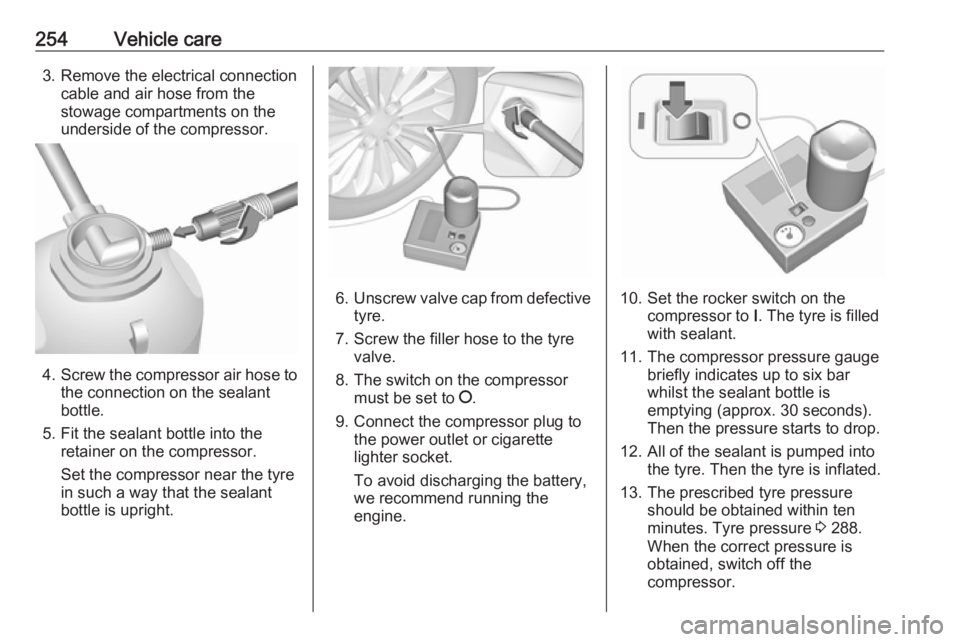
254Vehicle care3. Remove the electrical connectioncable and air hose from the
stowage compartments on the
underside of the compressor.
4. Screw the compressor air hose to
the connection on the sealant
bottle.
5. Fit the sealant bottle into the retainer on the compressor.
Set the compressor near the tyre
in such a way that the sealant
bottle is upright.
6. Unscrew valve cap from defective
tyre.
7. Screw the filler hose to the tyre valve.
8. The switch on the compressor must be set to J.
9. Connect the compressor plug to the power outlet or cigarette
lighter socket.
To avoid discharging the battery, we recommend running the
engine.10. Set the rocker switch on the compressor to I. The tyre is filled
with sealant.
11. The compressor pressure gauge briefly indicates up to six bar
whilst the sealant bottle is
emptying (approx. 30 seconds).
Then the pressure starts to drop.
12. All of the sealant is pumped into the tyre. Then the tyre is inflated.
13. The prescribed tyre pressure should be obtained within ten
minutes. Tyre pressure 3 288.
When the correct pressure is
obtained, switch off the
compressor.
Page 264 of 307
262Vehicle careJump startingDo not start with quick charger.
A vehicle with a discharged battery
can be started using jump leads and the battery of another vehicle.9 Warning
Be extremely careful when starting
with jump leads. Any deviation
from the following instructions can
lead to injuries or damage caused
by battery explosion or damage to the electrical systems of both
vehicles.
9 Warning
Avoid contact of the battery with
eyes, skin, fabrics and painted
surfaces. The fluid contains
sulphuric acid which can cause
injuries and damage in the event
of direct contact.
● Never expose the battery to naked flames or sparks.
●A discharged battery can already
freeze at a temperature of 0 °C.
Defrost the frozen battery before
connecting jump leads.
● Wear eye protection and protective clothing when
handling a battery.
● Use a booster battery with the same voltage (12 Volts). Its
capacity (Ah) must not be much less than that of the discharged
battery.
● Use jump leads with insulated terminals and a cross section of
at least 16 mm 2
(25 mm 2
for
diesel engines).
● Do not disconnect the discharged
battery from the vehicle.
● Switch off all unnecessary electrical consumers.
● Do not lean over the battery during jump starting.
● Do not allow the terminals of one
lead to touch those of the other
lead.
● The vehicles must not come into contact with each other during
the jump starting process.● Apply the parking brake, transmission in neutral,
automatic transmission in P.
● Open the positive terminal protection caps of both batteries.
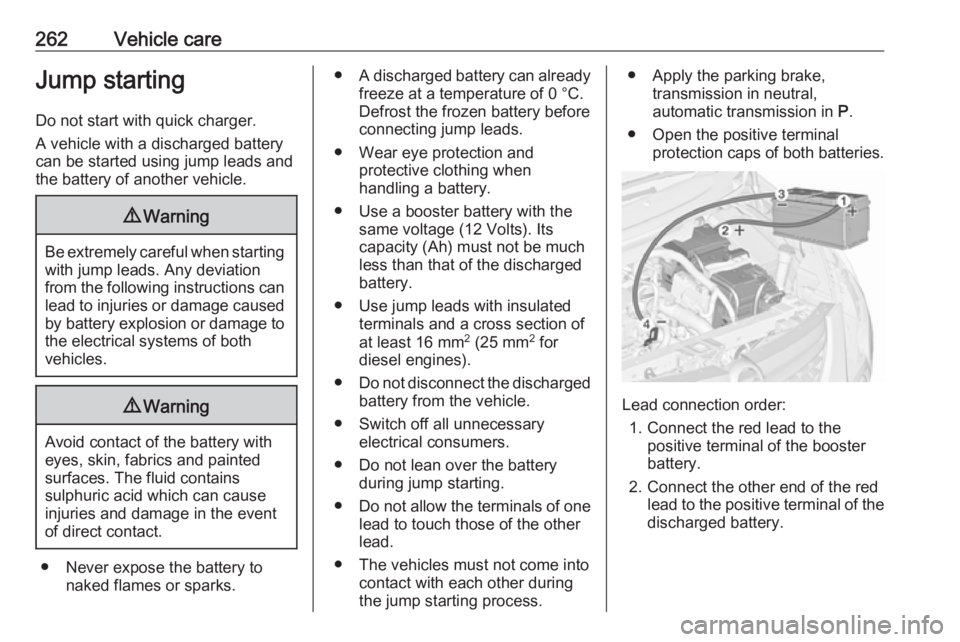
Lead connection order:
1. Connect the red lead to the positive terminal of the booster
battery.
2. Connect the other end of the red lead to the positive terminal of the
discharged battery.
Page 265 of 307
Vehicle care2633. Connect the black lead to thenegative terminal of the booster
battery.
4. Connect the other end of the black
lead to a vehicle grounding point,
such as the engine block or an
engine mounting bolt. Connect as far away from the discharged
battery as possible, however at
least 60 cm.
Route the leads so that they cannot
catch on rotating parts in the engine
compartment.
To start the engine: 1. Start the engine of the vehicle providing the jump.
2. After five minutes, start the other engine. Start attempts should be
made for no longer than
15 seconds at an interval of one
minute.
3. Allow both engines to idle for approx. three minutes with the
leads connected.4. Switch on electrical consumers (e.g. headlights, heated rear
window) of the vehicle receiving
the jump start.
5. Reverse above sequence exactly when removing leads.Towing
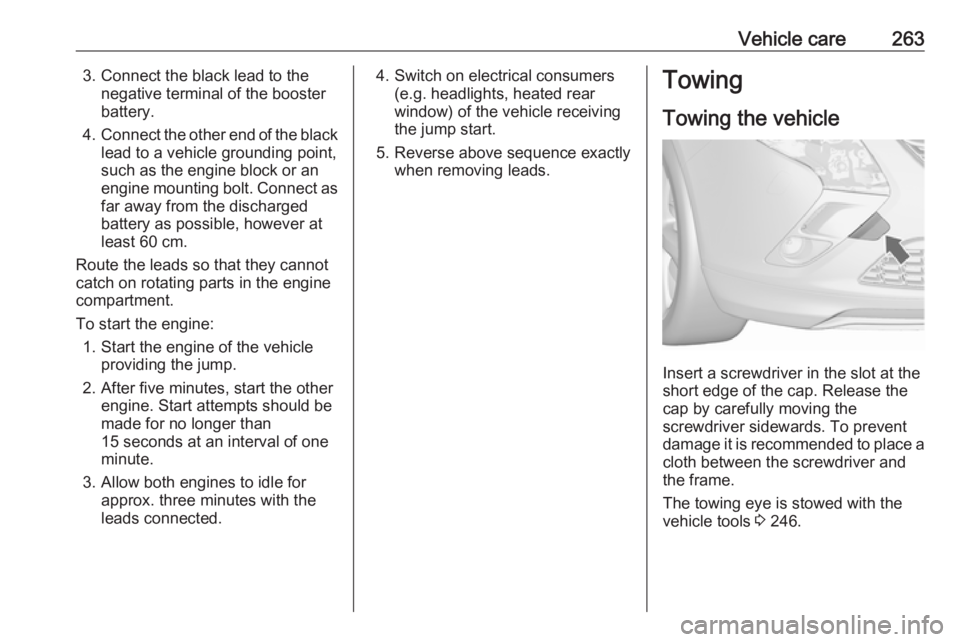
Towing the vehicle
Insert a screwdriver in the slot at the
short edge of the cap. Release the
cap by carefully moving the
screwdriver sidewards. To prevent
damage it is recommended to place a cloth between the screwdriver and
the frame.
The towing eye is stowed with the vehicle tools 3 246.
Page 302 of 307
300IndexAAccessories and vehicle modifications .......................... 224
Active Emergency Braking .........192
Active head restraints ...................37
Adaptive cruise control .......116, 182
Adaptive forward lighting ..115,
142, 234
AdBlue ........................ 114, 166, 270
Adjustable air vents ...................156
Airbag and belt tensioners .........110
Airbag deactivation ..............58, 111
Airbag label................................... 54
Airbag system .............................. 54
Air conditioning regular operation ................................ 157
Air conditioning system .............. 151
Air intake .................................... 157
Air vents...................................... 156
Antilock brake system ................ 173
Antilock brake system (ABS) .....112
Anti-theft alarm system ................27
Anti-theft locking system .............. 26
Appearance care ........................265
Armrest ......................................... 42
Armrest storage ........................... 69
Ashtrays ..................................... 103
Automatic anti-dazzle ..................31
Automatic light control ...............139
Automatic locking ........................24Automatic transmission .............169
Autostop ..................................... 161
Auxiliary heater ........................... 156
B Battery discharge protection ......149
Battery voltage ........................... 126
Bicycle rack .................................. 70
BlueInjection ............................... 166
Bonnet ....................................... 225
Brake and clutch fluid .................270
Brake and clutch system ...........111
Brake assist ............................... 175
Brake fluid .................................. 229
Brakes ............................... 173, 229
Breakdown.................................. 263
Bulb replacement ....................... 232
C Capacities .................................. 286
Cargo management system ........88
Car Pass ...................................... 21
Catalytic converter .....................165
Central locking system ................22
Centre console lighting ..............148
Centre console storage ...............70
Changing tyre and wheel size ...252
Charging system ........................ 111
Child locks ................................... 25
Child restraint installation locations ................................... 62
Page 306 of 307
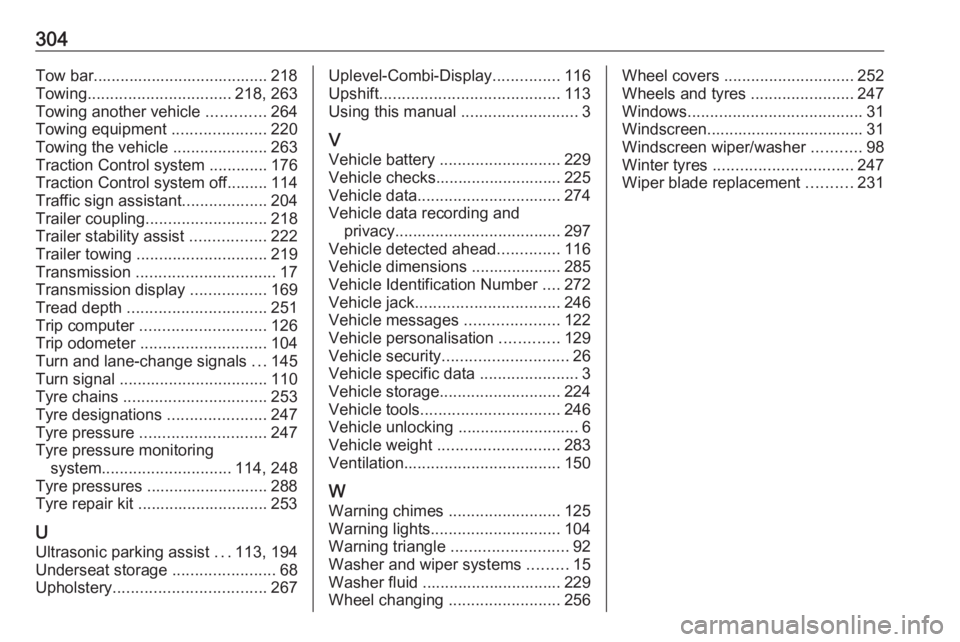
304Tow bar....................................... 218
Towing ................................ 218, 263
Towing another vehicle .............264
Towing equipment .....................220
Towing the vehicle .....................263
Traction Control system ............. 176
Traction Control system off......... 114
Traffic sign assistant ...................204
Trailer coupling ........................... 218
Trailer stability assist .................222
Trailer towing ............................. 219
Transmission ............................... 17
Transmission display .................169
Tread depth ............................... 251
Trip computer ............................ 126
Trip odometer ............................ 104
Turn and lane-change signals ...145
Turn signal ................................. 110
Tyre chains ................................ 253
Tyre designations ......................247
Tyre pressure ............................ 247
Tyre pressure monitoring system ............................. 114, 248
Tyre pressures ........................... 288
Tyre repair kit ............................. 253
U Ultrasonic parking assist ...113, 194
Underseat storage .......................68
Upholstery .................................. 267Uplevel-Combi-Display ...............116
Upshift ........................................ 113
Using this manual ..........................3
V Vehicle battery ........................... 229
Vehicle checks............................ 225
Vehicle data ................................ 274
Vehicle data recording and privacy ..................................... 297
Vehicle detected ahead ..............116
Vehicle dimensions .................... 285
Vehicle Identification Number ....272
Vehicle jack ................................ 246
Vehicle messages .....................122
Vehicle personalisation .............129
Vehicle security ............................ 26
Vehicle specific data ......................3
Vehicle storage ........................... 224
Vehicle tools ............................... 246
Vehicle unlocking ........................... 6 Vehicle weight ........................... 283
Ventilation ................................... 150
W
Warning chimes .........................125
Warning lights ............................. 104
Warning triangle .......................... 92
Washer and wiper systems .........15
Washer fluid ............................... 229
Wheel changing .........................256Wheel covers ............................. 252
Wheels and tyres .......................247
Windows ....................................... 31
Windscreen................................... 31
Windscreen wiper/washer ...........98
Winter tyres ............................... 247
Wiper blade replacement ..........231