2017 NISSAN TITAN engine coolant
[x] Cancel search: engine coolantPage 529 of 671
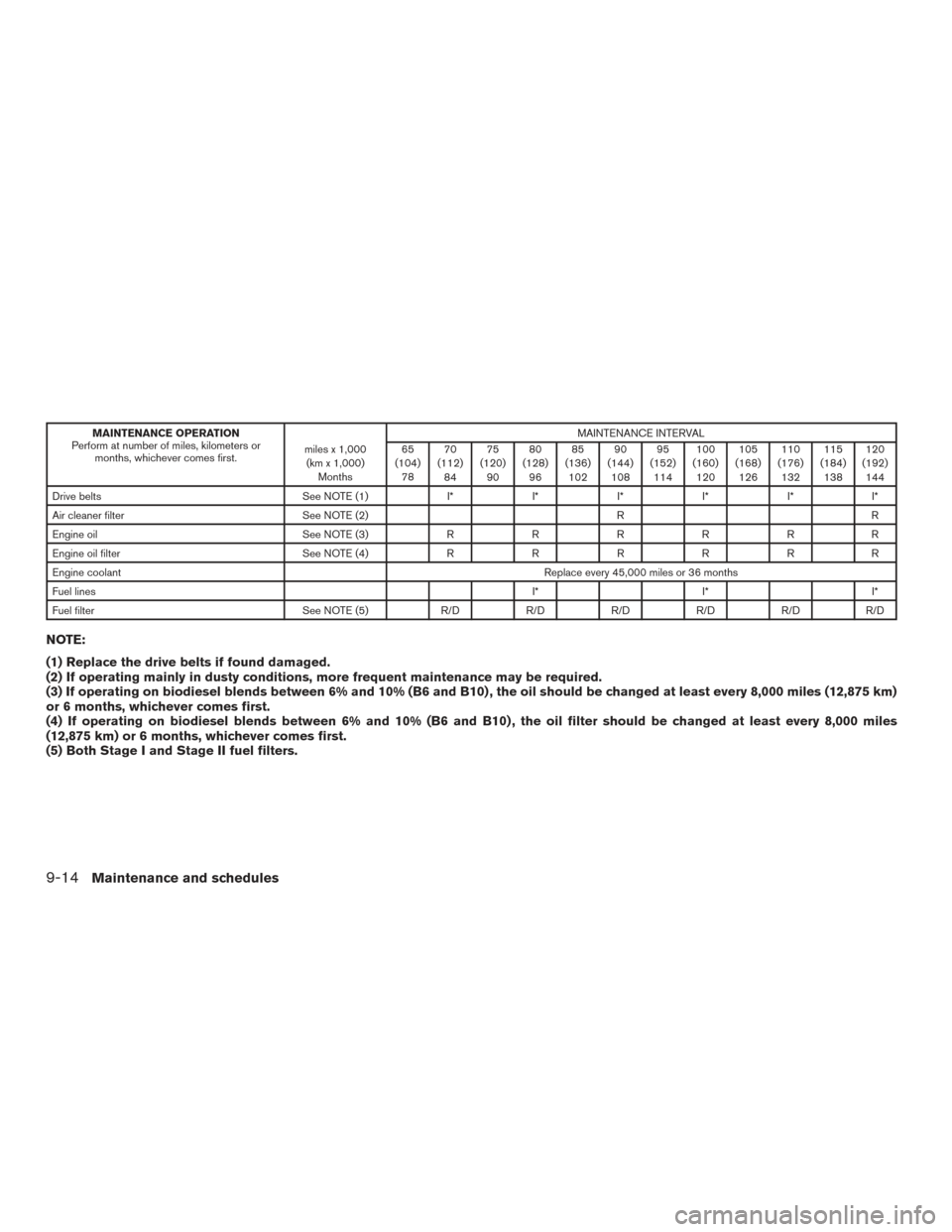
MAINTENANCE OPERATION
Perform at number of miles, kilometers or months, whichever comes first. miles x 1,000
(km x 1,000) Months MAINTENANCE INTERVAL
65
(104) 78 70
(112) 84 75
(120) 90 80
(128) 96 85
(136) 102 90
(144) 108 95
(152) 114 100
(160) 120 105
(168) 126 110
(176) 132 115
(184) 138 120
(192) 144
Drive belts See NOTE (1)I*I*I*I*I*I*
Air cleaner filter See NOTE (2) RR
Engine oil See NOTE (3)RRRRRR
Engine oil filter See NOTE (4)RRRRRR
Engine coolant Replace every 45,000 miles or 36 months
Fuel lines I*I*I*
Fuel filter See NOTE (5)R/DR/DR/DR/DR/DR/D
NOTE:
(1) Replace the drive belts if found damaged.
(2) If operating mainly in dusty conditions, more frequent maintenance may be required.
(3) If operating on biodiesel blends between 6% and 10% (B6 and B10) , the oil should be changed at least every 8,000 miles (12,875 km)
or 6 months, whichever comes first.
(4) If operating on biodiesel blends between 6% and 10% (B6 and B10) , the oil filter should be changed at least every 8,000 miles
(12,875 km) or 6 months, whichever comes first.
(5) Both Stage I and Stage II fuel filters.
9-14Maintenance and schedules
Page 537 of 671
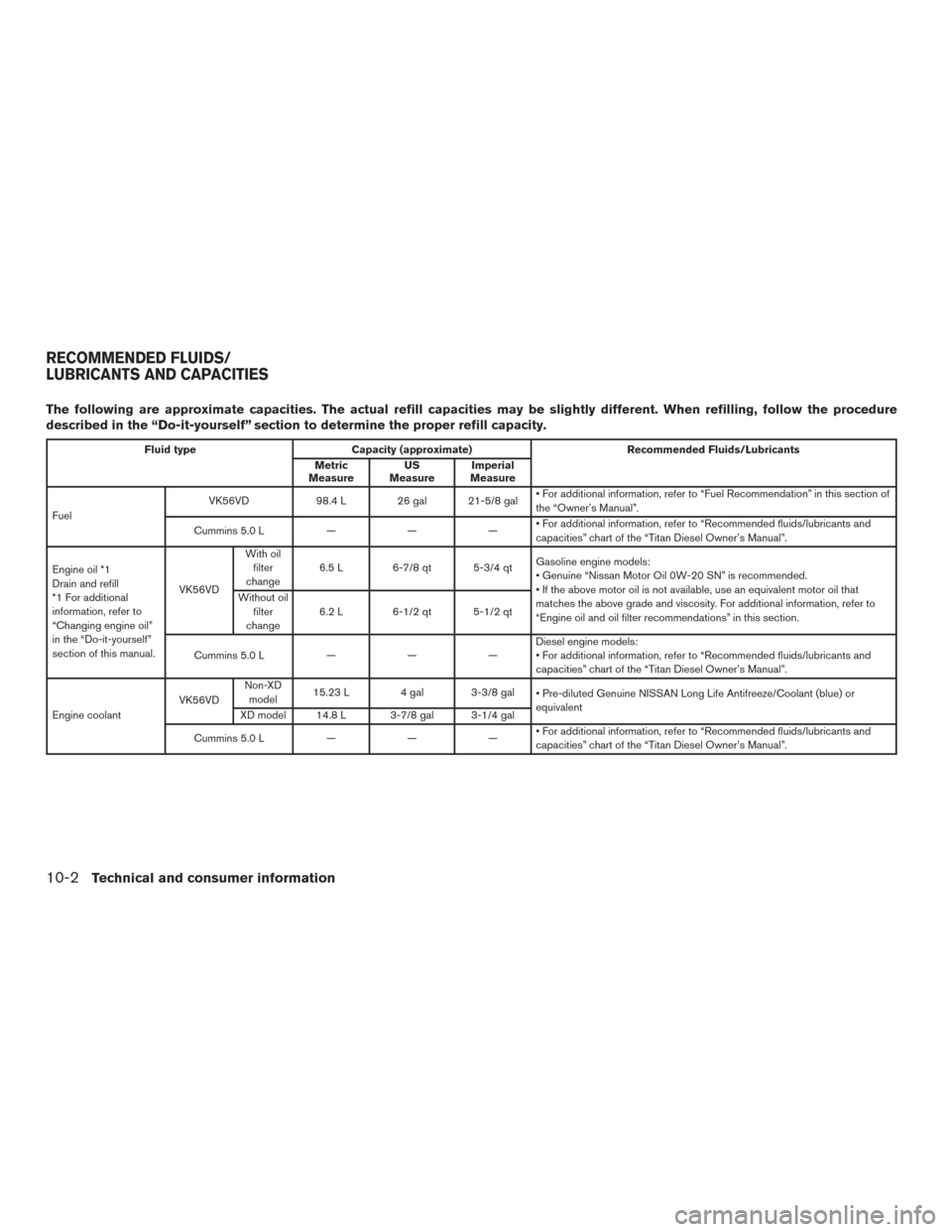
The following are approximate capacities. The actual refill capacities may be slightly different. When refilling, follow the procedure
described in the “Do-it-yourself” section to determine the proper refill capacity.
Fluid typeCapacity (approximate) Recommended Fluids/Lubricants
Metric
Measure US
Measure Imperial
Measure
Fuel VK56VD
98.4 L 26 gal 21-5/8 gal • For additional information, refer to “Fuel Recommendation” in this section of
the “Owner’s Manual”.
Cummins 5.0 L ———• For additional information, refer to “Recommended fluids/lubricants and
capacities” chart of the “Titan Diesel Owner’s Manual”.
Engine oil *1
Drain and refill
*1 For additional
information, refer to
“Changing engine oil”
in the “Do-it-yourself”
section of this manual. VK56VD
With oil
filter
change 6.5 L 6-7/8 qt 5-3/4 qt
Gasoline engine models:
• Genuine “Nissan Motor Oil 0W-20 SN” is recommended.
• If the above motor oil is not available, use an equivalent motor oil that
matches the above grade and viscosity. For additional information, refer to
“Engine oil and oil filter recommendations” in this section.
Without oil
filter
change 6.2 L 6-1/2 qt 5-1/2 qt
Cummins 5.0 L ———Diesel engine models:
• For additional information, refer to “Recommended fluids/lubricants and
capacities” chart of the “Titan Diesel Owner’s Manual”.
Engine coolant VK56VD
Non-XD
model 15.23 L 4 gal 3-3/8 gal
• Pre-diluted Genuine NISSAN Long Life Antifreeze/Coolant (blue) or
equivalent
XD model 14.8 L 3-7/8 gal 3-1/4 gal
Cummins 5.0 L ———• For additional information, refer to “Recommended fluids/lubricants and
capacities” chart of the “Titan Diesel Owner’s Manual”.
RECOMMENDED FLUIDS/
LUBRICANTS AND CAPACITIES
10-2Technical and consumer information
Page 590 of 671
●While going downhill, the weight of the
trailer pushing on the tow vehicle may de-
crease overall stability. Therefore, to main-
tain adequate control, reduce your speed
and shift to a lower gear. Avoid long or
repeated use of the brakes when descend-
ing a hill, as this reduces their effectiveness
and could cause overheating. Shifting to a
lower gear instead provides “engine brak-
ing” and reduces the need to brake as fre-
quently.
● If the engine coolant temperature rises to a
high temperature, refer to “If your vehicle
overheats” in the “In case of emergency”
section of this owner’s manual.
● Trailer towing requires more fuel than normal
circumstances.
● Avoid towing a trailer for your vehicle’s first
500 miles (805 km) .
● For the first 500 miles (805 km) that you do
tow, do not drive over 50 mph (80 km/h).
● Have your vehicle serviced more often than
at intervals specified. For additional informa-
tion, refer to “Maintenance schedules” in the
“Maintenance and schedule” section of this
manual. ●
When making a turn, your trailer wheels will
be closer to the inside of the turn than your
vehicle wheels. To compensate for this,
make a larger than normal turning radius
during the turn.
● Crosswinds and rough roads will adversely
affect vehicle/trailer handling, possibly caus-
ing vehicle sway. When being passed by
larger vehicles, be prepared for possible
changes in crosswinds that could affect ve-
hicle handling.
Trailer Sway Assist:
To minimize trailer sway, your vehicle may apply
braking to individual wheels based on input from
your vehicle sensors and vehicle speed. Trailer
sway control is a function of the Vehicle Dynamic
Control (VDC) system and is active when the
VDC function is enabled.
CAUTION
If the VDC-OFF switch is on (meaning VDC
system OFF) , the Trailer Sway Assist is
also disabled
When Trailer Sway Assist is in operation, the
VDC warning light blinks. When vehicle control is
regained, VDC warning light will turn OFF. For additional information about the VDC system,
refer to “Vehicle Dynamic Control (VDC) OFF
switch” and Vehicle Dynamic Control (VDC) sys-
tem” sections of this manual.
If Trailer Sway Assist activates, do the fol-
lowing:
1. Take your foot off the accelerator pedal to allow the vehicle to coast and steer as
straight ahead as the road conditions allow.
This combination will help stabilize the ve-
hicle
CAUTION
Do not try to correct trailer sway by steer-
ing or applying the brakes.
2. When the trailer sway stops, gently apply the brakes and pull to the side of the road in a
safe area.
3. Try to rearrange the trailer load so it is bal- anced. For additional information, refer to
“Pre-towing tips” in this section.
Technical and consumer information10-55
Page 599 of 671
Brake system...................5-54
Break-in schedule ................5-42
Brightness/contrastbutton............4-9
Brightness control Instrument panel ...............2-56
Bulb check/instrument panel ..........2-22
Bulb replacement ................8-29
C
Capacities and recommended
fuel/lubricants ..................10-2
Cargolightswitch................2-58
Cargo (See vehicle loading information) . . .10-20
Car phone or CB radio .............4-113
CD care and cleaning ..............4-81
CD player (See audio system) . .4-56, 4-62, 4-69
Check tire pressure ...............2-42
Child restraints .......1-24,1-24,1-26,1-28
LATCH (Lower Anchors and Tethers for
CHildren) System ..............1-28
Precautions on child
restraints.....1-26,1-33,1-39,1-43,1-48
Top tether strap anchor point locations . .1-31
Child safety rear door lock ............3-7
Chimes, audible reminders ...........2-31
Cleaningexteriorandinterior........7-2,7-4
Climatecontrolseatswitch...........2-58
Clock setting
(models with Navigation System) ........4-7
Clock setting (models without Navigation
System) ..................4-55,4-59
C.M.V.S.S. certification label .........10-16
Cold weather driving ...............5-65
Compact disc (CD) player ....4-56,4-62,4-69Compass
.....................2-18
Connect phone .................4-84
Console light ...................2-88
Control panel buttons ...............4-4
Back button ..................4-7
Brightness/contrast button ..........4-9
Enterbutton..................4-4
With navigation system ............4-4
Controls Audio controls (steering wheel) .......4-82
Heater and air conditioner controls .....4-43
Heater and air conditioner controls
(manual) ...................4-33
Coolant Capacities and recommended
fuel/lubricants ................10-2
Changingenginecoolant...........8-6
Checking engine coolant level ........8-6
Engine coolant temperature gauge .....2-9
Corrosion protection ...............7-7
Cruisecontrol ...........5-40,5-40,5-41
Cupholders...................2-80
Curtainside-impactandrolloverairbag....1-74
D
Daytime Running Light System .....2-56,8-28
Diesel Particulate Filter (DPF) ..........8-11
Digital video disc DVD ..............4-88
Dimensionsandweights............10-11
Dimmer switch for instrument panel ......2-56
Display......................2-32
Display controls (see control panel buttons) . .4-4
Door locks .....................3-5
Door open warning light .............2-25 Doors
........................3-5
Drive belt .....................8-17
Drive positioner, Automatic ........3-37,3-39
Driving Cold weather driving .............5-65
Driving with automatic transmission ....5-17
Precautions when starting and
driving ...................5-2,5-8
Driving the vehicle ................5-16
E
Eco Drive Report .................5-52
Economy-fuel..................5-44
Electronic
locking rear differential (E-Lock)
system ......................5-51
Electronic locking rear differential (E-Lock)
system switch ..................2-65
Emergency engine shutoff .........5-13,6-2
Emission control information label ......10-17
Emission control system warranty .......10-59
Engine Before starting the engine ..........5-14
Blockheater.................5-66
Capacities and recommended
fuel/lubricants ................10-2
Changing engine coolant ...........8-6
Changingengineoil..............8-8
Changing engine oil filter ...........8-9
Checking engine coolant level ........8-6
Checking engine oil level ...........8-7
Engine compartment check locations ....8-3
Engine coolant temperature gauge .....2-9
Engine cooling system ............8-5
Engineoil ...................8-7
11-2
Page 600 of 671
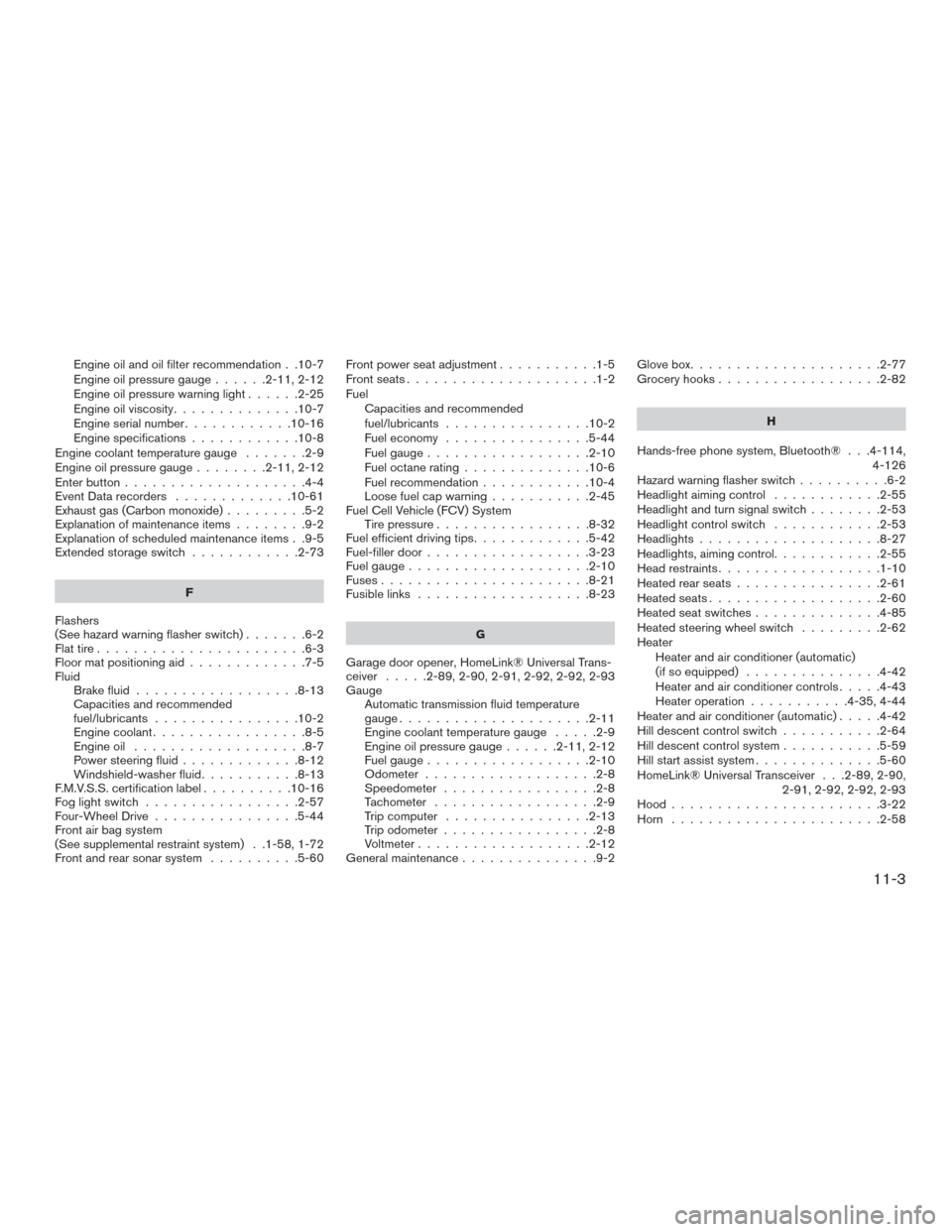
Engine oil and oil filter recommendation . .10-7
Engine oil pressure gauge......2-11,2-12
Engine oil pressure warning light ......2-25
Engine oil viscosity ..............10-7
Engine serial number ............10-16
Engine specifications ............10-8
Engine coolant temperature gauge .......2-9
Engineoilpressuregauge........2-11,2-12
Enterbutton....................4-4
Event Data recorders .............10-61
Exhaust gas (Carbon monoxide) .........5-2
Explanation of maintenance items ........9-2
Explanation of scheduled maintenance items . .9-5
Extendedstorageswitch ............2-73
F
Flashers
(See hazard warning flasher switch) .......6-2
Flat tire .......................6-3
Floor mat positioning aid .............7-5
Fluid Brake fluid ..................8-13
Capacities and recommended
fuel/lubricants ................10-2
Engine coolant .................8-5
Engine oil ...................8-7
Power steering fluid .............8-12
Windshield-washerfluid...........8-13
F.M.V.S.S. certification label ..........10-16
Foglightswitch .................2-57
Four-Wheel Drive ................5-44
Front air bag system
(See supplemental restraint system) . .1-58, 1-72
Front and rear sonar system ..........5-60Front power seat adjustment
...........1-5
Frontseats.....................1-2
Fuel Capacities and recommended
fuel/lubricants ................10-2
Fuel economy ................5-44
Fuel gauge ..................2-10
Fuel octane rating ..............10-6
Fuel recommendation ............10-4
Loose fuel cap warning ...........2-45
Fuel Cell Vehicle (FCV) System Tirepressure.................8-32
Fuel efficient driving tips .............5-42
Fuel-filler door ..................3-23
Fuelgauge....................2-10
Fuses.......................8-21
Fusiblelinks ...................8-23
G
Garage door opener, HomeLink® Universal Trans-
ceiver .....2-89,2-90,2-91,2-92,2-92,2-93
Gauge Automatic transmission fluid temperature
gauge.....................2-11
Engine coolant temperature gauge .....2-9
Engine oil pressure gauge ......2-11,2-12
Fuel gauge ..................2-10
Odometer ...................2-8
Speedometer .................2-8
Tachometer ..................2-9
Trip computer ................2-13
Trip odometer .................2-8
Voltmeter...................2-12
General maintenance ...............9-2 Glovebox.....................2-77
Groceryhooks..................2-82
H
Hands-free phone system, Bluetooth® . . .4-114, 4-126
Hazard warning flasher switch ..........6-2
Headlightaimingcontrol ............2-55
Headlightandturnsignalswitch........2-53
Headlightcontrolswitch ............2-53
Headlights....................8-27
Headlights, aiming control ............2-55
Head restraints ..................1-10
Heated
rear seats ................2-61
Heated seats ...................2-60
Heated seat switches ..............4-85
Heated steering wheel switch .........2-62
Heater Heater and air conditioner (automatic)
(if so equipped) ...............4-42
Heater and air conditioner controls .....4-43
Heater operation ...........4-35,4-44
Heater and air conditioner (automatic) .....4-42
Hill descent control switch ...........2-64
Hill descent control system ...........5-59
Hill start assist system ..............5-60
HomeLink® Universal Transceiver . . .2-89, 2-90, 2-91, 2-92, 2-92, 2-93
Hood.......................3-22
Horn .......................2-58
11-3
Page 604 of 671
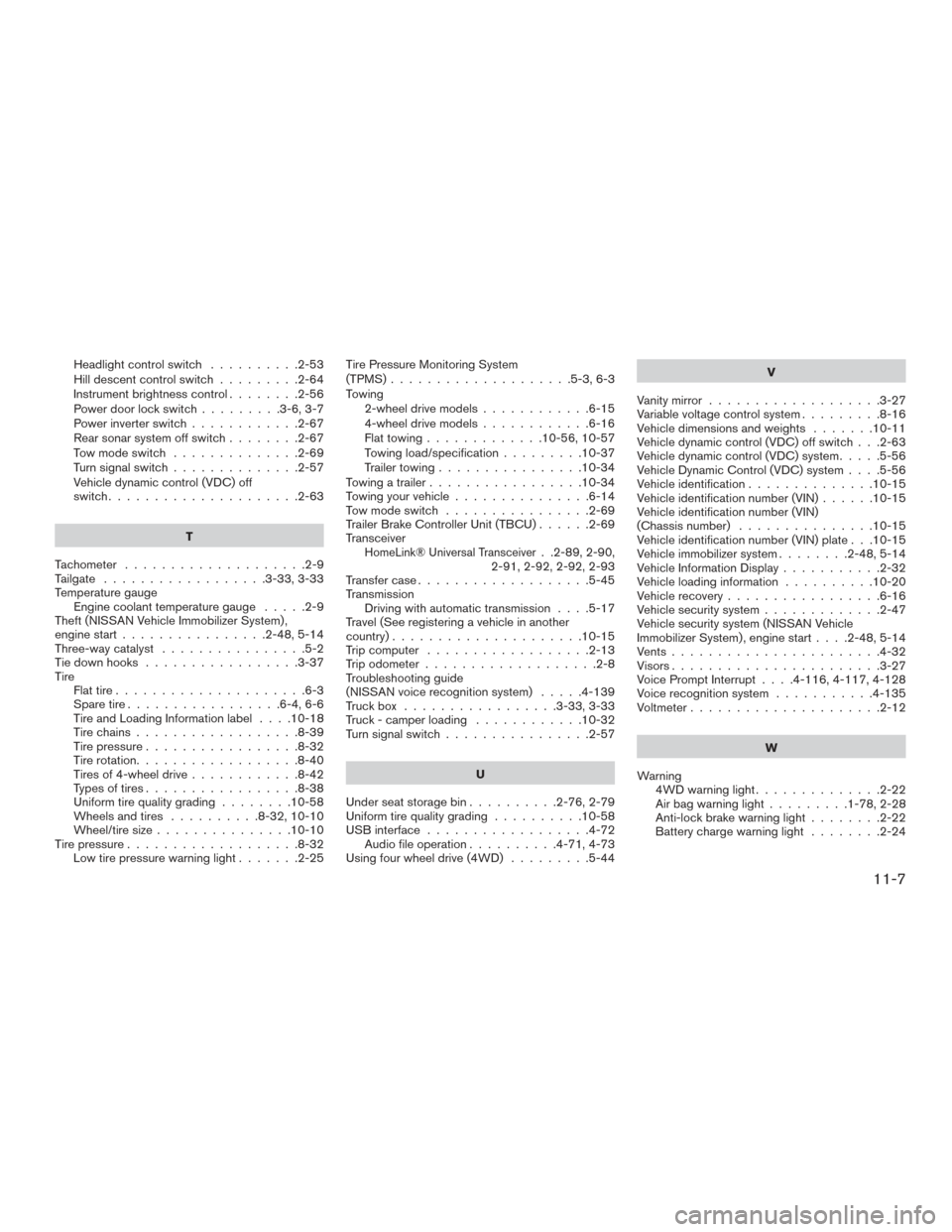
Headlight control switch..........2-53
Hill descent control switch .........2-64
Instrument brightness control ........2-56
Power door lock switch .........3-6,3-7
Power inverter switch ............2-67
Rear sonar system off switch ........2-67
Tow mode switch ..............2-69
Turnsignalswitch..............2-57
Vehicle dynamic control (VDC) off
switch.....................2-63
T
Tachometer ....................2-9
Tailgate ..................3-33,3-33
Temperature gauge Engine coolant temperature gauge .....2-9
Theft (NISSAN Vehicle Immobilizer System) ,
engine start ................2-48,5-14
Three-way catalyst ................5-2
Tie down hooks .................3-37
Tire Flat tire .....................6-3
Spare tire .................6-4,6-6
TireandLoadingInformationlabel ....10-18
Tire chains ..................8-39
Tirepressure.................8-32
Tire rotation..................8-40
Tires of 4-wheel drive ............8-42
Types of tires .................8-38
Uniform tire quality grading ........10-58
Wheels and tires ..........8-32,10-10
Wheel/tire size ...............10-10
Tirepressure...................8-32 Low tire pressure warning light .......2-25Tire Pressure Monitoring System
(TPMS)
....................5-3,6-3
Towing 2-wheel drive models ............6-15
4-wheel drive models ............6-16
Flattowing.............10-56,10-57
Towing load/specification .........10-37
Trailer towing ................10-34
Towing a trailer .................10-34
Towingyourvehicle...............6-14
Tow mode switch ................2-69
Trailer Brake Controller Unit (TBCU) ......2-69
Transceiver
HomeLink® Universal Transceiver. .2-89, 2-90,
2-91, 2-92, 2-92, 2-93
Transfer case ...................5-45
Transmission Driving with automatic transmission ....5-17
Travel (See registering a vehicle in another
country) .....................10-15
Trip computer ..................2-13
Trip odometer ...................2-8
Troubleshooting guide
(NISSAN voice recognition system) .....4-139
Truckbox .................3-33,3-33
Truck - camper loading ............10-32
Turn signal switch ................2-57
U
Under seat storage bin ..........2-76,2-79
Uniform tire quality grading ..........10-58
USB interface ..................4-72
Audio file operation ..........4-71,4-73
Using four wheel drive (4WD) .........5-44 V
Vanity mirror ...................3-27
Variable voltage control system .........8-16
Vehicle dimensions and weights .......10-11
Vehicle dynamic control (VDC) off switch . . .2-63
Vehicle dynamic control (VDC) system .....5-56
Vehicle Dynamic Control (VDC) system . . . .5-56
Vehicle identification ..............10-15
Vehicle identification number (VIN) ......10-15
Vehicle identification number (VIN)
(Chassis number) ...............10-15
Vehicle identification number (VIN) plate . . .10-15
Vehicle immobilizer system ........2-48,5-14
Vehicle Information Display ...........2-32
Vehicle loading information ..........10-20
Vehicle recovery .................6-16
Vehicle security system .............2-47
Vehicle security system (NISSAN Vehicle
Immobilizer System) , engine start ....2-48,5-14
Vents.......................4-32
Visors.......................3-27
Voice Prompt Interrupt ....4-116, 4-117, 4-128
Voice recognition system ...........4-135
Voltmeter.....................2-12
W
Warning 4WD warning light ..............2-22
Airbagwarninglight.........1-78,2-28
Anti-lock brake warning light ........2-22
Battery charge warning light ........2-24
11-7
Page 614 of 671
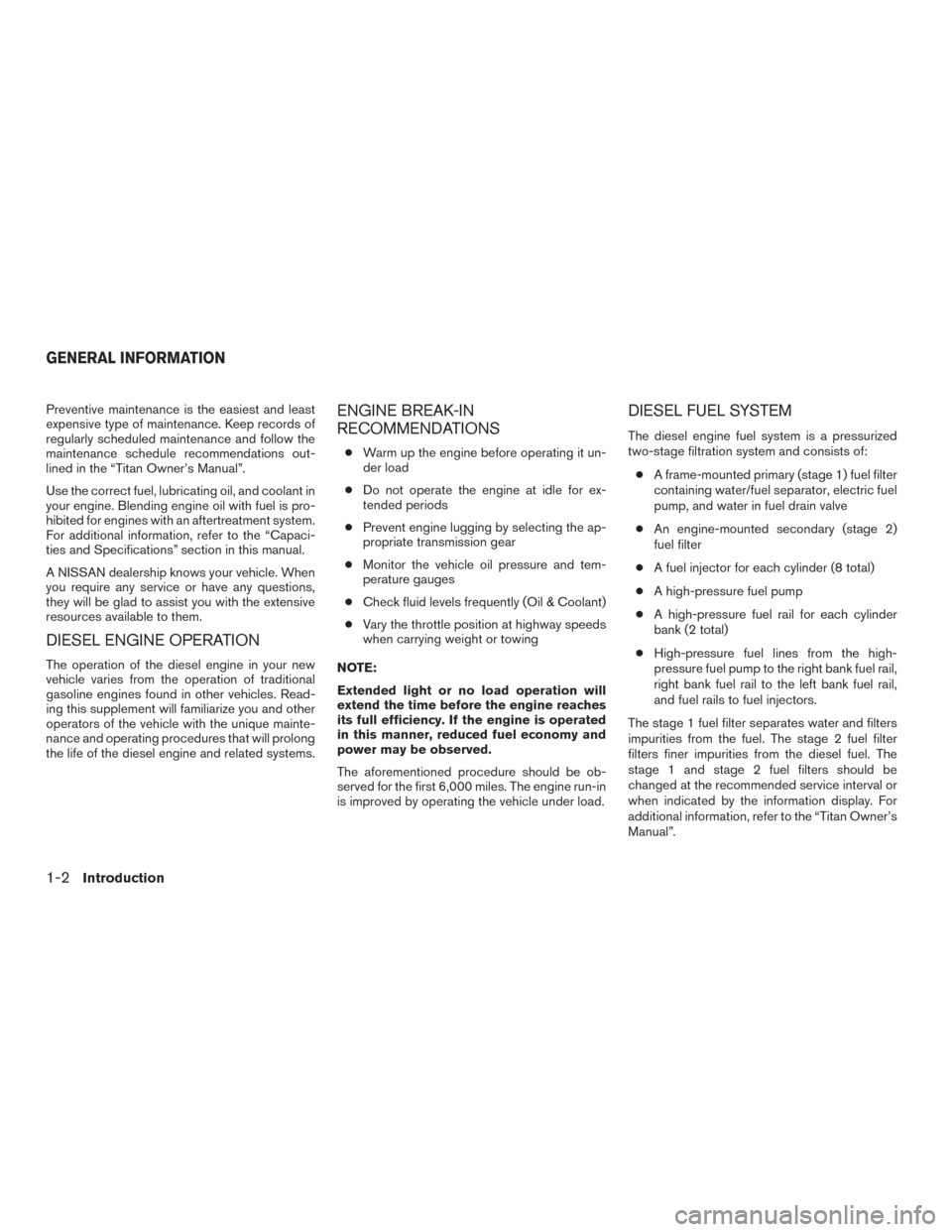
Preventive maintenance is the easiest and least
expensive type of maintenance. Keep records of
regularly scheduled maintenance and follow the
maintenance schedule recommendations out-
lined in the “Titan Owner’s Manual”.
Use the correct fuel, lubricating oil, and coolant in
your engine. Blending engine oil with fuel is pro-
hibited for engines with an aftertreatment system.
For additional information, refer to the “Capaci-
ties and Specifications” section in this manual.
A NISSAN dealership knows your vehicle. When
you require any service or have any questions,
they will be glad to assist you with the extensive
resources available to them.
DIESEL ENGINE OPERATION
The operation of the diesel engine in your new
vehicle varies from the operation of traditional
gasoline engines found in other vehicles. Read-
ing this supplement will familiarize you and other
operators of the vehicle with the unique mainte-
nance and operating procedures that will prolong
the life of the diesel engine and related systems.
ENGINE BREAK-IN
RECOMMENDATIONS
●Warm up the engine before operating it un-
der load
● Do not operate the engine at idle for ex-
tended periods
● Prevent engine lugging by selecting the ap-
propriate transmission gear
● Monitor the vehicle oil pressure and tem-
perature gauges
● Check fluid levels frequently (Oil & Coolant)
● Vary the throttle position at highway speeds
when carrying weight or towing
NOTE:
Extended light or no load operation will
extend the time before the engine reaches
its full efficiency. If the engine is operated
in this manner, reduced fuel economy and
power may be observed.
The aforementioned procedure should be ob-
served for the first 6,000 miles. The engine run-in
is improved by operating the vehicle under load.
DIESEL FUEL SYSTEM
The diesel engine fuel system is a pressurized
two-stage filtration system and consists of: ● A frame-mounted primary (stage 1) fuel filter
containing water/fuel separator, electric fuel
pump, and water in fuel drain valve
● An engine-mounted secondary (stage 2)
fuel filter
● A fuel injector for each cylinder (8 total)
● A high-pressure fuel pump
● A high-pressure fuel rail for each cylinder
bank (2 total)
● High-pressure fuel lines from the high-
pressure fuel pump to the right bank fuel rail,
right bank fuel rail to the left bank fuel rail,
and fuel rails to fuel injectors.
The stage 1 fuel filter separates water and filters
impurities from the fuel. The stage 2 fuel filter
filters finer impurities from the diesel fuel. The
stage 1 and stage 2 fuel filters should be
changed at the recommended service interval or
when indicated by the information display. For
additional information, refer to the “Titan Owner’s
Manual”.
GENERAL INFORMATION
1-2Introduction
Page 615 of 671
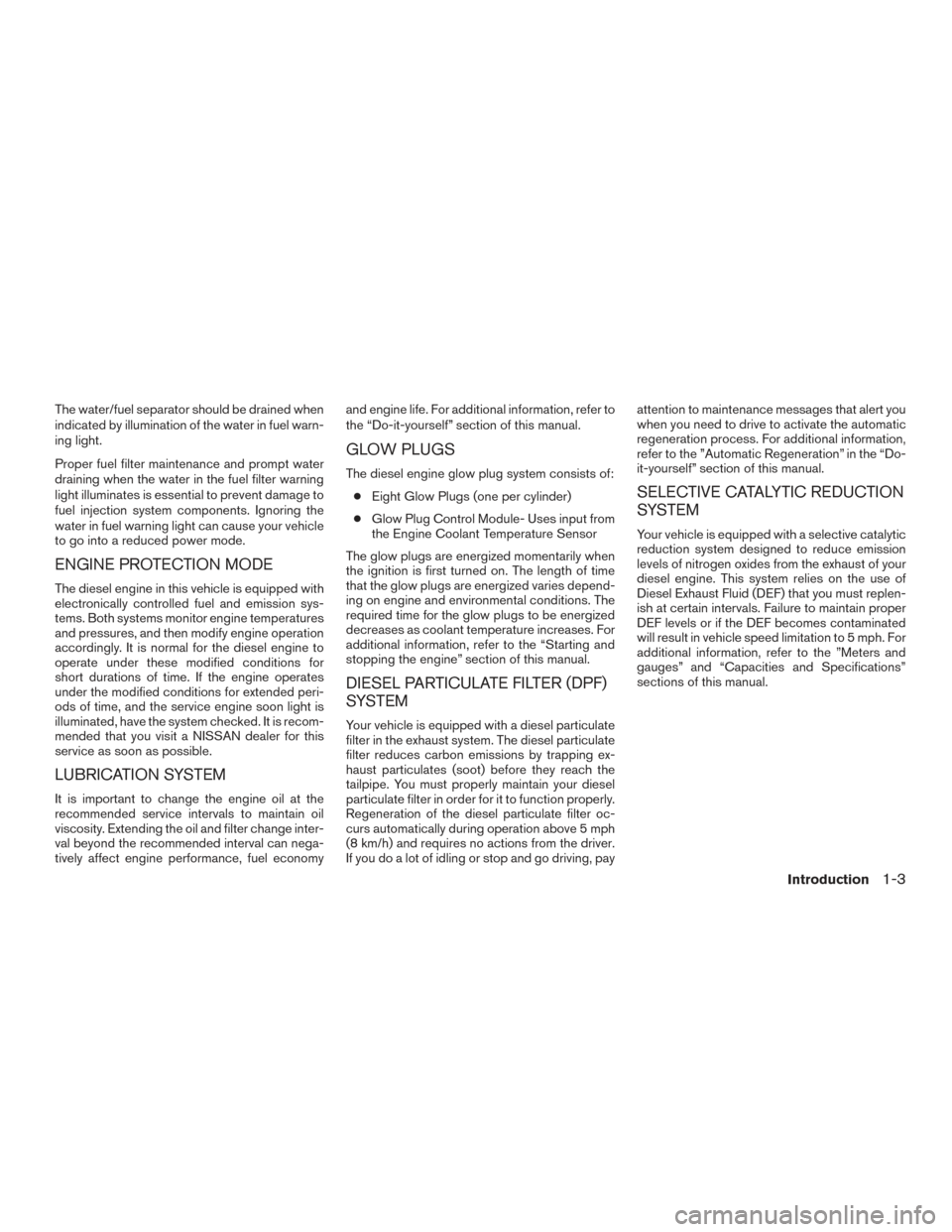
The water/fuel separator should be drained when
indicated by illumination of the water in fuel warn-
ing light.
Proper fuel filter maintenance and prompt water
draining when the water in the fuel filter warning
light illuminates is essential to prevent damage to
fuel injection system components. Ignoring the
water in fuel warning light can cause your vehicle
to go into a reduced power mode.
ENGINE PROTECTION MODE
The diesel engine in this vehicle is equipped with
electronically controlled fuel and emission sys-
tems. Both systems monitor engine temperatures
and pressures, and then modify engine operation
accordingly. It is normal for the diesel engine to
operate under these modified conditions for
short durations of time. If the engine operates
under the modified conditions for extended peri-
ods of time, and the service engine soon light is
illuminated, have the system checked. It is recom-
mended that you visit a NISSAN dealer for this
service as soon as possible.
LUBRICATION SYSTEM
It is important to change the engine oil at the
recommended service intervals to maintain oil
viscosity. Extending the oil and filter change inter-
val beyond the recommended interval can nega-
tively affect engine performance, fuel economyand engine life. For additional information, refer to
the “Do-it-yourself” section of this manual.
GLOW PLUGS
The diesel engine glow plug system consists of:
● Eight Glow Plugs (one per cylinder)
● Glow Plug Control Module- Uses input from
the Engine Coolant Temperature Sensor
The glow plugs are energized momentarily when
the ignition is first turned on. The length of time
that the glow plugs are energized varies depend-
ing on engine and environmental conditions. The
required time for the glow plugs to be energized
decreases as coolant temperature increases. For
additional information, refer to the “Starting and
stopping the engine” section of this manual.
DIESEL PARTICULATE FILTER (DPF)
SYSTEM
Your vehicle is equipped with a diesel particulate
filter in the exhaust system. The diesel particulate
filter reduces carbon emissions by trapping ex-
haust particulates (soot) before they reach the
tailpipe. You must properly maintain your diesel
particulate filter in order for it to function properly.
Regeneration of the diesel particulate filter oc-
curs automatically during operation above 5 mph
(8 km/h) and requires no actions from the driver.
If you do a lot of idling or stop and go driving, pay attention to maintenance messages that alert you
when you need to drive to activate the automatic
regeneration process. For additional information,
refer to the ”Automatic Regeneration” in the “Do-
it-yourself” section of this manual.
SELECTIVE CATALYTIC REDUCTION
SYSTEM
Your vehicle is equipped with a selective catalytic
reduction system designed to reduce emission
levels of nitrogen oxides from the exhaust of your
diesel engine. This system relies on the use of
Diesel Exhaust Fluid (DEF) that you must replen-
ish at certain intervals. Failure to maintain proper
DEF levels or if the DEF becomes contaminated
will result in vehicle speed limitation to 5 mph. For
additional information, refer to the ”Meters and
gauges” and “Capacities and Specifications”
sections of this manual.
Introduction1-3