2017 NISSAN TITAN fuel
[x] Cancel search: fuelPage 115 of 671
CAUTION
●This gauge is not designed to indicate
low engine oil level. Use the dipstick to
check the oil level. For additional infor-
mation, refer to “Engine oil” in the “Do-
it-yourself” section of this manual.
● If the gauge needle does not move with
the proper amount of engine oil, it is
recommended that you have the vehicle
checked by a NISSAN dealer. Continued
vehicle operation in such a condition
could cause serious damage to the
engine.
Engine oil temperature gauge
This gauge measures the temperature of the en-
gine oil.
Voltmeter
When the ignition switch is placed in the ON
position, the voltmeter indicates the battery volt-
age. When the engine is running, it indicates the
generator voltage. While cranking the engine, the volts drop below
the normal range. If the range is not within the
normal range (11 – 15 volts) while the engine is
running, it may indicate that the charging system
is not functioning properly. Have the system
checked. It is recommended that you visit a
NISSAN dealer for this service.
DIESEL EXHAUST FLUID (DEF)
LEVEL (if so equipped)
This gauge measures the DEF level remaining in
the vehicle. For additional information, refer to
“Fuel and refueling” in the “Titan Diesel Owner’s
Supplement”.
LIC3479
2-12Instruments and controls
Page 116 of 671
OFF-ROAD MONITOR (if so
equipped)
The off-road monitor displays the various slopes
of the vehicle.
The Pitch Gauge (left) indicates the angle of the
vehicle position up or down. The value will be
displayed below the gauge while the vehicle
graphic will rotate to indicate condition pointed
up or down.
The Tire Angle (center) indicates the angle of the
tires based on turning of the steering wheel. The
graphic image will show the actual vehicle tire
position while the angle is to be displayed below
as reference.The Roll Gauge (right) indicates the angle of the
vehicle position left and right. The value will be
displayed below the gauge while the vehicle
graphic will rotate to indicate condition of the
vehicle leaning to the left or right.
TRIP COMPUTER (if so equipped)
When the ignition switch is placed in the ON
position, the modes of the trip computer can be
selected by pressing the
buttons on the
steering wheel. The following modes can be se-
lected:
● Range
● Average fuel economy
● Average speed
● Time
● Tire info
● Settings
Range
The range mode provides you with an estimation
of the distance that can be driven before refuel-
ing. The range is constantly being calculated,
based on the amount of fuel in the fuel tank and
the actual fuel economy which will depend on
driving conditions. Dashes (—) indicate that fuel
remaining volume cannot be read by the fuel
pump and should be refilled as soon as possible.
The display is updated every 30 seconds.
LIC3417LIC3504
Instruments and controls2-13
Page 117 of 671
NOTE:
When driving uphill or rounding curves, the
fuel in the tank shifts, which may momen-
tarily change the display.
Average fuel economy
The average fuel economy mode shows the av-
erage fuel economy since the last reset. Reset-
ting is done by pressing the ENTER button on the
steering wheel for more than approximately
1 second. The display is updated every 30 sec-
onds. At about the first 1/3 mile (500 m) after a
reset, the display shows (----) .
Average speed
The average speed mode shows the average
vehicle speed since last reset. Resetting is done
by pressing the ENTER button on the steering
wheel for more than approximately 1 second. The
display is updated every 30 seconds. The first
30 seconds after a reset, the display shows
(----) .
LIC3505LIC3506
2-14Instruments and controls
Page 124 of 671
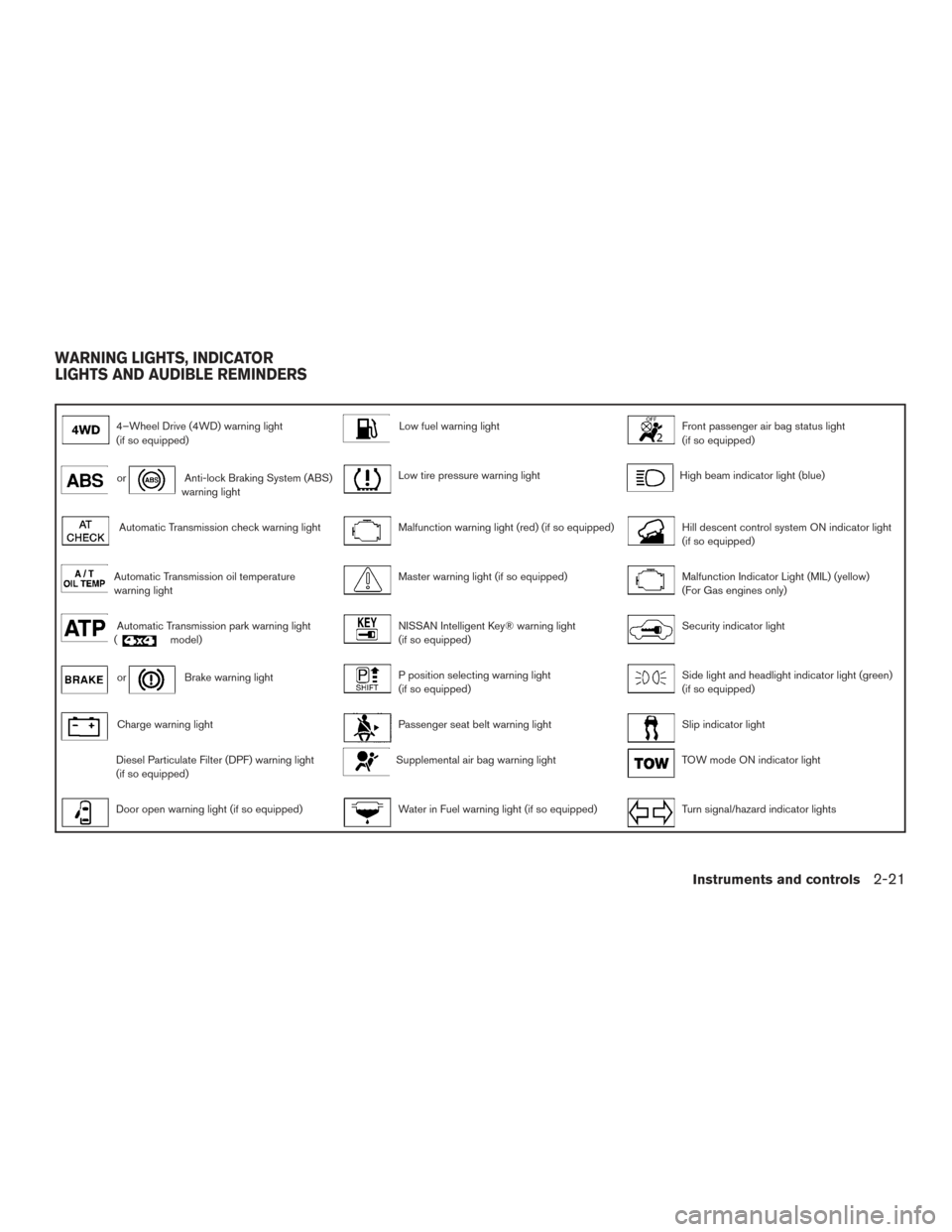
4–Wheel Drive (4WD) warning light
(if so equipped)Low fuel warning lightFront passenger air bag status light
(if so equipped)
orAnti-lock Braking System (ABS)
warning lightLow tire pressure warning lightHigh beam indicator light (blue)
Automatic Transmission check warning lightMalfunction warning light (red) (if so equipped)Hill descent control system ON indicator light
(if so equipped)
Automatic Transmission oil temperature
warning lightMaster warning light (if so equipped)Malfunction Indicator Light (MIL) (yellow)
(For Gas engines only)
Automatic Transmission park warning light
(model)NISSAN Intelligent Key® warning light
(if so equipped)Security indicator light
orBrake warning lightP position selecting warning light
(if so equipped)Side light and headlight indicator light (green)
(if so equipped)
Charge warning lightPassenger seat belt warning lightSlip indicator light
Diesel Particulate Filter (DPF) warning light
(if so equipped)Supplemental air bag warning lightTOW mode ON indicator light
Door open warning light (if so equipped)Water in Fuel warning light (if so equipped)Turn signal/hazard indicator lights
WARNING LIGHTS, INDICATOR
LIGHTS AND AUDIBLE REMINDERS
Instruments and controls2-21
Page 128 of 671
CAUTION
●Do not ground electrical accessories di-
rectly to the battery terminal. Doing so
will bypass the variable voltage control
system (if so equipped) and the vehicle
battery may not charge completely. For
additional information, refer to “Vari-
able voltage control system” in the “Do-
it-yourself” section of this manual.
● Do not continue driving if the generator
belt is loose, broken or missing.
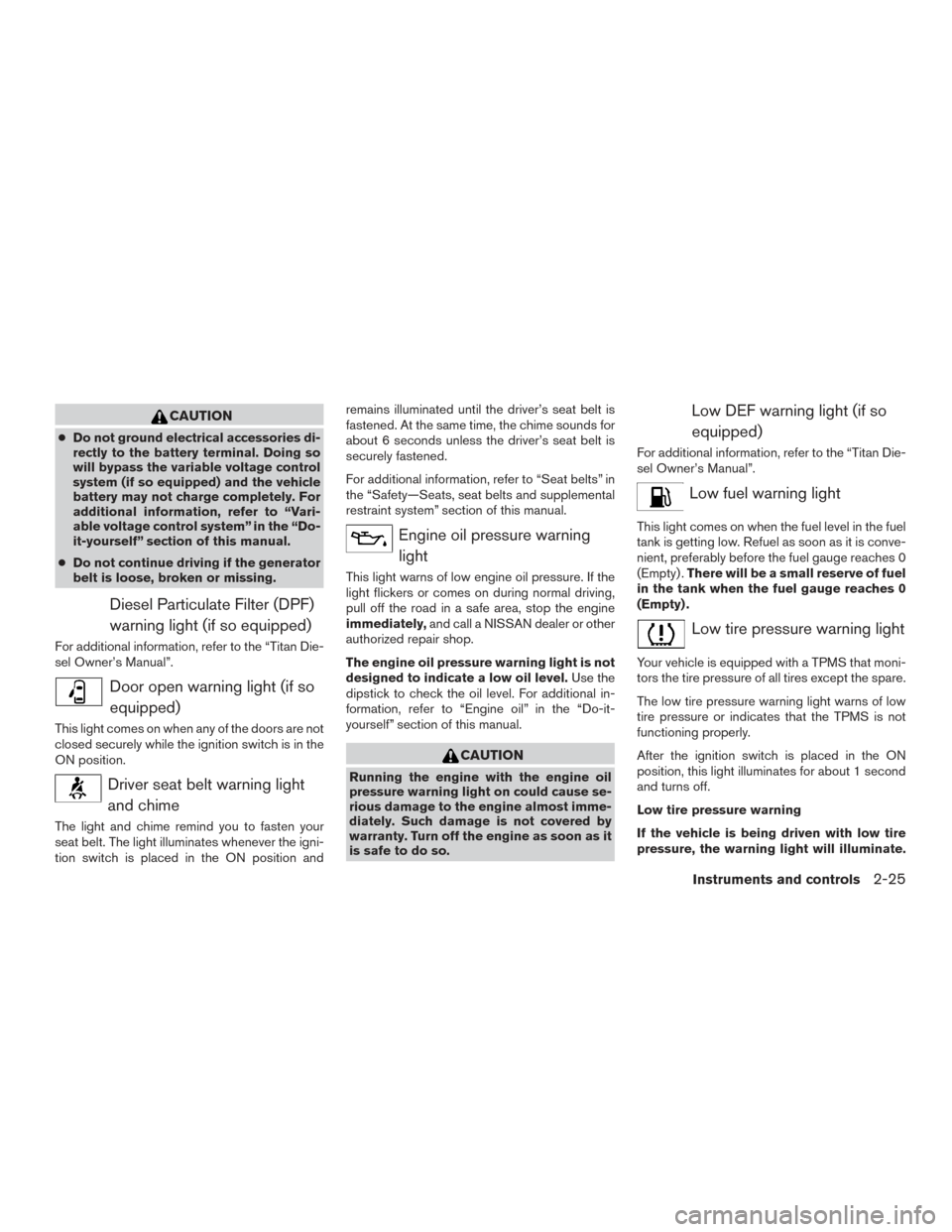
Diesel Particulate Filter (DPF)
warning light (if so equipped)
For additional information, refer to the “Titan Die-
sel Owner’s Manual”.
Door open warning light (if soequipped)
This light comes on when any of the doors are not
closed securely while the ignition switch is in the
ON position.
Driver seat belt warning lightand chime
The light and chime remind you to fasten your
seat belt. The light illuminates whenever the igni-
tion switch is placed in the ON position and remains illuminated until the driver’s seat belt is
fastened. At the same time, the chime sounds for
about 6 seconds unless the driver’s seat belt is
securely fastened.
For additional information, refer to “Seat belts” in
the “Safety—Seats, seat belts and supplemental
restraint system” section of this manual.
Engine oil pressure warning
light
This light warns of low engine oil pressure. If the
light flickers or comes on during normal driving,
pull off the road in a safe area, stop the engine
immediately, and call a NISSAN dealer or other
authorized repair shop.
The engine oil pressure warning light is not
designed to indicate a low oil level. Use the
dipstick to check the oil level. For additional in-
formation, refer to “Engine oil” in the “Do-it-
yourself” section of this manual.
CAUTION
Running the engine with the engine oil
pressure warning light on could cause se-
rious damage to the engine almost imme-
diately. Such damage is not covered by
warranty. Turn off the engine as soon as it
is safe to do so.
Low DEF warning light (if so
equipped)
For additional information, refer to the “Titan Die-
sel Owner’s Manual”.
Low fuel warning light
This light comes on when the fuel level in the fuel
tank is getting low. Refuel as soon as it is conve-
nient, preferably before the fuel gauge reaches 0
(Empty) . There will be a small reserve of fuel
in the tank when the fuel gauge reaches 0
(Empty) .
Low tire pressure warning light
Your vehicle is equipped with a TPMS that moni-
tors the tire pressure of all tires except the spare.
The low tire pressure warning light warns of low
tire pressure or indicates that the TPMS is not
functioning properly.
After the ignition switch is placed in the ON
position, this light illuminates for about 1 second
and turns off.
Low tire pressure warning
If the vehicle is being driven with low tire
pressure, the warning light will illuminate.
Instruments and controls2-25
Page 130 of 671
●Since the spare tire is not equipped with
TPMS, when a spare tire is mounted or a
wheel is replaced the TPMS will not
function and the low tire pressure warn-
ing light will flash for approximately
1 minute. The light will remain on after
1 minute. Have your tires replaced
and/or TPMS system reset as soon as
possible. It is recommended that you
visit a NISSAN dealer for these services.
● Replacing tires with those not originally
specified by NISSAN could affect the
proper operation of the TPMS.
CAUTION
● The TPMS is not a substitute for the
regular tire pressure check. Be sure to
check the tire pressure regularly.
● If the vehicle is being driven at speeds
of less than 16 mph (25 km/h), the
TPMS may not operate correctly.
● Be sure to install the specified size of
tires to the four wheels correctly.
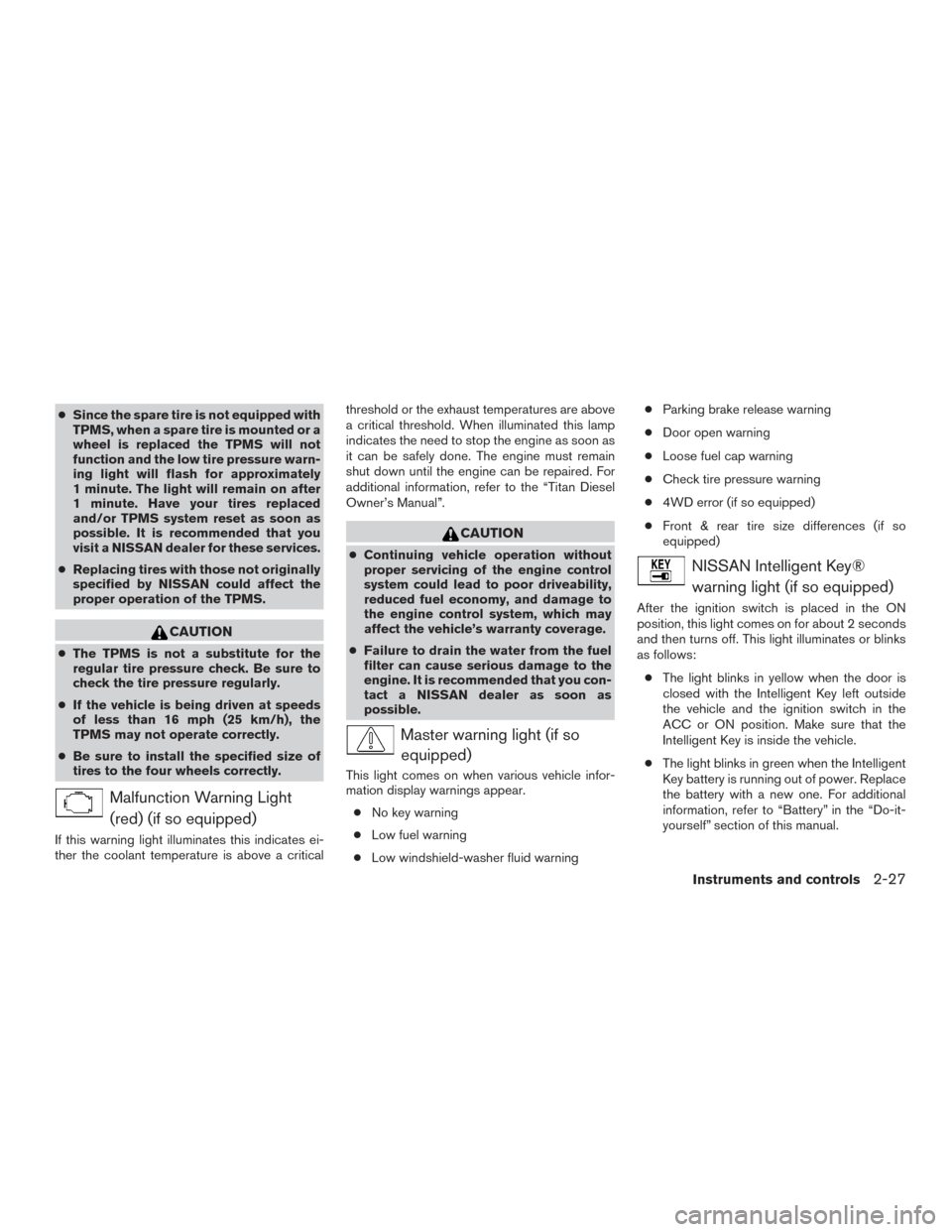
Malfunction Warning Light
(red) (if so equipped)
If this warning light illuminates this indicates ei-
ther the coolant temperature is above a critical threshold or the exhaust temperatures are above
a critical threshold. When illuminated this lamp
indicates the need to stop the engine as soon as
it can be safely done. The engine must remain
shut down until the engine can be repaired. For
additional information, refer to the “Titan Diesel
Owner’s Manual”.
CAUTION
●
Continuing vehicle operation without
proper servicing of the engine control
system could lead to poor driveability,
reduced fuel economy, and damage to
the engine control system, which may
affect the vehicle’s warranty coverage.
● Failure to drain the water from the fuel
filter can cause serious damage to the
engine. It is recommended that you con-
tact a NISSAN dealer as soon as
possible.
Master warning light (if so
equipped)
This light comes on when various vehicle infor-
mation display warnings appear.
● No key warning
● Low fuel warning
● Low windshield-washer fluid warning ●
Parking brake release warning
● Door open warning
● Loose fuel cap warning
● Check tire pressure warning
● 4WD error (if so equipped)
● Front & rear tire size differences (if so
equipped)
NISSAN Intelligent Key®
warning light (if so equipped)
After the ignition switch is placed in the ON
position, this light comes on for about 2 seconds
and then turns off. This light illuminates or blinks
as follows:
● The light blinks in yellow when the door is
closed with the Intelligent Key left outside
the vehicle and the ignition switch in the
ACC or ON position. Make sure that the
Intelligent Key is inside the vehicle.
● The light blinks in green when the Intelligent
Key battery is running out of power. Replace
the battery with a new one. For additional
information, refer to “Battery” in the “Do-it-
yourself” section of this manual.
Instruments and controls2-27
Page 131 of 671
●The light illuminates in yellow when it warns
of a malfunction with the Intelligent Key sys-
tem.
If the warning light illuminates in yellow while the
engine is stopped, it may be impossible to start
the engine. If the light comes on while the engine
is running, you can drive the vehicle. Have the
system checked. It is recommended that you visit
a NISSAN dealer for this service.
For additional information, refer to “NISSAN In-
telligent Key®” in the “Pre-driving checks and
adjustments” section of this manual.
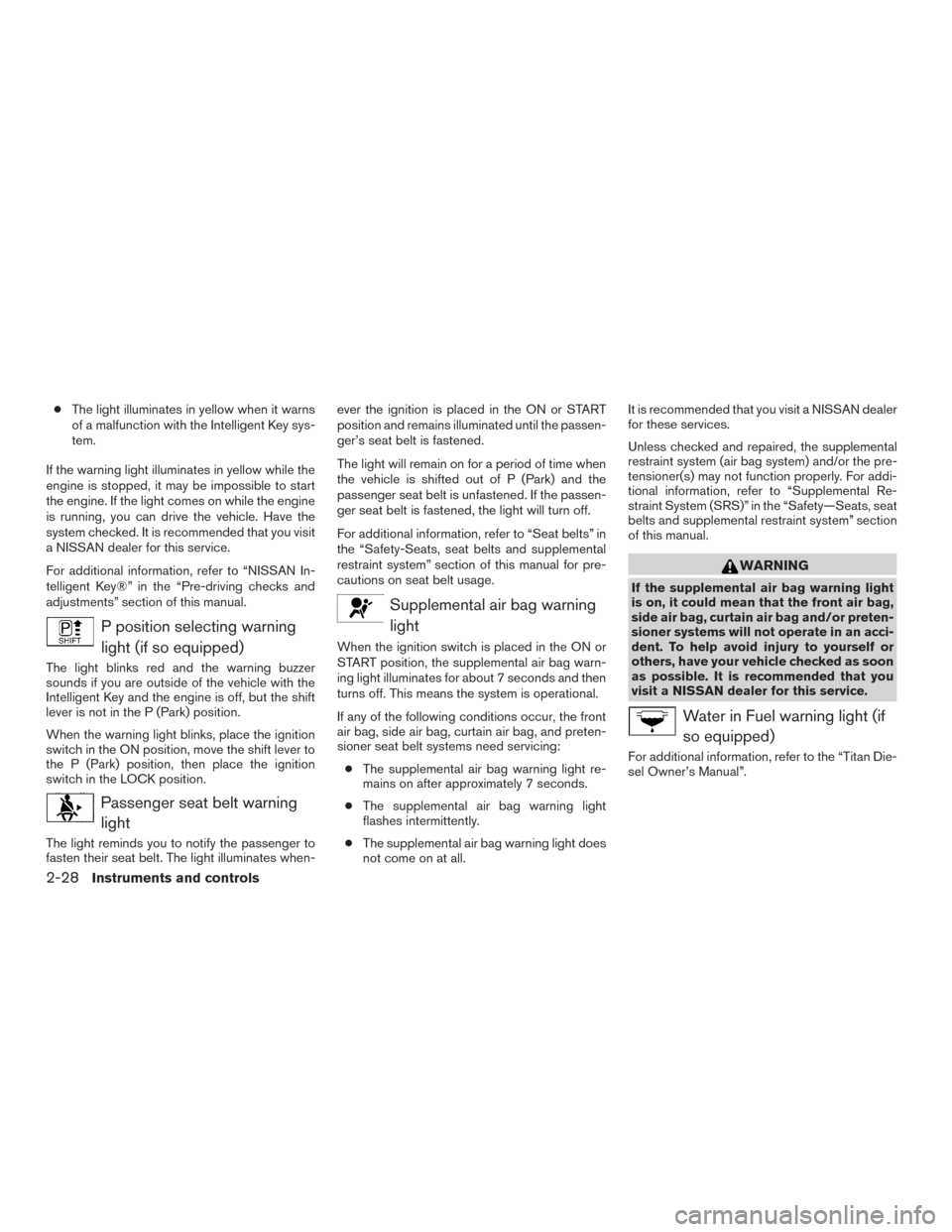
P position selecting warning light (if so equipped)
The light blinks red and the warning buzzer
sounds if you are outside of the vehicle with the
Intelligent Key and the engine is off, but the shift
lever is not in the P (Park) position.
When the warning light blinks, place the ignition
switch in the ON position, move the shift lever to
the P (Park) position, then place the ignition
switch in the LOCK position.
Passenger seat belt warninglight
The light reminds you to notify the passenger to
fasten their seat belt. The light illuminates when- ever the ignition is placed in the ON or START
position and remains illuminated until the passen-
ger’s seat belt is fastened.
The light will remain on for a period of time when
the vehicle is shifted out of P (Park) and the
passenger seat belt is unfastened. If the passen-
ger seat belt is fastened, the light will turn off.
For additional information, refer to “Seat belts” in
the “Safety-Seats, seat belts and supplemental
restraint system” section of this manual for pre-
cautions on seat belt usage.
Supplemental air bag warning
light
When the ignition switch is placed in the ON or
START position, the supplemental air bag warn-
ing light illuminates for about 7 seconds and then
turns off. This means the system is operational.
If any of the following conditions occur, the front
air bag, side air bag, curtain air bag, and preten-
sioner seat belt systems need servicing:
● The supplemental air bag warning light re-
mains on after approximately 7 seconds.
● The supplemental air bag warning light
flashes intermittently.
● The supplemental air bag warning light does
not come on at all. It is recommended that you visit a NISSAN dealer
for these services.
Unless checked and repaired, the supplemental
restraint system (air bag system) and/or the pre-
tensioner(s) may not function properly. For addi-
tional information, refer to “Supplemental Re-
straint System (SRS)” in the “Safety—Seats, seat
belts and supplemental restraint system” section
of this manual.
WARNING
If the supplemental air bag warning light
is on, it could mean that the front air bag,
side air bag, curtain air bag and/or preten-
sioner systems will not operate in an acci-
dent. To help avoid injury to yourself or
others, have your vehicle checked as soon
as possible. It is recommended that you
visit a NISSAN dealer for this service.
Water in Fuel warning light (if
so equipped)
For additional information, refer to the “Titan Die-
sel Owner’s Manual”.
2-28Instruments and controls
Page 133 of 671
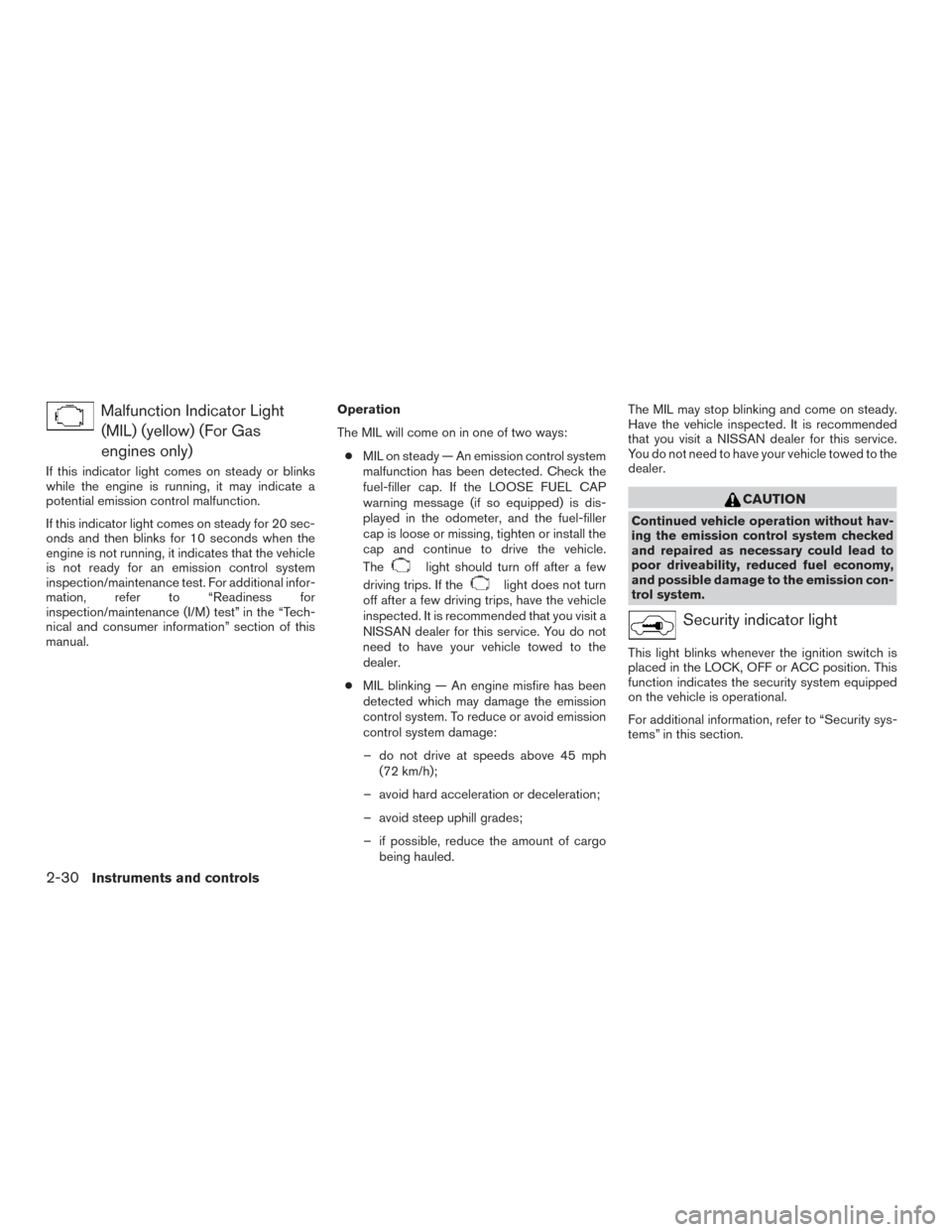
Malfunction Indicator Light(MIL) (yellow) (For Gas
engines only)
If this indicator light comes on steady or blinks
while the engine is running, it may indicate a
potential emission control malfunction.
If this indicator light comes on steady for 20 sec-
onds and then blinks for 10 seconds when the
engine is not running, it indicates that the vehicle
is not ready for an emission control system
inspection/maintenance test. For additional infor-
mation, refer to “Readiness for
inspection/maintenance (I/M) test” in the “Tech-
nical and consumer information” section of this
manual. Operation
The MIL will come on in one of two ways:
● MIL on steady — An emission control system
malfunction has been detected. Check the
fuel-filler cap. If the LOOSE FUEL CAP
warning message (if so equipped) is dis-
played in the odometer, and the fuel-filler
cap is loose or missing, tighten or install the
cap and continue to drive the vehicle.
The
light should turn off after a few
driving trips. If the
light does not turn
off after a few driving trips, have the vehicle
inspected. It is recommended that you visit a
NISSAN dealer for this service. You do not
need to have your vehicle towed to the
dealer.
● MIL blinking — An engine misfire has been
detected which may damage the emission
control system. To reduce or avoid emission
control system damage:
– do not drive at speeds above 45 mph (72 km/h);
– avoid hard acceleration or deceleration;
– avoid steep uphill grades;
– if possible, reduce the amount of cargo being hauled. The MIL may stop blinking and come on steady.
Have the vehicle inspected. It is recommended
that you visit a NISSAN dealer for this service.
You do not need to have your vehicle towed to the
dealer.
CAUTION
Continued vehicle operation without hav-
ing the emission control system checked
and repaired as necessary could lead to
poor driveability, reduced fuel economy,
and possible damage to the emission con-
trol system.
Security indicator light
This light blinks whenever the ignition switch is
placed in the LOCK, OFF or ACC position. This
function indicates the security system equipped
on the vehicle is operational.
For additional information, refer to “Security sys-
tems” in this section.
2-30Instruments and controls