Page 453 of 491
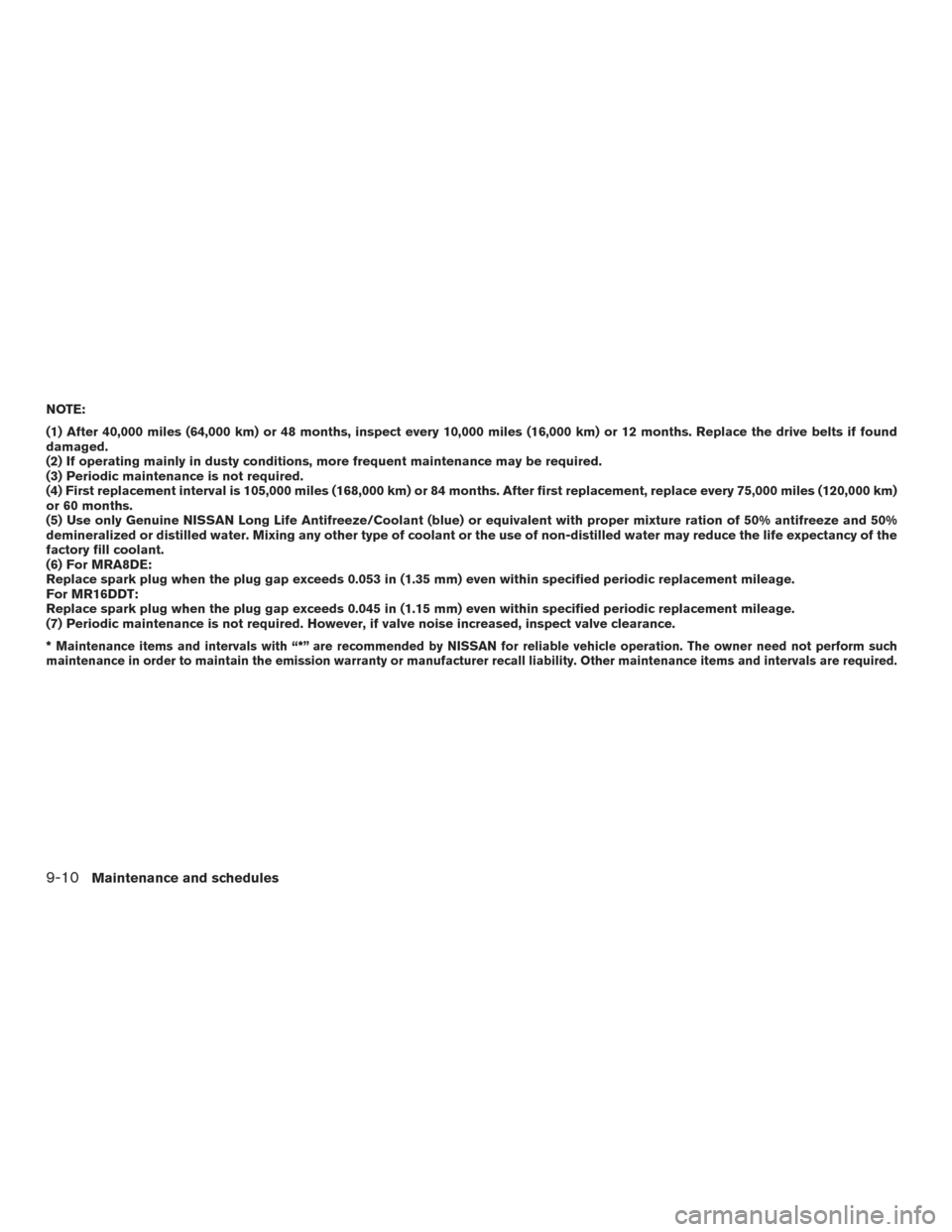
NOTE:
(1) After 40,000 miles (64,000 km) or 48 months, inspect every 10,000 miles (16,000 km) or 12 months. Replace the drive belts if found
damaged.
(2) If operating mainly in dusty conditions, more frequent maintenance may be required.
(3) Periodic maintenance is not required.
(4) First replacement interval is 105,000 miles (168,000 km) or 84 months. After first replacement, replace every 75,000 miles (120,000 km)
or 60 months.
(5) Use only Genuine NISSAN Long Life Antifreeze/Coolant (blue) or equivalent with proper mixture ration of 50% antifreeze and 50%
demineralized or distilled water. Mixing any other type of coolant or the use of non-distilled water may reduce the life expectancy of the
factory fill coolant.
(6) For MRA8DE:
Replace spark plug when the plug gap exceeds 0.053 in (1.35 mm) even within specified periodic replacement mileage.
For MR16DDT:
Replace spark plug when the plug gap exceeds 0.045 in (1.15 mm) even within specified periodic replacement mileage.
(7) Periodic maintenance is not required. However, if valve noise increased, inspect valve clearance.
* Maintenance items and intervals with “*” are recommended by NISSAN for reliable vehicle operation. The owner need not perform such
maintenance in order to maintain the emission warranty or manufacturer recall liability. Other maintenance items and intervals are required.
9-10Maintenance and schedules
Page 456 of 491
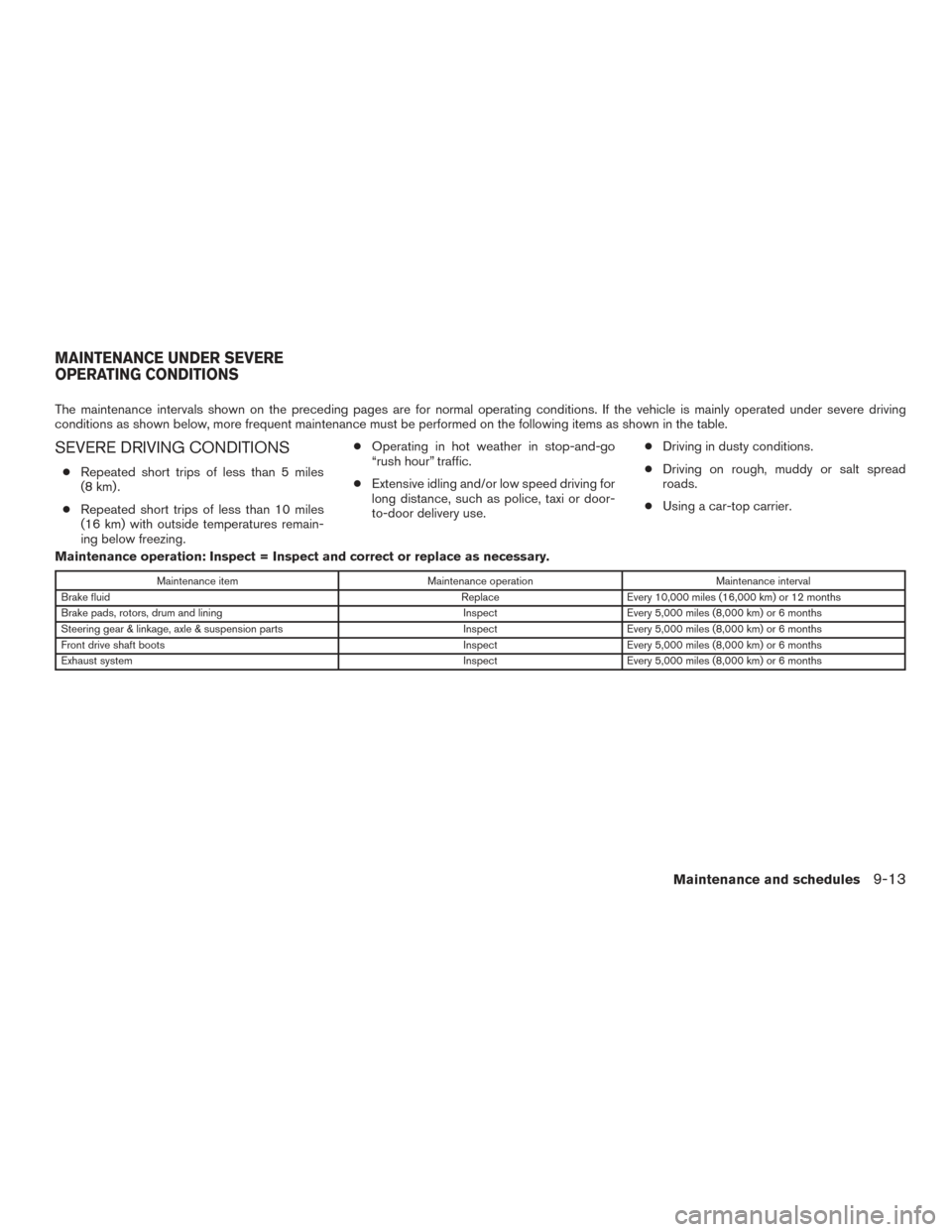
The maintenance intervals shown on the preceding pages are for normal operating conditions. If the vehicle is mainly operated under severe driving
conditions as shown below, more frequent maintenance must be performed on the following items as shown in the table.
SEVERE DRIVING CONDITIONS
●Repeated short trips of less than 5 miles
(8 km) .
● Repeated short trips of less than 10 miles
(16 km) with outside temperatures remain-
ing below freezing. ●
Operating in hot weather in stop-and-go
“rush hour” traffic.
● Extensive idling and/or low speed driving for
long distance, such as police, taxi or door-
to-door delivery use. ●
Driving in dusty conditions.
● Driving on rough, muddy or salt spread
roads.
● Using a car-top carrier.
Maintenance operation: Inspect = Inspect and correct or replace as necessary.
Maintenance item Maintenance operation Maintenance interval
Brake fluid ReplaceEvery 10,000 miles (16,000 km) or 12 months
Brake pads, rotors, drum and lining InspectEvery 5,000 miles (8,000 km) or 6 months
Steering gear & linkage, axle & suspension parts InspectEvery 5,000 miles (8,000 km) or 6 months
Front drive shaft boots InspectEvery 5,000 miles (8,000 km) or 6 months
Exhaust system InspectEvery 5,000 miles (8,000 km) or 6 months
MAINTENANCE UNDER SEVERE
OPERATING CONDITIONS
Maintenance and schedules9-13
Page 461 of 491
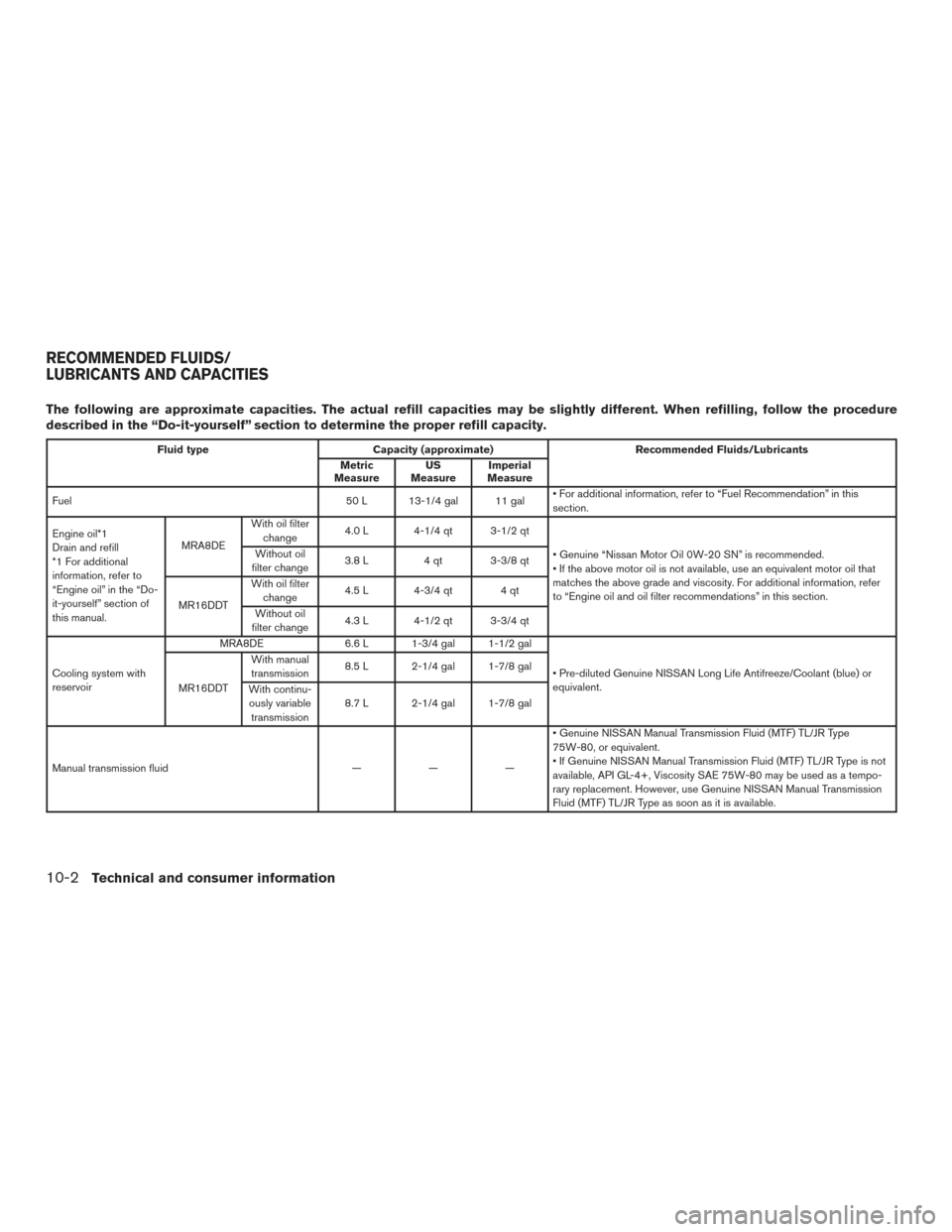
The following are approximate capacities. The actual refill capacities may be slightly different. When refilling, follow the procedure
described in the “Do-it-yourself” section to determine the proper refill capacity.
Fluid typeCapacity (approximate) Recommended Fluids/Lubricants
Metric
Measure US
Measure Imperial
Measure
Fuel 50 L 13-1/4 gal 11 gal• For additional information, refer to “Fuel Recommendation” in this
section.
Engine oil*1
Drain and refill
*1 For additional
information, refer to
“Engine oil” in the “Do-
it-yourself” section of
this manual. MRA8DE
With oil filter
change 4.0 L 4-1/4 qt 3-1/2 qt
• Genuine “Nissan Motor Oil 0W-20 SN” is recommended.
• If the above motor oil is not available, use an equivalent motor oil that
matches the above grade and viscosity. For additional information, refer
to “Engine oil and oil filter recommendations” in this section.
Without oil
filter change 3.8L 4qt 3-3/8qt
MR16DDT With oil filter
change 4.5 L 4-3/4 qt 4 qt
Without oil
filter change 4.3 L 4-1/2 qt 3-3/4 qt
Cooling system with
reservoir MRA8DE
6.6 L 1-3/4 gal 1-1/2 gal
• Pre-diluted Genuine NISSAN Long Life Antifreeze/Coolant (blue) or
equivalent.
MR16DDT With manual
transmission 8.5 L 2-1/4 gal 1-7/8 gal
With continu- ously variable transmission 8.7 L 2-1/4 gal 1-7/8 gal
Manual transmission fluid ———• Genuine NISSAN Manual Transmission Fluid (MTF) TL/JR Type
75W-80, or equivalent.
• If Genuine NISSAN Manual Transmission Fluid (MTF) TL/JR Type is not
available, API GL-4+, Viscosity SAE 75W-80 may be used as a tempo-
rary replacement. However, use Genuine NISSAN Manual Transmission
Fluid (MTF) TL/JR Type as soon as it is available.
RECOMMENDED FLUIDS/
LUBRICANTS AND CAPACITIES
10-2Technical and consumer information
Page 476 of 491
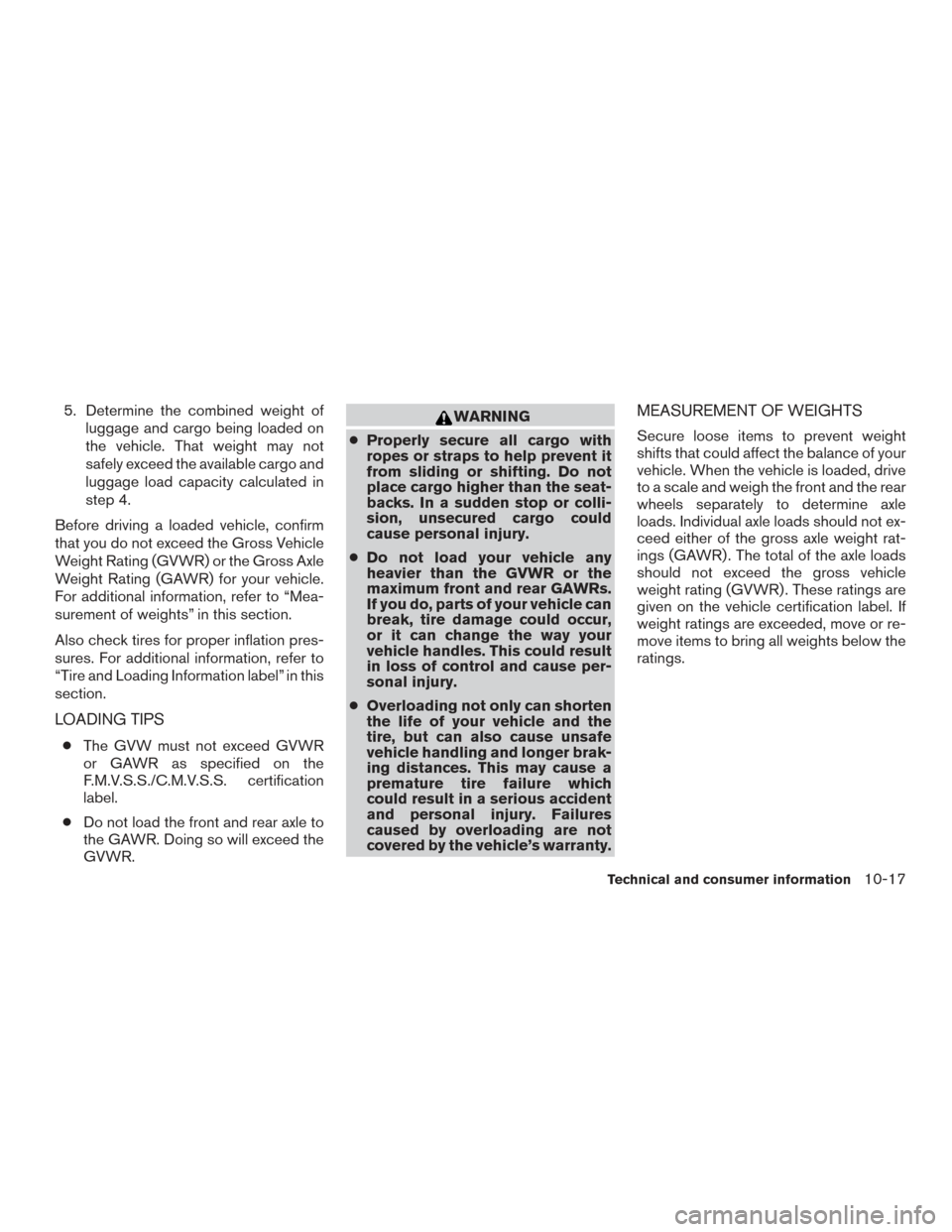
5. Determine the combined weight ofluggage and cargo being loaded on
the vehicle. That weight may not
safely exceed the available cargo and
luggage load capacity calculated in
step 4.
Before driving a loaded vehicle, confirm
that you do not exceed the Gross Vehicle
Weight Rating (GVWR) or the Gross Axle
Weight Rating (GAWR) for your vehicle.
For additional information, refer to “Mea-
surement of weights” in this section.
Also check tires for proper inflation pres-
sures. For additional information, refer to
“Tire and Loading Information label” in this
section.
LOADING TIPS
● The GVW must not exceed GVWR
or GAWR as specified on the
F.M.V.S.S./C.M.V.S.S. certification
label.
● Do not load the front and rear axle to
the GAWR. Doing so will exceed the
GVWR.
WARNING
● Properly secure all cargo with
ropes or straps to help prevent it
from sliding or shifting. Do not
place cargo higher than the seat-
backs. In a sudden stop or colli-
sion, unsecured cargo could
cause personal injury.
● Do not load your vehicle any
heavier than the GVWR or the
maximum front and rear GAWRs.
If you do, parts of your vehicle can
break, tire damage could occur,
or it can change the way your
vehicle handles. This could result
in loss of control and cause per-
sonal injury.
● Overloading not only can shorten
the life of your vehicle and the
tire, but can also cause unsafe
vehicle handling and longer brak-
ing distances. This may cause a
premature tire failure which
could result in a serious accident
and personal injury. Failures
caused by overloading are not
covered by the vehicle’s warranty.MEASUREMENT OF WEIGHTS
Secure loose items to prevent weight
shifts that could affect the balance of your
vehicle. When the vehicle is loaded, drive
to a scale and weigh the front and the rear
wheels separately to determine axle
loads. Individual axle loads should not ex-
ceed either of the gross axle weight rat-
ings (GAWR) . The total of the axle loads
should not exceed the gross vehicle
weight rating (GVWR) . These ratings are
given on the vehicle certification label. If
weight ratings are exceeded, move or re-
move items to bring all weights below the
ratings.
Technical and consumer information10-17