2017 NISSAN ROGUE tire type
[x] Cancel search: tire typePage 497 of 547
Engine coolant*:Replace coolant at the speci-
fied interval. When adding or replacing coolant,
be sure to use only Genuine NISSAN Long Life
Antifreeze/Coolant (blue) or equivalent with the
proper mixture. (For additional information on the
proper mixture for your area, refer to “Engine
cooling system” in the “Do-it-yourself” section of
this manual.)
NOTE: Mixing any other type of coolant or
the use of non-distilled water may reduce
the recommended service interval of the
coolant.
Engine oil and oil filter: Replace engine oil
and oil filter at the specified intervals. For recom-
mended oil grade and viscosity refer to “Recom-
mended fluids/lubricants and capacities” in the
“Technical and consumer information” section of
this manual.
Engine valve clearance*: Inspect only if valve
noise increase. Adjust valve clearance if neces-
sary.
Evaporative emissions control vapor lines*:
Check vapor lines for leaks or looseness. Tighten
connections or replace parts as necessary.
Fuel filter*: Periodic maintenance is not re-
quired. (in-tank type filter) Fuel lines*:
Check the fuel hoses, piping and
connections for leaks, looseness, or deteriora-
tion. Tighten connections or replace parts as
necessary.
Spark plugs: Replace at specified intervals. In-
stall new plugs of the same type as originally
equipped.
CHASSIS AND BODY
MAINTENANCE:
Brake lines and cables: Visually inspect for
proper installation. Check for chafing, cracks,
deterioration, and signs of leaking. Replace any
deteriorated or damaged parts immediately.
Brake pads and rotors: Check for wear, dete-
rioration and fluid leaks. Replace any deteriorated
or damaged parts immediately.
Exhaust system: Visually inspect the exhaust
pipes, muffler and hangers for leaks, cracks, de-
terioration, and damage. Tighten connections or
replace parts as necessary.
In-cabin microfilter: Replace at specified in-
tervals. When driving for prolonged periods in
dusty conditions, replace the filter more fre-
quently.
Propeller shaft(s): Check for damage, loose-
ness, and grease leakage. (AWD) Steering gear and linkage, axle and sus-
pension parts, drive shaft boots:
Check for
damage, looseness, and leakage of oil or grease.
Under severe driving conditions, inspect more
frequently.
Tire rotation: Tires should be rotated every
5,000 miles (8,000 km) according to the instruc-
tions under “Explanation of general maintenance
items” in this section. When rotating tires, check
for damage and uneven wear. Replace if neces-
sary.
Transmission fluid/oil, differential oil,
transfer case oil: Visually inspect for signs of
leakage at specified intervals.
If towing a trailer, using a camper or car-top
carrier, or driving on rough or muddy roads:
● Replace the fluid/oil every 20,000 miles
(32,000 km) or 24 months.
● Replace the CVT fluid every 60,000 miles
(96,000 km) or request the dealer to inspect
the fluid deterioration data using a CON-
SULT. If the deterioration data is more than
210000, replace the CVT fluid.
9-6Maintenance and schedules
Page 516 of 547
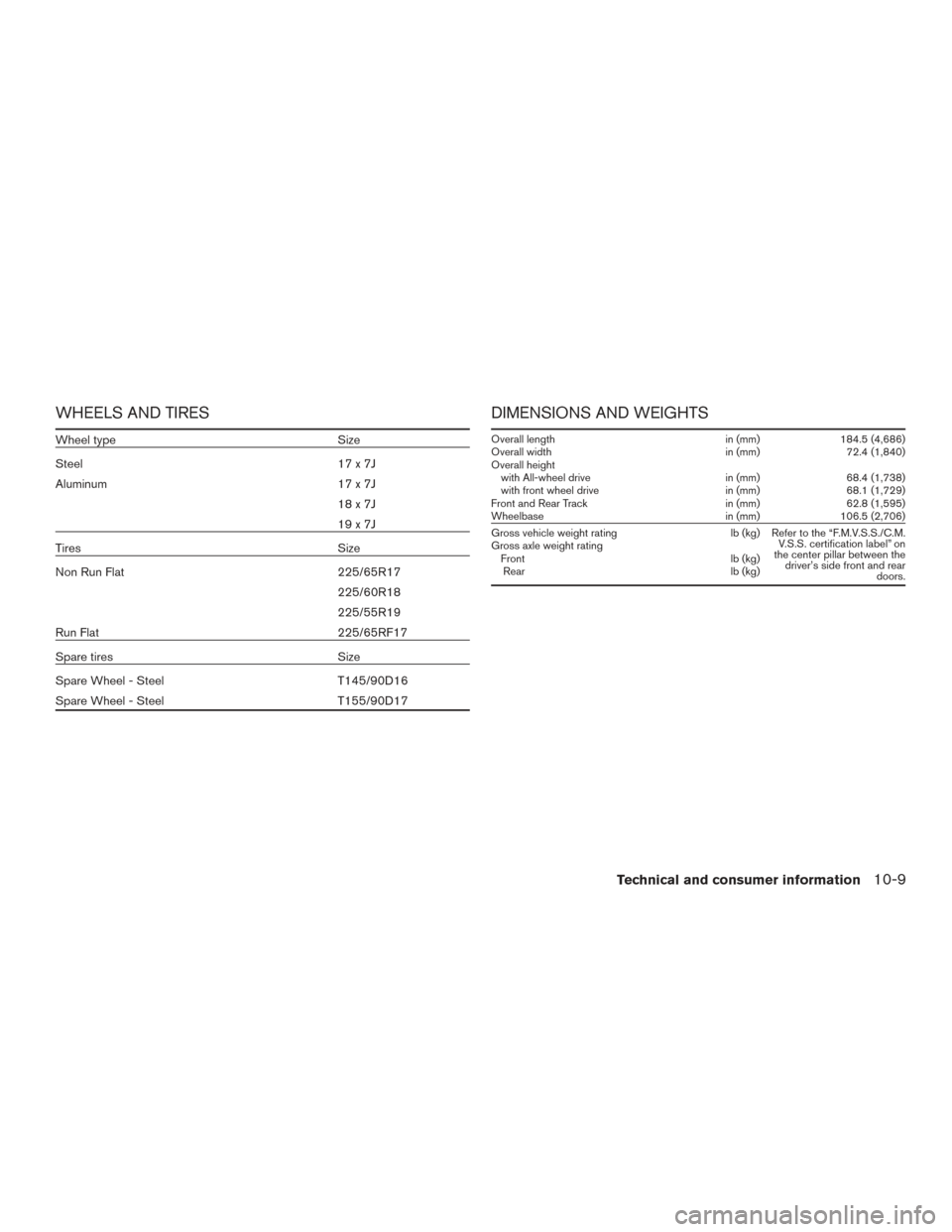
WHEELS AND TIRES
Wheel typeSize
Steel 17 x 7J
Aluminum 17 x 7J
18x7J
19x7J
Tires Size
Non Run Flat 225/65R17
225/60R18
225/55R19
Run Flat 225/65RF17
Spare tires Size
Spare Wheel - Steel T145/90D16
Spare Wheel - Steel T155/90D17
DIMENSIONS AND WEIGHTS
Overall lengthin (mm)184.5 (4,686)
Overall width in (mm)72.4 (1,840)
Overall height with All-wheel drive in (mm)68.4 (1,738)
with front wheel drive in (mm)68.1 (1,729)
Front and Rear Track in (mm)62.8 (1,595)
Wheelbase in (mm)106.5 (2,706)
Gross vehicle weight rating lb (kg) Refer to the “F.M.V.S.S./C.M.
V.S.S. certification label” on
the center pillar between the driver’s side front and rear doors.
Gross axle weight rating
Front lb (kg)
Rear lb (kg)
Technical and consumer information10-9
Page 522 of 547
Steps for determining correct load
limit
1. Locate the statement “The combinedweight of occupants and cargo
should never exceed XXX lbs or XXX
kg” on your vehicle’s Tire and Load-
ing Information label.
2. Determine the combined weight of the driver and passengers that will be
riding in your vehicle.
3. Subtract the combined weight of the driver and passengers from XXX lbs
or XXX kg.
4. The resulting figure equals the avail- able amount of cargo and luggage
load capacity. For example, if the
XXX amount equals 1,400 lbs. and
there will be five 150 lb. passengers
in your vehicle, the amount of avail-
able cargo and luggage load capac-
ity is 650 lbs. (1,400-750 (5 X 150)
= 650 lbs) or (640-340 (5 X 70) =
300 kg.) 5. Determine the combined weight of
luggage and cargo being loaded on
the vehicle. That weight may not
safely exceed the available cargo and
luggage load capacity calculated in
step 4.
6. If your vehicle will be towing a trailer, load from your trailer will be trans-
ferred to your vehicle. Consult this
manual to determine how this re-
duces the available cargo and lug-
gage load capacity of your vehicle.
Before driving a loaded vehicle, confirm
that you do not exceed the Gross Vehicle
Weight Rating (GVWR) or the Gross Axle
Weight Rating (GAWR) for your vehicle.
For additional information, refer to “Mea-
surement of weights” in this section.
Also check tires for proper inflation pres-
sures. For additional information, refer to
the “Tire and loading information label” in
this section.
SECURING THE LOAD
There are luggage hooks located in the cargo
area as shown. The hooks can be used to secure
cargo with ropes or other types of straps.
Do not apply a total load of more than
6.5 lbs. (29 N) to a single metal floor hook
when securing cargo.
Cargo area luggage hooks
LIC2629
Technical and consumer information10-15
Page 530 of 547
Trailer lights
CAUTION
When splicing into the vehicle electrical
system, a commercially available power-
type module/converter must be used to
provide power for all trailer lighting. This
unit uses the vehicle battery as a direct
power source for all trailer lights while
using the vehicle tail light, stoplight and
turn signal circuits as a signal source. The
module/converter must draw no more that
15 milliamps from the stop and tail lamp
circuits. Using a module/converter that
exceeds these power requirements may
damage the vehicle’s electrical system. It
is recommended that you visit a reputable
trailer retailer to obtain the proper equip-
ment and to have it installed.
Trailer lights should comply with federal and/or
local regulations. For assistance in hooking up
trailer lights, contact a NISSAN dealer or repu-
table trailer retailer. Vehicles equipped with the
optional trailer tow package are equipped with a
7-pin trailer harness connector. If your trailer is
equipped with a flat 4-pin connector, an adapter
will be needed to connect the trailer lights to the
vehicle. Adapters are available at auto parts
stores and hitch retailers.
Pre-towing tips
● Be certain your vehicle maintains a level
position when a loaded and/or unloaded
trailer is hitched. Do not drive the vehicle if it
has an abnormal nose-up or nose-down
condition; check for improper tongue load,
overload, worn suspension or other possible
causes of either condition.
● Always secure items in the trailer to prevent
load shift while driving.
● Keep the cargo load as low as possible in
the trailer to keep the trailer center of gravity
low.
● Load the trailer so approximately 60% of the
trailer load is in the front half and 40% is in
the back half. Also make sure the load is
balanced side to side.
● Check your hitch, trailer tire pressure, ve-
hicle tire pressure, trailer light operation, and
trailer wheel lug nuts every time you attach a
trailer to the vehicle.
● Be certain your rearview mirrors conform to
all federal, state or local regulations. If not,
install any mirrors required for towing before
driving the vehicle. ●
Determine the overall height of the vehicle
and trailer so the required clearance is
known.
Trailer towing tips
In order to gain skill and an understanding of the
vehicle’s behavior, you should practice turning,
stopping and backing up in an area which is free
from traffic. Steering stability and braking perfor-
mance will be somewhat different than under
normal driving conditions.
● Always secure items in the trailer to prevent
load shift while driving.
● Lock the trailer hitch coupler with a pin or
lock to prevent the coupler from inadver-
tently becoming unlatched.
● Avoid abrupt starts, acceleration or stops.
● Avoid sharp turns or lane changes.
● Always drive your vehicle at a moderate
speed.
● When backing up, hold the bottom of the
steering wheel with one hand. Move your
hand in the direction in which you want the
trailer to go. Make small corrections and
back up slowly. If possible, have someone
guide you when you are backing up.
Technical and consumer information10-23
Page 544 of 547
Foglightswitch ...............2-46
Hazard warning flasher switch........6-2
Headlight aiming control .......2-43,2-44
Headlight and turn signal switch ......2-39
Headlight control switch ..........2-39
Ignition switch ................5-13
Instrument brightness control ........2-45
Power door lock switch ............3-6
Rear window and outside mirror defroster
switch.....................2-38
Rear window wiper and washer
switches ...................2-37
Turnsignalswitch..............2-45
Vehicle dynamic control (VDC) off
switch.....................2-50
T
Tachometer ....................2-6
Temperature gauge Engine coolant temperature gauge .....2-6
Theft (NISSAN Vehicle Immobilizer System) ,
engine start .............2-35,5-14,5-17
Three-way catalyst ................5-4
Tire Flat tire .....................6-3
Spare tire ................6-5,8-41
TireandLoadingInformationlabel ....10-12
Tire chains ..................8-37
Tirepressure.................8-29
Tire rotation..................8-38
Types of tires .................8-35
Uniform tire quality grading ........10-26Wheels and tires
...............8-29
Wheel/tire size ................10-9
Tire pressure Low tire pressure warning light .......2-13
Tire Pressure Monitoring System (TPMS) ....5-5
Top tether strap child restraint .........1-30
Towing Flattowing.................10-25
Towing load/specification .........10-20
Towtrucktowing...............6-14
Trailer towing ................10-17
Towing a trailer .................10-17
Transceiver HomeLink® Universal
Transceiver ....2-69,2-70,2-71,2-72,2-72
Transmission Continuously Variable Transmission (CVT)
fluid.......................8-9
Driving with Continuously Variable
Transmission (CVT) .............5-20
Travel (See registering a vehicle in another
country) .....................10-10
Trip odometer ...................2-5
Troubleshooting guide (NISSAN voice recognition
system) .....................4-107
Turn signal switch ................2-45
U
Uniform tire quality grading ..........10-26
USB interface ...............4-63,4-65
Audio file operation ..........4-64,4-66 V
Vanity mirror ...................3-38
Variable voltage control system .........8-13
Vehicle dimensions and weights ........10-9
Vehicle dynamic control (VDC) off switch . . .2-50
Vehicle Dynamic Control (VDC) system . . .5-105
Vehicle identification ..............10-10
Vehicle identification number (VIN) ......10-10
Vehicle identification number (VIN)
(Chassis number) ...............10-10
Vehicle identification number (VIN) plate . . .10-10
Vehicle immobilizer system ....2-35,5-14,5-17
Vehicle Information Display ...........2-20
Vehicle loading information ..........10-13
Vehicle recovery ..............6-16,6-17
V
ehicle security system .............2-34
Vehicle security system (NISSAN Vehicle Immobi-
lizer System) , engine start .....2-35,5-14,5-17
Ventilators ....................4-32
Visors.......................3-38
Voice Prompt Interrupt ..........4-84,4-96
Voice recognition system ...........4-103
W
Warning Airbagwarninglight.........1-64,2-16
Anti-lock brake warning light ........2-12
Battery charge warning light ........2-13
Blind Spot Warning (BSW) warning
light......................5-37
Brake warning light .............2-12
Hazard warning flasher switch ........6-2
11-7