2017 NISSAN QUEST service
[x] Cancel search: servicePage 63 of 520
1-44Safety — Seats, seat belts and supplemental restraint system
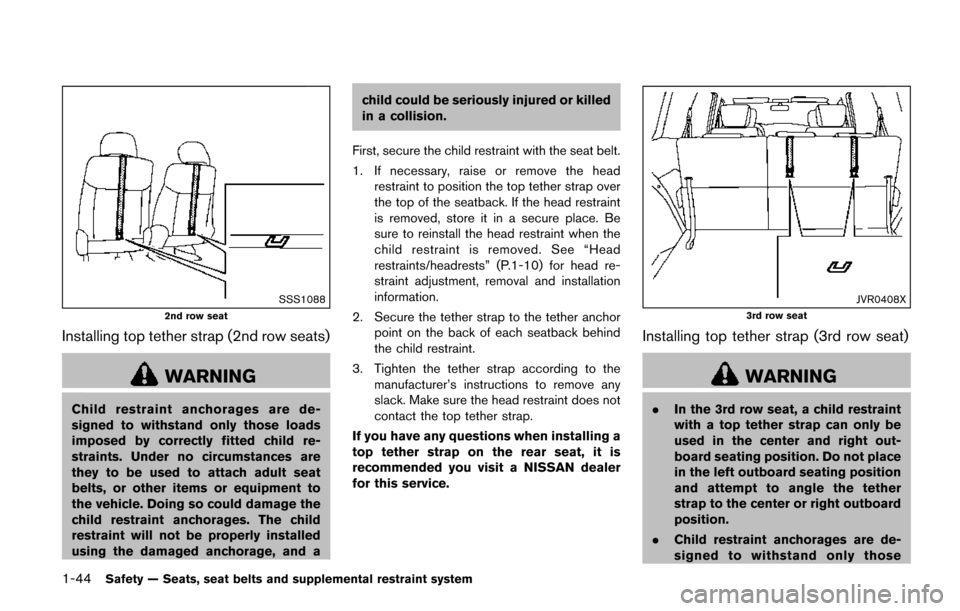
SSS1088
2nd row seat
Installing top tether strap (2nd row seats)
WARNING
Child restraint anchorages are de-
signed to withstand only those loads
imposed by correctly fitted child re-
straints. Under no circumstances are
they to be used to attach adult seat
belts, or other items or equipment to
the vehicle. Doing so could damage the
child restraint anchorages. The child
restraint will not be properly installed
using the damaged anchorage, and achild could be seriously injured or killed
in a collision.
First, secure the child restraint with the seat belt.
1. If necessary, raise or remove the head restraint to position the top tether strap over
the top of the seatback. If the head restraint
is removed, store it in a secure place. Be
sure to reinstall the head restraint when the
child restraint is removed. See “Head
restraints/headrests” (P.1-10) for head re-
straint adjustment, removal and installation
information.
2. Secure the tether strap to the tether anchor point on the back of each seatback behind
the child restraint.
3. Tighten the tether strap according to the manufacturer’s instructions to remove any
slack. Make sure the head restraint does not
contact the top tether strap.
If you have any questions when installing a
top tether strap on the rear seat, it is
recommended you visit a NISSAN dealer
for this service.
JVR0408X
3rd row seat
Installing top tether strap (3rd row seat)
WARNING
. In the 3rd row seat, a child restraint
with a top tether strap can only be
used in the center and right out-
board seating position. Do not place
in the left outboard seating position
and attempt to angle the tether
strap to the center or right outboard
position.
. Child restraint anchorages are de-
signed to withstand only those
Page 64 of 520
loads imposed by correctly fitted
child restraints. Under no circum-
stances are they to be used to
attach adult seat belts, or other
items or equipment to the vehicle.
Doing so could damage the child
restraint anchorages. The child re-
straint will not be properly installed
using the damaged anchorage, and
a child could be seriously injured or
killed in a collision.
The center and right side positions of the 3rd
row seat are the seating positions that can use a
top tether strap.
First, secure the child restraint with the seat belt.
1. Position the top tether strap over the top of the center or right outboard seating position
seatback.
2. Secure the tether strap to the tether anchor point on the seatback behind the child
restraint.
3. Refer to the appropriate child restraint installation procedure steps in this section
before tightening the tether strap.
If you have any questions when installing a
top tether strap child restraint on the rear
seat, it is recommended you visit a NISSAN dealer for this service.BOOSTER SEATS
Precautions on booster seats
WARNING
If a booster seat and seat belt are not
used properly, the risk of a child being
injured in a sudden stop or collision
greatly increases:
.
Make sure the shoulder portion of
the belt is away from the child’s face
and neck and the lap portion of the
belt does not cross the stomach.
. Make sure the shoulder belt is not
behind the child or under the child ’s
arm.
. A booster seat must only be in-
stalled in a seating position that has
a lap/shoulder belt.
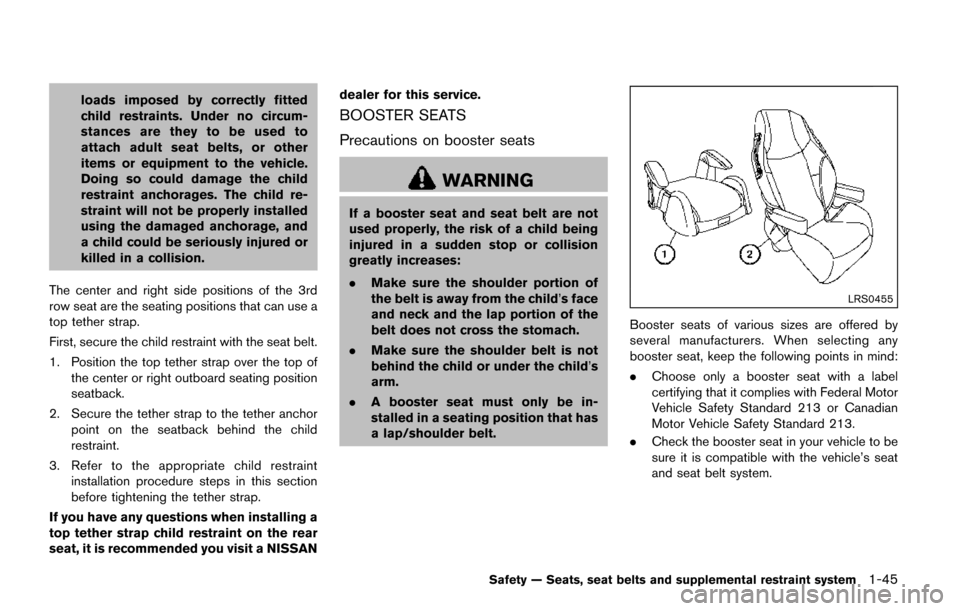
LRS0455
Booster seats of various sizes are offered by
several manufacturers. When selecting any
booster seat, keep the following points in mind:
.Choose only a booster seat with a label
certifying that it complies with Federal Motor
Vehicle Safety Standard 213 or Canadian
Motor Vehicle Safety Standard 213.
. Check the booster seat in your vehicle to be
sure it is compatible with the vehicle’s seat
and seat belt system.
Safety — Seats, seat belts and supplemental restraint system1-45
Page 76 of 520
restrains and to use the ALR mode may allow
the restraint to tip or move in an accident or
sudden stop. This can also result in the
passenger air bag inflating in a crash instead
of being OFF. (See “Child restraints” (P.1-27)
for proper use and installation.)
If the front passenger seat is not occupied, the
passenger air bag is designed not to inflate in a
crash. However, heavy objects placed on the
seat could result in air bag inflation, because of
the object being detected by the occupant
classification sensors. Other conditions could
also result in air bag inflation, such as if a child is
standing on the seat, or if two children are on the
seat, contrary to the instructions in this manual.
Always be sure that you and all vehicle
occupants are seated and restrained properly.
Using the front passenger air bag status light,
you can monitor when the front passenger air
bag is automatically turned OFF with the seat
occupied. The light will not illuminate when the
front passenger seat is unoccupied.
If an adult occupant is in the seat but the front
passenger air bag status light is illuminated
(indicating that the air bag is OFF) , it could be
that the person is a small adult, or is not sitting
on the seat properly.
If a child restraint must be used in the front seat,
the front passenger air bag status light may ormay not be illuminated, depending on the size of
the child and the type of child restraint being
used. If the front passenger air bag status light is
not illuminated (indicating that the air bag might
inflate in a crash) , it could be that the child
restraint or seat belt is not being used properly.
Make sure that the child restraint is installed
properly, the seat belt is used properly and the
occupant is positioned properly. If the front
passenger air bag status light is still not
illuminated, reposition the occupant or child
restraint in a rear seat.
If the front passenger air bag status light will not
illuminate even though you believe that the child
restraint, the seat belts and the occupant are
properly positioned, the system may be sensing
an unoccupied seat (in which case the air bag is
OFF) . Your NISSAN dealer can check that the
system is OFF by using a special tool. However,
until you have confirmed with your dealer that
your air bag is working properly, reposition the
occupant or child restraint in a rear seat.
The NISSAN Advanced Air Bag System and the
front passenger air bag status light will take a
few seconds to register a change in the
passenger seat status. However, if the seat
becomes unoccupied, the front passenger air
bag status light will remain off.
If a malfunction occurs in the front passenger air
bag system, the supplemental air bag warning
light, located in the meter and gauges area
will blink. Have the system checked. It is
recommended you visit a NISSAN dealer for
this service.
Normal operation:
In order for the occupant classification sensor
system to classify the front passenger based on
weight, please follow the precautions and steps
outlined below:
Precautions:
. Make sure that there are no objects weigh-
ing over 9.1 lbs. (4 kg) hanging on the seat
or placed in the seatback pocket.
. Make sure that a child restraint or other
object is not pressing against the rear of the
seatback.
. Make sure that a rear passenger is not
pushing or pulling on the back of the front
passenger seat.
. Make sure that the front passenger seat or
seatback is not forced back against an
object on the seat or floor behind it.
. Make sure that there is no object placed
under the front passenger seat.
Safety — Seats, seat belts and supplemental restraint system1-57
Page 77 of 520
1-58Safety — Seats, seat belts and supplemental restraint system
Steps:
1. Adjust the seat as outlined. (See “Seats”(P.1-2) .) Sit upright, leaning against the
seatback, and centered on the seat cushion
with your feet comfortably extended to the
floor.
2. Make sure there are no objects on your lap.
3. Fasten the seat belt as outlined. (See “Seat belts” (P.1-15) .)
4. Remain in this position for 30 seconds allowing the system to classify the front
passenger before the vehicle is put into
motion.
5. Ensure proper classification by checking the front passenger air bag status light.
NOTE:
This vehicle’s occupant classification sen-
sor system locks the classification during
driving so it is important that you confirm
that the front passenger is properly classi-
fied prior to driving. Also, the occupant
classification sensor system may recalcu-
late the weight of the occupant when the
vehicle comes to a stop (i.e. stop light, stop
sign, etc.) , so the front passenger seat
occupant should continue to remain
seated as outlined above. Troubleshooting:
If you think the front passenger air bag status
light is incorrect:
1. If the light is ON with no front passenger and no
objects on the front passenger seat:
This may be due to the following conditions that
may be interfering with the weight sensors:
.An object weighing over 9.1 lbs. (4 kg)
hanging on the seat or placed in the
seatback pocket.
. A child restraint or other object pressing
against the rear of the seatback.
. A rear passenger pushing or pulling on the
back of the front passenger seat.
. Forcing the front seat or seatback against an
object on the seat or floor behind it.
. An object placed under the front passenger
seat.
. An object placed between the seat cushion
and center console or between the seat
cushion and the door.
If the vehicle is moving, please come to a stop
when it is safe to do so. Check and correct any
of the above conditions. Restart the vehicle and
wait 1 minute.
NOTE:
A system check will be performed during
which the front passenger air bag status light will remain lit for about 7 seconds
initially.
If the light is still ON after this, the vehicle should
be checked as soon as possible. It is recom-
mended you visit a NISSAN dealer for this
service.2. If the light is ON with an adult occupying the
front passenger seat:
.Occupant is a small adult — the front
passenger air bag status light is functioning
as intended. The front passenger air bag is
suppressed.
However, if the occupant is not a small adult,
then this may be due to the following conditions
that may be interfering with the weight sensors:
. Occupant is not sitting upright, leaning
against the seatback, and centered on the
seat cushion with his/her feet comfortably
extended to the floor.
. A child restraint or other object pressing
against the rear of the seatback.
. A rear passenger pushing or pulling on the
back of the front passenger seat.
. Forcing the front seat or seatback against an
object on the seat or floor behind it.
. An object placed under the front passenger
seat.
Page 78 of 520
.An object placed between the seat cushion
and center console or between the seat
cushion and the door.
If the vehicle is moving, please come to a stop
when it is safe to do so. Check and correct any
of the above conditions. Restart the vehicle and
wait 1 minute.
NOTE:
A system check will be performed during
which the front passenger air bag status
light will remain lit for about 7 seconds
initially.
If the light is still ON after this, the person should
be advised not to ride in the front passenger
seat and the vehicle should be checked as soon
as possible. It is recommended you visit a
NISSAN dealer for this service.
3. If the light is OFF with a small adult, child or child restraint occupying the front passenger seat.
This may be due to the following conditions that
may be interfering with the weight sensors:
.Small adult or child is not sitting upright,
leaning against the seatback, and centered
on the seat cushion with his/her feet
comfortably extended to the floor.
. The child restraint is not properly installed as
outlined. (See “Child restraints” (P.1-27) .) .
An object weighing over 9.1 lbs. (4 kg)
hanging on the seat or placed in the
seatback pocket.
. A child restraint or other object pressing
against the rear of the seatback.
. A rear passenger pushing or pulling on the
back of the front passenger seat.
. Forcing the front seat or seatback against an
object on the seat or floor behind it.
. An object placed under the front passenger
seat.
. An object placed between the seat cushion
and center console.
If the vehicle is moving, please come to a stop
when it is safe to do so. Check and correct any
of the above conditions. Restart the vehicle and
wait 1 minute.
NOTE:
A system check will be performed during
which the front passenger air bag status
light will remain lit for about 7 seconds
initially.
If the light is still OFF after this, the small adult,
child or child restraint should be repositioned in
the rear seat and the vehicle should be checked
as soon as possible. It is recommended you visit
a NISSAN dealer for this service.
Other supplemental front-impact air bag
precautions
WARNING
. Do not place any objects on the
steering wheel pad or on the instru-
ment panel. Also, do not place any
objects between any occupant and
the steering wheel or instrument
panel. Such objects may become
dangerous projectiles and cause
injury if the front air bags inflate.
. Do not place objects with sharp
edges on the seat. Also, do not
place heavy objects on the seat that
will leave permanent impressions in
the seat. Such objects can damage
the seat or occupant classification
sensors (weight sensors) . This can
affect the operation of the air bag
system and result in serious perso-
nal injury.
. Do not use water or acidic cleaners
(hot steam cleaners) on the seat.
This can damage the seat or occu-
pant classification sensors. This can
also affect the operation of the air
bag system and result in serious
Safety — Seats, seat belts and supplemental restraint system1-59
Page 81 of 520
1-62Safety — Seats, seat belts and supplemental restraint system
.Right after inflation, several side air
bags and curtain air bag system
components will be hot. Do not
touch them; you may severely burn
yourself.
. No unauthorized changes should be
made to any components or wiring
of side air bag and curtain air bags.
This is to prevent damage to or
accidental inflation of the side air
bag and curtain air bag systems.
. Do not make unauthorized changes
to your vehicle’s electrical system,
suspension system or side panel.
This could affect proper operation
of the side air bag and curtain air
bag systems.
. Tampering with the air bag system
may result in serious personal in-
jury. For example, do not change the
front seats by placing material near
the seatback or by installing addi-
tional trim material, such as seat
covers, around the side air bags.
. It is recommended you visit a
NISSAN dealer for work on and
around the side air bag and curtain
air bag systems. It is also recom-
mended you visit a NISSAN dealer for installation of electrical equip-
ment. The Supplemental Restraint
System (SRS) wiring harnesses*
should not be modified or discon-
nected. Unauthorized electrical test
equipment and probing devices
should not be used on the side-
impact air bag system.
*
The SRS wiring harness connectors are
yellow and orange for easy identification.
When selling your vehicle, we request that you
inform the buyer about the side air bag and
curtain air bag systems and guide the buyer to
the appropriate sections in this Owner’s Manual.
SEAT BELTS WITH PRETENSIONERS
(front seats)
WARNING
.The pretensioners cannot be reused
after activation. They must be re-
placed together with the retractor
and buckle as a unit.
. If the vehicle becomes involved in a
collision but a pretensioner is not
activated, be sure to have the pre-
tensioner system checked and, if
necessary replaced. It is recom- mended you visit a NISSAN dealer
for this service.
. No unauthorized changes should be
made to any components or wiring
of the pretensioner system. This is
to prevent damage to or accidental
activation of the pretensioners.
Tampering with the pretensioner
system may result in serious perso-
nal injury.
. It is recommended you visit a
NISSAN dealer for work on and
around the pretensioner system. It
is also recommended you visit a
NISSAN dealer for installation of
electrical equipment. Unauthorized
electrical test equipment and prob-
ing devices should not be used on
the pretensioner system.
. If you need to dispose of a preten-
sioner or scrap the vehicle, it is
recommended you visit a NISSAN
dealer for this service. Correct pre-
tensioner disposal procedures are
set forth in the appropriate NISSAN
Service Manual. Incorrect disposal
procedures could cause personal
injury.
Page 82 of 520
The pretensioner system may activate with the
supplemental air bag system in certain types of
collisions. Working with the seat belt retractor, it
helps tighten the seat belt when the vehicle
becomes involved in certain types of collisions,
helping to restrain front seat occupants.
The pretensioner is encased with the seat belt
retractor. These seat belts are used the same
way as conventional seat belts.
When a pretensioner activates, smoke is re-
leased and a loud noise may be heard. The
smoke is not harmful, and it does not indicate a
fire. Care should be taken not to inhale it as it
may cause irritation and choking. Those with a
history of a breathing condition should get fresh
air promptly.
After pretensioner activation, load limiters allow
the seat belt to release webbing (if necessary) to
reduce forces against the chest.
The supplemental air bag warning light
is
used to indicate malfunctions in the pretensioner
system. (See “Supplemental air bag warning
light” (P.1-64) for more details.) If the operation
of the supplemental air bag warning light
indicates there is a malfunction, have the system
checked. It is recommended you visit a NISSAN
dealer for this service.
When selling your vehicle, we request that you
inform the buyer about the pretensioner system and guide the buyer to the appropriate sections
in this Owner’s Manual.
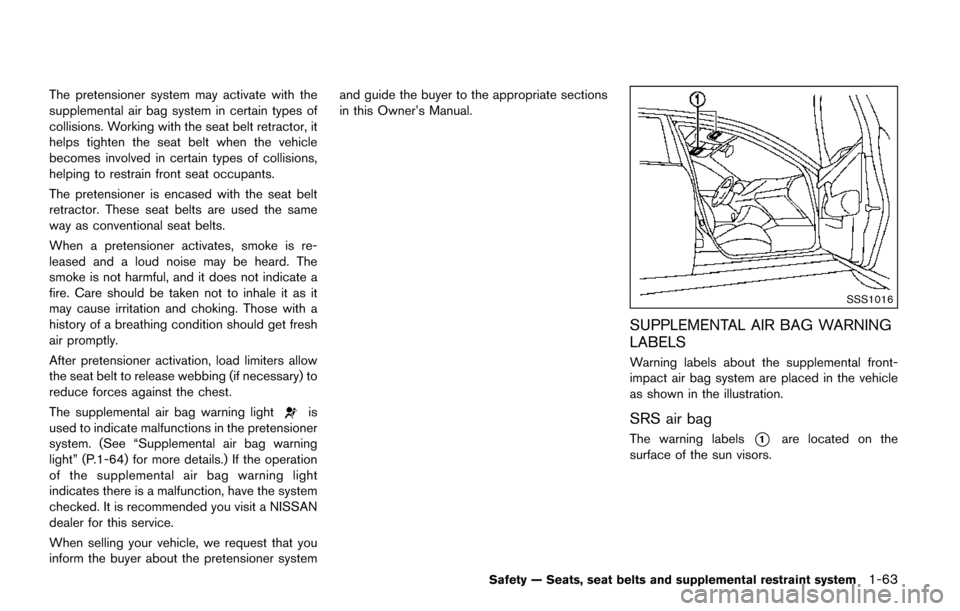
SSS1016
SUPPLEMENTAL AIR BAG WARNING
LABELS
Warning labels about the supplemental front-
impact air bag system are placed in the vehicle
as shown in the illustration.
SRS air bag
The warning labels*1are located on the
surface of the sun visors.
Safety — Seats, seat belts and supplemental restraint system1-63
Page 83 of 520
1-64Safety — Seats, seat belts and supplemental restraint system
SPA1097
SUPPLEMENTAL AIR BAG WARNING
LIGHT
The supplemental air bag warning light, display-
ingin the instrument panel, monitors the
circuits for the air bag systems, pretensioners
and all related wiring.
When the ignition switch is in the ON position,
the supplemental air bag warning light illumi-
nates for about 7 seconds and then turns off.
This means the SRS air bag systems are
operational. If any of the following conditions occur, the air
bag and/or pretensioner systems need servi-
cing:
.
The supplemental air bag warning light
remains on approximately 7 seconds after
the ignition switch is pushed to the ON
position.
. The supplemental air bag warning light
flashes intermittently.
. The supplemental air bag warning light does
not come on at all.
Under these conditions, the air bag and/or
pretensioner systems may not operate properly.
They must be checked and repaired. It is
recommended you visit a NISSAN dealer for
this service.WARNING
If the supplemental air bag warning
light is on, it could mean that the front
air bag, side air bag and curtain air bag
and/or pretensioner systems will not
operate in an accident. To help avoid
injury to yourself or others, have your
vehicle checked as soon as possible. It
is recommended you visit a NISSAN
dealer for this service.
REPAIR AND REPLACEMENT PRO-
CEDURE
The front air bags, side air bags and curtain air
bags and pretensioners are designed to activate
on a one-time-only basis. As a reminder, unless
it is damaged, the supplemental air bag warning
light will remain illuminated after inflation has
occurred. These systems should be repaired
and/or replaced as soon as possible. It is
recommended you visit a NISSAN dealer for
this service.
When maintenance work is required on the
vehicle, the front air bags, side air bags and
curtain air bags, pretensioners and related parts
should be pointed out to the person conducting
the maintenance. The ignition switch should
always be in the LOCK position when working
under the hood or inside the vehicle.
WARNING
. Once a front air bag, side air bag or
curtain air bag has inflated, the air
bag module will not function again
and must be replaced. Additionally,
the activated pretensioner must
also be replaced. The air bag mod-
ule and pretensioner should be
replaced. It is recommended you