2017 NISSAN QUEST light
[x] Cancel search: lightPage 20 of 520

1 Safety — Seats, seat belts and supplementalrestraint system
Seats ........................................................................\
.................... 1-2
Front seats ........................................................................\
.... 1-3
2nd row seats ...................................................................... 1-6
3rd row seats ....................................................................... 1-7
Armrests ........................................................................\
........ 1-7
Flexible seating .................................................................... 1-8
Head restraints/headrests .................................................... 1-10 Adjustable head restraint/headrest components ..... 1-11
Non-adjustable head
restraint/headrest components ..................................... 1-12
Remove ........................................................................\
....... 1-12
Install ........................................................................\
........... 1-12
Adjust ........................................................................\
.......... 1-13
Front-seat Active Head Restraint ................................. 1-14
Seat belts ........................................................................\
......... 1-15 Precautions on seat belt usage .................................... 1-15
Pregnant women .............................................................. 1-17
Injured persons ................................................................. 1-17
Three-point type seat belt .............................................. 1-17
Seat belt extenders .......................................................... 1-23
Seat belt maintenance .................................................... 1-24
Child safety ........................................................................\
...... 1-24 Infants ........................................................................\
.......... 1-25
Small children .................................................................... 1-25
Larger children .................................................................. 1-26 Child restraints ....................................................................... 1-27
Precautions on child restraints ................................... 1-27
Lower Anchors and Tethers for CHildren
System (LATCH) ............................................................ 1-29
Top tether strap child restraint ................................... 1-32
Rear-facing child restraint installation
using LATCH ................................................................... 1-32
Rear-facing child restraint installation using the
seat belts ........................................................................\
.. 1-34
Forward-facing child restraint installation
using LATCH ................................................................... 1-37
Forward-facing child restraint installation using the
seat belt ........................................................................\
.... 1-40
Booster seats .................................................................. 1-45
Supplemental restraint system ........................................... 1-48 Precautions on supplemental restraint system ....... 1-48
NISSAN advanced air bag system (front seats) ..... 1-54
Front seat-mounted side-impact supplemental
air bag and roof-mounted curtain side-impact
supplemental air bag systems .................................... 1-61
Seat belts with pretensioners (front seats) ............. 1-62
Supplemental air bag warning labels ....................... 1-63
Supplemental air bag warning light .......................... 1-64
Repair and replacement procedure .......................... 1-64
Page 35 of 520
1-16Safety — Seats, seat belts and supplemental restraint system
WARNING
.Every person who drives or rides in
this vehicle should use a seat belt at
all times. Children should be prop-
erly restrained in the rear seat and,
if appropriate, in a child restraint.
. The seat belt should be properly
adjusted to a snug fit. Failure to do
so may reduce the effectiveness of
the entire restraint system and in-
crease the chance or severity of
injury in an accident. Serious injury
or death can occur if the seat belt is
not worn properly.
. Always route the shoulder belt over
your shoulder and across your
chest. Never put the belt behind
your back, under your arm or across
your neck. The belt should be away
from your face and neck, but not
falling off your shoulder.
. Position the lap belt as low and
snug as possible AROUND THE
HIPS, NOT THE WAIST. A lap belt
worn too high could increase the
risk of internal injuries in an acci-
dent. .
Be sure the seat belt tongue is
securely fastened to the proper
buckle.
. Do not wear the seat belt inside out
or twisted. Doing so may reduce its
effectiveness.
. Do not allow more than one person
to use the same seat belt.
. Never carry more people in the
vehicle than there are seat belts.
. If the seat belt warning light glows
continuously while the ignition is
turned ON with all doors closed and
all seat belts fastened, it may in-
dicate a malfunction in the system.
Have the system checked. It is
recommended you visit a NISSAN
dealer for this service.
. No changes should be made to the
seat belt system. For example, do
not modify the seat belt, add mate-
rial or install devices that may
change the seat belt routing or
tension. Doing so may affect the
operation of the seat belt system.
Modifying or tampering with the
seat belt system may result in
serious personal injury. .
Once a seat belt pretensioner has
activated, it cannot be reused and
must be replaced together with the
retractor. It is recommended you
visit a NISSAN dealer for this ser-
vice.
. All seat belt assemblies, including
retractors and attaching hardware,
should be inspected after any colli-
sion. It is recommended you visit a
NISSAN dealer for this service.
NISSAN recommends that all seat
belt assemblies in use during a
collision be replaced unless the
collision was minor and the belts
show no damage and continue to
operate properly.
Seat belt assemblies not in use
during a collision should also be
inspected and replaced if either
damage or improper operation is
noted.
. All child restraints and attaching
hardware should be inspected after
any collision. Always follow the
restraint manufacturer’s inspection
instructions and replacement re-
commendations. The child restraints
should be replaced if they are
Page 53 of 520
1-34Safety — Seats, seat belts and supplemental restraint system
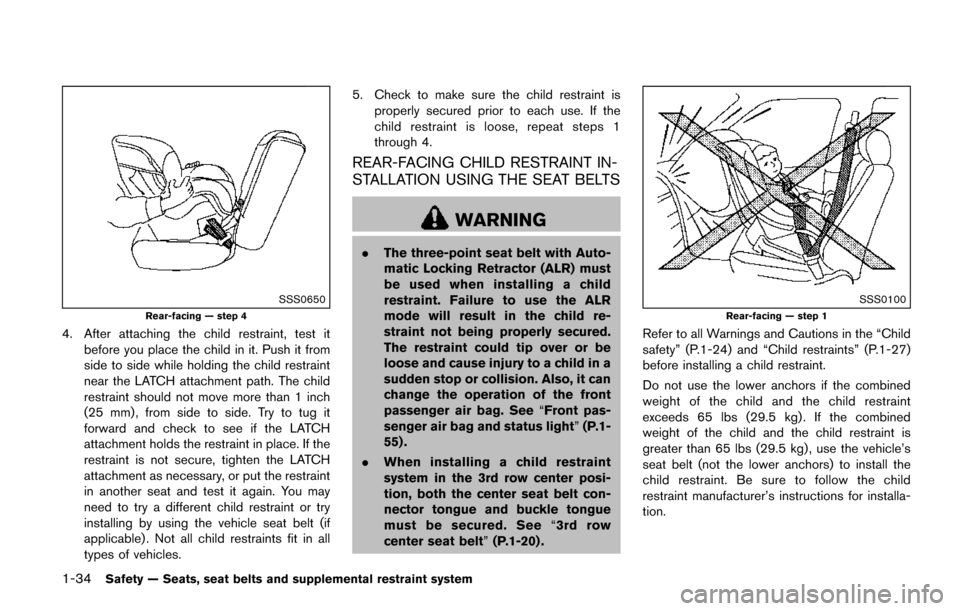
SSS0650
Rear-facing — step 4
4. After attaching the child restraint, test itbefore you place the child in it. Push it from
side to side while holding the child restraint
near the LATCH attachment path. The child
restraint should not move more than 1 inch
(25 mm) , from side to side. Try to tug it
forward and check to see if the LATCH
attachment holds the restraint in place. If the
restraint is not secure, tighten the LATCH
attachment as necessary, or put the restraint
in another seat and test it again. You may
need to try a different child restraint or try
installing by using the vehicle seat belt (if
applicable) . Not all child restraints fit in all
types of vehicles. 5. Check to make sure the child restraint is
properly secured prior to each use. If the
child restraint is loose, repeat steps 1
through 4.
REAR-FACING CHILD RESTRAINT IN-
STALLATION USING THE SEAT BELTS
WARNING
.The three-point seat belt with Auto-
matic Locking Retractor (ALR) must
be used when installing a child
restraint. Failure to use the ALR
mode will result in the child re-
straint not being properly secured.
The restraint could tip over or be
loose and cause injury to a child in a
sudden stop or collision. Also, it can
change the operation of the front
passenger air bag. See “Front pas-
senger air bag and status light ”(P.1-
55) .
. When installing a child restraint
system in the 3rd row center posi-
tion, both the center seat belt con-
nector tongue and buckle tongue
must be secured. See “3rd row
center seat belt” (P.1-20) .
SSS0100
Rear-facing — step 1
Refer to all Warnings and Cautions in the “Child
safety” (P.1-24) and “Child restraints” (P.1-27)
before installing a child restraint.
Do not use the lower anchors if the combined
weight of the child and the child restraint
exceeds 65 lbs (29.5 kg) . If the combined
weight of the child and the child restraint is
greater than 65 lbs (29.5 kg) , use the vehicle’s
seat belt (not the lower anchors) to install the
child restraint. Be sure to follow the child
restraint manufacturer’s instructions for installa-
tion.
Page 59 of 520
1-40Safety — Seats, seat belts and supplemental restraint system
child restraints. Under no circum-
stances are they to be used to
attach adult seat belts, or other
items or equipment to the vehicle.
Doing so could damage the child
restraint anchorages. The child re-
straint will not be properly installed
using the damaged anchorage, and
a child could be seriously injured or
killed in a collision.
The right side position of the 3rd row seat is the
seating position that can use a top tether strap.
First, secure the child restraint with the LATCH
lower anchors.
1. Position the top tether strap over the top of the right outboard seating position seatback.
2. Secure the tether strap to the tether anchor point on the seatback behind the child
restraint.
3. Refer to the appropriate child restraint installation procedure steps in this section
before tightening the tether strap.
If you have any questions when installing a
top tether strap child restraint on the rear
seat. It is recommended you visit a NISSAN
dealer for this service.FORWARD-FACING CHILD RE-
STRAINT INSTALLATION USING THE
SEAT BELT
WARNING
. The three-point seat belt with Auto-
matic Locking Retractor (ALR) must
be used when installing a child
restraint. Failure to use the ALR
mode will result in the child re-
straint not being properly secured.
The restraint could tip over or be
loose and cause injury to a child in a
sudden stop or collision. Also, it can
change the operation of the front
passenger air bag. See “Front pas-
senger air bag and status light ”(P.1-
55) .
. When installing a child restraint
system in the 3rd row center posi-
tion, both the center seat belt con-
nector tongue and buckle tongue
must be secured. See “3rd row
center seat belt” (P.1-20) .
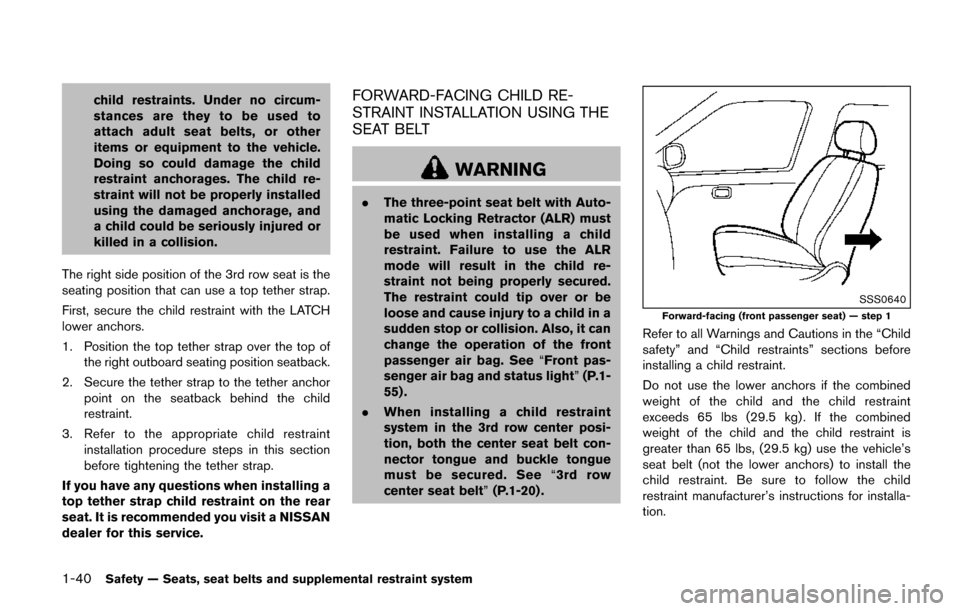
SSS0640
Forward-facing (front passenger seat) — step 1
Refer to all Warnings and Cautions in the “Child
safety” and “Child restraints” sections before
installing a child restraint.
Do not use the lower anchors if the combined
weight of the child and the child restraint
exceeds 65 lbs (29.5 kg) . If the combined
weight of the child and the child restraint is
greater than 65 lbs, (29.5 kg) use the vehicle’s
seat belt (not the lower anchors) to install the
child restraint. Be sure to follow the child
restraint manufacturer’s instructions for installa-
tion.
Page 62 of 520
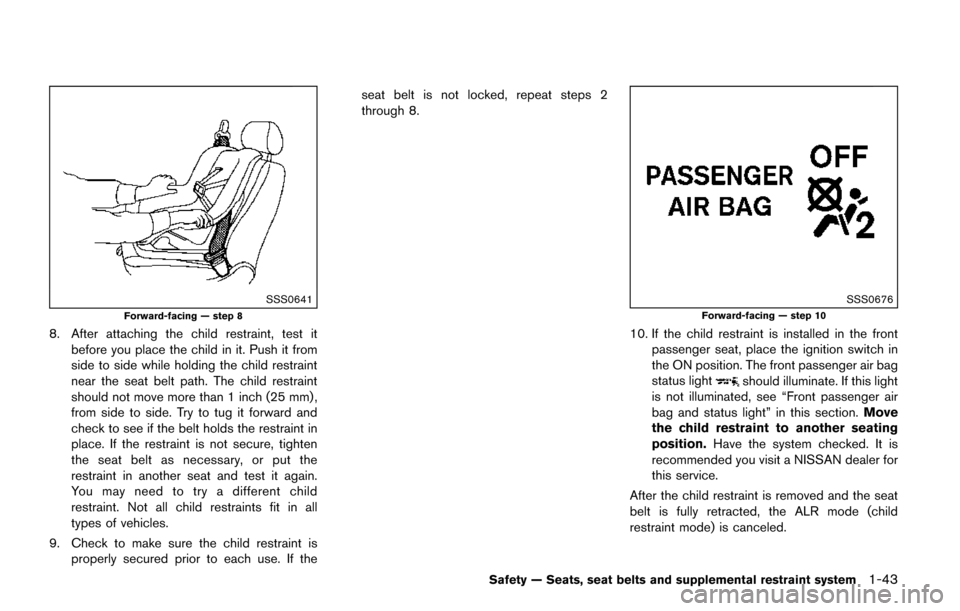
SSS0641
Forward-facing — step 8
8. After attaching the child restraint, test itbefore you place the child in it. Push it from
side to side while holding the child restraint
near the seat belt path. The child restraint
should not move more than 1 inch (25 mm) ,
from side to side. Try to tug it forward and
check to see if the belt holds the restraint in
place. If the restraint is not secure, tighten
the seat belt as necessary, or put the
restraint in another seat and test it again.
You may need to try a different child
restraint. Not all child restraints fit in all
types of vehicles.
9. Check to make sure the child restraint is properly secured prior to each use. If the seat belt is not locked, repeat steps 2
through 8.
SSS0676
Forward-facing — step 10
10. If the child restraint is installed in the front
passenger seat, place the ignition switch in
the ON position. The front passenger air bag
status light
should illuminate. If this light
is not illuminated, see “Front passenger air
bag and status light” in this section. Move
the child restraint to another seating
position. Have the system checked. It is
recommended you visit a NISSAN dealer for
this service.
After the child restraint is removed and the seat
belt is fully retracted, the ALR mode (child
restraint mode) is canceled.
Safety — Seats, seat belts and supplemental restraint system1-43
Page 67 of 520
1-48Safety — Seats, seat belts and supplemental restraint system
SSS0676
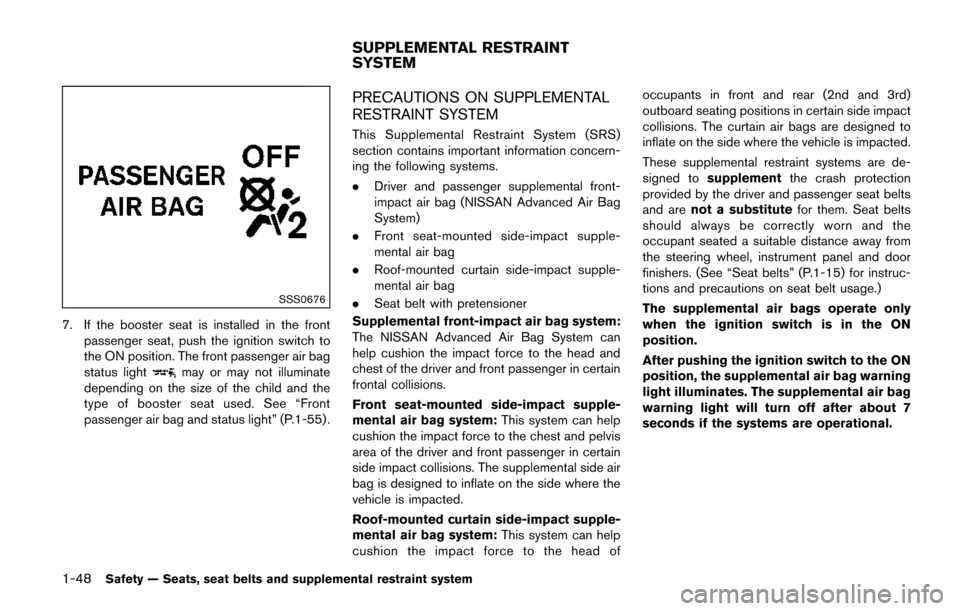
7. If the booster seat is installed in the frontpassenger seat, push the ignition switch to
the ON position. The front passenger air bag
status light
may or may not illuminate
depending on the size of the child and the
type of booster seat used. See “Front
passenger air bag and status light” (P.1-55) .
PRECAUTIONS ON SUPPLEMENTAL
RESTRAINT SYSTEM
This Supplemental Restraint System (SRS)
section contains important information concern-
ing the following systems.
. Driver and passenger supplemental front-
impact air bag (NISSAN Advanced Air Bag
System)
. Front seat-mounted side-impact supple-
mental air bag
. Roof-mounted curtain side-impact supple-
mental air bag
. Seat belt with pretensioner
Supplemental front-impact air bag system:
The NISSAN Advanced Air Bag System can
help cushion the impact force to the head and
chest of the driver and front passenger in certain
frontal collisions.
Front seat-mounted side-impact supple-
mental air bag system: This system can help
cushion the impact force to the chest and pelvis
area of the driver and front passenger in certain
side impact collisions. The supplemental side air
bag is designed to inflate on the side where the
vehicle is impacted.
Roof-mounted curtain side-impact supple-
mental air bag system: This system can help
cushion the impact force to the head of occupants in front and rear (2nd and 3rd)
outboard seating positions in certain side impact
collisions. The curtain air bags are designed to
inflate on the side where the vehicle is impacted.
These supplemental restraint systems are de-
signed to
supplement the crash protection
provided by the driver and passenger seat belts
and are not a substitute for them. Seat belts
should always be correctly worn and the
occupant seated a suitable distance away from
the steering wheel, instrument panel and door
finishers. (See “Seat belts” (P.1-15) for instruc-
tions and precautions on seat belt usage.)
The supplemental air bags operate only
when the ignition switch is in the ON
position.
After pushing the ignition switch to the ON
position, the supplemental air bag warning
light illuminates. The supplemental air bag
warning light will turn off after about 7
seconds if the systems are operational.
SUPPLEMENTAL RESTRAINT
SYSTEM
Page 68 of 520
SSS0131
SSS0132
WARNING
.The supplemental front air bags
ordinarily will not inflate in the
event of a side impact, rear impact,
rollover, or lower severity frontal
collision. Always wear your seat
belts to help reduce the risk or
severity of injury in various kinds
of accidents.
. The front passenger air bag will not
inflate if the passenger air bag
status light is lit or if the front
passenger seat is unoccupied. See
“Front passenger air bag and status
light” (P.1-55) .
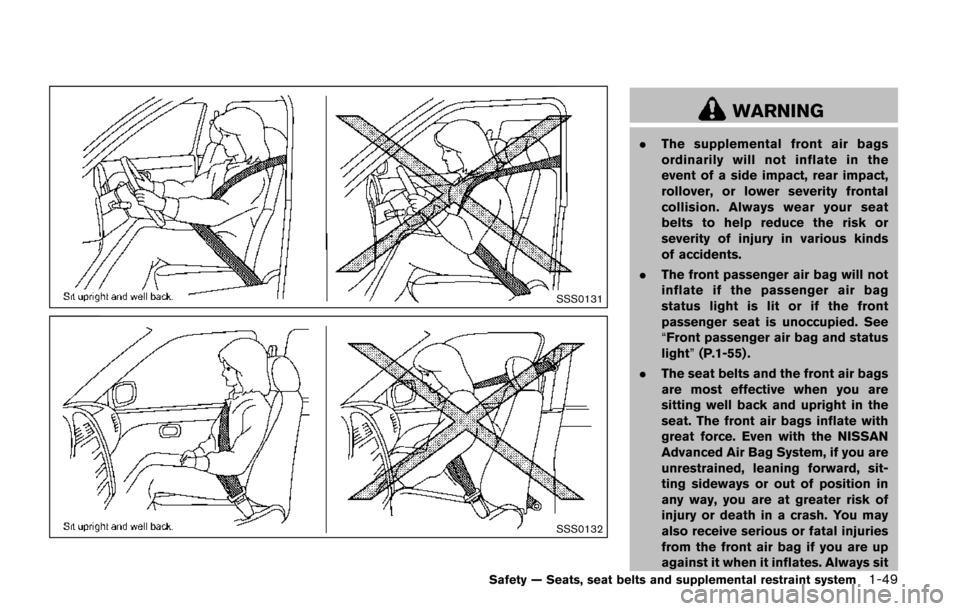
. The seat belts and the front air bags
are most effective when you are
sitting well back and upright in the
seat. The front air bags inflate with
great force. Even with the NISSAN
Advanced Air Bag System, if you are
unrestrained, leaning forward, sit-
ting sideways or out of position in
any way, you are at greater risk of
injury or death in a crash. You may
also receive serious or fatal injuries
from the front air bag if you are up
against it when it inflates. Always sit
Safety — Seats, seat belts and supplemental restraint system1-49
Page 69 of 520
1-50Safety — Seats, seat belts and supplemental restraint system
back against the seatback and as
far-away as practical from the steer-
ing wheel or instrument panel. Al-
ways use the seat belts.
. The driver and front passenger seat
belt buckles are equipped with
sensors that detect if the seat belts
are fastened. The Advanced Air Bag
System monitors the severity of a
collision and seat belt usage then
inflates the air bags. Failure to
properly wear seat belts can in-
crease the risk or severity of injury
in an accident.
. The front passenger seat is
equipped with occupant classifica-
tion sensors (weight sensors) that
turn the front passenger air bag
OFF under some conditions. This
sensor is only used in this seat.
Failure to be properly seated and
wearing the seat belt can increase
the risk or severity of injury in an
accident. See “Front passenger air
bag and status light” (P.1-55) .
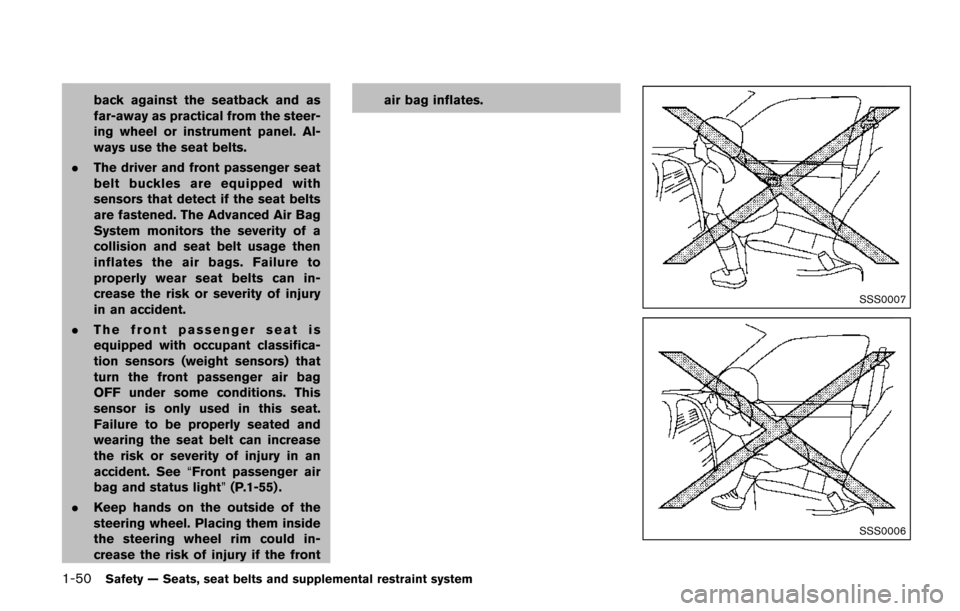
. Keep hands on the outside of the
steering wheel. Placing them inside
the steering wheel rim could in-
crease the risk of injury if the front air bag inflates.
SSS0007
SSS0006