2017 NISSAN QUEST ABS
[x] Cancel search: ABSPage 401 of 520
5-32Starting and driving
Self-test feature
The ABS includes electronic sensors, electric
pumps, hydraulic solenoids and a computer. The
computer has a built-in diagnostic feature that
tests the system each time you start the engine
and move the vehicle at a low speed in forward
or reverse. When the self-test occurs, you may
hear a “clunk” noise and/or feel a pulsation in the
brake pedal. This is normal and does not
indicate a malfunction. If the computer senses
a malfunction, it switches the ABS off and
illuminates the ABS warning light on the
instrument panel. The brake system then oper-
ates normally, but without anti-lock assistance.
If the ABS warning light illuminates during the
self-test or while driving, have the vehicle
checked. It is recommended you visit a NISSAN
dealer for this service.
Normal operation
The ABS operates at speeds above 3 to 6 MPH
(5 to 10 km/h) . The speed varies according to
road conditions.
When the ABS senses that one or more wheels
are close to locking up, the actuator rapidly
applies and releases hydraulic pressure. This
action is similar to pumping the brakes very
quickly. You may feel a pulsation in the brake
pedal and hear a noise from under the hood orfeel a vibration from the actuator when it is
operating. This is normal and indicates that the
ABS is operating properly. However, the pulsa-
tion may indicate that road conditions are
hazardous and extra care is required while
driving.
The Vehicle Dynamic Control (VDC) system
uses various sensors to monitor driver inputs
and vehicle motion. Under certain driving con-
ditions, the VDC system helps to perform the
following functions.
.
Controls brake pressure to reduce wheel
slip on one slipping drive wheel so power is
transferred to a non slipping drive wheel on
the same axle.
. Controls brake pressure and engine output
to reduce drive wheel slip based on vehicle
speed (traction control function) .
. Controls brake pressure at individual wheels
and engine output to help the driver maintain
control of the vehicle in the following
conditions:
— understeer (vehicle tends to not follow
the steered path despite increased
steering input)
— oversteer (vehicle tends to spin due to certain road or driving conditions) .
The VDC system can help the driver to maintain
control of the vehicle, but it cannot prevent loss
of vehicle control in all driving situations.
When the VDC system operates, the VDC
warning light
in the instrument panel flashes
so note the following:
. The road may be slippery or the system may
determine some action is required to help
VEHICLE DYNAMIC CONTROL (VDC)
SYSTEM
Page 402 of 520
keep the vehicle on the steered path.
. You may feel a pulsation in the brake pedal
and hear a noise or vibration from under the
hood. This is normal and indicates that the
VDC system is working properly.
. Adjust your speed and driving to the road
conditions.
See “Vehicle Dynamic Control (VDC) warning
light” (P.2-16).
If a malfunction occurs in the system, the VDC
warning light
illuminates in the instrument
panel. The VDC system automatically turns off.
The VDC OFF switch is used to turn off the VDC
system. The VDC off indicator light
illuminates to indicate the VDC system is off.
When the VDC switch is used to turn off the
system, the VDC system still operates to prevent
one drive wheel from slipping by transferring
power to a non slipping drive wheel. The VDC
warning light
flashes if this occurs. All other
VDC functions are off, and the VDC warning
light
will not flash. The VDC system is
automatically reset to on when the ignition
switch is placed in the off position then back
to the on position.
See “Vehicle Dynamic Control (VDC) warning
light” (P.2-16) and “Vehicle Dynamic Control
(VDC) off indicator light” (P.2-18).
The computer has a built-in diagnostic feature that tests the system each time you start the
engine and move the vehicle forward or in
reverse at a slow speed. When the self-test
occurs, you may hear a “clunk” noise and/or feel
a pulsation in the brake pedal. This is normal and
is not an indication of a malfunction.
WARNING
.
The VDC system is designed to help
the driver maintain stability but
does not prevent accidents due to
abrupt steering operation at high
speeds or by careless or dangerous
driving techniques. Reduce vehicle
speed and be especially careful
when driving and cornering on slip-
pery surfaces and always drive care-
fully.
. Do not modify the vehicle’s suspen-
sion. If suspension parts such as
shock absorbers, struts, springs,
stabilizer bars, bushings and
wheels are not NISSAN recom-
mended for your vehicle or are
extremely deteriorated, the VDC
system may not operate properly.
This could adversely affect vehicle
handling performance, and the VDC warning light
may illuminate.
. If brake related parts such as brake
pads, rotors and calipers are not
NISSAN recommended or are extre-
mely deteriorated, the VDC system
may not operate properly and the
VDC warning light
may illumi-
nate.
. If engine control related parts are
not NISSAN recommended or are
extremely deteriorated, the VDC
warning light
may illuminate.
. When driving on extremely inclined
surfaces such as higher banked
corners, the VDC system may not
operate properly and the VDC warn-
ing light
may illuminate. Do not
drive on these types of roads.
. When driving on an unstable sur-
face such as a turntable, ferry,
elevator or ramp, the VDC warning
light
may illuminate. This is not
a malfunction. Restart the engine
after driving onto a stable surface.
. If wheels or tires other than the
NISSAN recommended ones are
used, the VDC system may not
operate properly and the VDC warn-
Starting and driving5-33
Page 443 of 520
8-14Do-it-yourself
SDI2180
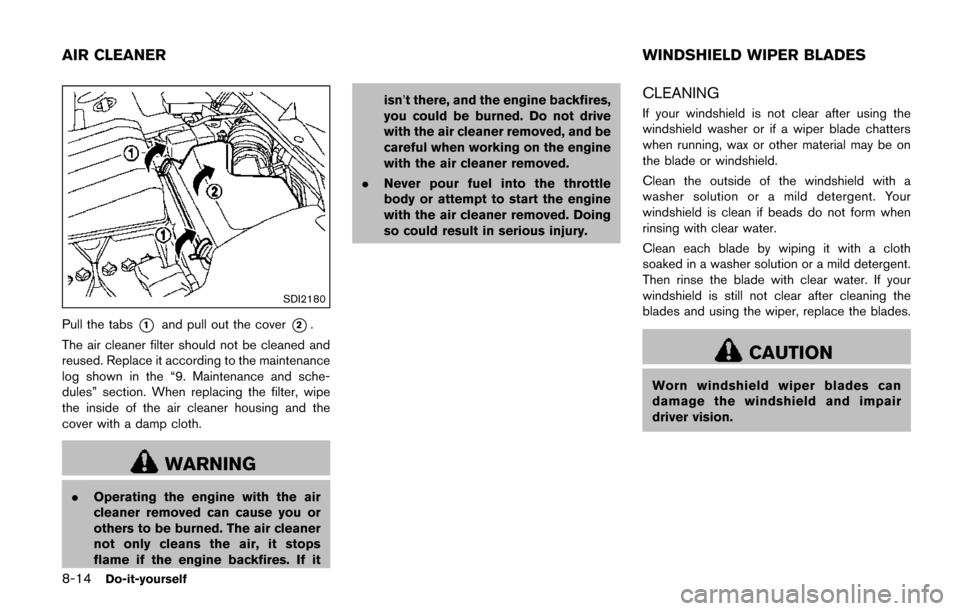
Pull the tabs*1and pull out the cover*2.
The air cleaner filter should not be cleaned and
reused. Replace it according to the maintenance
log shown in the “9. Maintenance and sche-
dules” section. When replacing the filter, wipe
the inside of the air cleaner housing and the
cover with a damp cloth.
WARNING
. Operating the engine with the air
cleaner removed can cause you or
others to be burned. The air cleaner
not only cleans the air, it stops
flame if the engine backfires. If it isn’t there, and the engine backfires,
you could be burned. Do not drive
with the air cleaner removed, and be
careful when working on the engine
with the air cleaner removed.
. Never pour fuel into the throttle
body or attempt to start the engine
with the air cleaner removed. Doing
so could result in serious injury.
CLEANING
If your windshield is not clear after using the
windshield washer or if a wiper blade chatters
when running, wax or other material may be on
the blade or windshield.
Clean the outside of the windshield with a
washer solution or a mild detergent. Your
windshield is clean if beads do not form when
rinsing with clear water.
Clean each blade by wiping it with a cloth
soaked in a washer solution or a mild detergent.
Then rinse the blade with clear water. If your
windshield is still not clear after cleaning the
blades and using the wiper, replace the blades.
CAUTION
Worn windshield wiper blades can
damage the windshield and impair
driver vision.
AIR CLEANER WINDSHIELD WIPER BLADES
Page 449 of 520
8-20Do-it-yourself
NOTE:
If the extended storage fuse switch mal-
functions, or if the fuse is open, it is not
necessary to replace the switch. In this
case, remove the extended storage fuse
switch and replace it with a new fuse of the
same rating.
How to remove the extended storage fuse
switch:
1. To remove the extended storage fuse switch,be sure the ignition switch is in the OFF or
LOCK position.
2. Be sure the headlight switch is in the OFF position.
3. Remove the fuse box cover.
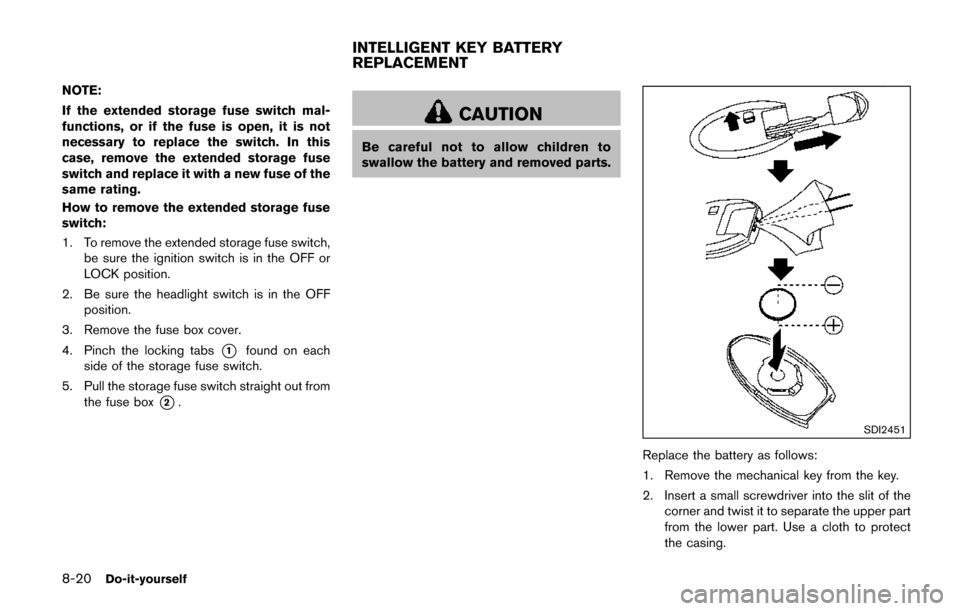
4. Pinch the locking tabs
*1found on each
side of the storage fuse switch.
5. Pull the storage fuse switch straight out from the fuse box
*2.
CAUTION
Be careful not to allow children to
swallow the battery and removed parts.
SDI2451
Replace the battery as follows:
1. Remove the mechanical key from the key.
2. Insert a small screwdriver into the slit of thecorner and twist it to separate the upper part
from the lower part. Use a cloth to protect
the casing.
INTELLIGENT KEY BATTERY
REPLACEMENT
Page 503 of 520
10-20Technical and consumer information
TOWING SAFETY
Trailer hitch
Choose a proper hitch for your vehicle and
trailer. A genuine NISSAN trailer hitch is
available from a NISSAN dealer. Make sure the
trailer hitch is securely attached to the vehicle to
help avoid personal injury or property damage
due to sway caused by crosswinds, rough road
surfaces or passing trucks.
WARNING
Trailer hitch components have specific
weight ratings. Your vehicle may be
capable of towing a trailer heavier than
the weight rating of the hitch compo-
nents. Never exceed the weight rating
of the hitch components. Doing so can
cause serious personal injury or prop-
erty damage.
Hitch ball
Choose a hitch ball of the proper size and
weight rating for your trailer:
.The required hitch ball size is stamped on
most trailer couplers. Most hitch balls also
have the size printed on top of the ball. .
Choose the proper class hitch ball based on
the trailer weight.
. The diameter of the threaded shank of the
hitch ball must be matched to the ball mount
hole diameter. The hitch ball shank should
be no more than 1/16´´ smaller than the hole
in the ball mount.
. The threaded shank of the hitch ball must be
long enough to be properly secured to the
ball mount. There should be at least 2
threads showing beyond the lock washer
and nut.
Sway control device
Sudden maneuvers, wind gusts and buffeting
caused by other vehicles can affect trailer
handling. Sway control devices may be used to
help control these affects. If you choose to use
one, contact a reputable trailer hitch supplier to
make sure the sway control device will work with
the vehicle, hitch, trailer and the trailer’s brake
system. Follow the instructions provided by the
manufacturer for installing and using the sway
control device.
Class I hitch
Class I trailer hitch equipment (receiver, ball
mount and hitch ball) can be used to tow trailers
of a maximum weight of 2,000 lb (907 kg) .
Class II hitch
Class II trailer hitch equipment (receiver, ball
mount and hitch ball) can be used to tow trailers
of a maximum weight of 3,500 lb (1,588 kg).
CAUTION
.Use hitches designed for your vehi-
cle when towing. Check with your
NISSAN dealer for availability of
suitable genuine NISSAN hitches.
. The hitch should not be attached to
or affect the operation of the im-
pact-absorbing bumper.
. Do not use axle-mounted hitches.
. Do not modify the vehicle exhaust
system, brake system, etc. to install
a trailer hitch.
. To reduce the possibility of addi-
tional damage if your vehicle is
struck from the rear, where practi-
cal, remove the hitch and/or recei-
ver when not in use. After the hitch
Page 505 of 520
10-22Technical and consumer information
.Check your hitch, trailer tire pressure,
vehicle tire pressure, trailer light operation,
and trailer wheel lug nuts every time you
attach a trailer to the vehicle.
. Be certain your rearview mirrors conform to
all federal, state or local regulations. If not,
install any mirrors required for towing before
driving the vehicle.
. Determine the overall height of the vehicle
and trailer so the required clearance is
known.
Trailer towing tips
In order to gain skill and an understanding of the
vehicle’s behavior, you should practice turning,
stopping and backing up in an area which is free
from traffic. Steering stability, and braking
performance will be somewhat different than
under normal driving conditions.
.Always secure items in the trailer to prevent
load shift while driving.
. Lock the trailer hitch coupler with a pin or
lock to prevent the coupler from inadver-
tently becoming unlatched.
. Avoid abrupt starts, acceleration or stops.
. Avoid sharp turns or lane changes.
. Always drive your vehicle at a moderate
speed. Some states or provinces have
specific speed limits for vehicles that are towing trailers. Obey the local speed limits.
. When backing up, hold the bottom of the
steering wheel with one hand. Move your
hand in the direction in which you want the
trailer to go. Make small corrections and
back up slowly. If possible, have someone
guide you when you are backing up.
Always block the wheels on both vehicle and
trailer when parking. Parking on a slope is not
recommended; however, if you must do so:
CAUTION
If you move the shift lever to the P
(Park) position before blocking the
wheels and applying the parking brake,
transmission damage could occur.
1. Apply and hold the brake pedal.
2. Have someone place blocks on the downhill side of the vehicle and trailer wheels.
3. After the wheel blocks are in place, slowly release the brake pedal until the blocks
absorb the vehicle load.
4. Apply the parking brake.
5. Shift the transmission into P (Park) . 6. Turn off the engine.
To drive away:
1. Apply and hold the brake pedal.
2. Start the engine.
3. Shift the transmission into gear.
4. Release the parking brake.
5. Drive slowly until the vehicle and trailer are
clear from the blocks.
6. Apply and hold the brake pedal.
7. Have someone retrieve and store the blocks.
. When going down a hill, shift into a lower
gear and use the engine braking effect.
When going up a long grade, downshift the
transmission to a lower gear and reduce
speed to reduce chances of engine over-
loading and/or overheating.
. If the engine coolant rises to an extremely
high temperature when the air conditioning
system is on, turn off the air conditioner.
Coolant heat can be additionally vented by
opening the windows, switching the fan
control to high and setting the temperature
control to the HOT position.
. Trailer towing requires more fuel than normal
circumstances.
. Avoid towing a trailer for the first 500 miles
(800 km) .
Page 512 of 520
11 Index
A
A/C (Air Conditioner) operation ............................. 4-49
ABS (Anti-lock Braking System) ............................ 5-31
Advanced air bag system ......................................... 1-54
Aiming control, Headlights ....................................... 2-37
Air bag systemAdvanced air bag system .................................. 1-54
Front passenger air bag and status light ...... 1-55
Front-seat mounted side-impact
supplemental air bag system ............................ 1-61
Roof-mounted curtain side-impact
supplemental air bag system ............................ 1-61
Air bag warning labels .............................................. 1-63
Air bag warning light ..................................... 1-64, 2-15
Air cleaner housing filter ........................................... 8-14
Air conditioner Air conditioner operation ................................... 4-47
Air conditioner service ....................................... 4-60
Air conditioner specification label ................. 10-10
Air conditioning system refrigerant and
lubricant recommendations .................... 4-60, 10-6
In-cabin microfilter ............................................... 4-60
Alarm, How to stop alarm (see vehicle
security system) .......................................................... 2-30
Alcohol, drugs and driving ......................................... 5-8
Antenna ...................................................................... 4-109
Anti-lock Braking System (ABS) ............................ 5-31
Anti-lock braking system (ABS) warning light .... 2-12
Appearance care Exterior appearance care ..................................... 7-2
Interior appearance care ....................................... 7-4
Armrests .......................................................................... 1-7
Around view
Šmonitor ............................................... 4-32
Audible reminders ...................................................... 2-18 Audio operation precautions ................................... 4-61
Audio system ............................................................... 4-61
Steering wheel audio controls ....................... 4-108
Auto closure ................................................................. 3-29
Autolight system ......................................................... 2-34
Automatic Air conditioner ...................................................... 4-54
Door locks ................................................................ 3-7
Drive positioner .................................................... 3-36
Moonroof ............................................................... 2-54
Seat positioner ..................................................... 3-36
AUX (Auxiliary) input .................................................. 4-85
Avoiding collision and rollover .................................. 5-6
B
Back door (See liftgate) ........................................... 3-26
Battery ........................................................................... 8-10 Battery saver system .......................................... 2-36
Intelligent Key ....................................................... 8-20
Variable voltage control system ....................... 8-12
Before starting the engine ....................................... 5-11
Blind Spot Warning (BSW) system ...................... 5-17
Blind Spot Warning (BSW) system
warning light ................................................................ 2-12
Bluetooth
Šhands-free phone system
(Type A) ..................................................................... 4-122
Bluetooth
Šhands-free phone system
(Type B) ..................................................................... 4-133
Bluetooth
Šhands-free phone system
(Type C) ..................................................................... 4-146
Bluetooth
Šstreaming audio .................................. 4-101
Booster seats .............................................................. 1-45
Brake
Anti-lock Braking System (ABS) ..................... 5-31
Brake fluid ................................................................ 8-9 Brake system ........................................................ 5-30
Parking brake operation ..................................... 5-16
Warning light ........................................................ 2-12
Break-in schedule ....................................................... 5-27
Brightness control Display ON/OFF button ..................................... 4-10
Instrument panel .................................................. 2-38
Bulb replacement ....................................................... 8-22
C
Cabin air filter .............................................................. 4-60
Capacities and
recommended fluids/lubricants ............................... 10-2
Car phone or CB radio .......................................... 4-121
Cargo floor box ........................................................... 2-48
Cargo lights ................................................................. 2-60
Catalytic converter, Three way catalyst .................. 5-3
CD/DVD/USB memory care and cleaning ....... 4-107
Center multi-function control panel ......................... 4-5
Chassis and body maintenance ............................. 9-11
Checking lights ........................................................... 2-12
Child restraints ............................................................ 1-27 Booster seats ....................................................... 1-45
LATCH system ..................................................... 1-29
Precautions on child restraints ........................ 1-27
Top tether strap ................................................... 1-32
Child safety .................................................................. 1-24
Chimes Audible reminders ............................................... 2-18
Seat belt warning light and chime .................. 2-15
Circuit breaker, Fusible link ..................................... 8-18
Cleaning exterior and interior ........................... 7-2, 7-4
Coat hooks ................................................................... 2-51
Cockpit ............................................................................ 2-3
Cold weather driving ................................................. 5-34
Page 517 of 520
11-6
Turn signal switch ................................................ 2-38
Vehicle dynamic control (VDC) off switch .... 2-41
T
Tachometer ..................................................................... 2-7
Temperature display ................................................... 2-26
Temperature gauge, Engine coolant
temperature gauge ....................................................... 2-7
Theft (NISSAN Vehicle Immobilizer System) ,
Engine start .................................................................. 2-30
Three-way catalyst ....................................................... 5-3
Tilt/telescopic steering .............................................. 3-32
TirePressure, Low tire pressure warning light .... 2-14
Tire replacement indicator ................................. 2-23
Tires Flat tire ...................................................................... 6-3
Low tire pressure warning system ..................... 5-3
Tire and Loading Information label .... 8-29, 10-10
Tire chains ............................................................. 8-33
Tire dressing ............................................................ 7-4
Tire pressure ......................................................... 8-27
Tire pressure monitoring
system (TPMS) .............................................. 5-3, 6-3
Tire rotation ........................................................... 8-35
Types of tires ........................................................ 8-33
Uniform tire quality grading ............................. 10-24
Wheel/tire size ..................................................... 10-7
Wheels and tires ................................................. 8-27
Top tether strap child restraints .............................. 1-32
Touch screen system ................................................... 4-7
Towing Flat towing ........................................................... 10-23
Tow truck towing ................................................. 6-14
Towing a trailer ................................................... 10-15
Towing safety ...................................................... 10-20 TPMS, Tire pressure monitoring system ................ 5-3
TPMS with Easy Fill Tire Alert ............................ 5-6
TPMS, Tire pressure warning system ..................... 6-3
Trailer towing ............................................................ 10-15
Transceiver, HomeLink
ŠUniversal Transceiver .... 2-60
Transmission Continuously Variable Transmission
(CVT) fluid ................................................................ 8-8
Driving with CVT (Continuously
Variable Transmission) ....................................... 5-13
Transmission shift lever lock release .............. 5-16
Transmitter (See remote keyless
entry system) ............................................................... 3-21
Traveling or registering in another country........... 10-8
Trip computer .............................................................. 2-24
Trip odometer .............................................................. 2-25
Turn signal switch ....................................................... 2-38
U
Underbody cleaning ..................................................... 7-3
Uniform tire quality grading ................................... 10-24
USB (Universal Serial Bus)
connection port ............................................... 4-81, 4-94
V
Vanity mirror ................................................................. 3-36
Vanity mirror lights ...................................................... 2-59
Variable voltage control system .............................. 8-12
Vehicle Dimensions and weights ................................... 10-8
Identification number (VIN) ............................... 10-8
Loading information .......................................... 10-12
Recovery (freeing a stuck vehicle) .................. 6-15
Security system .................................................... 2-28
Vehicle dynamic control (VDC) off switch .... 2-41 Vehicle dynamic control (VDC) system ......... 5-32
Vehicle dynamic control (VDC)
warning light ......................................................... 2-16
Vehicle information display ....................................... 2-19
Ventilators ..................................................................... 4-46
Voice command (Bluetooth
ŠHands-Free
Phone System) ........................................................ 4-139
Voice command (NISSAN Voice
Recognition system) ................................. 4-160, 4-168
W
Warning Hazard warning flasher switch ............................ 6-2
Lights ...................................................................... 2-12
Tire pressure monitoring
system (TPMS) .............................................. 5-3, 6-3
Vehicle information display ................................ 2-19
Warning lights, indicator lights and
audible reminders ................................................ 2-11
Warning labels, Air bag warning labels ................ 1-63
Warning light
Air bag warning light ............................... 1-64, 2-15
Anti-lock braking system (ABS)
warning light ......................................................... 2-12
Brake warning light ............................................. 2-12
Intelligent Key system warning light ............... 2-14
Low tire pressure warning light ....................... 2-14
Seat belt warning light and chime .................. 2-15
Warranty, Emission control system warranty .... 10-25
Washer switch Rear window wiper and washer switch ........ 2-32
Wiper and washer switch ................................. 2-31
Washing .......................................................................... 7-2
Waxing ............................................................................ 7-2
Weights (See dimensions and weights) .............. 10-8
Wheel/tire size ............................................................ 10-7