2017 NISSAN MAXIMA tire type
[x] Cancel search: tire typePage 358 of 406
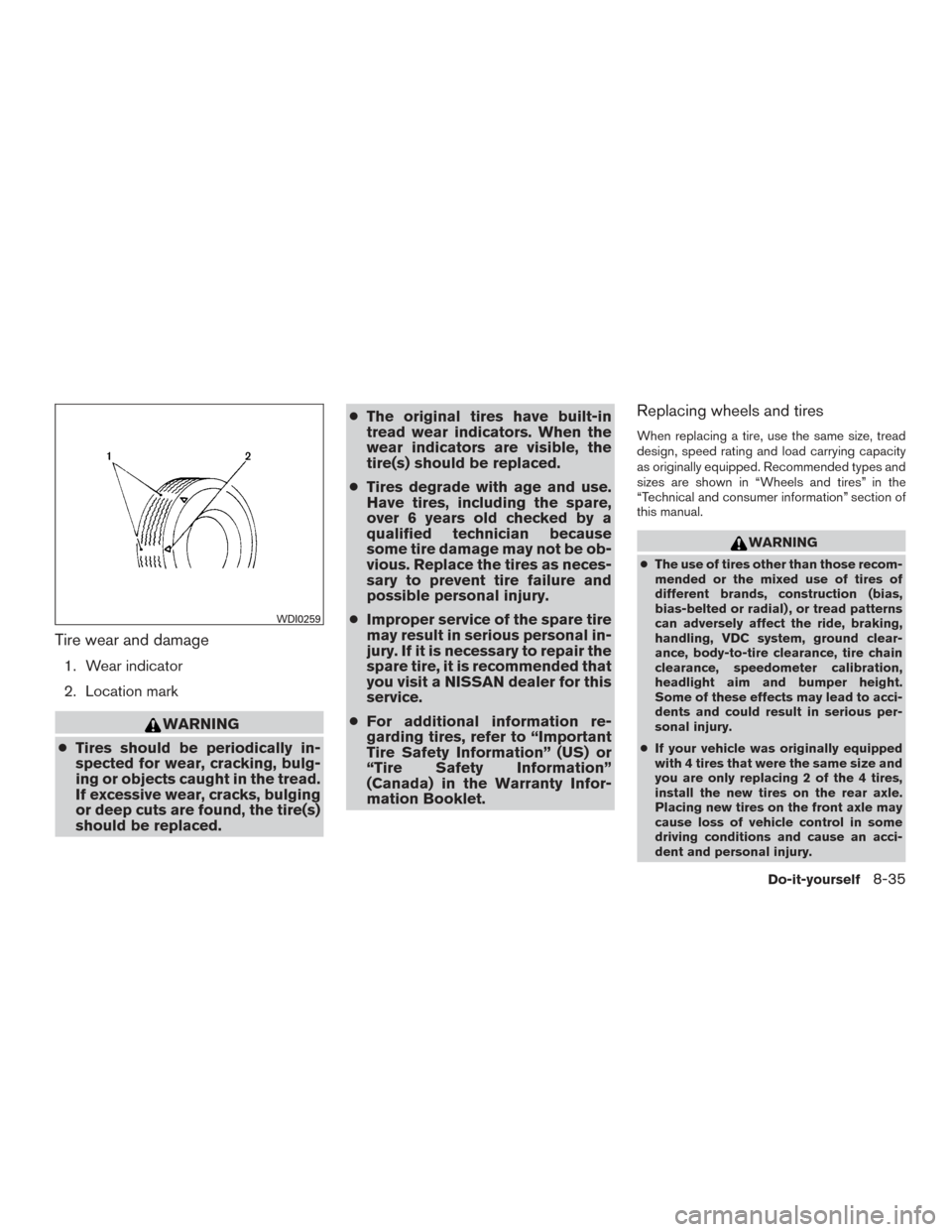
Tire wear and damage
1. Wear indicator
2. Location mark
WARNING
● Tires should be periodically in-
spected for wear, cracking, bulg-
ing or objects caught in the tread.
If excessive wear, cracks, bulging
or deep cuts are found, the tire(s)
should be replaced. ●
The original tires have built-in
tread wear indicators. When the
wear indicators are visible, the
tire(s) should be replaced.
● Tires degrade with age and use.
Have tires, including the spare,
over 6 years old checked by a
qualified technician because
some tire damage may not be ob-
vious. Replace the tires as neces-
sary to prevent tire failure and
possible personal injury.
● Improper service of the spare tire
may result in serious personal in-
jury. If it is necessary to repair the
spare tire, it is recommended that
you visit a NISSAN dealer for this
service.
● For additional information re-
garding tires, refer to “Important
Tire Safety Information” (US) or
“Tire Safety Information”
(Canada) in the Warranty Infor-
mation Booklet.
Replacing wheels and tires
When replacing a tire, use the same size, tread
design, speed rating and load carrying capacity
as originally equipped. Recommended types and
sizes are shown in “Wheels and tires” in the
“Technical and consumer information” section of
this manual.
WARNING
● The use of tires other than those recom-
mended or the mixed use of tires of
different brands, construction (bias,
bias-belted or radial) , or tread patterns
can adversely affect the ride, braking,
handling, VDC system, ground clear-
ance, body-to-tire clearance, tire chain
clearance, speedometer calibration,
headlight aim and bumper height.
Some of these effects may lead to acci-
dents and could result in serious per-
sonal injury.
● If your vehicle was originally equipped
with 4 tires that were the same size and
you are only replacing 2 of the 4 tires,
install the new tires on the rear axle.
Placing new tires on the front axle may
cause loss of vehicle control in some
driving conditions and cause an acci-
dent and personal injury.
WDI0259
Do-it-yourself8-35
Page 367 of 406
Engine coolant*:Replace coolant at the speci-
fied interval. When adding or replacing coolant,
be sure to use only Genuine NISSAN Long Life
Antifreeze/Coolant (blue) or equivalent with the
proper mixture. (For additional information on the
proper mixture for your area, refer to “Engine
cooling system” in the “Do-it-yourself” section of
this manual.)
NOTE: Mixing any other type of coolant or the use
of non-distilled water may reduce the recom-
mended service interval of the coolant.
Engine oil and oil filter: Replace engine oil
and oil filter at the specified intervals. For recom-
mended oil grade and viscosity refer to “Recom-
mended fluids/lubricants and capacities” in the
“Technical and consumer information” section of
this manual.
Fuel lines*: Check the fuel hoses, piping and
connections for leaks, looseness, or deteriora-
tion. Tighten connections or replace parts as
necessary.
Spark plugs: Replace at specified intervals. In-
stall new plugs of the same type as originally
equipped.CHASSIS AND BODY
MAINTENANCE:
Brake lines and cables: Visually inspect for
proper installation. Check for chafing, cracks,
deterioration, and signs of leaking. Replace any
deteriorated or damaged parts immediately.
Brake pads, rotors, drums and linings:
Check for wear, deterioration and fluid leaks.
Replace any deteriorated or damaged parts im-
mediately.
Exhaust system: Visually inspect the exhaust
pipes, muffler and hangers for leaks, cracks, de-
terioration, and damage. Tighten connections or
replace parts as necessary.
In-cabin microfilter: Replace at specified in-
tervals. When driving for prolonged periods in
dusty conditions, replace the filter more fre-
quently.
Steering gear and linkage, axle and sus-
pension parts, drive shaft boots: Check for
damage, looseness, and leakage of oil or grease.
Under severe driving conditions, inspect more
frequently. Tire rotation:
Tires should be rotated every
5,000 miles (8,000 km) according to the instruc-
tions under “General maintenance” in this sec-
tion. When rotating tires, check for damage and
uneven wear. Replace if necessary.
Transmission fluid/oil: Visually inspect for
signs of leakage at specified intervals.
If towing a trailer, using a camper or car-top
carrier, or driving on rough or muddy roads, re-
place the CVT fluid every 60,000 miles
(96,000 km) or request the dealer to inspect the
fluid deterioration data using a CONSULT. If the
deterioration data is more than 210000, replace
the CVT fluid.
9-6Maintenance and schedules
Page 403 of 406
Security systemsVehicle security system ...........2-36
Self-adjusting brakes ..............8-18
Service manual order form ...........10-20
Servicing air conditioner .............4-28
Shifting Continuously Variable Transmission
(CVT) .....................5-17
Shoulder belt height adjustment ........1-17
Spark plug replacement .............8-15
Spark plugs ...................8-15
Specifications ..................10-8
Speedometer ...................2-4
Speedometer and odometer ...........2-4
Spotlights(Seemaplight) ...........2-63
SRS warning label ................1-59
Stability control .................5-81
Standardmaintenance..............9-7
Starting Before starting the engine ..........5-14
Jump starting ..............6-8,8-13
Precautions when starting and driving ....5-4
Push starting .................6-10
Starting the engine .............5-14
Starting the engine ...............5-14
Steering Power steering fluid .............8-10
Power steering system ...........5-79
Steering wheel ..................3-26
Stoplight.....................8-24
Storage......................2-51
Storage tray ...................2-52
Sunglassescase.................2-53
Sunglassesholder................2-53
Sunroof......................2-58
Sunroof (see Moonroof) .............2-58 Sun visors
....................3-28
Supplemental air bag warning light . . .1-59, 2-12
Supplemental front impact air bag system . . .1-48
Supplemental restraint system Information and warning labels .......1-59
Precautions on supplemental restraint
system ....................1-41
Supplemental restraint system
(Supplemental air bag system) .........1-41
Switch Autolightswitch...............2-43
Automatic power window switch ......2-57
Foglightswitch ...............2-46
Hazard warning flasher switch ........6-2
Headlight and turn signal switch ......2-42
Headlight control switch ..........2-42
Instrument brightness control ........2-45
Power door lock switch .........3-5,3-6
Rear window and outside mirror defroster
switch.....................2-41
Turn signal switch ..............2-45
Vehicle dynamic control (VDC) off
switch.....................2-49
T
Tachometer ....................2-5
Temperature gauge Engine coolant temperature gauge .....2-5
Theft (NISSAN Vehicle Immobilizer System) ,
engine start ................2-37,5-13
Three-way catalyst ................5-4
Tire Flat tire .....................6-3
Spare tire ................6-4,8-37 Tire and Loading Information label
....10-12
Tire chains ..................8-34
Tire pressure .................8-26
Tire rotation..................8-34
Types of tires .................
8-33
Uniform tire quality grading ........10-17
Wheels and tires ...............8-26
Wheel/tire size ................10-9
Tire pressure Low tire pressure warning light ........2-9
Tire Pressure Monitoring System (TPMS) ....5-5
Towing Flattowing.................10-16
Trailer towing ................10-16
Towing a trailer .................10-16
Towingyourvehicle...............6-11
Transceiver HomeLink® Universal
Transceiver .......2-64,2-65,2-66,2-67,
2-67, 2-68
Transmission Continuously Variable Transmission (CVT)
fluid.......................8-9
Driving with Continuously Variable
Transmission (CVT) .............5-15
Travel (See registering a vehicle in another
country) .....................10-10
Trip odometer ...................2-4
Trunkaccessthroughtherearseat....1-5,3-23
Trunklidlockopenerlever............3-22
Trunklight ....................2-64
Turn signal switch ................2-45
11-6