Page 374 of 424
MOTOR COMPARTMENT
WARNING
• Never touch, disassemble, remove or replace the high-voltage parts and
cables, as well as their connectors.
High-voltage cables are colored or-
ange. Touching, disassembling, re-
moving or replacing those parts and
cables can cause severe burns or elec-
tric shock that may result in serious
injury or death. • Never use a fuse of a higher or lower
amperage rating than that specified on
the fuse box cover. This could damage
the electrical system or electronic con-
trol units or cause a fire.
If any electrical equipment does not operate,
check for an open fuse.
1. Confirm that the power switch and the head- light switch are turned off.
2. Open the hood. 3. Remove the fuse/fusible link holder cover by
pushing the tab and lifting the cover from the
right side, and then the left side.
4. Locate the fuse that needs to be replaced.
5. Remove the fuse using the fuse puller located in the passenger compartment fuse box.
FUSES
Maintenance and do-it yourself8-17
Page 376 of 424
PASSENGER COMPARTMENT
WARNING
Never use a fuse of a higher or lower
amperage rating than that specified on
the fuse box cover. This could damage
the electrical system or electronic control
units or cause a fire.
If any electrical equipment does not operate,
check for an open fuse.
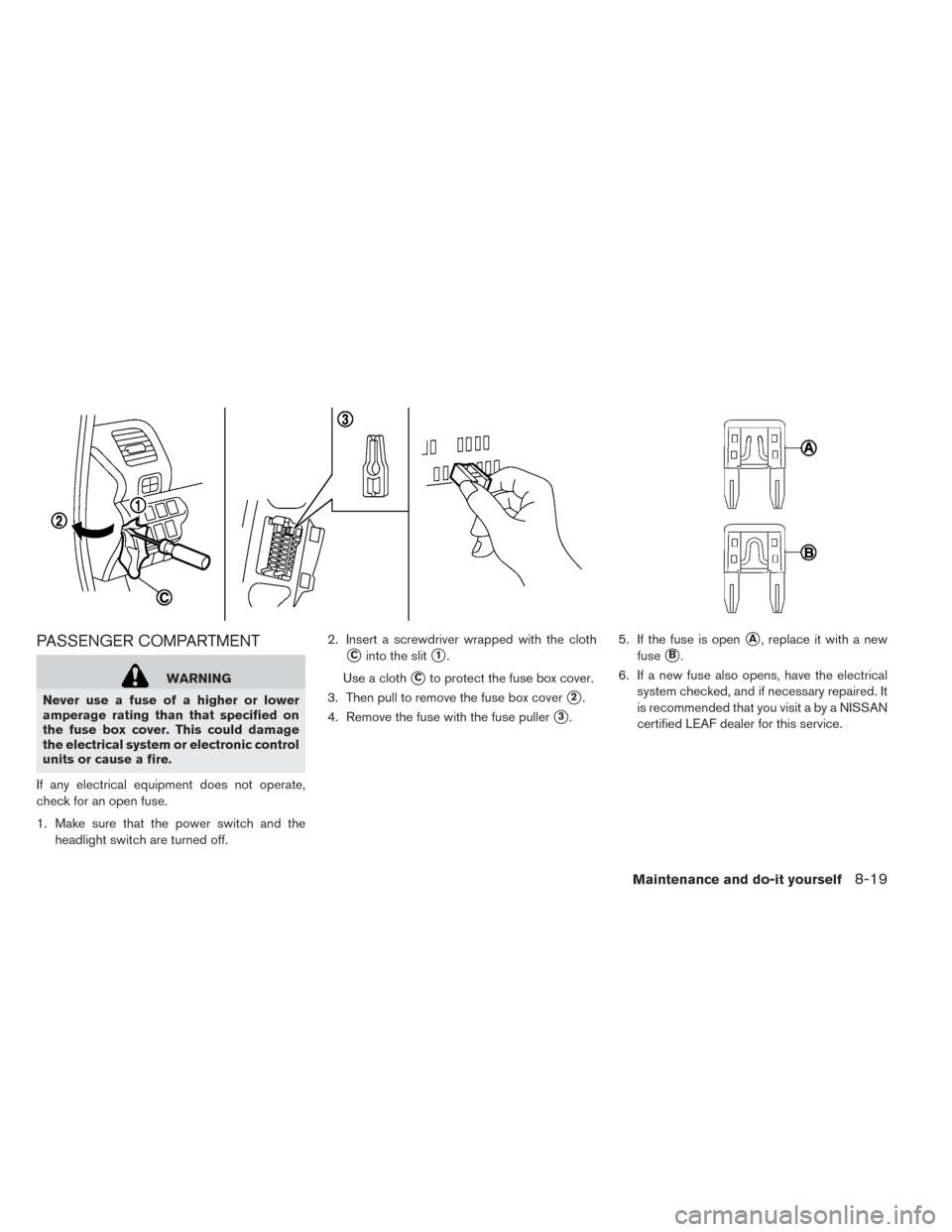
1. Make sure that the power switch and the headlight switch are turned off. 2. Insert a screwdriver wrapped with the cloth
�Cinto the slit�1.
Use a cloth
�Cto protect the fuse box cover.
3. Then pull to remove the fuse box cover
�2.
4. Remove the fuse with the fuse puller
�3. 5. If the fuse is open
�A, replace it with a new
fuse
�B.
6. If a new fuse also opens, have the electrical system checked, and if necessary repaired. It
is recommended that you visit a by a NISSAN
certified LEAF dealer for this service.
Maintenance and do-it yourself8-19
Page 379 of 424
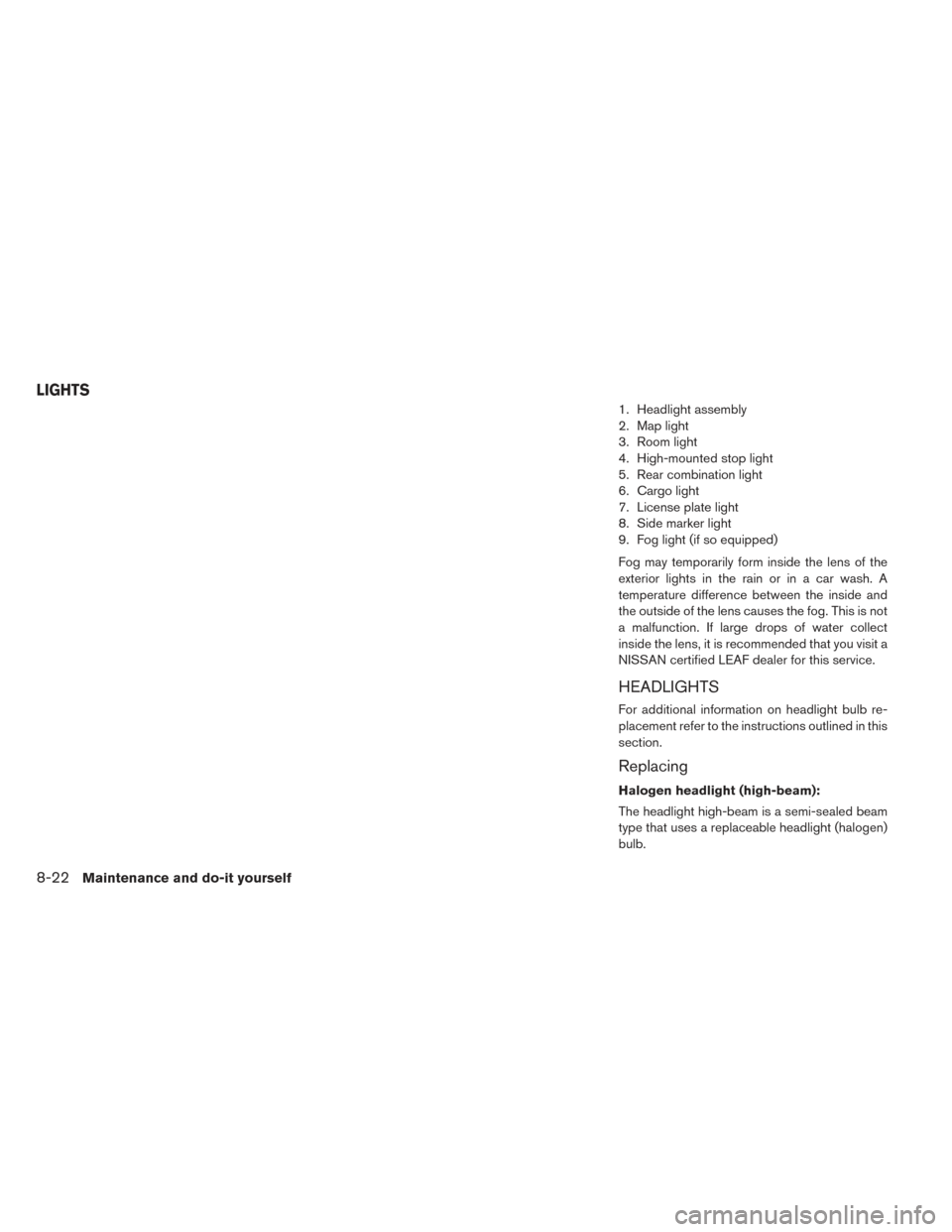
1. Headlight assembly
2. Map light
3. Room light
4. High-mounted stop light
5. Rear combination light
6. Cargo light
7. License plate light
8. Side marker light
9. Fog light (if so equipped)
Fog may temporarily form inside the lens of the
exterior lights in the rain or in a car wash. A
temperature difference between the inside and
the outside of the lens causes the fog. This is not
a malfunction. If large drops of water collect
inside the lens, it is recommended that you visit a
NISSAN certified LEAF dealer for this service.
HEADLIGHTS
For additional information on headlight bulb re-
placement refer to the instructions outlined in this
section.
Replacing
Halogen headlight (high-beam):
The headlight high-beam is a semi-sealed beam
type that uses a replaceable headlight (halogen)
bulb.
LIGHTS
8-22Maintenance and do-it yourself
Page 380 of 424
CAUTION
• Do not leave the bulb out of the head- light reflector for a long period of time.
Dust, moisture, smoke, etc. entering
the headlight body may affect bulb
performance.
• High-pressure halogen gas is sealed inside the halogen bulb. The bulb may
break if the glass envelope is
scratched or the bulb is dropped.
• Only touch the base when handling the bulb. Never touch the glass envelope.
Touching the glass envelope could sig-
nificantly affect bulb life and/or head-
light performance.
• Aiming is not necessary after replacing the bulb. When aiming adjustment is
necessary, it is recommended that you
visit a NISSAN certified LEAF dealer
for this service.
• Fog may temporarily form inside the lens of the exterior lights in the rain or
in a car wash. A temperature differ-
ence between the inside and the out-
side of the lens causes the fog. This is
not a malfunction. If large drops of
water collect inside the lens, it is rec-
ommended that you visit a NISSAN
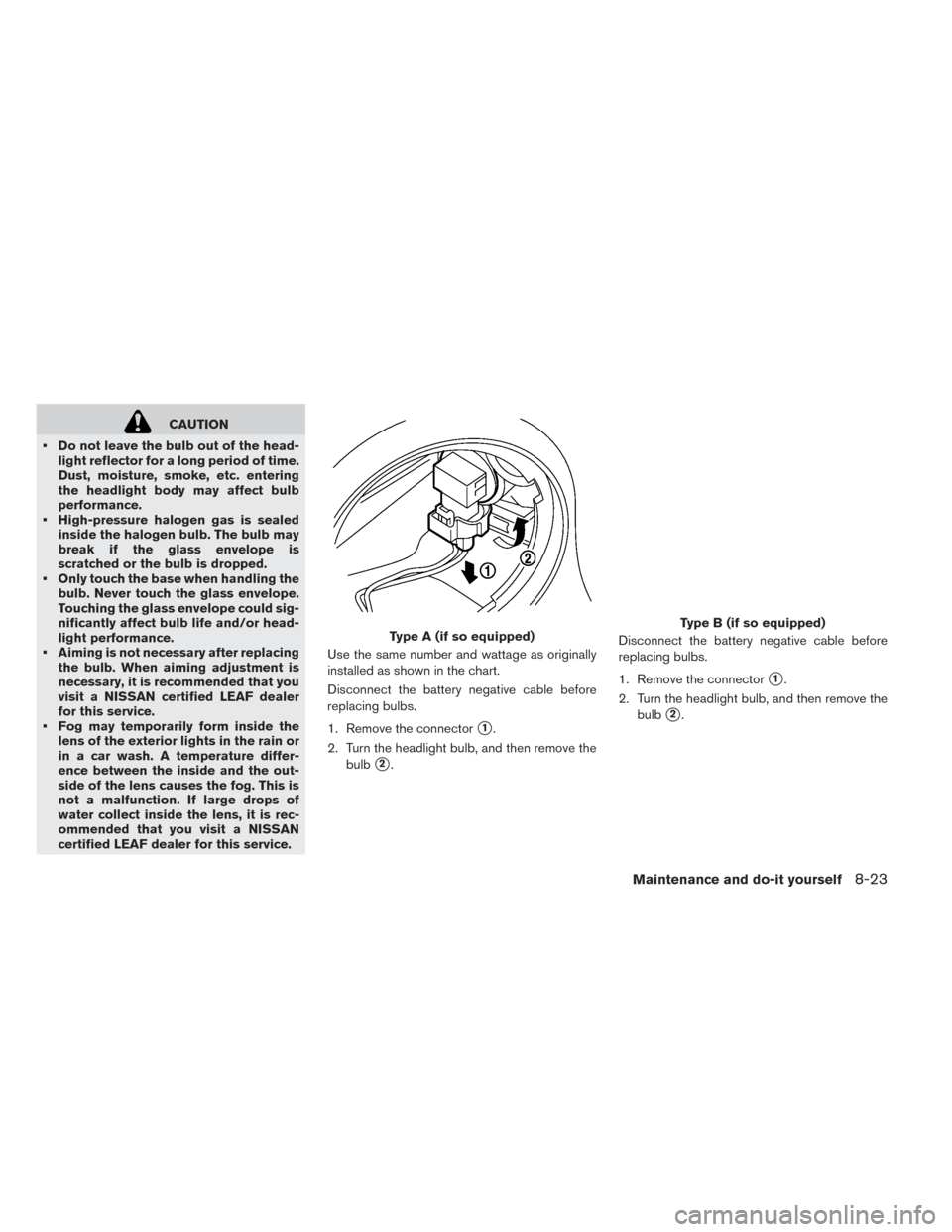
certified LEAF dealer for this service. Use the same number and wattage as originally
installed as shown in the chart.
Disconnect the battery negative cable before
replacing bulbs.
1. Remove the connector
�1.
2. Turn the headlight bulb, and then remove the bulb
�2. Disconnect the battery negative cable before
replacing bulbs.
1. Remove the connector
�1.
2. Turn the headlight bulb, and then remove the bulb
�2.
Type A (if so equipped)Type B (if so equipped)
Maintenance and do-it yourself8-23
Page 381 of 424
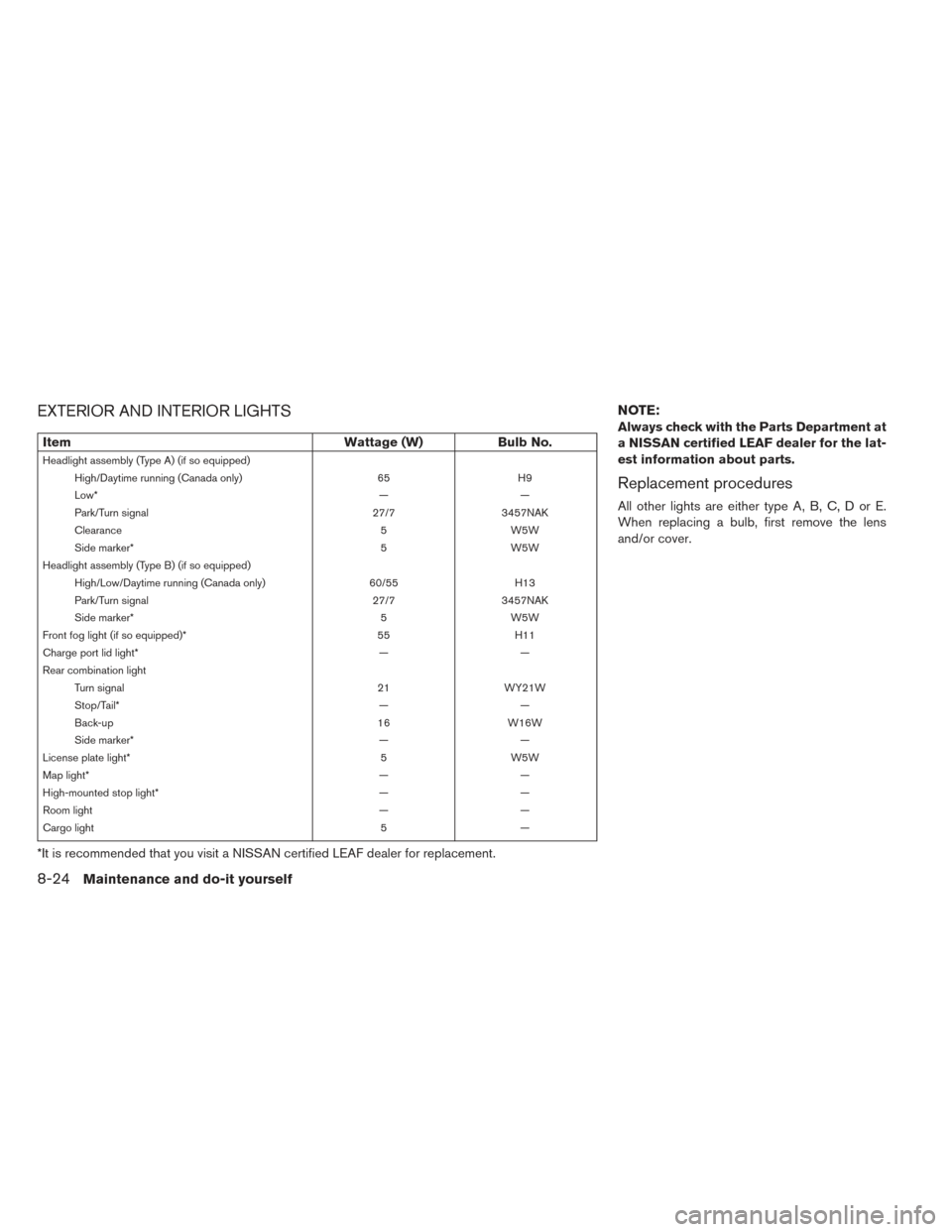
EXTERIOR AND INTERIOR LIGHTS
ItemWattage (W)Bulb No.
Headlight assembly (Type A) (if so equipped)
High/Daytime running (Canada only) 65H9
Low* ——
Park/Turn signal 27/73457NAK
Clearance 5W5W
Side marker* 5W5W
Headlight assembly (Type B) (if so equipped) High/Low/Daytime running (Canada only) 60/55H13
Park/Turn signal 27/73457NAK
Side marker* 5W5W
Front fog light (if so equipped)* 55H11
Charge port lid light* ——
Rear combination light Turn signal 21WY21W
Stop/Tail* ——
Back-up 16W16W
Side marker* ——
License plate light* 5W5W
Map light* ——
High-mounted stop light* ——
Room light ——
Cargo light 5—
*It is recommended that you visit a NISSAN certified LEAF dealer for replacement.
NOTE:
Always check with the Parts Department at
a NISSAN certified LEAF dealer for the lat-
est information about parts.
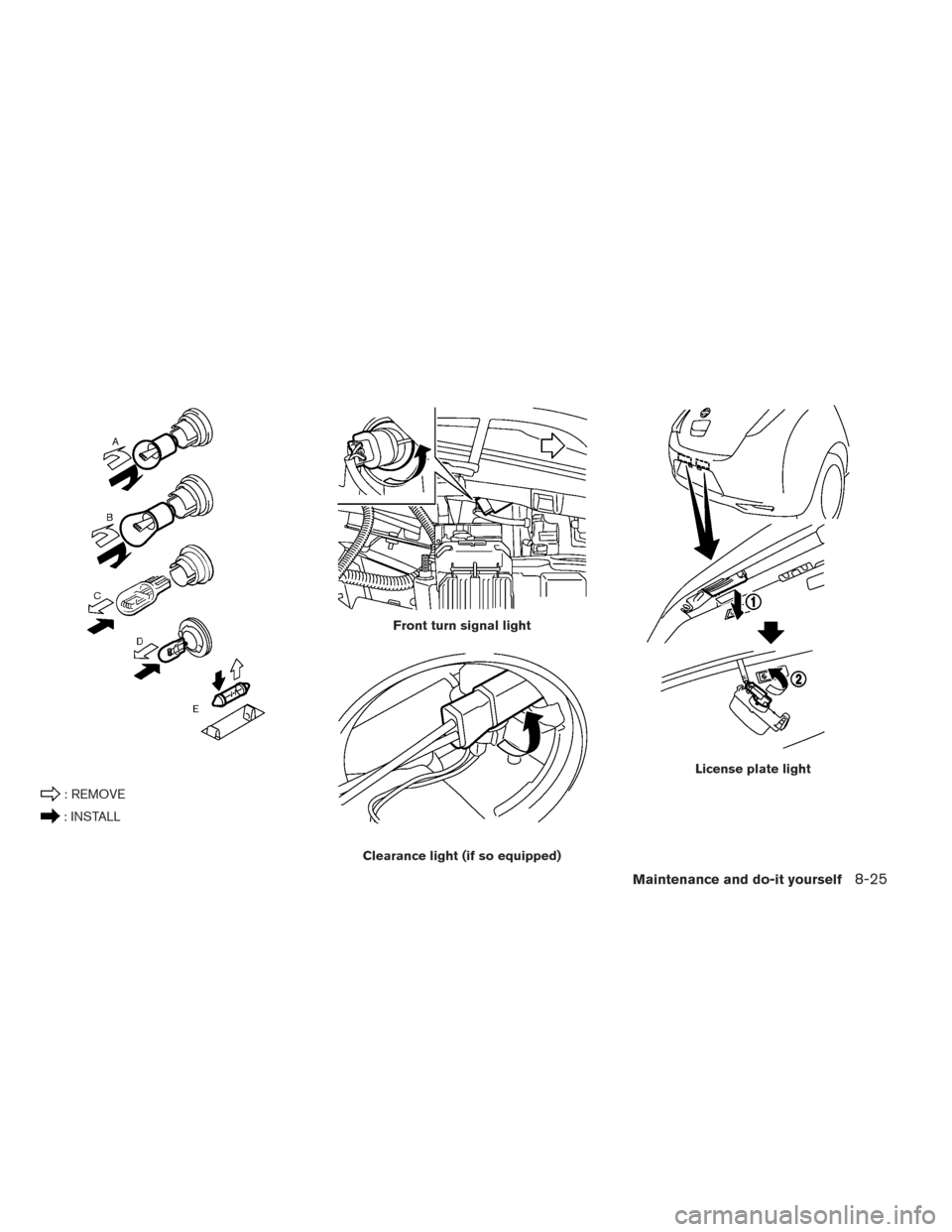
Replacement procedures
All other lights are either type A, B, C, D or E.
When replacing a bulb, first remove the lens
and/or cover.
8-24Maintenance and do-it yourself
Page 382 of 424
: REMOVE
: INSTALL
Front turn signal light
Clearance light (if so equipped)
License plate light
Maintenance and do-it yourself8-25
Page 383 of 424
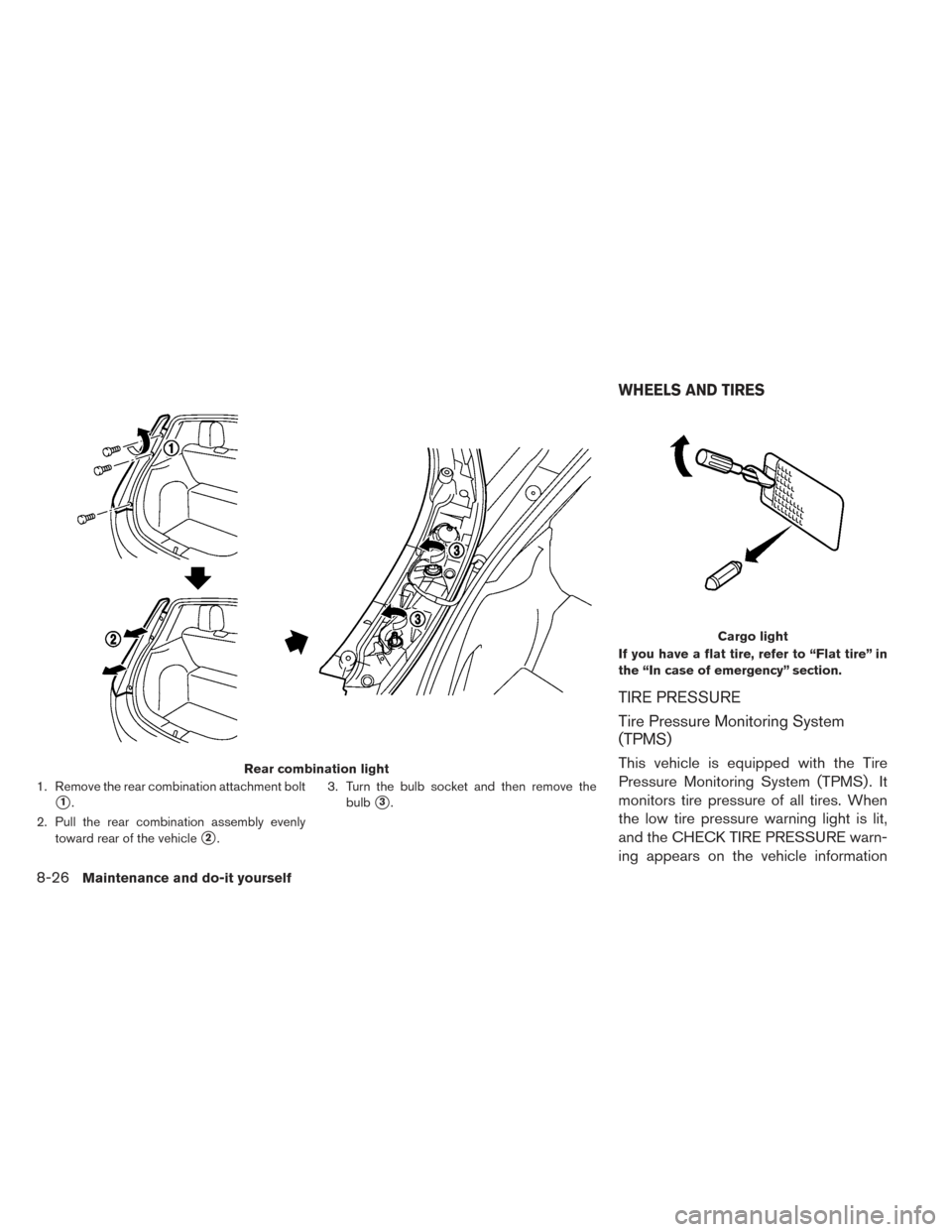
1. Remove the rear combination attachment bolt
�1.
2. Pull the rear combination assembly evenly toward rear of the vehicle
�2. 3. Turn the bulb socket and then remove the
bulb
�3. If you have a flat tire, refer to “Flat tire” in
the “In case of emergency” section.
TIRE PRESSURE
Tire Pressure Monitoring System
(TPMS)
This vehicle is equipped with the Tire
Pressure Monitoring System (TPMS) . It
monitors tire pressure of all tires. When
the low tire pressure warning light is lit,
and the CHECK TIRE PRESSURE warn-
ing appears on the vehicle informationRear combination light
Cargo light
WHEELS AND TIRES
8-26Maintenance and do-it yourself
Page 384 of 424
display, one or more of your tires is signifi-
cantly under-inflated.
The TPMS will activate only when the
vehicle is driven at speeds above 16 mph
(25 km/h) . Also, this system may not de-
tect a sudden drop in tire pressure (for
example a flat tire while driving) .
For additional information, refer to “Low
tire pressure warning light” in the “Instru-
ments and controls” section, “Tire Pres-
sure Monitoring System (TPMS)” in the
“Starting and driving” section and “Tire
Pressure Monitoring System (TPMS)” in
the “In case of emergency” section of this
manual.
Tire inflation pressure
Check the pressure of the tires often and
always prior to long distance trips. The
recommended tire pressure specifica-
tions are shown on the F.M.V.S.S/
C.M.V.S.S certification label or Tire and
Loading Information label under the “Cold
Tire Pressure” heading. The Tire andLoading Information label is affixed to the
driver side center pillar. Tire pressures
should be checked regularly because:
• Most tires naturally lose air over time.
• Tires can lose air suddenly when driven
over potholes or other objects or if the
vehicle strikes a curb while parking.
The tire pressures should be checked
when the tires are cold. The tires are
considered COLD after the vehicle has
been parked for 3 or more hours, or driven
less than 1 mile (1.6 km) at moderate
speeds.
The TPMS with Easy-Fill Tire Alert also
provides visual and audible signals out-
side the vehicle for inflating the tires to the
recommended COLD tire pressure. For
additional information, refer to “TPMS
with Easy-Fill Tire Alert” in the “Starting
and driving” section of this manual.
Incorrect tire pressure, including un-
der inflation, may adversely affect
tire life and vehicle handling.
WARNING
•
Improperly inflated tires can fail
suddenly and cause an accident.
•The Gross Vehicle Weight rating
(GVWR) is located on the
F.M.V.S.S./C.M.V.S.S certifica-
tion label. The vehicle weight ca-
pacity is indicated on the Tire
and Loading Information label.
Do not load your vehicle beyond
this capacity. Overloading your
vehicle may result in reduced tire
life, unsafe operating conditions
due to premature tire failure, or
unfavorable handling character-
istics and could also lead to a
serious accident. Loading be-
yond the specified capacity may
also result in failure of other ve-
hicle components.
Maintenance and do-it yourself8-27