2017 NISSAN JUKE turn signal
[x] Cancel search: turn signalPage 266 of 416
accident and could result in serious
personal injury. Check the tire pres-
sure for all four tires. Adjust the tire
pressure to the recommended COLD
tire pressure shown on the Tire and
Loading Information label to turn
the low tire pressure warning light
OFF. If you have a flat tire, replace it
with a spare tire as soon as possi-
ble. (See“Flat tire” (P.6-3) for chan-
ging a flat tire.)
. Since the spare tire is not equipped
with the TPMS, when a spare tire is
mounted or a wheel is replaced, the
TPMS will not function and the low
tire pressure warning light will flash
for approximately 1 minute. The
light will remain on after 1 minute.
Have your tires replaced and/or
TPMS system reset as soon as
possible. It is recommended you
visit a NISSAN dealer for these
services.
. Replacing tires with those not ori-
ginally specified by NISSAN could
affect the proper operation of the
TPMS.
. Do not inject any tire liquid or
aerosol tire sealant into the tires, as this may cause a malfunction of
the tire pressure sensors.
CAUTION
.
The TPMS may not function properly
when the wheels are equipped with
tire chains or the wheels are buried
in snow.
. Do not place metalized film or any
metal parts (antenna, etc.) on the
windows. This may cause poor re-
ception of the signals from the tire
pressure sensors, and the TPMS will
not function properly.
Some devices and transmitters may temporarily
interfere with the operation of the TPMS and
cause the low tire pressure warning light to
illuminate. Some examples are:
. Facilities or electric devices using similar
radio frequencies are near the vehicle.
. If a transmitter set to similar frequencies is
being used in or near the vehicle.
. If a computer (or similar equipment) or a DC/
AC converter is being used in or near the
vehicle. Low tire pressure warning light may illuminate in
the following cases.
.
If the vehicle is equipped with a wheel and
tire without TPMS.
. If the TPMS has been replaced and the ID
has not been registered.
. If the wheel is not originally specified by
NISSAN.
FCC Notice:
For USA:
This device complies with Part 15 of the
FCC Rules. Operation is subject to the
following two conditions: (1) This device
may not cause harmful interference, and
(2) this device must accept any interfer-
ence received, including interference that
may cause undesired operation.
Note: Changes or modifications not ex-
pressly approved by the party responsible
for compliance could void the user’s
authority to operate the equipment.
For Canada:
This device complies with Industry Canada
licence-exempt RSS standard(s) . Opera-
tion is subject to the following two condi-
tions: (1) this device may not cause
interference, and (2) this device must
accept any interference, including interfer-
Starting and driving5-5
Page 303 of 416
6-2In case of emergency
SIC2574
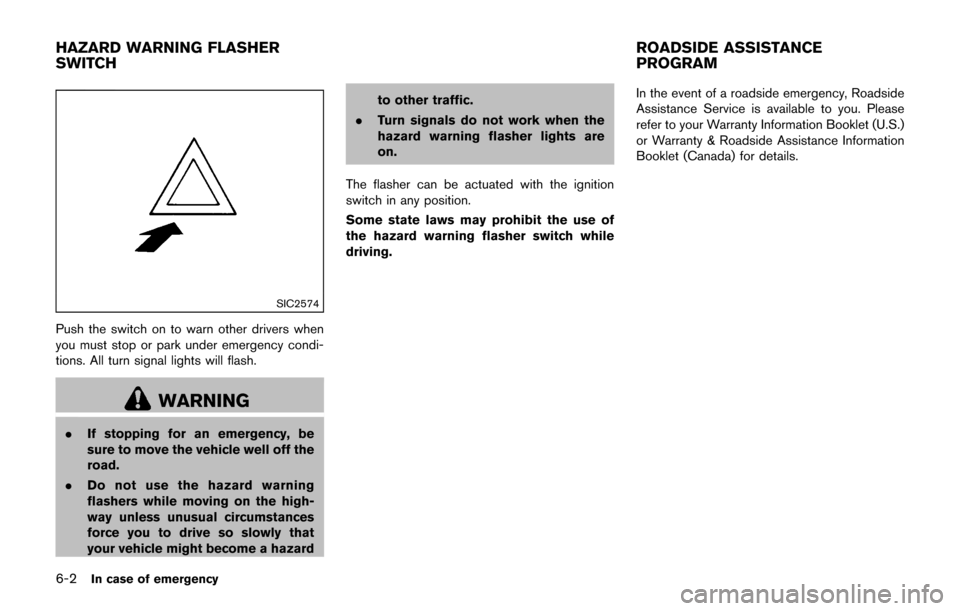
Push the switch on to warn other drivers when
you must stop or park under emergency condi-
tions. All turn signal lights will flash.
WARNING
.If stopping for an emergency, be
sure to move the vehicle well off the
road.
. Do not use the hazard warning
flashers while moving on the high-
way unless unusual circumstances
force you to drive so slowly that
your vehicle might become a hazard to other traffic.
. Turn signals do not work when the
hazard warning flasher lights are
on.
The flasher can be actuated with the ignition
switch in any position.
Some state laws may prohibit the use of
the hazard warning flasher switch while
driving. In the event of a roadside emergency, Roadside
Assistance Service is available to you. Please
refer to your Warranty Information Booklet (U.S.)
or Warranty & Roadside Assistance Information
Booklet (Canada) for details.
HAZARD WARNING FLASHER
SWITCH
ROADSIDE ASSISTANCE
PROGRAM
Page 305 of 416
6-4In case of emergency
.Do not inject any tire liquid or
aerosol tire sealant into the tires,
as this may cause a malfunction of
the tire pressure sensors.
CHANGING A FLAT TIRE
If you have a flat tire, follow the instructions
below.
Stopping the vehicle
1. Safely move the vehicle off the road and
away from traffic.
2. Turn on the hazard warning flashers.
3. Park on a level surface and apply the parking brake.
4. Continuously Variable Transmission
(CVT) models:
Move the shift lever to the P (Park) position.
Manual Transmission (MT) models:
Move the shift lever to the R (Reverse)
position.
5. Turn off the engine.
6. Raise the hood to warn other traffic, and to signal professional road assistance person-
nel that you need assistance.
7. Have all passengers get out of the vehicle and stand in a safe place, away from traffic and clear of the vehicle.
WARNING
.
Make sure the parking brake is
securely applied and the Manual
Transmission is shifted into R (Re-
verse) , or the Continuously Variable
Transmission into P (Park) .
. Never change tires when the vehicle
is on a slope, ice or slippery areas.
This is hazardous.
. Never change tires if oncoming
traffic is close to your vehicle. Wait
for professional road assistance.
MCE0001A
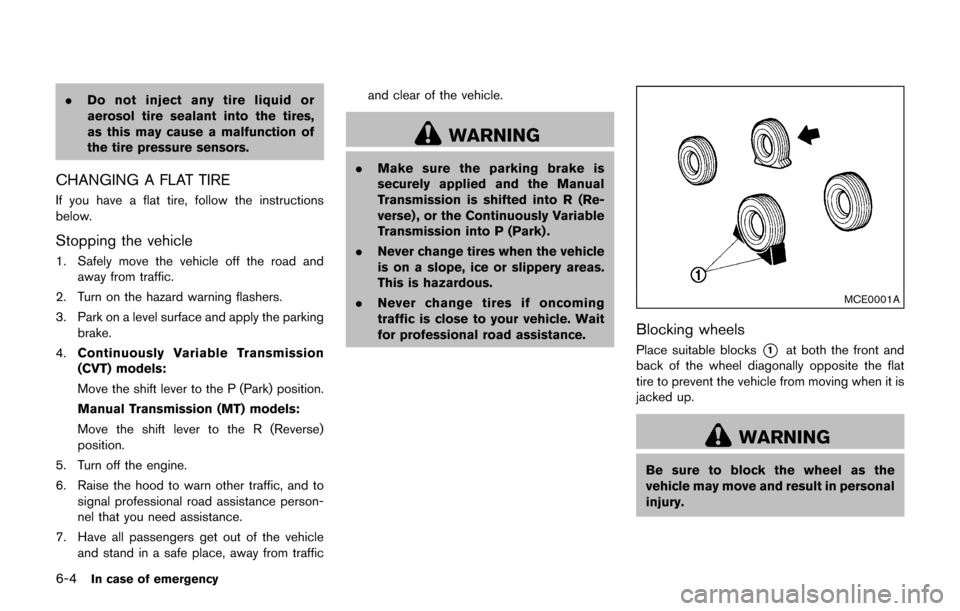
Blocking wheels
Place suitable blocks*1at both the front and
back of the wheel diagonally opposite the flat
tire to prevent the vehicle from moving when it is
jacked up.
WARNING
Be sure to block the wheel as the
vehicle may move and result in personal
injury.
Page 348 of 416
JVM0505X
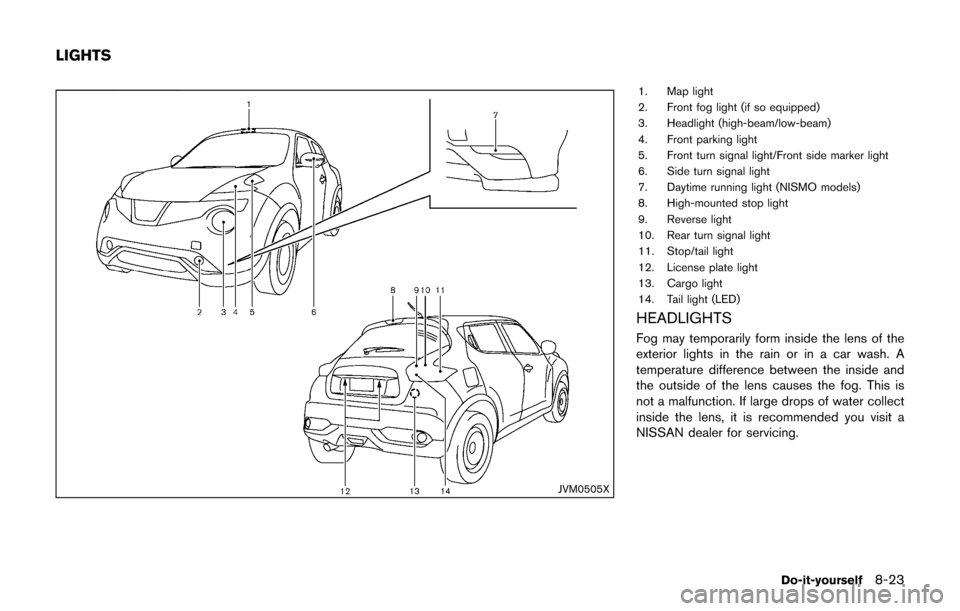
1. Map light
2. Front fog light (if so equipped)
3. Headlight (high-beam/low-beam)
4. Front parking light
5. Front turn signal light/Front side marker light
6. Side turn signal light
7. Daytime running light (NISMO models)
8. High-mounted stop light
9. Reverse light
10. Rear turn signal light
11. Stop/tail light
12. License plate light
13. Cargo light
14. Tail light (LED)
HEADLIGHTS
Fog may temporarily form inside the lens of the
exterior lights in the rain or in a car wash. A
temperature difference between the inside and
the outside of the lens causes the fog. This is
not a malfunction. If large drops of water collect
inside the lens, it is recommended you visit a
NISSAN dealer for servicing.
Do-it-yourself8-23
LIGHTS
Page 349 of 416

8-24Do-it-yourself
Replacing
Xenon headlight model:
If replacement is required, it is recommended
you visit a NISSAN dealer for this service.
WARNING
HIGH VOLTAGE
When xenon headlights are on, they
produce a high voltage. To prevent an
electric shock, never attempt to modify
or disassemble. It is recommended to
have your xenon headlights replaced at
a NISSAN dealer. For additional infor-
mation, see “Headlight and turn signal
switch” (P.2-39) .
Halogen headlight model:
The headlight is a semi-sealed beam type which
uses a replaceable headlight (halogen) bulb.
CAUTION
. Do not leave the bulb out of the
headlight reflector for a long period
of time. Dust, moisture, smoke, etc.
entering the headlight body may affect bulb performance.
. High pressure halogen gas is sealed
inside the halogen bulb. The bulb
may break if the glass envelope is
scratched or the bulb is dropped.
. Only touch the base when handling
the bulb. Never touch the glass
envelope. Touching the glass envel-
ope could significantly affect bulb
life and/or headlight performance.
. Aiming is not necessary after repla-
cing the bulb. When aiming adjust-
ment is necessary, it is
recommended you visit a NISSAN
dealer for this service.
Use the same number and wattage as originally
installed as shown in the chart.
JVM0488X
Page 351 of 416

8-26Do-it-yourself
EXTERIOR AND INTERIOR LIGHTS
ItemWattage (W)Bulb No.
Headlight high/low beams (Xenon)* 60/35HB3/D2S
Headlight high/low beams (Halogen) 60/55HB3/H11
Front turn signal light* 21WY21W
Front parking light* LED-
Front side marker light* 5W5W
Front fog light (if so equipped)* 55H11
Side turn signal light* LED-
Daytime running light (for NISMO models)* LED-
Rear combination light*
turn signal light 21WY21W
stop/tail light 21/5W21/5W
tail light (LED) LED—
back-up 16W16W
License plate light* 5W5W
Map light 5—
High-mounted stop light* LED—
Cargo light 5—
Glove box light* 1.4—
*: It is recommended you visit a NISSAN dealer for replacement.
NOTE: Always check with the Parts Department at a NISSAN dealer for the latest information about parts.
Page 370 of 416
corrosive materials, check lubrication frequently.
Lights*:Clean the headlights on a regular basis.
Make sure that the headlights, stop lights, tail
lights, turn signal lights, and other lights are all
operating properly and installed securely. Also
check headlight aim.
Road wheel nuts (lug nuts)*: When checking
the tires, make sure no wheel nuts are missing,
and check for any loose wheel nuts. Tighten if
necessary.
Tire rotation*: Tires should be rotated every
5,000 miles (8,000 km) .
Tires*: Check the pressure with a gauge often
and always prior to long distance trips. If
necessary, adjust the pressure in all tires,
including the spare, to the pressure specified.
Check carefully for damage, cuts or excessive
wear.
Tire Pressure Monitoring System (TPMS)
transmitter components: Replace the TPMS
transmitter grommet seal, valve core and cap
when the tires are replaced due to wear or age.
Wheel alignment and balance: If the vehicle
should pull to either side while driving on a
straight and level road, or if you detect uneven or
abnormal tire wear, there may be a need for
wheel alignment.
If the steering wheel or seat vibrates at normal highway speeds, wheel balancing may be
needed.
For additional information regarding tires, refer
to “Important Tire Safety Information” (US) or
“Tire Safety Information” (Canada) in the
NISSAN Warranty Information Booklet.
Windshield:
Clean the windshield on a regular
basis. Check the windshield at least every six
months for cracks or other damage. Have a
damaged windshield repaired by a qualified
repair facility.
Windshield wiper blades*: Check for cracks
or wear if they do not wipe properly.
Inside the vehicle
The maintenance items listed here should be
checked on a regular basis, such as when
performing scheduled maintenance, cleaning
the vehicle, etc.
Accelerator pedal: Check the pedal for
smooth operation and make sure the pedal
does not catch or require uneven effort. Keep
the floor mat away from the pedal.
Brake pedal: Check the pedal for smooth
operation. If the brake pedal suddenly goes
down further than normal, the pedal feels
spongy or the vehicle seems to take longer to
stop, have your vehicle checked immediately. It
is recommended you visit a NISSAN dealer for this service. Keep the floor mat away from the
pedal.
Brakes:
Check that the brakes do not pull the
vehicle to one side when applied.
Continuously Variable Transmission (CVT)
P (Park) mechanism: On a fairly steep hill,
check that the vehicle is held securely with the
shift lever in the P (Park) position without
applying any brakes.
Parking brake: Check the parking brake
operation regularly. The vehicle should be
securely held on a fairly steep hill with only the
parking brake applied. If the parking brake needs
adjusted, it is recommended you visit a NISSAN
dealer for this service.
Seat belts: Check that all parts of the seat belt
system (for example, buckles, anchors, adjusters
and retractors) operate properly and smoothly,
and are installed securely. Check the belt
webbing for cuts, fraying, wear or damage.
Seats: Check seat position controls such as
seat adjusters, seatback recliners, etc. to ensure
they operate smoothly and that all latches lock
securely in every position. Check that the head
restraints move up and down smoothly and that
the locks (if so equipped) hold securely in all
latched positions.
Steering wheel: Check for changes in the
steering conditions, such as excessive free play,
Maintenance and schedules9-3
Page 412 of 416
S
SafetyChild seat belts .................................................... 1-16
Reporting safety defects ................................. 10-20
Seat adjustment Front manual seat adjustment ............................. 1-3
Front seats ............................................................... 1-3
Seat belt(s) Child safety ........................................................... 1-16
Infants ..................................................................... 1-17
Injured persons .................................................... 1-12
Larger children ..................................................... 1-17
Precautions on seat belt usage ....................... 1-10
Pregnant women .................................................. 1-12
Seat belt cleaning .................................................. 7-7
Seat belt extenders ............................................. 1-15
Seat belt hooks .................................................... 1-15
Seat belt maintenance ....................................... 1-15
Seat belt warning light ....................................... 2-20
Seat belts .............................................................. 1-10
Seat belts with pretensioners .......................... 1-52
Shoulder belt height adjustment ..................... 1-14
Small children ....................................................... 1-17
Three-point type .................................................. 1-12
Seat(s) Heated seats ........................................................ 2-45
Seats .......................................................................... 1-2
Security system (NISSAN Vehicle Immobilizer
System) , Engine start ................................................ 2-34
Security system, Vehicle security system ............. 2-33
Servicing air conditioner ........................................... 4-35
Setting climate eco .................................................... 4-34
Shift lever Shift lock release ................................................. 5-18
Shift lock release Transmission ......................................................... 5-18 Shifting
CVT (Continuously Variable Transmission) .... 5-14
Manual transmission ........................................... 5-19
Shoulder belt height adjustment, For
front seats .................................................................... 1-14
Siri
ŠEyes Free ............................................................ 4-76
SOURCE select switch ............................................ 4-73
Spare tire .......................................................... 8-41, 10-9
Spark plugs .................................................................. 8-13
Speedometer ................................................................. 2-7
Standard maintenance ................................................ 9-7
Starting Before starting the engine ................................ 5-12
Jump starting ........................................................... 6-9
Precautions when starting and driving ............. 5-2
Push starting ......................................................... 6-11
Starting the engine ............................................. 5-13
Status light, Front passenger air bag .................... 1-46
Steering Electric power steering ...................................... 5-34
Steering wheel switch for audio controls ..... 4-73
Tilting steering column ....................................... 3-20
Storage ......................................................................... 2-47
Sun visors ..................................................................... 3-21
Supplemental air bag warning labels .................... 1-54
Supplemental air bag warning light ........... 1-54, 2-20
Supplemental restraint system ................................ 1-38 Precautions on supplemental
restraint system .................................................... 1-38
Switch Audio control steering wheel switch .............. 4-73
Autolight switch ................................................... 2-40
Fog light switch ................................................... 2-44
Hazard warning flasher switch ............................ 6-2
Headlight switch .................................................. 2-40
Power door lock switch ........................................ 3-5 Rear window and outside mirror
defroster switch ................................................... 2-38
Turn signal switch ................................................ 2-43
Vehicle dynamic control (VDC) off switch .... 2-44T
Tachometer ..................................................................... 2-9
Temperature display ................................................... 2-12
Temperature gauge, Engine coolant
temperature gauge ..................................................... 2-10
Text messaging ........................................................... 4-93
Theft (NISSAN Vehicle Immobilizer System) ,
Engine start .................................................................. 2-34
Three-way catalyst ....................................................... 5-3
Tilt steering column .................................................... 3-20
Tire pressure, Low tire pressure warning light .... 2-18
Tires
Flat tire ...................................................................... 6-3
Low tire pressure warning system ..................... 5-3
Tire and Loading information label .... 8-30, 10-12
Tire chains ............................................................. 8-37
Tire dressing ............................................................ 7-4
Tire pressure ......................................................... 8-28
Tire pressure monitoring
system (TPMS) .............................................. 5-3, 6-3
Tire rotation ........................................................... 8-38
Types of tires ........................................................ 8-36
Uniform tire quality grading ............................. 10-19
Wheel/tire size ..................................................... 10-9
Wheels and tires ................................................. 8-28
Tonneau cover (see cargo cover) .......................... 2-49
Touch screen ................................................................. 4-4
Towing Flat towing ........................................................... 10-18
Tow truck towing ................................................. 6-13
Towing a trailer ................................................... 10-18
11-5