2017 NISSAN ARMADA engine oil
[x] Cancel search: engine oilPage 522 of 614
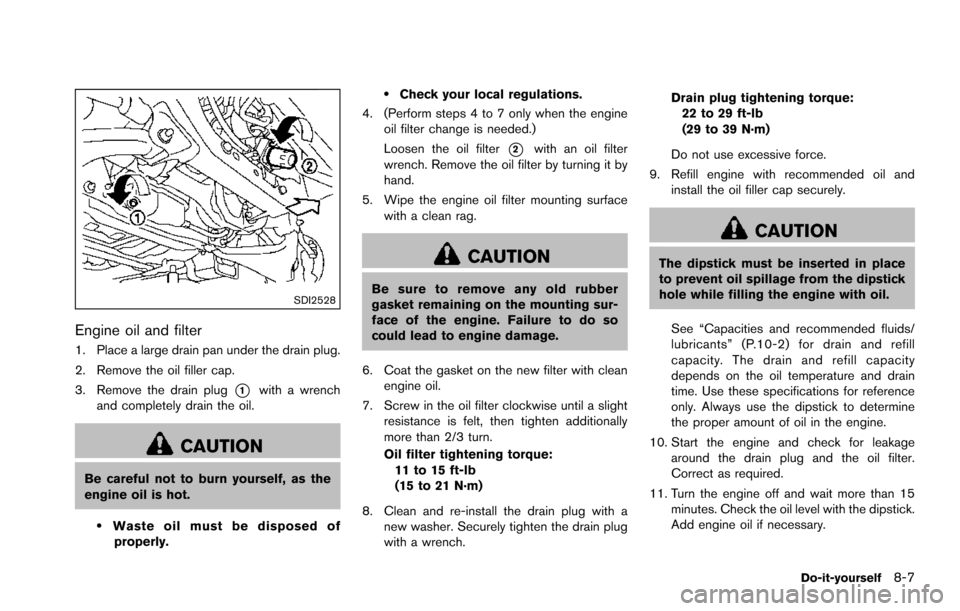
SDI2528
Engine oil and filter
1. Place a large drain pan under the drain plug.
2. Remove the oil filler cap.
3. Remove the drain plug
*1with a wrench
and completely drain the oil.
CAUTION
Be careful not to burn yourself, as the
engine oil is hot.
.Waste oil must be disposed of properly.
.Check your local regulations.
4. (Perform steps 4 to 7 only when the engine oil filter change is needed.)
Loosen the oil filter
*2with an oil filter
wrench. Remove the oil filter by turning it by
hand.
5. Wipe the engine oil filter mounting surface with a clean rag.
CAUTION
Be sure to remove any old rubber
gasket remaining on the mounting sur-
face of the engine. Failure to do so
could lead to engine damage.
6. Coat the gasket on the new filter with clean engine oil.
7. Screw in the oil filter clockwise until a slight resistance is felt, then tighten additionally
more than 2/3 turn.
Oil filter tightening torque:11 to 15 ft-lb
(15 to 21 N·m)
8. Clean and re-install the drain plug with a new washer. Securely tighten the drain plug
with a wrench. Drain plug tightening torque:
22 to 29 ft-lb
(29 to 39 N·m)
Do not use excessive force.
9. Refill engine with recommended oil and install the oil filler cap securely.
CAUTION
The dipstick must be inserted in place
to prevent oil spillage from the dipstick
hole while filling the engine with oil.
See “Capacities and recommended fluids/
lubricants” (P.10-2) for drain and refill
capacity. The drain and refill capacity
depends on the oil temperature and drain
time. Use these specifications for reference
only. Always use the dipstick to determine
the proper amount of oil in the engine.
10. Start the engine and check for leakage around the drain plug and the oil filter.
Correct as required.
11. Turn the engine off and wait more than 15 minutes. Check the oil level with the dipstick.
Add engine oil if necessary.
Do-it-yourself8-7
Page 523 of 614
8-8Do-it-yourself
After the operation
1. Install the engine undercover into positionusing the bolts.
2. Lower the vehicle carefully to the ground.
3. Dispose of waste oil and filter properly.
WARNING
. Prolonged and repeated contact
with used engine oil may cause skin
cancer.
. Try to avoid direct skin contact with
used oil. If skin contact is made,
wash thoroughly with soap or hand
cleaner as soon as possible.
. Keep used engine oil out of reach of
children. When checking or replacement is required, we
recommend a NISSAN dealer for servicing.
CAUTION
.
It is recommended that you use only
Genuine NISSAN Matic S ATF. Do
not mix with other fluids.
. Using automatic transmission fluid
(ATF) other than Genuine NISSAN
Matic S ATF may cause deteriora-
tion in driveability and automatic
transmission durability, and may
damage the automatic transmis-
sion. Damage caused by use of
fluids other than as recommended
is not covered by the NISSAN new
vehicle limited warranty.
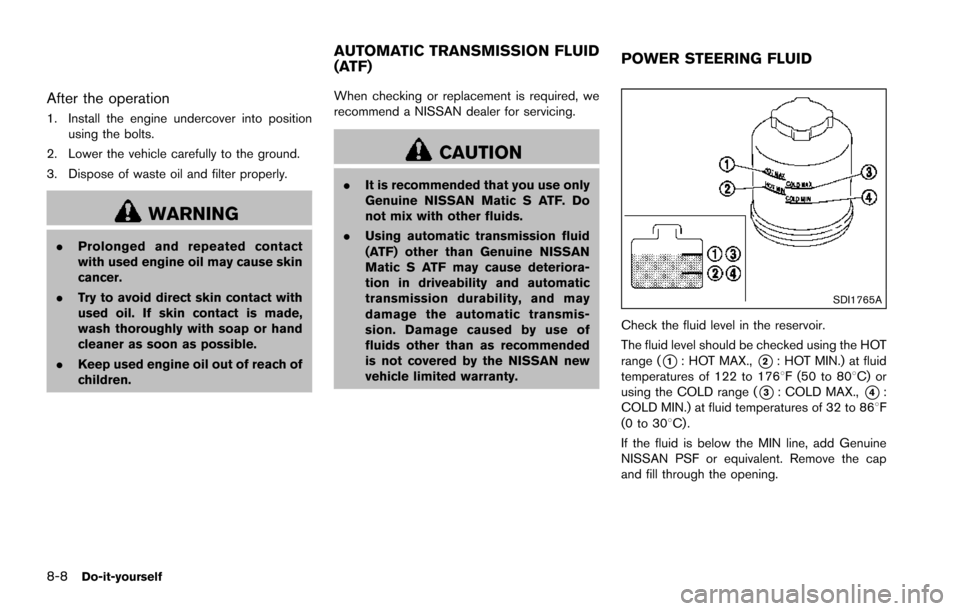
SDI1765A
Check the fluid level in the reservoir.
The fluid level should be checked using the HOT
range (
*1: HOT MAX.,*2: HOT MIN.) at fluid
temperatures of 122 to 1768F (50 to 808C) or
using the COLD range (
*3: COLD MAX.,*4:
COLD MIN.) at fluid temperatures of 32 to 868F
(0 to 308C) .
If the fluid is below the MIN line, add Genuine
NISSAN PSF or equivalent. Remove the cap
and fill through the opening.
AUTOMATIC TRANSMISSION FLUID
(ATF) POWER STEERING FLUID
Page 559 of 614
9-4Maintenance and schedules
Steering wheel:Check for changes in the
steering conditions, such as excessive free play,
hard steering or strange noises.
Warning lights and chimes: Make sure that
all warning lights and chimes are operating
properly.
Windshield defroster: Check that the air
comes out of the defroster outlets properly and
in sufficient quantity when operating the heater
or air conditioner.
Windshield wiper and washer*: Check that
the wipers and washer operate properly and that
the wipers do not streak.
Under the hood and vehicle
The maintenance items listed here should be
checked periodically (for example, each time you
check the engine oil or refuel) .
Battery*: Check the fluid level in each cell. It
should be between the MAX and MIN lines.
Vehicles operated in high temperatures or under
severe condition require frequent checks of the
battery fluid level.
NOTE:
Care should be taken to avoid situations
that can lead to potential battery discharge
and potential no-start conditions such as: 1.
Installation or extended use of electro-
nic accessories that consume battery
power when the engine is not running
(Phone chargers, GPS, DVD players,
etc.)
2. Vehicle is not driven regularly and/or
only driven short distances.
In these cases, the battery may need to be
charged to maintain battery health.
Brake fluid level*: Make sure that the brake
fluid level is between the MAX and MIN lines on
the reservoir.
Engine coolant level*: Check the coolant level
when the engine is cold.
Engine drive belts*: Make sure that no belt is
frayed, worn, cracked or oily.
Engine oil level*: Check the level after parking
the vehicle on a level spot and turning off the
engine. Wait more than 15 minutes for the oil to
drain back into the oil pan.
Exhaust system: Make sure there are no loose
supports, cracks or holes. If the sound of the
exhaust seems unusual or there is a smell of
exhaust fumes, immediately have the exhaust
system inspected. It is recommended you visit a
NISSAN dealer for this service. (See “Precau-
tions when starting and driving” (P.5-4) for
exhaust gas (carbon monoxide) .) Fluid leaks:
Check under the vehicle for fuel,
oil, water or other fluid leaks after the vehicle has
been parked for a while. Water dripping from the
air conditioner after use is normal. If you should
notice any leaks or if gasoline fumes are evident,
check for the cause and have it corrected
immediately.
Power steering fluid level* and lines: Check
the level when the fluid is cold, with the engine
off. Check the lines for proper attachment, leaks,
cracks, etc.
Radiator and hoses: Check the front of the
radiator and clean off any dirt, insects, leaves,
etc., that may have accumulated. Make sure the
hoses have no cracks, deformation, rot or loose
connections.
Underbody: The underbody is frequently ex-
posed to corrosive substances such as those
used on icy roads or to control dust. It is very
important to remove these substances, other-
wise rust will form on the floor pan, frame, fuel
lines and around the exhaust system. At the end
of winter, the underbody should be thoroughly
flushed with plain water, being careful to clean
those areas where mud and dirt may accumu-
late. For additional information, see “Cleaning
exterior” (P.7-2).
Windshield washer fluid*: Check that there is
adequate fluid in the reservoir.
Page 560 of 614
The following descriptions are provided to give
you a better understanding of the scheduled
maintenance items that should be regularly
checked or replaced. The maintenance sche-
dule indicates at which mileage/time intervals
each item requires service.
In addition to scheduled maintenance, your
vehicle requires that some items be checked
during normal day-to-day operation. Refer to
“General maintenance” (P.9-2) .
Items marked with “*” are recommended by
NISSAN for reliable vehicle operation. You are
not required to perform maintenance on these
items in order to maintain the warranties which
come with your vehicle. Other maintenance
items and intervals are required.
When applicable, additional information can be
found in the “8. Do-it yourself” section of this
manual.
NOTE:
NISSAN does not advocate the use of non-
OEM approved aftermarket flushing sys-
tems and strongly advises against per-
forming these services on a NISSAN
product. Many of the aftermarket flushing
systems use non-OEM approved chemicals
or solvents, the use of which has not been
validated by NISSAN.For recommended fuel, lubricants, fluids,
grease, and refrigerant, refer to
“Capaci-
ties and recommended fluids/lubricants”
(P.10-2) of this manual.
EMISSION CONTROL SYSTEM MAIN-
TENANCE
Drive belts*:
Check engine drive belts for wear, fraying or
cracking and for proper tension. Replace any
damaged drive belts.
Engine air filter:
Replace at specified intervals. When driving for
prolonged periods in dusty conditions, check/
replace the filter more frequently.
Engine coolant*:
Replace coolant at the specified interval. When
adding or replacing coolant, be sure to use only
Genuine NISSAN Long Life Antifreeze/Coolant
(blue) or equivalent with the proper mixture.
(Refer to “Engine cooling system” (P.8-4) to
determine the proper mixture for your area.)
NOTE:
Mixing any other type of coolant or the use
of non-distilled water may reduce the
recommended service interval of the cool-
ant. Engine oil and oil filter:
Replace engine oil and oil filter at the specified
intervals. For recommended oil grade and vis-
cosity refer to “Capacities and recommended
fluids/lubricants” (P.10-2) .
Evaporative Emissions Control Vapor
Lines*:
Check vapor lines for leaks or looseness.
Tighten connections or replace parts as neces-
sary.
Fuel lines*:
Check the fuel hoses, piping and connections
for leaks, looseness, or deterioration. Tighten
connections or replace parts as necessary.
Spark plugs:
Replace at specified intervals. Install new plugs
of the type as originally equipped.
CHASSIS AND BODY MAINTENANCE
Brake lines and cables:
Visually inspect for proper installation. Check for
chafing, cracks, deterioration, and signs of
leaking. Replace any deteriorated or damaged
parts immediately.
Brake pads and rotors:
Check for wear, deterioration and fluid leaks.
Replace any deteriorated or damaged parts
immediately.
Maintenance and schedules9-5
EXPLANATION OF SCHEDULED
MAINTENANCE ITEMS
Page 561 of 614
9-6Maintenance and schedules
Exhaust system:
Visually inspect the exhaust pipes, muffler and
hangers for leaks, cracks, deterioration, and
damage. Tighten connections or replace parts
as necessary.
Propeller shaft(s):
Check for damage, looseness, and grease
leakage.
In-cabin microfilter:
Replace at specified intervals. When driving for
prolonged periods in dusty conditions, replace
the filter more frequently.
Steering gear and linkage, axle and sus-
pension parts:
Check for damage, looseness, and leakage of oil
or grease. Under severe driving conditions,
inspect more frequently.
Tire rotation:
Tires should be rotated every 5,000 miles
(8,000km) . When rotating tires, check for
damage and uneven wear. Replace if necessary.
Transmission fluid/oil, differential oil:
Visually inspect for signs of leakage at specified
intervals.Off-road maintenance:
Check the following items frequently whenever
you drive off-road through deep sand, mud or
water:
.
Brake pads and rotors
. Brake linings and drums
. Brake lines and hoses
. Differential, transmission and transfer case
oil
. Steering linkage
. Propeller shaft(s) and front drive shafts
. Engine air filter
. Clutch housing drain (AWD only) To help ensure smooth, safe and economical
driving, NISSAN provides two maintenance
schedules that may be used, depending upon
the conditions in which you usually drive. These
schedules contain both distance and time
intervals, up to 120,000 miles (192,000 km)/
144 months. For most people, the odometer
reading will indicate when service is needed.
However, if you drive very little, your vehicle
should be serviced at the regular time intervals
shown in the schedule.
After 120,000 miles (192,000 km)/144
months, continue maintenance at the
same mileage/time intervals.
ADDITIONAL MAINTENANCE ITEMS
FOR SEVERE OPERATING CONDI-
TIONS
Additional maintenance items for severe
operating conditions;
should be performed
on vehicles that are driven under especially
demanding conditions. Additional maintenance
items should be performed if you primarily
operate your vehicle under the following condi-
tions:
. Repeated short trips of less than 5 miles (8
km) .
. Repeated short trips of less than 10 miles
(16 km) with outside temperatures remain-
ing below freezing.
MAINTENANCE SCHEDULES
Page 563 of 614
9-8Maintenance and schedules
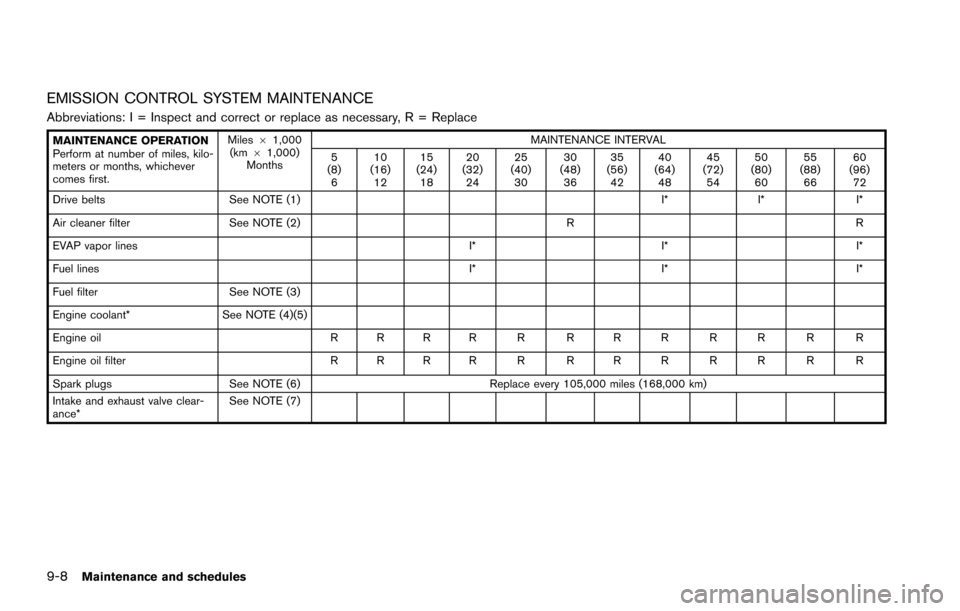
EMISSION CONTROL SYSTEM MAINTENANCE
Abbreviations: I = Inspect and correct or replace as necessary, R = Replace
MAINTENANCE OPERATION
Perform at number of miles, kilo-
meters or months, whichever
comes first.Miles
61,000
(km 61,000)
Months MAINTENANCE INTERVAL
5
(8) 6 10
(16) 12 15
(24) 18 20
(32) 24 25
(40) 30 30
(48) 36 35
(56) 42 40
(64) 48 45
(72) 54 50
(80) 60 55
(88) 66 60
(96) 72
Drive belts See NOTE (1) I*I* I*
Air cleaner filter See NOTE (2) RR
EVAP vapor lines I*I* I*
Fuel lines I*I* I*
Fuel filter See NOTE (3)
Engine coolant* See NOTE (4)(5)
Engine oil R R R R R R R R R R R R
Engine oil filter R R R R R R R R R R R R
Spark plugs See NOTE (6) Replace every 105,000 miles (168,000 km)
Intake and exhaust valve clear-
ance* See NOTE (7)
Page 564 of 614
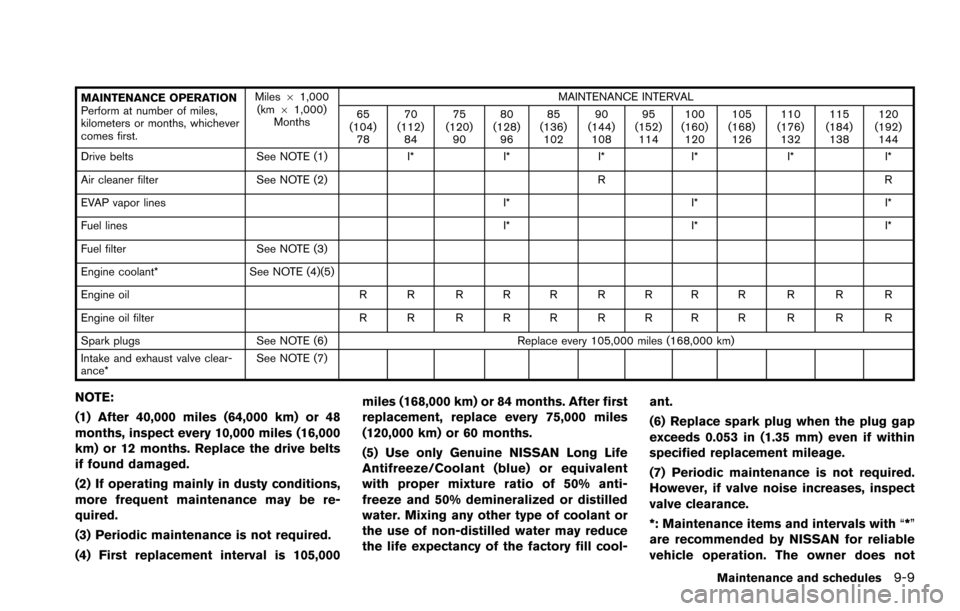
MAINTENANCE OPERATION
Perform at number of miles,
kilometers or months, whichever
comes first.Miles
61,000
(km 61,000)
Months MAINTENANCE INTERVAL
65
(104) 78 70
(112) 84 75
(120) 90 80
(128) 96 85
(136) 102 90
(144) 108 95
(152) 114 100
(160) 120 105
(168) 126 110
(176) 132 115
(184) 138 120
(192) 144
Drive belts See NOTE (1)I*I*I*I* I* I*
Air cleaner filter See NOTE (2) RR
EVAP vapor lines I*I* I*
Fuel lines I*I* I*
Fuel filter See NOTE (3)
Engine coolant* See NOTE (4)(5)
Engine oil R R R R R R R R R R R R
Engine oil filter R R R R R R R R R R R R
Spark plugs See NOTE (6) Replace every 105,000 miles (168,000 km)
Intake and exhaust valve clear-
ance* See NOTE (7)
NOTE:
(1) After 40,000 miles (64,000 km) or 48
months, inspect every 10,000 miles (16,000
km) or 12 months. Replace the drive belts
if found damaged.
(2) If operating mainly in dusty conditions,
more frequent maintenance may be re-
quired.
(3) Periodic maintenance is not required.
(4) First replacement interval is 105,000 miles (168,000 km) or 84 months. After first
replacement, replace every 75,000 miles
(120,000 km) or 60 months.
(5) Use only Genuine NISSAN Long Life
Antifreeze/Coolant (blue) or equivalent
with proper mixture ratio of 50% anti-
freeze and 50% demineralized or distilled
water. Mixing any other type of coolant or
the use of non-distilled water may reduce
the life expectancy of the factory fill cool-
ant.
(6) Replace spark plug when the plug gap
exceeds 0.053 in (1.35 mm) even if within
specified replacement mileage.
(7) Periodic maintenance is not required.
However, if valve noise increases, inspect
valve clearance.
*: Maintenance items and intervals with
“*”
are recommended by NISSAN for reliable
vehicle operation. The owner does not
Maintenance and schedules9-9
Page 572 of 614
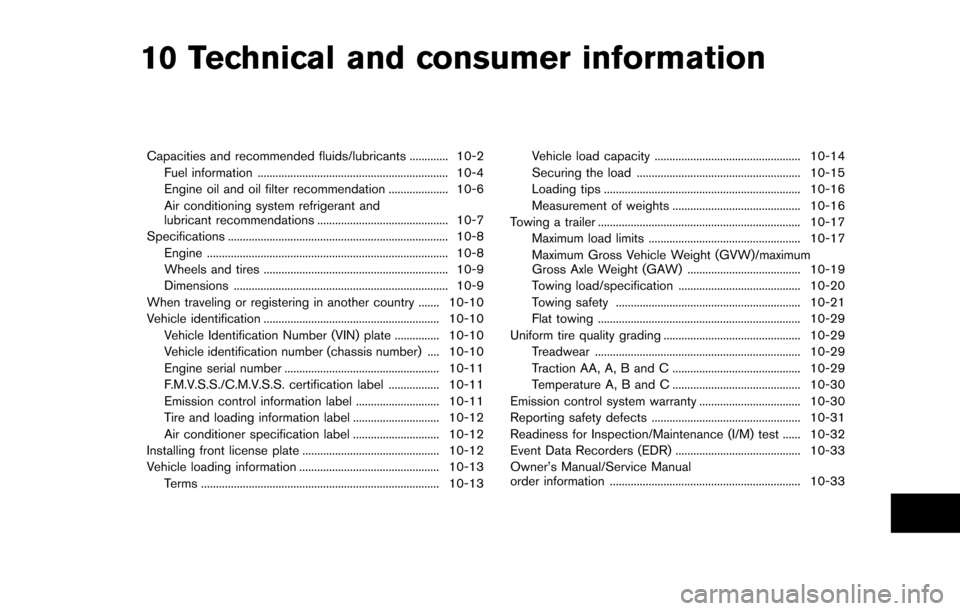
10 Technical and consumer information
Capacities and recommended fluids/lubricants ............. 10-2Fuel information ................................................................ 10-4
Engine oil and oil filter recommendation .................... 10-6
Air conditioning system refrigerant and
lubricant recommendations ............................................ 10-7
Specifications ........................................................................\
.. 10-8
Engine ........................................................................\
......... 10-8
Wheels and tires .............................................................. 10-9
Dimensions ........................................................................\
10-9
When traveling or registering in another country ....... 10-10
Vehicle identification ........................................................... 10-10 Vehicle Identification Number (VIN) plate ............... 10-10
Vehicle identification number (chassis number) .... 10-10
Engine serial number .................................................... 10-11
F.M.V.S.S./C.M.V.S.S. certification label ................. 10-11
Emission control information label ............................ 10-11
Tire and loading information label ............................. 10-12
Air conditioner specification label ............................. 10-12
Installing front license plate .............................................. 10-12
Vehicle loading information ............................................... 10-13
Terms ........................................................................\
........ 10-13 Vehicle load capacity ................................................. 10-14
Securing the load ....................................................... 10-15
Loading tips .................................................................. 10-16
Measurement of weights ........................................... 10-16
Towing a trailer .................................................................... 10-17 Maximum load limits ................................................... 10-17
Maximum Gross Vehicle Weight (GVW)/maximum
Gross Axle Weight (GAW) ...................................... 10-19
Towing load/specification ......................................... 10-20
Towing safety .............................................................. 10-21
Flat towing .................................................................... 10-29
Uniform tire quality grading .............................................. 10-29 Treadwear ..................................................................... 10-29
Traction AA, A, B and C ........................................... 10-29
Temperature A, B and C ........................................... 10-30
Emission control system warranty .................................. 10-30
Reporting safety defects .................................................. 10-31
Readiness for Inspection/Maintenance (I/M) test ...... 10-32
Event Data Recorders (EDR) .......................................... 10-33
Owner’s Manual/Service Manual
order information ................................................................ 10-33