Page 31 of 614
1-12Safety — seats, seat belts and supplemental restraint system
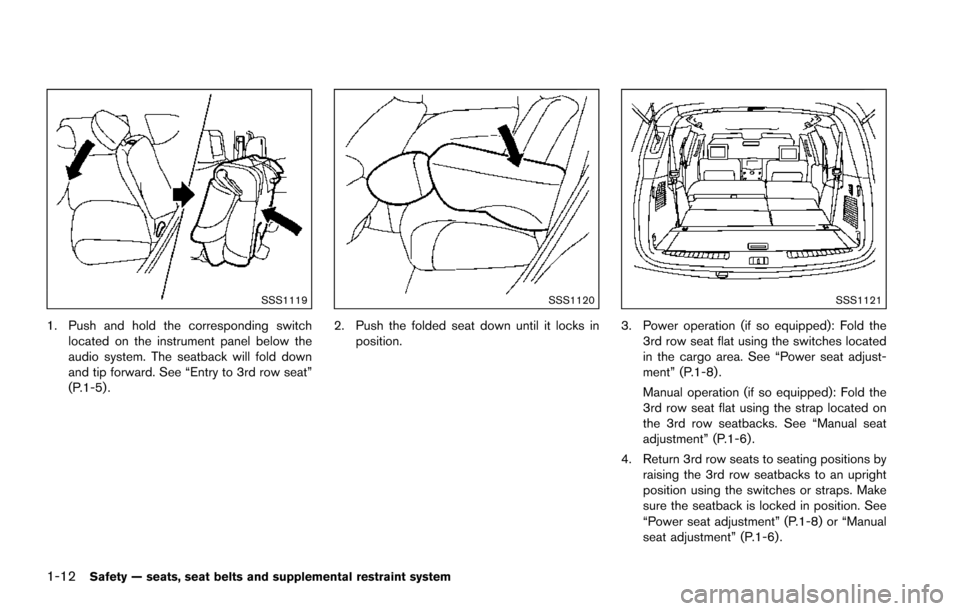
SSS1119
1. Push and hold the corresponding switchlocated on the instrument panel below the
audio system. The seatback will fold down
and tip forward. See “Entry to 3rd row seat”
(P.1-5) .
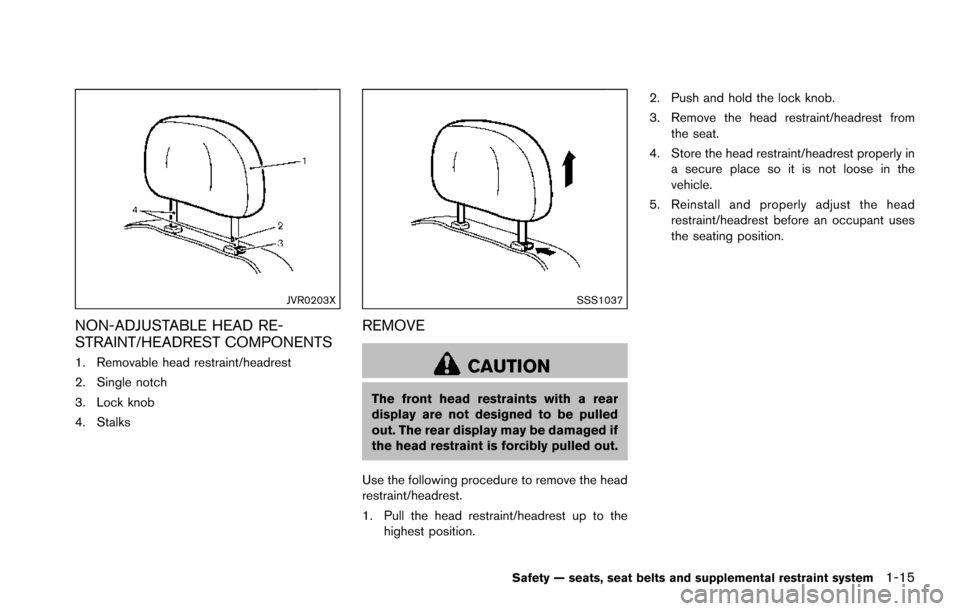
SSS1120
2. Push the folded seat down until it locks inposition.
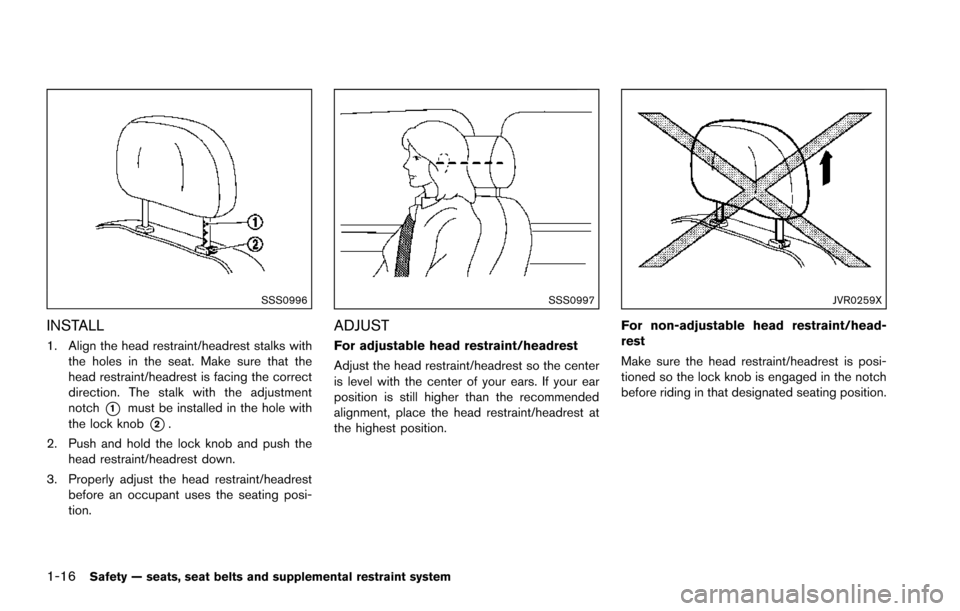
SSS1121
3. Power operation (if so equipped): Fold the3rd row seat flat using the switches located
in the cargo area. See “Power seat adjust-
ment” (P.1-8) .
Manual operation (if so equipped): Fold the
3rd row seat flat using the strap located on
the 3rd row seatbacks. See “Manual seat
adjustment” (P.1-6) .
4. Return 3rd row seats to seating positions by raising the 3rd row seatbacks to an upright
position using the switches or straps. Make
sure the seatback is locked in position. See
“Power seat adjustment” (P.1-8) or “Manual
seat adjustment” (P.1-6).
Page 32 of 614
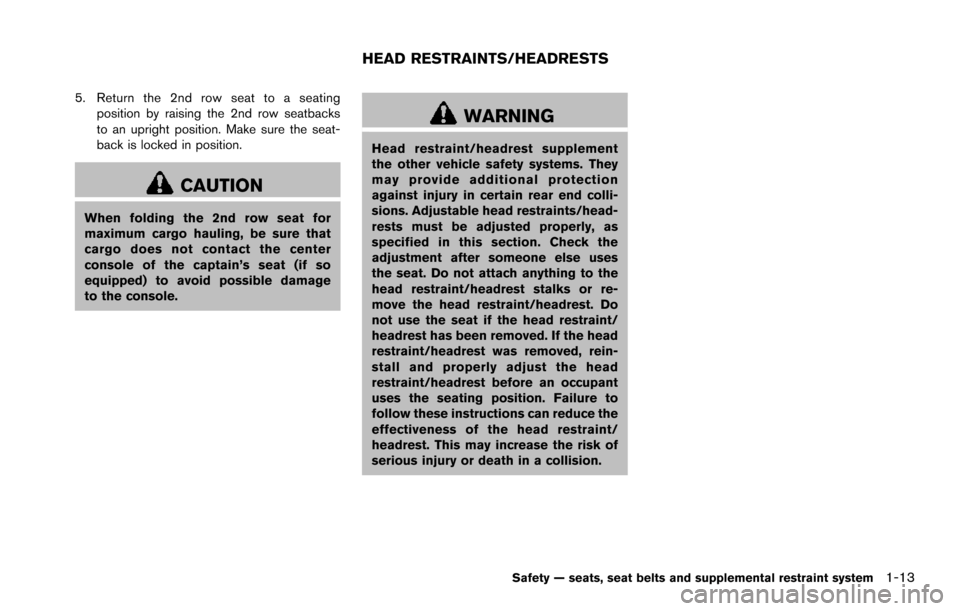
5. Return the 2nd row seat to a seatingposition by raising the 2nd row seatbacks
to an upright position. Make sure the seat-
back is locked in position.
CAUTION
When folding the 2nd row seat for
maximum cargo hauling, be sure that
cargo does not contact the center
console of the captain’s seat (if so
equipped) to avoid possible damage
to the console.
WARNING
Head restraint/headrest supplement
the other vehicle safety systems. They
may provide additional protection
against injury in certain rear end colli-
sions. Adjustable head restraints/head-
rests must be adjusted properly, as
specified in this section. Check the
adjustment after someone else uses
the seat. Do not attach anything to the
head restraint/headrest stalks or re-
move the head restraint/headrest. Do
not use the seat if the head restraint/
headrest has been removed. If the head
restraint/headrest was removed, rein-
stall and properly adjust the head
restraint/headrest before an occupant
uses the seating position. Failure to
follow these instructions can reduce the
effectiveness of the head restraint/
headrest. This may increase the risk of
serious injury or death in a collision.
Safety — seats, seat belts and supplemental restraint system1-13
HEAD RESTRAINTS/HEADRESTS
Page 33 of 614
1-14Safety — seats, seat belts and supplemental restraint system
JVR0403X
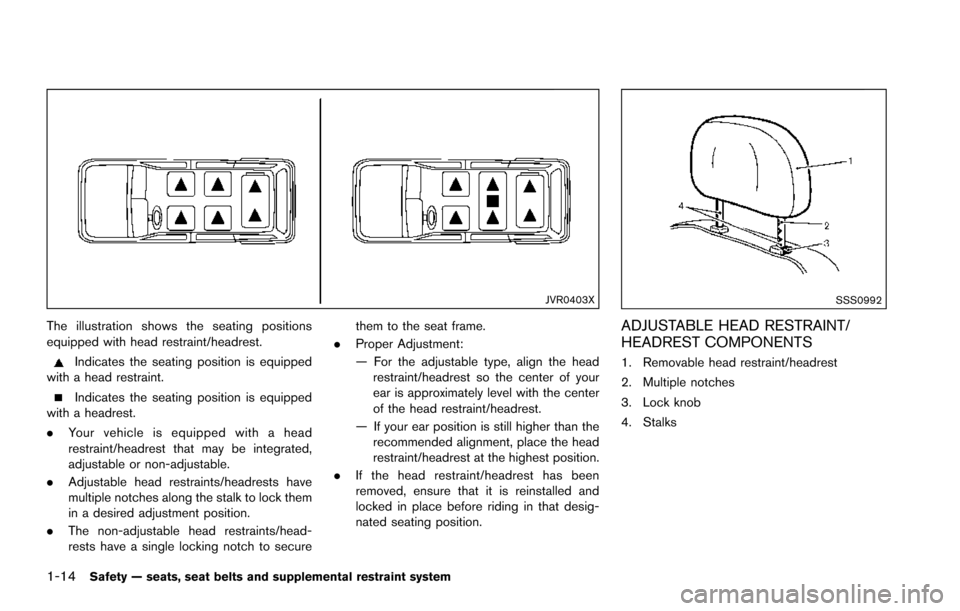
The illustration shows the seating positions
equipped with head restraint/headrest.
Indicates the seating position is equipped
with a head restraint.
Indicates the seating position is equipped
with a headrest.
. Your vehicle is equipped with a head
restraint/headrest that may be integrated,
adjustable or non-adjustable.
. Adjustable head restraints/headrests have
multiple notches along the stalk to lock them
in a desired adjustment position.
. The non-adjustable head restraints/head-
rests have a single locking notch to secure them to the seat frame.
. Proper Adjustment:
— For the adjustable type, align the head
restraint/headrest so the center of your
ear is approximately level with the center
of the head restraint/headrest.
— If your ear position is still higher than the recommended alignment, place the head
restraint/headrest at the highest position.
. If the head restraint/headrest has been
removed, ensure that it is reinstalled and
locked in place before riding in that desig-
nated seating position.
SSS0992
ADJUSTABLE HEAD RESTRAINT/
HEADREST COMPONENTS
1. Removable head restraint/headrest
2. Multiple notches
3. Lock knob
4. Stalks
Page 34 of 614
JVR0203X
NON-ADJUSTABLE HEAD RE-
STRAINT/HEADREST COMPONENTS
1. Removable head restraint/headrest
2. Single notch
3. Lock knob
4. Stalks
SSS1037
REMOVE
CAUTION
The front head restraints with a rear
display are not designed to be pulled
out. The rear display may be damaged if
the head restraint is forcibly pulled out.
Use the following procedure to remove the head
restraint/headrest.
1. Pull the head restraint/headrest up to the highest position. 2. Push and hold the lock knob.
3. Remove the head restraint/headrest from
the seat.
4. Store the head restraint/headrest properly in a secure place so it is not loose in the
vehicle.
5. Reinstall and properly adjust the head restraint/headrest before an occupant uses
the seating position.
Safety — seats, seat belts and supplemental restraint system1-15
Page 35 of 614
1-16Safety — seats, seat belts and supplemental restraint system
SSS0996
INSTALL
1. Align the head restraint/headrest stalks withthe holes in the seat. Make sure that the
head restraint/headrest is facing the correct
direction. The stalk with the adjustment
notch
*1must be installed in the hole with
the lock knob
*2.
2. Push and hold the lock knob and push the head restraint/headrest down.
3. Properly adjust the head restraint/headrest before an occupant uses the seating posi-
tion.
SSS0997
ADJUST
For adjustable head restraint/headrest
Adjust the head restraint/headrest so the center
is level with the center of your ears. If your ear
position is still higher than the recommended
alignment, place the head restraint/headrest at
the highest position.
JVR0259X
For non-adjustable head restraint/head-
rest
Make sure the head restraint/headrest is posi-
tioned so the lock knob is engaged in the notch
before riding in that designated seating position.
Page 36 of 614
SSS1035
Raise
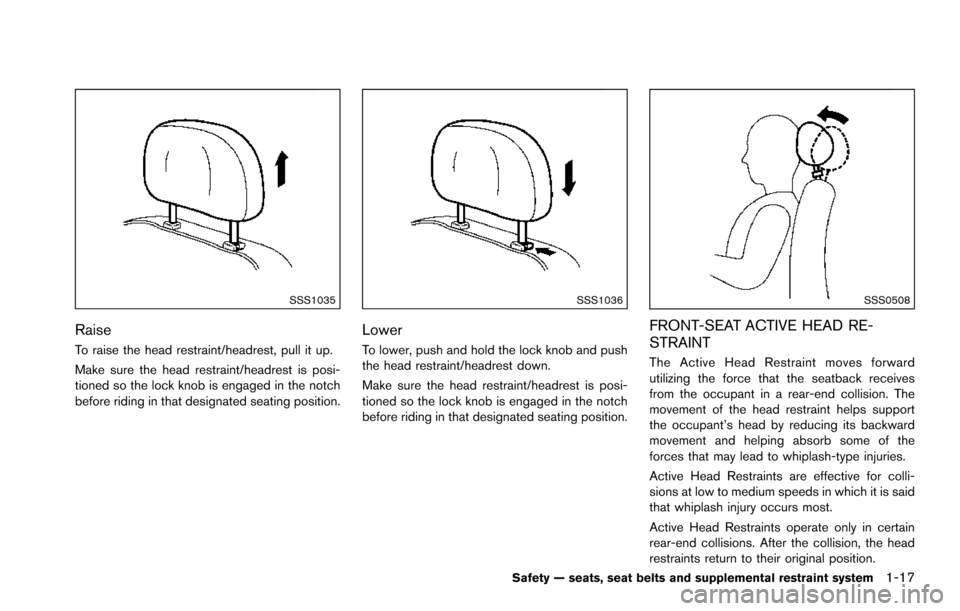
To raise the head restraint/headrest, pull it up.
Make sure the head restraint/headrest is posi-
tioned so the lock knob is engaged in the notch
before riding in that designated seating position.
SSS1036
Lower
To lower, push and hold the lock knob and push
the head restraint/headrest down.
Make sure the head restraint/headrest is posi-
tioned so the lock knob is engaged in the notch
before riding in that designated seating position.
SSS0508
FRONT-SEAT ACTIVE HEAD RE-
STRAINT
The Active Head Restraint moves forward
utilizing the force that the seatback receives
from the occupant in a rear-end collision. The
movement of the head restraint helps support
the occupant’s head by reducing its backward
movement and helping absorb some of the
forces that may lead to whiplash-type injuries.
Active Head Restraints are effective for colli-
sions at low to medium speeds in which it is said
that whiplash injury occurs most.
Active Head Restraints operate only in certain
rear-end collisions. After the collision, the head
restraints return to their original position.
Safety — seats, seat belts and supplemental restraint system1-17
Page 40 of 614
PREGNANT WOMEN
NISSAN recommends that pregnant women use
seat belts. The seat belt should be worn snug,
and always position the lap belt as low as
possible around the hips, not the waist, and
place the shoulder belt over your shoulder and
across your chest. Never run the lap/shoulder
belt over your abdominal area. Contact your
doctor for specific recommendations.
INJURED PERSONS
NISSAN recommends that injured persons use
seat belts, depending on the injury. Check with
your doctor for specific recommendations.
THREE-POINT TYPE SEAT BELT
WARNING
.Every person who drives or rides in
this vehicle should use a seat belt at
all times.
. Do not ride in a moving vehicle
when the seatback is reclined. This
can be dangerous. The shoulder belt
will not be against your body. In an
accident, you could be thrown into it
and receive neck or other serious
injuries. You could also slide under
the lap belt and receive serious internal injuries.
. For the most effective protection
when the vehicle is in motion, the
seat should be upright. Always sit
well back and upright in the seat
with both feet on the floor and
adjust the seat belt properly.
JVR0183X
WARNING
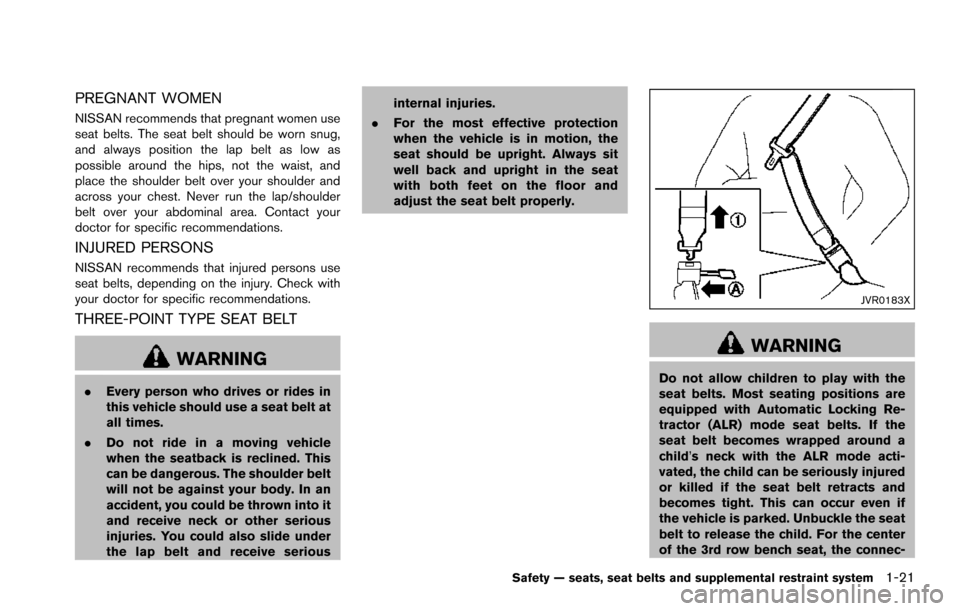
Do not allow children to play with the
seat belts. Most seating positions are
equipped with Automatic Locking Re-
tractor (ALR) mode seat belts. If the
seat belt becomes wrapped around a
child’s neck with the ALR mode acti-
vated, the child can be seriously injured
or killed if the seat belt retracts and
becomes tight. This can occur even if
the vehicle is parked. Unbuckle the seat
belt to release the child. For the center
of the 3rd row bench seat, the connec-
Safety — seats, seat belts and supplemental restraint system1-21
Page 41 of 614
1-22Safety — seats, seat belts and supplemental restraint system
tor tongue*1may also be released.
Release the connector tongue by in-
serting a suitable tool (such as a key)
into the connector buckle
*A. If the
seat belt cannot be unbuckled or is
already unbuckled, release the child by
cutting the seat belt with a suitable tool
(such as a knife or scissors) to release
the seat belt.
SSS0292
Fastening the seat belts
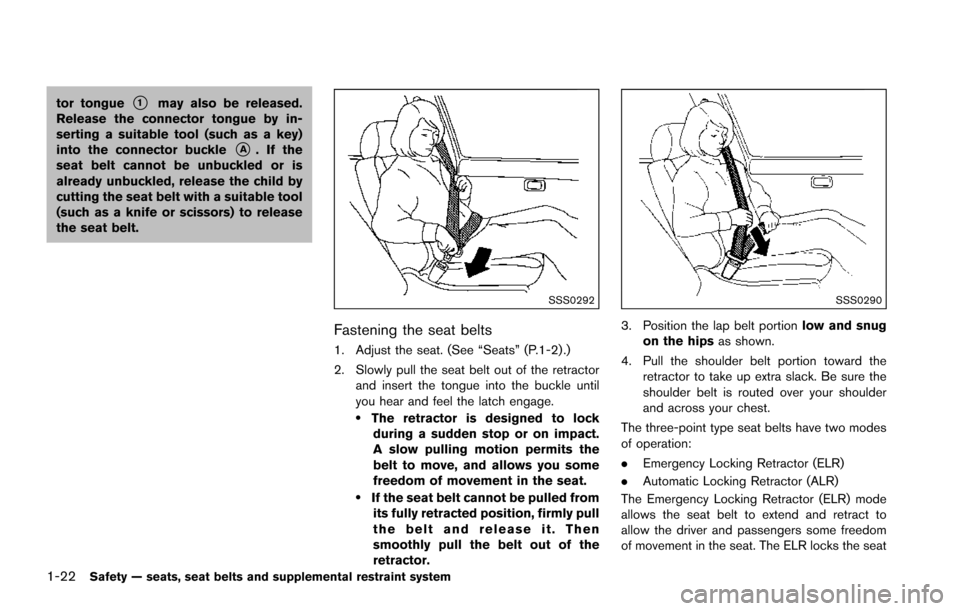
1. Adjust the seat. (See “Seats” (P.1-2) .)
2. Slowly pull the seat belt out of the retractor and insert the tongue into the buckle until
you hear and feel the latch engage.
.The retractor is designed to lockduring a sudden stop or on impact.
A slow pulling motion permits the
belt to move, and allows you some
freedom of movement in the seat.
.If the seat belt cannot be pulled from
its fully retracted position, firmly pull
the belt and release it. Then
smoothly pull the belt out of the
retractor.
SSS0290
3. Position the lap belt portion low and snug
on the hips as shown.
4. Pull the shoulder belt portion toward the retractor to take up extra slack. Be sure the
shoulder belt is routed over your shoulder
and across your chest.
The three-point type seat belts have two modes
of operation:
. Emergency Locking Retractor (ELR)
. Automatic Locking Retractor (ALR)
The Emergency Locking Retractor (ELR) mode
allows the seat belt to extend and retract to
allow the driver and passengers some freedom
of movement in the seat. The ELR locks the seat