2017 MITSUBISHI OUTLANDER SPORT airbag
[x] Cancel search: airbagPage 33 of 399
Seat belts 4-12 Seat and restraint systems
4
N00406201500
All seats are equipped with a seat belt which uses one combined lap-and-shoulder belt withan emergency locking retractor. This system is designed to provide both com- fort and safety. It permits full extension and automatic retraction of the belts during nor-mal vehicle operation. A sensing deviceinside the belt retractor is designed to lock the retractor in the event of a sudden change in the vehicle’s motion.
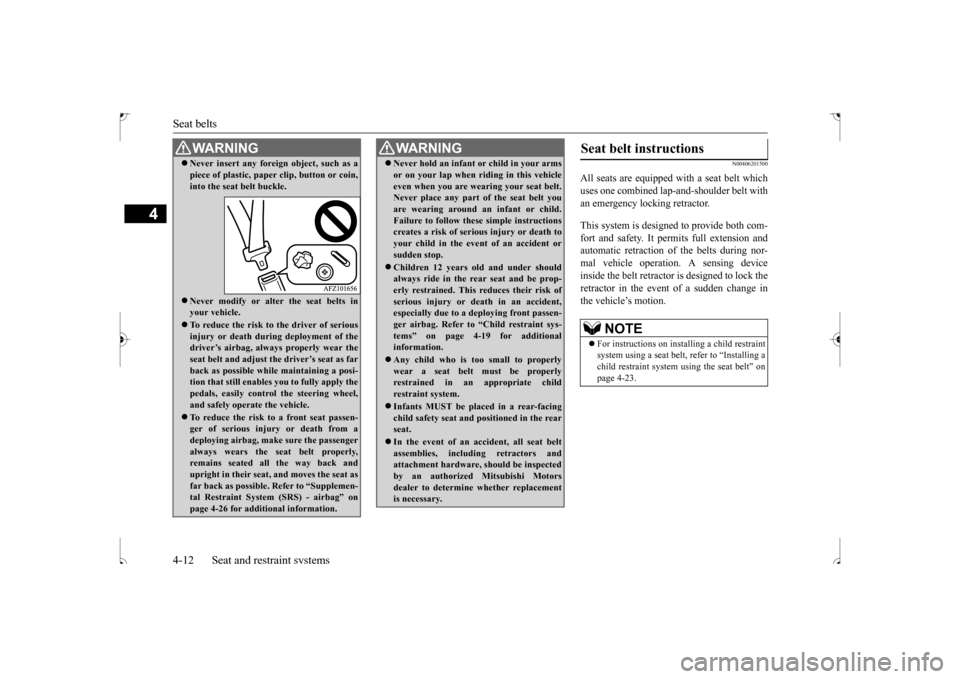
Never insert any foreign object, such as a piece of plastic, paper clip, button or coin, into the seat belt buckle. Never modify or alter the seat belts in your vehicle. To reduce the risk to the driver of serious injury or death during deployment of thedriver’s airbag, always properly wear the seat belt and adjust the driver’s seat as far back as possible while maintaining a posi-tion that still enables you to fully apply the pedals, easily control the steering wheel, and safely operate the vehicle. To reduce the risk to a front seat passen- ger of serious injury or death from adeploying airbag, make sure the passenger always wears the seat belt properly, remains seated all the way back and upright in their seat, and moves the seat as far back as possible. Refer to “Supplemen-tal Restraint System (SRS) - airbag” on page 4-26 for additional information.WA R N I N G
Never hold an infant or child in your arms or on your lap when riding in this vehicle even when you are wearing your seat belt. Never place any part of the seat belt you are wearing around an infant or child.Failure to follow these simple instructions creates a risk of serious injury or death to your child in the event of an accident orsudden stop. Children 12 years old and under should always ride in the rear seat and be prop- erly restrained. This reduces their risk of serious injury or death in an accident,especially due to a deploying front passen- ger airbag. Refer to “Child restraint sys- tems” on page 4-19 for additionalinformation. Any child who is too small to properly wear a seat belt must be properly restrained in an appropriate child restraint system. Infants MUST be placed in a rear-facing child safety seat and positioned in the rearseat. In the event of an accident, all seat belt assemblies, including retractors and attachment hardware, should be inspected by an authorized Mitsubishi Motors dealer to determine whether replacement is necessary.WA R N I N G
Seat belt instructions
NOTE
For instructions on installing a child restraint system using a seat belt, refer to “Installing a child restraint system using the seat belt” onpage 4-23.
BK0239500US.bo
ok 12 ページ 2016年5月13日 金曜日 午前8時53分
Page 34 of 399

Seat belts
Seat and restraint systems 4-13
4
1. Occupants should always sit back in their seats with their backs against the upright seatback. To reduce the risk of serious injury or death during deployment of theairbag, adjust the driver’s seat as far back as possible while maintaining a position that still enables you to fully apply thepedals, easily control the steering wheel, and safely operate the vehicle. The front passenger seat should also be moved asfar back as possible. Refer to “Supple-mental Restraint System (SRS) - airbag” on page 4-26. Also refer to “To adjust the seat forward or backward” on page 4-3.
2. Before using the rear center seat belt, make sure that the detachable anchor issecurely latched and the seat belt is not twisted. For details, refer to page 4-14. 3. Grasp the latch plate and slide it up thewebbing so that it easily pulls across your body.
4. Pull the seat belt out slowly while holding the latch plate. Push the latch plate into the buckle until you hear a “click”. Pull up on the belt to be sure the latch plate islocked securely in the buckle. 5. The lap part of the belt must always be worn low and snug across the hips. Pull up on the shoulder portion of the belt to take up any slack in the lap belt.
WA R N I N G To reduce the risk of serious injury or death in the event of an accident or sud- den stop, all seatbacks should be kept in the upright position while the vehicle is in motion.Seat belt performance during an accident can be adversely affected if the seatbacks are reclined. The more a seatback isreclined, the more likely seat belt perfor- mance will be adversely affected. If the seat belt is not properly positioned againstthe body during an accident, there is increased risk you will slide under the belt and receive serious injury or death.
NOTE
If the seat belt locks up and cannot be pulled out, pull it once with force and let it retractall the way. Then, pull the belt out slowly once again.
BK0239500US.bo
ok 13 ページ 2016年5月13日 金曜日 午前8時53分
Page 39 of 399
Seat belt pre-tensioner and force limiter systems 4-18 Seat and restraint systems
4
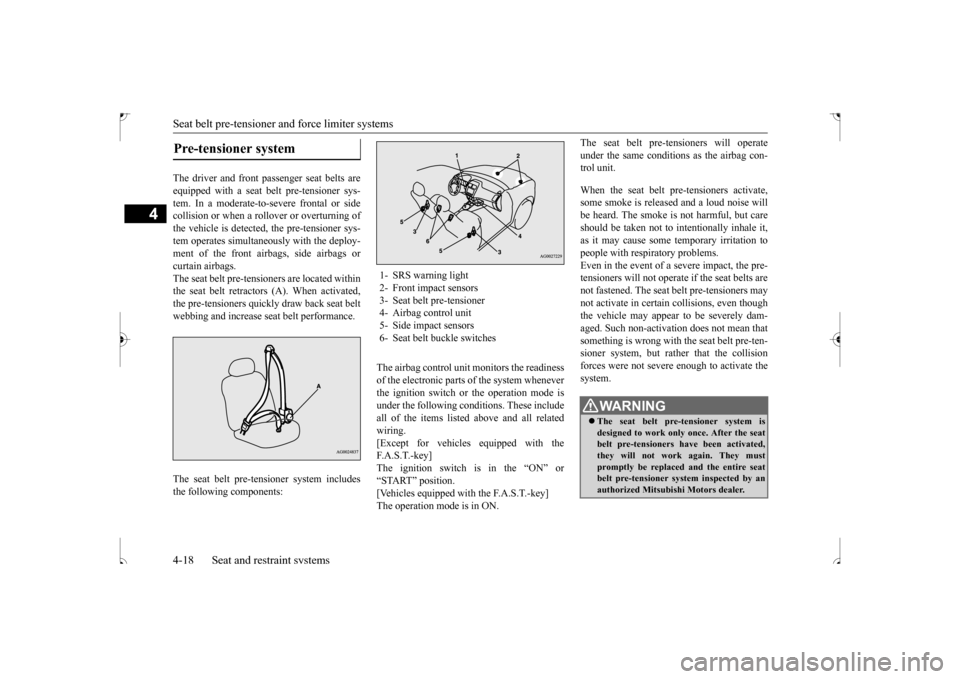
The driver and front passenger seat belts are equipped with a seat belt pre-tensioner sys-tem. In a moderate-to-severe frontal or side collision or when a rollover or overturning of the vehicle is detected, the pre-tensioner sys-tem operates simultaneously with the deploy- ment of the front airbags, side airbags or curtain airbags.The seat belt pre-tensioners are located withinthe seat belt retractors (A). When activated, the pre-tensioners quickly draw back seat belt webbing and increase seat belt performance. The seat belt pre-tensioner system includes the following components:
The airbag control unit monitors the readiness of the electronic parts of the system wheneverthe ignition switch or the operation mode isunder the following conditions. These include all of the items listed above and all related wiring.[Except for vehicles equipped with the F. A . S . T. - k e y ] The ignition switch is in the “ON” or“START” position. [Vehicles equipped with the F.A.S.T.-key] The operation mode is in ON.
The seat belt pre-tensioners will operate under the same conditions as the airbag con- trol unit. When the seat belt pre-tensioners activate, some smoke is released and a loud noise willbe heard. The smoke is not harmful, but care should be taken not to intentionally inhale it, as it may cause some temporary irritation topeople with respiratory problems. Even in the event of a severe impact, the pre- tensioners will not operate if the seat belts arenot fastened. The seat belt pre-tensioners maynot activate in certain collisions, even though the vehicle may appear to be severely dam- aged. Such non-activation does not mean thatsomething is wrong with the seat belt pre-ten- sioner system, but rather that the collision forces were not severe enough to activate thesystem.
Pre-tensioner system
1- SRS warning light2- Front impact sensors3- Seat belt pre-tensioner 4- Airbag control unit 5- Side impact sensors6- Seat belt buckle switches
WA R N I N G The seat belt pre-tensioner system is designed to work only once. After the seat belt pre-tensioners have been activated, they will not work again. They must promptly be replaced and the entire seat belt pre-tensioner system inspected by anauthorized Mitsubishi Motors dealer.
BK0239500US.bo
ok 18 ページ 2016年5月13日 金曜日 午前8時53分
Page 40 of 399
Child restraint systems
Seat and restraint systems 4-19
4
N00408700081
This warning light tells you if there is a prob- lem involving the SRS airbags and the seatbelt pre-tensioner system. Refer to “SRS warning light/display” on page 4-32.
N00408900126
In the event of an accident, the seat belt force limiter system will help reduce the force applied to the driver and front seat passenger.
N00407101724
When transporting infants or small childrenin your vehicle, an appropriate child restraint system must always be used. This is requiredby law in the U.S. and Canada. Child restraint systems specifically designed for infants and small children are offered byseveral manufacturers. Choose only a child restraint system with a label certifying that it complies with Federal Motor Vehicle SafetyStandard 213 (FMVSS 213) or Motor Vehicle Restraint Systems and Booster Seats Safety Regulations (RSSR). Look for the manufac-turer’s statement of compliance on the box and child restraint system itself.
The child restraint system should be appropri- ate for your child’s weight and height, and should properly fit your vehicle’s seat. For detailed information, refer to the instruc-tion manual accompanying the child restraint system. All children should be properly restrained in a restraint device that offers the maximum protection for their size and age.Be sure to check local, state, or provincial requirements for child size and age that may vary from the recommendations listed below. Children less than 1 year old and who weigh 22 pounds (10 kg) or less MUST ride in a rear-facing child safety seat that MUST ONLY be used in the rear seat. Children older than 1
year of age and who
weigh less than 40 pounds (18 kg) or who are less than 40 inches (100 cm) tallMUST be in a forward-facing restraint that MUST ONLY be used in the rear seat.
Children who weigh more than 40 pounds (18 kg) or who are more than 40 inches (100 cm) tall, regardless of age, should use a suitable child seat or a booster seatin the rear seat until the vehicle’s lap-and- shoulder belt fits them properly.
SRS warning Force limiter system Child restraint systems
Guidelines for child restraint system selection
WA R N I N G All children must be seated in the rear seat, and properly restrained. Accident statistics show that children of all sizes and ages are safer when properlyrestrained in the rear seat, rather than in the front seat. Any child who is too large to use a child restraint system should ride in the rear seat and wear the lap-and-shoulder beltproperly. The shoulder belt must be posi- tioned over the shoulder and across the chest, not across their neck, and with thelap belt positioned low on the child’s hips, not across their stomach. If necessary, a booster seat should be used to help achievea proper seat belt fit. Follow the booster seat manufacturer’s instructions. Only use a booster seat that is certified as comply-ing with Federal Motor Vehicle Safety Standards or Motor Vehicle Restraint Systems and Booster Seats Safety Regula- tions.
BK0239500US.bo
ok 19 ページ 2016年5月13日 金曜日 午前8時53分
Page 41 of 399
Child restraint systems 4-20 Seat and restraint systems
4
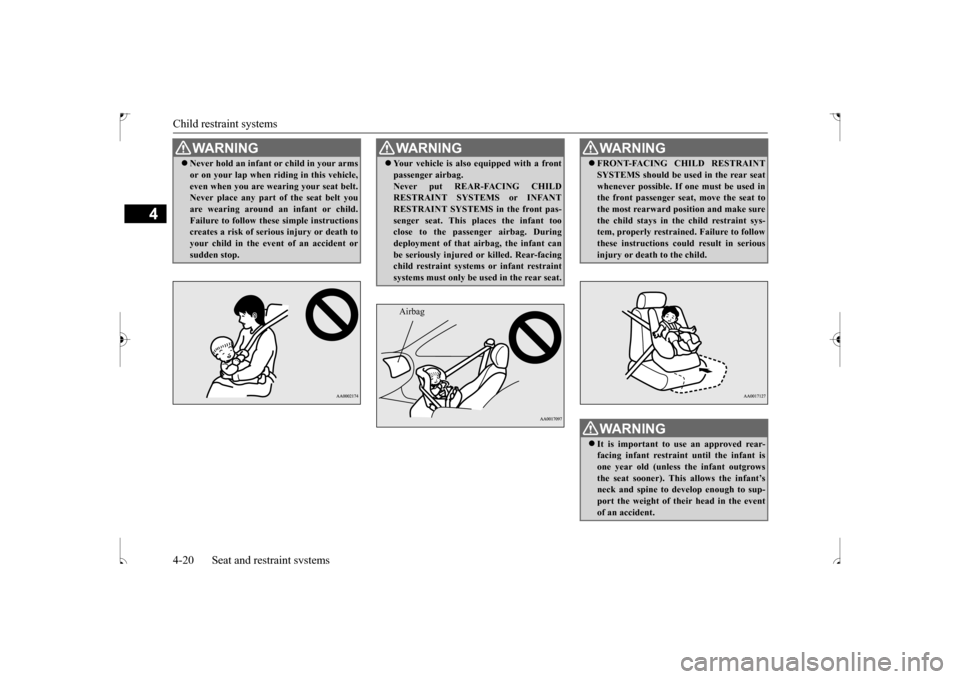
WA R N I N G Never hold an infant or child in your arms or on your lap when riding in this vehicle, even when you are wearing your seat belt. Never place any part of the seat belt you are wearing around an infant or child.Failure to follow these simple instructions creates a risk of serious injury or death to your child in the event of an accident orsudden stop.
WA R N I N G Your vehicle is also equipped with a front passenger airbag. Never put REAR-FACING CHILD RESTRAINT SYSTEMS or INFANT RESTRAINT SYSTEMS in the front pas-senger seat. This places the infant too close to the passenger airbag. During deployment of that airbag, the infant canbe seriously injured or killed. Rear-facing child restraint systems or infant restraint systems must only be used in the rear seat.Airbag
WA R N I N G FRONT-FACING CHILD RESTRAINT SYSTEMS should be used in the rear seat whenever possible. If one must be used in the front passenger seat, move the seat to the most rearward position and make surethe child stays in th
e child restraint sys-
tem, properly restrained. Failure to follow these instructions could result in seriousinjury or death to the child.WA R N I N G It is important to use an approved rear- facing infant restraint until the infant isone year old (unless the infant outgrows the seat sooner). This allows the infant’s neck and spine to develop enough to sup-port the weight of their head in the event of an accident.
BK0239500US.bo
ok 20 ページ 2016年5月13日 金曜日 午前8時53分
Page 47 of 399
Maintenance and inspection of seat belts 4-26 Seat and restraint systems
4
N00407001374
Regularly check your seat belt buckles and their release mechanisms for positive engage-ment and release of the latch plate. Check the retractors for automatic locking when in the Automatic Locking Retractor function. The entire seat belt assembly should be replaced if the webbing shows any obviouscuts, tears, increase in thickness in any sec- tion of the webbing from broken fibers, or severe fading from sunlight. All of these con-ditions indicate a weakening of the belt, which may adversely affect seat belt perfor- mance in an accident.
N00407701762
This vehicle is equipped with a SupplementalRestraint System (SRS), which includes air-bags for the driver and passengers. The SRS front airbags are designed to supple- ment the primary protection of the driver and front passenger seat belt systems by provid-ing those occupants with protection against head and chest injuries in certain moderate to severe frontal collisions. The SRS front air-bags, together with sensors at the front of the vehicle and sensors attached to the front seats, form an advanced airbag system. The SRS driver’s knee airbag is designed to supplement the primary protection of the
driver’s seat belt system. It can reduce the forward movement of the driver’s lower legs and provide increased overall body protection in certain moderate to severe frontal colli-sions. The SRS side airbags and the curtain airbags are also designed to supplement the seat belts. The SRS side airbags provide the driver andfront passenger with protection against chest injuries by deploying the bag on the side impacted in moderate to severe side impactcollisions. The SRS curtain airbags providethe driver and the passengers on the front seat and the rear outboard seats with protection against head injuries by deploying the curtainairbag on the side impacted in moderate to severe side impact collisions and by deploy- ing both curtain airbags when a rollover isdetected. The curtain airbags are also designed to help reduce the risk of complete and partial ejection from the vehicle throughside windows in both side impact and roll- over type accidents. The SRS airbags are NOT
a substitute for use
of the seat belts. For maximum protection inall types of accidents, seat belts must ALWAYS be worn by everyone who drives or rides in this vehicl
e (with infants and small
children in an appropriate child restraint sys- tem in the rear seat, and older children buck- led in the rear seat). Refer to “Child restraint
Maintenance and inspection of seat belts
WA R N I N G Do not attempt to repair or replace any part of the seat belt assemblies. This work should be done by an authorizedMitsubishi Motors dealer. Failure to have an authorized Mitsubishi Motors dealer perform the work could reduce the effec- tiveness of the belts and could result in a serious injury or death in an accident.
Never use an organic solvent to clean the seat belt webbing. Do not attempt to bleach or re-dye the seat belt webbing. These may weaken the seat belt webbing, increasing risk of injury or death in anaccident. Clean seat belt webbing only with mild soap or detergent solution and rinse itwith lukewarm water, and dry the seat belt webbing completely before retracting it.
Supplemental Restraint Sys- tem (SRS) - airbag
WA R N I N G
BK0239500US.bo
ok 26 ページ 2016年5月13日 金曜日 午前8時53分
Page 48 of 399
Supplemental Restraint System (SRS) - airbag
Seat and restraint systems 4-27
4
systems” on page 4-19.
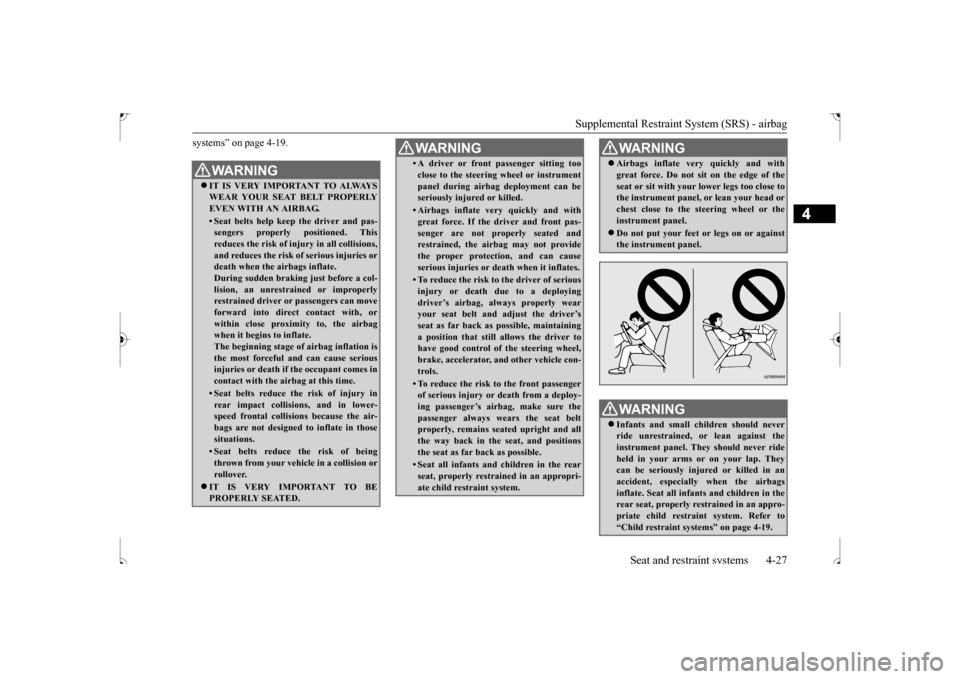
WA R N I N G IT IS VERY IMPORTANT TO ALWAYS WEAR YOUR SEAT BELT PROPERLYEVEN WITH AN AIRBAG.• Seat belts help keep the driver and pas-sengers properly positioned. This reduces the risk of injury in all collisions, and reduces the risk of serious injuries ordeath when the airbags inflate. During sudden braking just before a col- lision, an unrestrained or improperlyrestrained driver or passengers can move forward into direct contact with, or within close proximity to, the airbagwhen it begins to inflate. The beginning stage of airbag inflation is the most forceful and can cause seriousinjuries or death if the occupant comes in contact with the airbag at this time.• Seat belts reduce the risk of injury inrear impact collisions, and in lower- speed frontal collisions because the air-bags are not designed to inflate in those situations.• Seat belts reduce the risk of beingthrown from your vehicle in a collision or rollover.
IT IS VERY IMPORTANT TO BE PROPERLY SEATED.
• A driver or front passenger sitting too close to the steering wheel or instrument panel during airbag deployment can be seriously injured or killed.• Airbags inflate very quickly and withgreat force. If the driver and front pas- senger are not properly seated andrestrained, the airbag may not provide the proper protection, and can cause serious injuries or de
ath when it inflates.
• To reduce the risk to the driver of serious injury or death due to a deployingdriver’s airbag, always properly wear your seat belt and adjust the driver’s seat as far back as possible, maintaininga position that still allows the driver to have good control of the steering wheel, brake, accelerator, and other vehicle con-trols.• To reduce the risk to the front passengerof serious injury or death from a deploy- ing passenger’s airbag, make sure the passenger always wears the seat beltproperly, remains seated upright and all the way back in the seat, and positions the seat as far back as possible.• Seat all infants and children in the rearseat, properly restrained in an appropri- ate child restraint system.WA R N I N G
Airbags inflate very quickly and with great force. Do not sit on the edge of the seat or sit with your lower legs too close to the instrument panel, or lean your head or chest close to the steering wheel or theinstrument panel. Do not put your feet or legs on or against the instrument panel.WA R N I N G Infants and small children should never ride unrestrained, or lean against theinstrument panel. They should never ride held in your arms or on your lap. They can be seriously injured or killed in anaccident, especially when the airbags inflate. Seat all infants and children in the rear seat, properly restrained in an appro-priate child restraint system. Refer to “Child restraint systems” on page 4-19.WA R N I N G
BK0239500US.bo
ok 27 ページ 2016年5月13日 金曜日 午前8時53分
Page 49 of 399
Supplemental Restraint System (SRS) - airbag 4-28 Seat and restraint systems
4
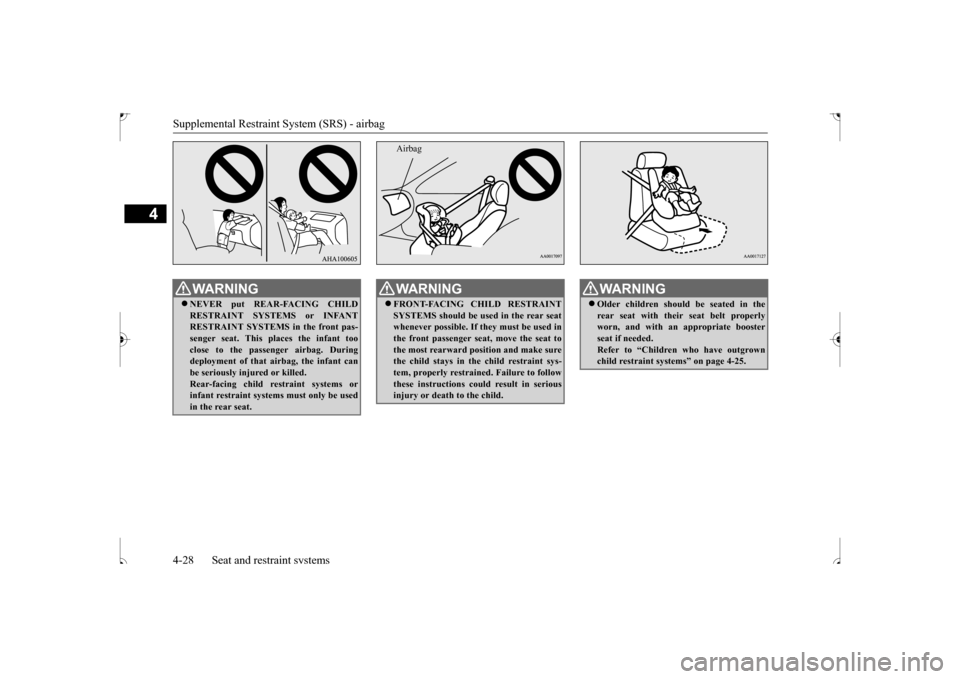
WA R N I N G NEVER put REAR-FACING CHILD RESTRAINT SYSTEMS or INFANT RESTRAINT SYSTEMS in the front pas-senger seat. This places the infant too close to the passenger airbag. During deployment of that airbag, the infant canbe seriously injured or killed. Rear-facing child restraint systems or infant restraint systems must only be usedin the rear seat.
WA R N I N G FRONT-FACING CHILD RESTRAINT SYSTEMS should be used in the rear seat whenever possible. If they must be used inthe front passenger seat, move the seat to the most rearward position and make sure the child stays in the child restraint sys-tem, properly restrained. Failure to follow these instructions could result in serious injury or death to the child.Airbag
WA R N I N G Older children should be seated in the rear seat with their seat belt properly worn, and with an appropriate boosterseat if needed. Refer to “Children who have outgrown child restraint systems” on page 4-25.
BK0239500US.bo
ok 28 ページ 2016年5月13日 金曜日 午前8時53分