2017 MITSUBISHI OUTLANDER SPORT 4WD
[x] Cancel search: 4WDPage 178 of 399
Indicator light, warning light, an
d information screen display list Features and controls 5-115
5
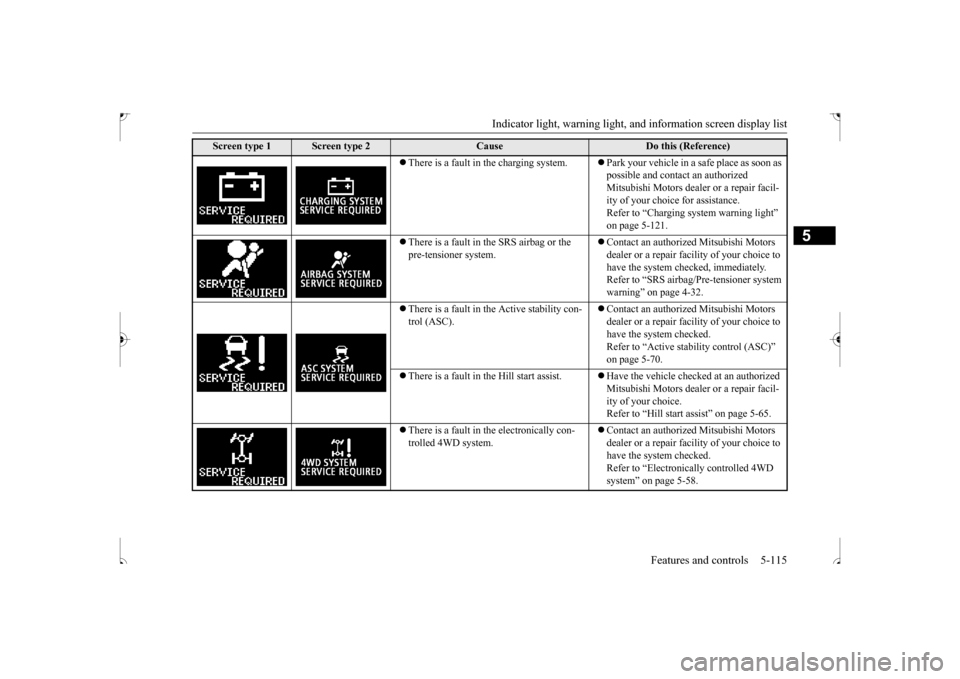
There is a fault in the charging system.
Park your vehicle in a safe place as soon as possible and contact an authorized Mitsubishi Motors dealer or a repair facil-ity of your choice for assistance. Refer to “Charging system warning light” on page 5-121.
There is a fault in the SRS airbag or the pre-tensioner system.
Contact an authorized Mitsubishi Motors dealer or a repair facility of your choice to have the system checked, immediately. Refer to “SRS airbag/Pre-tensioner system warning” on page 4-32.
There is a fault in the Active stability con- trol (ASC).
Contact an authorized Mitsubishi Motors dealer or a repair facility of your choice to have the system checked.Refer to “Active stability control (ASC)” on page 5-70.
There is a fault in the Hill start assist.
Have the vehicle checked at an authorized Mitsubishi Motors deal
er or a repair facil-
ity of your choice. Refer to “Hill start assist” on page 5-65.
There is a fault in the electronically con- trolled 4WD system.
Contact an authorized Mitsubishi Motors dealer or a repair facility of your choice to have the system checked. Refer to “Electronically controlled 4WD system” on page 5-58.
Screen type 1
Screen type 2
Cause
Do this (Reference)
BK0239500US.book
115 ページ 2016年5月13日 金曜日 午前8時53分
Page 179 of 399

Indicator light, warning light, an
d information screen display list
5-116 Features and controls
5
There is a fault in the CVT.
Contact an authorized Mitsubishi Motors dealer or a repair facility of your choice to have the system checked.Refer to “Continuously variable transmis- sion (CVT)” on page 5-51.
The electronically controlled 4WD system is hot.
Refer to “Electronically controlled 4WD sys- tem” on page 5-58.
The fuel is running low.
Refuel as soon as possible. Refer to “Fuel remaining display screen” on page 5-96.
The outside temperature is 37 °F (3 °C) or less.
Be careful driving on frozen ground. The ground may be frozen even when this warning is not displayed, so drive care- fully.
Screen type 1
Screen type 2
Cause
Do this (Reference)
BK0239500US.book
116 ページ 2016年5月13日 金曜日 午前8時53分
Page 181 of 399
Indicator light, warning light, an
d information screen display list
5-118 Features and controls
5
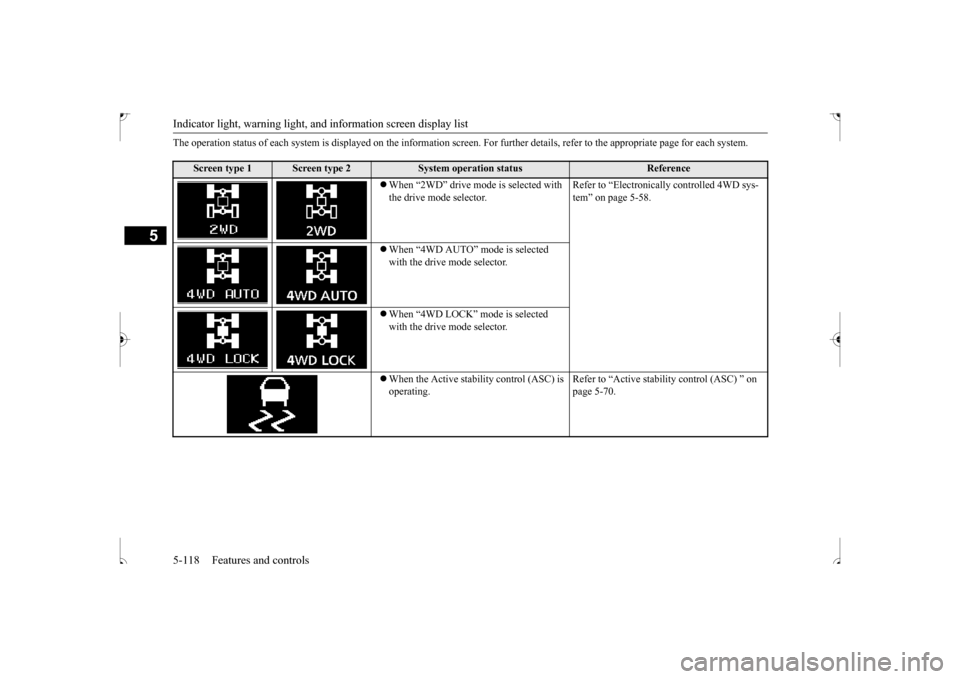
The operation status of each system is displayed on the informa
tion screen. For further details, refer to the appropriate page
for each system.
Screen type 1
Screen type 2
System operation status
Reference
When “2WD” drive mode is selected with the drive mode selector.
Refer to “Electronically controlled 4WD sys- tem” on page 5-58.
When “4WD AUTO” mode is selected with the drive mode selector. When “4WD LOCK” mode is selected with the drive mode selector. When the Active stability control (ASC) is operating.
Refer to “Active stability control (ASC) ” on page 5-70.
BK0239500US.book
118 ページ 2016年5月13日 金曜日 午前8時53分
Page 245 of 399
Driving precaution 6-2 Driving safety
6
N00629301106
Your vehicle has been designed for both nor- mal and occasional off-road use. However,avoid driving the vehicle through areas where the tires may get stuck in deep sand or mud as your vehicle is designed primarily for use onpavement, unlike a conventional off-road vehicle. Keep in mind that 2-wh
eel drive vehicles are
less capable than 4-wheel drive vehicles for driving on muddy, slippery, wet or snow-cov- ered roads.Utility vehicles have higher ground clearance and a narrower track, which enables them to perform in a wide variety of off-road situa-tions. Because of the higher ground clear- ance, these vehicles have a higher center of gravity, which makes them handle differentlythan ordinary vehicles when driving on pave- ment. They are not designed to maneuver or corner at the same speed on pavement as con-ventional 2-wheel drive passenger cars any more than low-slung sports cars are designed
to perform satisfactorily in off-road condi- tions. Always drive safely and steer the vehicle carefully. Avoid operating the vehicle in amanner that might require sharp turns or abrupt maneuvers. As with other vehicles of this type, failure to operate this vehicle cor-rectly can result in loss of control or vehicle rollover. In a rollover crash, an unbelted person is sig-nificantly more likely to die than a personwearing a seat belt. Before starting the vehi- cle, always make certain that you and all your passengers are properly wearing their seatbelts (with children in the rear seat, in appro- priate restraints).
N00628800152
Fuel economy is dependent on many factors.Your personal driving habits can have a sig- nificant effect on your fuel use. Several rec-ommendations for achieving the greatest fuel economy are listed below. Whenever accelerating from a stop, always accelerate slowly and smoothly. When parked for even a short period, do not idle the engine. Shut it off. Plan your trips to avoid unnecessary stops.
Keep your tires inflated to the recom- mended pressures. When you drive on highways or dry improved roads, set the drive mode-selec-tor “2WD” or “4WD AUTO” position (if so equipped). For freeway driving, maintain a speed of approximately 50 mph (80 km/h) when traffic, roadway and weather conditions safely permit. Keep your air filter clean and your vehicle lubricated according to the recommenda- tions in this manual. Always keep your vehicle well main- tained. A poorly maintained engine wastes fuel and costs money. Never overload your vehicle.
N00628900049
Drunk driving is one of the most frequent causes of accidents.Your driving ability can be seriously impaired even with blood alcohol levels far below the legal minimum. If you have beendrinking, don’t drive. Ride with a designated non-drinking driver, call a cab or a friend, or use public transportation. Drinking coffee ortaking a cold shower will not make you sober. Similarly, prescription and nonprescription drugs affect your alertness, perception andreaction time. Consult with your doctor or
Driving precaution
WA R N I N G Utility vehicles have
a significantly higher
rollover rate than other types of vehicles. Avoid abrupt maneuvers and excessive speed. Always buckle up.
Fuel economy
Driving, alcohol and drugs
BK0239500US.bo
ok 2 ページ 2016年5月13日 金曜日 午前8時53分
Page 395 of 399

Alphabetical index 12-2
12
Fluid
.....................
.................
9-9
, 11-5
Selector lever operation
...................
5-51
Selector lever positions
...................
5-54
Sports mode
..................
.................
5-55
Coolant (engine)
..........................
9-7
, 11-5
Cruise control
....................
.................
5-73
Cup holder
....................
...................
5-176
D
Daytime running lights
Bulb capacity
................
.................
9-30
Replacement
.................
.................
9-37
Defogger (rear window)
....................
5-136
Defrosting or defogging (windshield, door windows)
.................
7-8
, 7-13
, 7-18
, 7-24
Dimensions
...................
.....................
11-3
Dimmer (high/low beam change)
.......
5-127
Disc brake pads
.................
.................
9-23
Dome light
Bulb capacity
................
.................
9-32
Doors
Lock
......................
........................
5-28
Power door locks
............................
5-30
Driving during cold weather
..................
6-5
Driving precaution
................
................
6-2
Driving, alcohol and drugs
.....................
6-2
E
Electric rear window defogger switch
..5-136
Electronic immobilizer (Anti-theft starting system)
.....................
................
5-4
, 5-23
Electronically controlled 4WD system
..5-58
Emission-control system maintenance
...
9-22
Engine
Compartment
..................
.................
9-5
Coolant
...................
................
9-7
, 11-5
Hood
.......................
........................
9-3
Oil and oil filter
.......................
9-5
, 11-5
Overheating
....................
.................
8-4
Serial number
.................
................
11-2
Specification
...................
................
11-4
Engine coolant temperature display
.......
5-92
Engine hood
....................
....................
9-3
Engine switch
.....................
................
5-17
Exhaust system
...................
................
9-24
F
Floor console box
..............................
5-175
Floor mat
.........................
....................
6-3
Fluid
Automatic transaxle fluid
.................
11-5
Brake fluid
.....................
................
11-5
Continuously variable transmission (CVT) fluid
...................
...................
9-9
, 11-5
Engine coolant
.........................
9-7
, 11-5
Washer fluid
.........................
9-10
, 11-5
Fluid capacities and lubricants
.............
11-5
Free-hand advanced security transmitter (F.A.S.T.-key)
.................
.................
5-12
Front fog lights
Bulb capacity
................
.................
9-30
Indicators
..................
...................
5-120
Replacement
.................
.................
9-35
Switch
......................
...................
5-130
Front seat adjustment
............................
4-3
Front side-marker lights
Bulb capacity
................
.................
9-30
Replacement
.................
.................
9-34
Front turn signal light
Bulb capacity
................
.................
9-30
Replacement
.................
.................
9-35
Fuel
Filling the fuel tank
...........................
3-3
Fuel economy
...................
................
6-2
Fuel hoses
.....................
.................
9-23
Fuel selection
...................
................
3-2
Tank capacity
................
.................
11-5
Fuses
.........................
........................
9-25
Fusible links
..................
.....................
9-25
G
General maintenance
Maintenance
..................
.................
9-23
General vehicle data
............................
11-3
BK0239500US.bo
ok 2 ページ 2016年5月13日 金曜日 午前8時53分