2017 MITSUBISHI OUTLANDER PHEV light
[x] Cancel search: lightPage 255 of 548

Brake assist systemE00627001793
The brake assist system is a device assisting drivers who cannot depress the brake pedalfirmly when it is necessary to do so (such as
in emergency stop situations) and provides
greater braking force.
If the brake pedal is depressed suddenly, the brakes will be applied with more force thanusual.CAUTIONl The brake assist system is not a device de-
signed to exercise braking force greater than its capacity. Make sure to always keep a suf-
ficient distance between your vehicle and a
vehicle in front of you without relying too much on the brake assist system.NOTEl Once the brake assist system is operational,
it maintains great braking force even if the
brake pedal is lightly released.
To stop its operation, completely remove
your foot from the brake pedal.NOTEl When the brake assist system is in use, you
may feel as if the depressed brake pedal issoft, the pedal moves in small motions inconjunction with the sound of the ABS oper- ation, or the vehicle body and the steering
wheel vibrate. This occurs when the brake
assist system is operating normally and does not indicate faulty operation. Continue to
firmly depress the brake pedal.
l You may hear an operation noise when the
brake pedal is depressed suddenly while sta-
tionary. This does not indicate a malfunction
and the brake assist system is operating nor- mally.
l When the anti-lock brake system warning
lamp or only Active Stability Control warn- ing lamp illuminate, the brake assist system
in not functioning.Emergency stop signal
system E00626001060
This is a device that reduces the possibility ofrear end collisions by the rapid and automatic blinking of the hazard warning lamps to alert
vehicles approaching from behind during sudden braking. When the emergency stop
signal system operates, the hazard warning indication lamp in the instrument cluster
blinks rapidly at the same time.
CAUTIONl If the ABS warning or ASC warning is dis-
played, the emergency stop signal system may not operate. Refer to “ABS warning lamp/display” on page 7-38.
Refer to “ASC warning display” on page
7-42.NOTEl [Activating condition for the emergency stop
signal system]
It activates when all of the following condi-
tions are met.
• The vehicle speed is approximately
55 km/h (34 mph) or higher.
• The brake pedal has been depressed, and
the system judges that it was sudden brak- ing from the vehicle deceleration and theoperating condition of the anti-lock brake
system (ABS).
[Deactivating condition for the emergency
stop signal system]
It deactivates when one of the following conditions is met.
• The brake pedal is released.
• The hazard warning flasher switch is
pressed.
• The system judges that it was not sudden
braking from the vehicle deceleration and
the operating condition of the anti-lock
brake system (ABS).
Brake assist system
7-36OGGE17E1Starting and driving7
Page 257 of 548

CAUTIONlNever install a limited-slip differential,
which is not MITSUBISHI MOTORS GEN-
UINE parts, as the ABS may not function
normally.
We recommend you to consult a
MITSUBISHI MOTORS Authorized Serv-
ice Point.ABS warning lamp/display
E00607202321
Warning lampWarning display
If there is a malfunction in the system, the
ABS warning lamp will come on and the
warning display will appear on the informa- tion screen in the multi information display.
Under normal conditions, the ABS warning
lamp only comes on when the operation
mode is put in ON and goes off a few sec- onds later.
CAUTIONl Any of the following warning lamp/display
behaviour indicates that the ABS is not func-tioning and only the standard brake system
is working. (The standard brake system is functioning normally.) If this happens, takeyour vehicle to a MITSUBISHI MOTORS
Authorized Service Point.
• When the operation mode is put in ON,
the warning lamp does not come on or it remains on and does not go off.
• The warning lamp comes on while driv-
ing.
• The warning display appears while driv-
ing.If the warning lamp/display il-
luminate while driving
E00607302423
If only the ABS warning lamp/ display illuminate
l Avoid hard braking and high-speed driv-
ing. Stop the vehicle in a safe place.
Restart the Plug-in Hybrid EV System and check to see whether the lamp goes
out after a few minutes driving; if it then remains off during driving, there is no
problem.
However, if the lamp does not go out, or if it lights up again when the vehicle is driven, we recommend you to have the
vehicle checked as soon as possible.
l If you start Plug-in Hybrid EV System
when the auxiliary battery voltage is in-
sufficient, ABS warning lamp/display may illuminate, but this is not a failure
of ABS. When the drive battery is charg-
ed, the auxiliary battery is also charged, and the warning lamp/display will go
out. If the warning lamp/display contin- ues illuminating even after the battery is
sufficiently charged or the warning
lamp/display illuminates frequently, have your vehicle inspected by a
MITSUBISHI MOTORS Authorized
Service Point.
If the ABS warning lamp/ display and brake warning
lamp/display illuminate at the same time
Warning lamp
Anti-lock brake system (ABS)
7-38OGGE17E1Starting and driving7
Page 277 of 548

NOTElEven if the ACC is in the activated state
when the operation mode is set to “OFF”,
the system does not automatically become
activated when the operation mode is set to “ON” next time.
To activate ACC control
With the ACC turned on (in the ‘standby
state’), push down the “SET -” switch whiledriving.
When your desired speed is reached, release
the “SET -” switch; then this speed is set and
the ACC initiates the speed control to the set speed.
The set speed is indicated on the informationscreen of the multi-information display.
The ACC can be selected between approxi-
mately 40 km/h (25 mph) to 180 km/h
(112 mph).
You can set and initiate the speed control when driving at approximately 10-40 km/h
while a vehicle in front is being detected. In this case, the target speed is set to 40 km/h
(25 mph).
Setting to any speed outside this range does
not cause the ACC to start the control.
When the ACC is initialized, a buzzer sound
is heard and the “SET” indicator lights up on the screen. At the same time, the display showing the following distance setting and
the running-ahead vehicle symbol (only when
the ACC is detecting a vehicle in front) is switched to the in-control mode display.NOTEl The ACC cannot start the control when any
of the following conditions is present. You
are alerted to this state by a sounding buzzer.
• When the vehicle speed is lower than ap-
proximately 10 km/h (6 mph) or 180 km/h
(112 mph) or higher.
• When the vehicle is running at a speed be-
tween approximately 10 km/h (6 mph)
and 40 km/h (25 mph) and the ACC does
not detect a vehicle in front.
• When ASC is in the OFF state.
• When ABS, ASC or TCL is working.
Adaptive Cruise Control System (ACC)*
7-58OGGE17E1Starting and driving7
Page 286 of 548

CAUTION•When the vehicle in front is towing a
trailer.
• A freight trailer that is not carrying a con-
tainer.
• The vehicle has a protruding load from
the carrier.
• The vehicle has a low vehicle height.
• The vehicle has an extremely high ground
clearance.
• When a vehicle in front is extremely dirty.
• When a vehicle in front is covered with
snow.
• When a vehicle in front has a large glass
surface.
• When a vehicle in front does not have re-
flectors (lamp reflector) or the position of the reflector is low.
• When a vehicle in front is a car carrier or
a similar shaped vehicle.
• When there is a different object near the
vehicle.
• When driving on a road with many and
successive curves, including when pass-
ing their entrances and outlets.
• When accelerating and decelerating
quickly.
• When the system recognizes driver’s
steering, accelerating, braking or gear
shifting actions as evasive actions to
avoid collision.
• When you are driving on a road with
steep and alternating up and down slopes.CAUTION• When driving on a slippery road covered
by rain water, snow, ice etc.
• When a road surface is surging, and there
is unevenness.
• When driving in dark areas, such as in a
tunnel or at night.
• When your vehicle changed lanes, and
your vehicle approached immediately be-
hind the vehicle in front.
• During a certain time after your vehicle
turns left or right.
• When you are carrying extremely heavy
loads in the rear seats or luggage area.
• After the Plug-in Hybrid EV System has
been running for an extended period of
time.
• When using a windscreen washer.
• If windscreen wipers are not
MITSUBISHI MOTORS GENUINE
parts or equivalent.
• When the sensor becomes extremely hot
or cold.
• If the auxiliary battery becomes weak or
runs down.
• When the sensor is affected by strong
light, such as direct sunlight or the head-lamps of an oncoming vehicle.
• Under adverse weather conditions (rain,
snow, sand storms, etc.)
• When the windscreen of the sensor por-
tion is covered with dirt, water droplets,
snow and ice, etc.CAUTION• When water, snow or sand on the road are
extorted by the vehicle in front or an on- coming vehicle.
l The FCM may not detect a pedestrian in cer-
tain situations. Some of these include:
• It the pedestrian is shorter than approxi-
mately 1 m or taller than approximately 2 m.
• If the pedestrian is wearing loose-fitting
clothes.
• If part of a pedestrian’s body is hidden,
such as when holding an umbrella, large
bag, etc.
• If a pedestrian bends forward, sits or lies
on the road.
• When a pedestrian is pushing/pulling
something, such as a stroller, bicycle or
wheelchair.
• When pedestrians gather in a group.
• When a pedestrian’s clothing appears to
be nearly the same colour or brightness as
its surroundings.
• When a pedestrian is very close to an ob-
ject, such as a vehicle.
• When a pedestrian is in a dark area, such
as at night or in a tunnel.
• When the pedestrian is walking fast or
running.
• When a pedestrian suddenly rushes in
front of the vehicle.
• When the position of a pedestrian is close
to the edge of the vehicle.
Forward Collision Mitigation System (FCM)*
7-67OGGE17E1Starting and driving7
Page 294 of 548
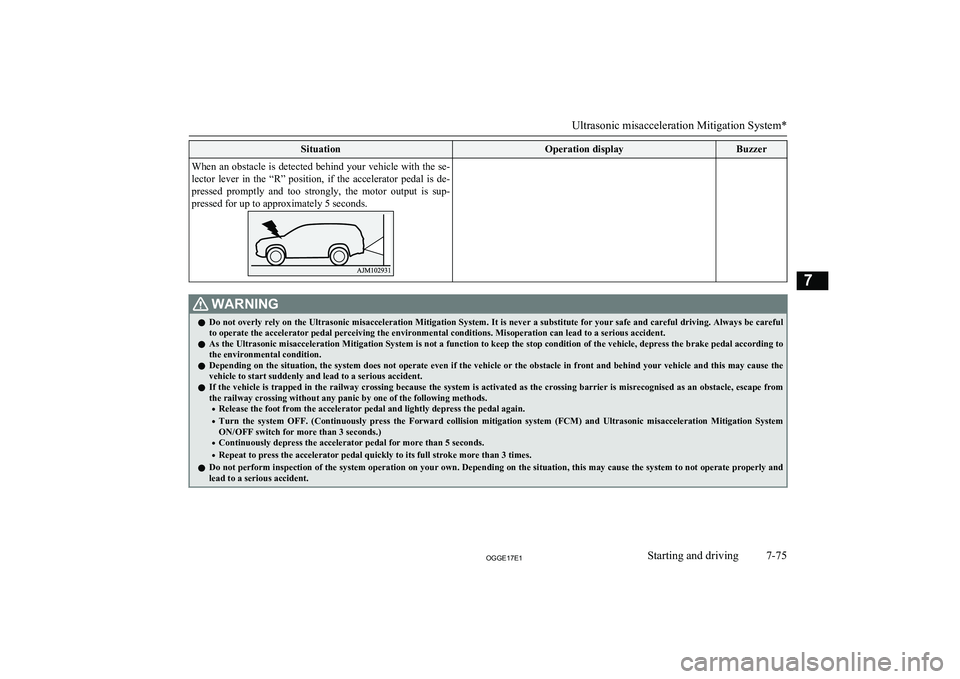
SituationOperation displayBuzzerWhen an obstacle is detected behind your vehicle with the se-
lector lever in the “R” position, if the accelerator pedal is de-
pressed promptly and too strongly, the motor output is sup- pressed for up to approximately 5 seconds.WARNINGl Do not overly rely on the Ultrasonic misacceleration Mitigation System. It is never a substitute for your safe and careful driving. Always be careful
to operate the accelerator pedal perceiving the environmental conditions. Misoperation can lead to a serious accident.
l As the Ultrasonic misacceleration Mitigation System is not a function to keep the stop condition of the vehicle, depress the brake pedal according to
the environmental condition.
l Depending on the situation, the system does not operate even if the vehicle or the obstacle in front and behind your vehicle and this may cause the
vehicle to start suddenly and lead to a serious accident.
l If the vehicle is trapped in the railway crossing because the system is activated as the crossing barrier is misrecognised as an obstacle, escape from
the railway crossing without any panic by one of the following methods.
• Release the foot from the accelerator pedal and lightly depress the pedal again.
• Turn the system OFF. (Continuously press the Forward collision mitigation system (FCM) and Ultrasonic misacceleration Mitigation System
ON/OFF switch for more than 3 seconds.)
• Continuously depress the accelerator pedal for more than 5 seconds.
• Repeat to press the accelerator pedal quickly to its full stroke more than 3 times.
l Do not perform inspection of the system operation on your own. Depending on the situation, this may cause the system to not operate properly and
lead to a serious accident.
Ultrasonic misacceleration Mitigation System*
7-75OGGE17E1Starting and driving7
Page 297 of 548

CAUTIONlImproperly handling the system components may result in such problems as degraded sensor performance and ultimately in an accident.
Be sure to take the following precautions to keep the system in good operating conditions.
• Avoid application of strong shock loads to the sensor.
• The sensor should be kept clean.
• Do not cover the sensor with a sticker or anything.
• Do not modify the suspension of your vehicle.
l If the bumper has been exposed to an impact, the sensors may fail and prevent the system from functioning properly. Have the vehicle inspected a
MITSUBISHI MOTORS Authorized Service Point.
Obstacle detection areas
E00643500047
The detection areas of the sensors are limited.
Moreover, the sensors are unable to detect
low or thin objects or objects near the rear
bumper. Make sure to check the surroundings
as you operate the vehicle in a safe manner.
Sensor locations
E00643600093
There are the sensors (A) on each of 4 places
of the front bumper and the rear bumper.
CAUTIONl The Ultrasonic misacceleration Mitigation
System may not operate because the sensor
cannot detect the vehicle in front or obstacle as follows.
• Vehicle towing a trailer etc.
• A freight trailer that is not carrying a con-
tainer.
• Vehicle that has a protruding load from
the carrier.
• An obstacle with a low height.
• Vehicle that has an extremely high ground
clearance.
• Vehicle that is extremely stained.
• Vehicle or obstacle that is covered with
snow.
• The vehicle is the specific shape such as
the carrier car.
• Obstacles that have the shape of the pole
such as the road marker or the streetlight.
Ultrasonic misacceleration Mitigation System*
7-78OGGE17E1Starting and driving7
Page 301 of 548

NOTElWhen the operation mode is set to OFF, the
selected condition just before setting to OFFis retained. However, the retained BSW state
is cleared when the auxiliary battery is re- moved, and the BSW turns ON when the op-
eration mode is set to ON at the next time.
l The BSW operates when all of the following
conditions are met.
• The operation mode is put in ON.
• The select position is in a position other
than “P” (PARK) and “R” (REVERSE).
• The speed of your vehicle is approximate-
ly 10 km/h (6 mph) or higher.
When the sensor detects an ap-
proaching vehicle
When the BSW indication lamp in the instru-
ment cluster is on, if a vehicle is approaching your vehicle in the detection area, the BlindSpot Warning lamp in the outside rear-view
mirror illuminates.
If the turn-signal lever is operated to the side
where the Blind Spot Warning lamp is illumi-
nated, the Blind Spot Warning lamp will
blink and the system will beep three times to alert the driver.NOTEl The Blind Spot Warning lamp in the outside
rear-view mirror may come on or blink inthe following conditions.
• When driving very near the guardrail or a
concrete wall.
• When driving on the entrance and outlet
of a tunnel or very near to the wall or near the evacuation area inside a tunnel.
• When turning an intersection in a town
area.
• Under adverse weather conditions (rain,
snow, sand stream etc.).NOTE• When you drive your vehicle with blow-
ing up the water, snow or sand etc. on the road.
• When driving near a pothole and tramline.
l Set the BSW to OFF when towing.
l The Blind Spot Warning lamp in the outside
rear-view mirror may appear not to be on
due to strong direct sunlight or the glare from the headlamps of vehicles behind youduring night driving.System problem warning
E00692500029
If a problem occurs with the system, a visual
warning specific to the type of the problem isgiven together with an audible alarm.
The warnings are combined with the Rear
Cross Traffic Alert (RCTA) system.
When there is a malfunction in
the system or the sensor
E00692600020Blind Spot Warning (BSW) (with Lane Change Assist)*
7-82OGGE17E1Starting and driving7
Page 304 of 548

CAUTION•When the reversing speed of your vehicle
is approximately 18 km/h (11 mph) or
higher.
• When the speed of an approaching vehicle
is approximately 7 km/h (5 mph) or less.
• If the sensor detection area is blocked by
a nearby object, such as a wall or parked vehicle.
• When a vehicle is approaching from
straight behind your vehicle.
• When your vehicle is exiting from an an-
gled parking spot.
• Immediately after the RCTA has been
turned on.
• Immediately after the operation mode of
the power switch has been put in ON.
• When the bumper surface around the sen-
sor is covered with dirt, snow and ice, etc.
• When the sensor becomes extremely hot
or cold, such as after the vehicle has been parked for a prolonged time under the
blazing sun or in cold weather.
CAUTIONl If the bumper has experienced an impact, the
sensor may have been damaged and the RCTA may not function properly. Have the
vehicle inspected at a MITSUBISHI
MOTORS Authorized Service Point.
To operate
1. Press the BSW switch while the opera-
tion mode is put in ON.
(Refer to “Blind Spot Warning (BSW):
To operate” on page 7-81.)
2. When the select position is put to the
“R” (REVERSE) position, the RCTAwill operate.
NOTEl Set the RCTA to OFF when towing.
l The Blind Spot Warning lamp in the outside
rear-view mirror may appear not to be on
due to strong direct sunlight or the glare from the headlamps of vehicles behind youduring night driving.
When a problem is detected in
the system
If the system detects a problem, a warning is
displayed on the information screen in the multi-information display.
Refer to “Blind Spot Warning (BSW): Sys-
tem problem warning” on page 7-82.
Lane Departure Warning
(LDW)* E00635701119
By recognizing through a sensor (A) the lane in which your vehicle is running, the LDW gives you a warning when your vehicle is
likely to drift from its lane with an audible
alarm and a visual alarm displayed on the in- formation screen of the multi-information
display.
Lane Departure Warning (LDW)*
7-85OGGE17E1Starting and driving7