2017 MITSUBISHI OUTLANDER lock
[x] Cancel search: lockPage 62 of 521
Child restraint systems
Seat and restraint systems 4-33
4
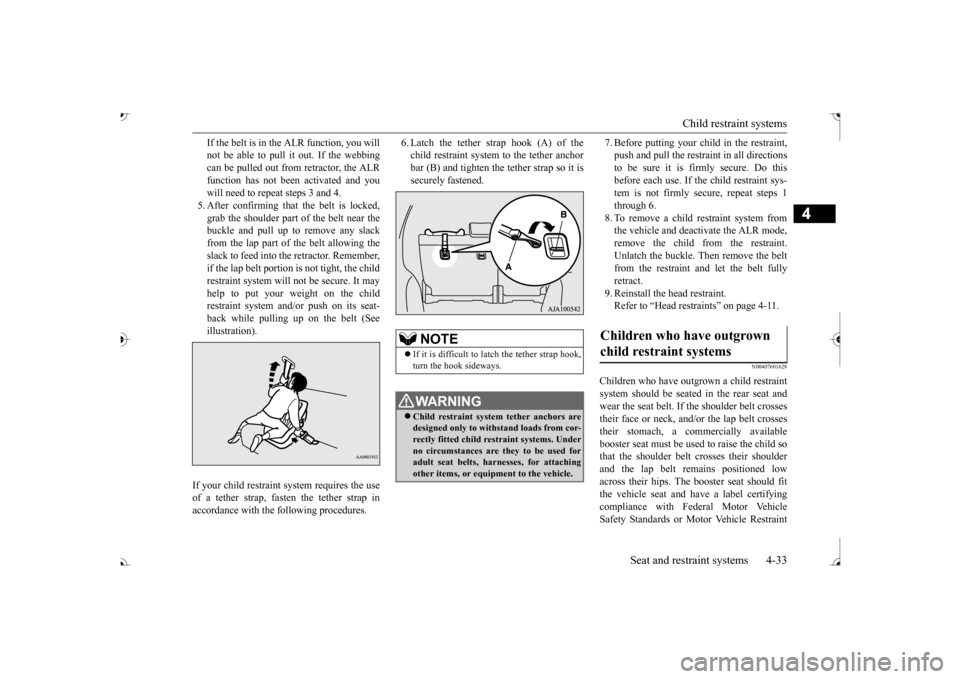
If the belt is in the ALR function, you will not be able to pull it out. If the webbingcan be pulled out from retractor, the ALR function has not been activated and you will need to repeat steps 3 and 4.5. After confirming that the belt is locked, grab the shoulder part of the belt near the buckle and pull up to remove any slackfrom the lap part of the belt allowing the slack to feed into the retractor. Remember, if the lap belt portion is not tight, the child restraint system will not be secure. It may help to put your weight on the childrestraint system and/or push on its seat- back while pulling up on the belt (See illustration).
6. Latch the tether strap hook (A) of the child restraint system to the tether anchorbar (B) and tighten the tether strap so it is securely fastened.
7. Before putting your child in the restraint, push and pull the restra
int in all directions
to be sure it is firmly secure. Do this before each use. If the child restraint sys- tem is not firmly secure, repeat steps 1through 6. 8. To remove a child restraint system from the vehicle and deactivate the ALR mode,remove the child from the restraint. Unlatch the buckle. Then remove the belt from the restraint and let the belt fully retract. 9. Reinstall the head restraint.Refer to “Head restraints” on page 4-11.
N00407601628
Children who have outgr
own a child restraint
system should be seated in the rear seat and wear the seat belt. If the shoulder belt crossestheir face or neck, and/
or the lap belt crosses
their stomach, a commercially available booster seat must be used to raise the child sothat the shoulder belt
crosses their shoulder
and the lap belt remains positioned low across their hips. The
booster seat should fit
the vehicle seat and have a label certifying compliance with Federal Motor Vehicle Safety Standards or Mo
tor Vehicle Restraint
If your child restraint system requires the use of a tether strap, fasten the tether strap inaccordance with the following procedures.
NOTE
If it is difficult to latch the tether strap hook, turn the hook sideways.WA R N I N G Child restraint system tether anchors are designed only to with
stand loads from cor-
rectly fitted child restraint systems. Underno circumstances are they to be used for adult seat belts, harnesses, for attaching other items, or equipment to the vehicle.
Children who have outgrown child restraint systems
BK0239700US.book 33 ページ 2016年6月16日 木曜日 午前10時58分
Page 63 of 521

Maintenance and inspection of seat belts 4-34 Seat and restraint systems
4
Systems and Booster Se
ats Safety Regula-
tions.
N00407001390
Regularly check your seat belt buckles andtheir release mechanisms for positive engage-ment and release of the latch plate. Check the retractors for automatic locking when in the Automatic Locking Retractor function. The entire seat belt assembly should be replaced if the webbing shows any obvious
cuts, tears, increase in thickness in any sec- tion of the webbing from broken fibers, orsevere fading from sunlig
ht. All of these con-
ditions indicate a weakening of the belt, which may adversely affe
ct seat belt perfor-
mance in an accident.
N00407701863
This vehicle is equippe
d with a Supplemental
Restraint System (SRS), which includes air- bags for the driver and passengers. The SRS front airbags are designed to supple- ment the primary protection of the driver and front passenger seat belt systems by provid- ing those occupants w
ith protection against
head and chest injuries
in certain moderate to
severe frontal collisi
ons. The SRS front air-
bags, together with sensors at the front of the vehicle and sensors attached to the front seats, form an adva
nced airbag system.
The SRS side airbags and the curtain airbags are also designed to s
upplement the seat belts.
The SRS side airbags provide the driver and front passenger with pr
otection against chest
injuries by deploying the bag on the side impacted in moderate
to severe side impact
collisions. The SRS curtain airbags providethe driver and the passengers on the front seat and the second row outboard seats with pro- tection against head in
juries by deploying the
curtain airbag on the side impacted in moder- ate to severe side im
pact collisions and by
deploying both curtain airbags when a roll-over is detected. The curtain airbags are also designed to help reduce the risk of complete
WA R N I N G Any child who is too small to properly wear a seat belt
must be properly
restrained in an appropriate child restraint system, to reduce their risk ofserious injury or de
ath in an
accident.
A child should never be
left unattended in,
or unsupervised around, your vehicle. When you leave the ve
hicle, always take
the child out as well. Children can die from heat stroke if left or trapped inside the vehicle, especially onhot days. Keep your vehicle locked when not in use. Keep your vehicle keys away from chil- dren.
Maintenance and inspection of seat belts
WA R N I N G Do not attempt to repair or replace any part of the seat belt assemblies. This workshould be done by an authorized Mitsubishi Motors dealer. Failure to have an authorized Mits
ubishi Motors dealer
perform the work could reduce the effec- tiveness of the belts an
d could result in a
serious injury or de
ath in an accident.
Never use an organic solvent to clean the seat belt webbing. Do not attempt tobleach or re-dye th
e seat belt webbing.
These may weaken the
seat belt webbing,
increasing risk of in
jury or death in an
accident. Clean seat belt webb
ing only with mild
soap or detergent solution and rinse itwith lukewarm water, and dry the seat belt webbing completely before retracting it.
Supplemental Restraint Sys- tem (SRS) - airbag
BK0239700US.book 34 ページ 2016年6月16日 木曜日 午前10時58分
Page 82 of 521

5
Features and controlsBreak-in recommendations ..............................................................5-3 Keys .................................................................................................5-3 Electronic immobilizer (Anti-theft starting system) ........................5-4Keyless entry system (if so equipped) ..............................................5-7 Free-hand Advanced Security
Transmitter (F.A.S.T.-key)
(if so equipped) ..........................................................................5-13Door locks ......................................................................................5-34 Power door locks ......
...........
...........
...........
...........
...........
.........
.....5-36
Child safety locks for rear door ..........
...........
.........
.........
.........
.....5-37
Liftgate (except for vehi
cles equipped with the
power liftgate) ....5-38
Power liftgate (if so equipped) .......................................................5-39 Inside liftgate release .....................................................................5-46Theft-alarm system ........................................................................5-46 Power window control ...................................................................5-49 Sunroof (if so equipped) .................................................................5-51Parking brake .................................................................................5-53 Steering wheel height and reach adjustment ..................................5-57 Inside rearview mirror ...................................................................5-57Outside rearview mirrors ...............................................................5-60 Ignition switch ...............................................................................5-63 Steering wheel lock (if so equipped) ..............................................5-65Starting the engine .........................................................................5-66 Automatic transaxle (if so equipped)..............................................5-67 Continuously variable transmission
(CVT) (if so equipped)..........5-75
Electronically controlled
4WD system (if so equipped).................5-82
S-AWC (Super-All Wheel Control) (if
so equipped) .....................5-85
4-wheel drive operation .................................................................5-88Inspection and maintenance followi
ng rough road operation ........5-91
Cautions on the handling of 4-wheel dr
ive vehicles ..................... 5-91
Service brake ................................................................................. 5-92 Brake auto hold (if so equipped) .................................................... 5-93Hill start assist (if so equipped) ...................................................... 5-95 Brake assist system ........................................................................ 5-96 Anti-lock braking system .............................................................. 5-97Electric power steering system (EPS) ........................................... 5-99 Active stability control (ASC) ..................................................... 5-100 Cruise control (if so equipped) ..................................................... 5-102Adaptive Cruise Control System (ACC)
(if so equipped) ............ 5-106
Forward Collision Mitigation System
(FCM) (if so equipped) .... 5-117
Ultrasonic misacceleration Mitigati
on System (if so equipped) .. 5-127
Blind Spot Warning (BSW) (wit
h Lane Change Assist) (if so
equipped) .................................................................................. 5-131 Rear Cross Traffic Alert (RCTA) (if so equipped) ....................... 5-136Lane Departure Warning System (LDW
) (if so equipped)........... 5-139
Tire pressure monitoring system ................................................. 5-142 Parking sensors (Front/Rear) (if so equipped).............................. 5-147Rear-view camera (if so equipped)............................................... 5-151 Multi Around Monitor (if so
equipped)..................
...........
........... 5-154
Instrument cluster ........................................................................ 5-163Multi Information display - Type 1 ............................................. 5-164 Multi Information display - Type 2 ............................................. 5-183 Indicator light, warning light, and information screen display list (multi informati
on display - Type 1) .......... 5-191
Indicator and warning light package (multi information display - Type 2) ....................................... 5-214Indicators ..................................................................................... 5-215
BK0239700US.book 1 ページ 2016年6月16日 木曜日 午前10時58分
Page 84 of 521
Break-in recommendations
Features and controls 5-3
5
N00508701366
Advanced automobile
manufacturing tech-
niques permit you to operate your new vehi- cle without requiring a long break-in periodof low-speed driving. However, you can add to the future perfor- mance and economy of your vehicle byobserving the following precautions during the first 300 miles (500 km). Drive your vehicle at m
oderate speeds during
the break-in period. Avoid revving the engine. Avoid rough driving such as sudden starts, sudden accelerati
on, prolonged high-
speed driving and sudden braking. These actions would have a detrimental effect onthe engine and lead to increased fuel and oil consumption; th
is could ultimately
result in the malfunction of engine com-ponents. Be particularly careful to avoid full acceleration while in low shift posi- tion (low gears). Do not overload the vehicle. Stay within the seating capacity. (Refer to “Cargo load precautions” on page 6-10.) Refrain from towing a trailer or other vehicle (Refer to “T
railer towing” on page
6-11).
N00508801716
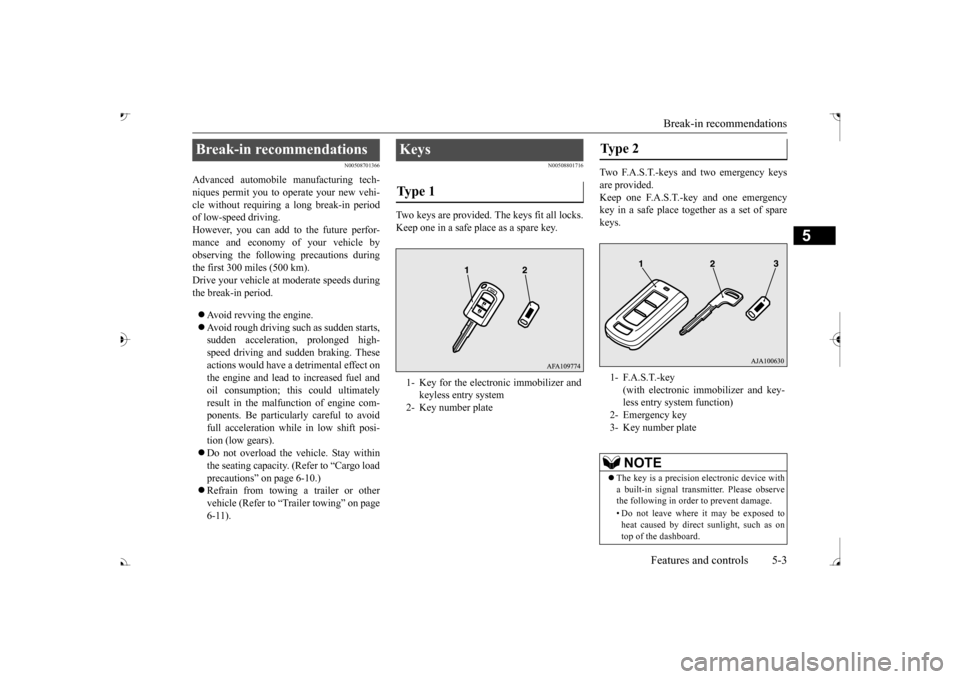
Two keys are provided. The keys fit all locks.Keep one in a safe place as a spare key.
Two F.A.S.T.-keys and two emergency keys are provided. Keep one F.A.S.T.-key and one emergency key in a safe pl
ace together as a set of spare
keys.
Break-in recommendations
Keys Ty p e 1 1- Key for the electronic immobilizer and
keyless entry system
2- Key number plate
Type 2 1- F.A.S.T.-key
(with electronic im
mobilizer and key-
less entry system function)
3- Key number plate
NOTE
The key is a precision
electronic device with
a built-in signal transm
itter. Please observe
the following in order to prevent damage. • Do not leave where it may be exposed to heat caused by direct
sunlight, such as on
top of the dashboard.
BK0239700US.book 3 ページ 2016年6月16日 木曜日 午前10時58分
Page 85 of 521
![MITSUBISHI OUTLANDER 2017 3.G Owners Manual Electronic immobilizer (Anti-theft starting system)
5
N00509101888
[For vehicles equippe
d with the Free-hand
Advanced Security Transmitter (F.A.S.T.-key)] For information on ope
rations for vehicl](/manual-img/19/7536/w960_7536-84.png "MITSUBISHI OUTLANDER 2017 3.G Owners Manual Electronic immobilizer (Anti-theft starting system)
5
N00509101888
[For vehicles equippe
d with the Free-hand
Advanced Security Transmitter (F.A.S.T.-key)] For information on ope
rations for vehicl")
Electronic immobilizer (Anti-theft starting system)
5
N00509101888
[For vehicles equippe
d with the Free-hand
Advanced Security Transmitter (F.A.S.T.-key)] For information on ope
rations for vehicles
equipped with the Free-hand Advanced Secu-rity Transmitter (F.A
.S.T.-key), refer to
“Free-hand Advanced
Security Transmitter
(F.A.S.T.-key): Electr
onic immobilizer (Anti-
theft starting system)” on page 5-18.
[Except for vehicles equipped with the Free- hand Advanced Security Transmitter(F.A.S.T.-key)] The electronic immobilize
r is designed to sig-
nificantly reduce the
possibility of vehicle
theft. The purpose of the system is to immo- bilize the vehicle if
an invalid start is
attempted. A valid st
art attempt can only be
achieved (subject to ce
rtain conditions) using
a key “registered” to the immobilizer system. All of the keys provided with your new vehi- cle have been program
med to the vehicle’s
electronics.
• Do not take the remote control transmitter apart. • Do not excessively be
nd the key or subject
it to strong impacts. • Keep the remote control transmitter dry. • Keep away from magnetic objects such as key rings. • Keep away from devi
ces that produce mag-
netism, such as audio systems, computers and televisions. • Keep away from devices that emit strong electromagneti
c waves, such as cellular
phones, wireless devices and high fre-quency equipment (i
ncluding medical
devices). • Do not clean with
ultrasonic cleaners.
• Do not leave the key where it may be exposed to high temperature or high humid- ity.
If you lose your key, to prevent the theft of the vehicle immediatel
y contact an autho-
rized Mitsubishi Motors dealer.If you notify an authorized Mitsubishi Motors dealer of the key number, they can make a new key. The key number is stampedon the key number plate. Keep the key num- ber plate in a safe pl
ace separate from the
key itself.NOTE
No keys other than those registered in advance can be used
to start the engine.
Refer to “Electronic immobilizer (Anti-theftstarting system)” on page 5-4. Refer to “Free-hand
Advanced Security
Transmitter (F.A.S.T.-key): “Electronicimmobilizer (Anti-thef
t starting system)” on
page 5-18. When the theft-alarm is in the system opera- tional status, the alarm operates if a door or liftgate is opened after using the key, thedoor lock knob or the power door lock switch to unlock the vehicle. The system does not enter the preparation status if the keyless entry system or the F.A.S.T.-key operation was not used to lockthe vehicle.
Electronic immobilizer (Anti-theft starting system)
NOTE
NOTE
In the following cases, the vehicle may not be able to recognize
the registered ID code
from the key. This mean
s the engine will not
start even when the key is turned to the “START” position. • When the key contacts a key ring or other metallic or ma
gnetic object
BK0239700US.book 4 ページ 2016年6月16日 木曜日 午前10時58分
Page 86 of 521
Electronic immobilizer (Ant
i-theft starting system)
Features and controls 5-5
5
Only keys that have been programmed to the vehicle’s electronics can be used to start the vehicle. If you lose the key, you can order a key from your authorized Mitsubi
shi Motors dealer by
referring to the key number. To prevent vehicle theft, the ID code for thevehicle keys must be changed.
Take your vehicle and
all remaining keys to
your authorized Mitsubishi Motors dealer tohave your ID code changed. To add a key, you must already have 2 regis- tered keys. You need to register the ID code to the vehicle. Registering the ID code can be done by your- self (except for vehicles
sold in Canada), or
by your authorized Mitsubishi Motors dealer.For you to register the ID code yourself, fol- low the “Customer key programming” proce- dure below.If you choose to have
your authorized Mit-
subishi Motors dealer register the ID code, take your vehicle and
all remaini
ng keys to
your authorized Mitsubishi Motors dealer.
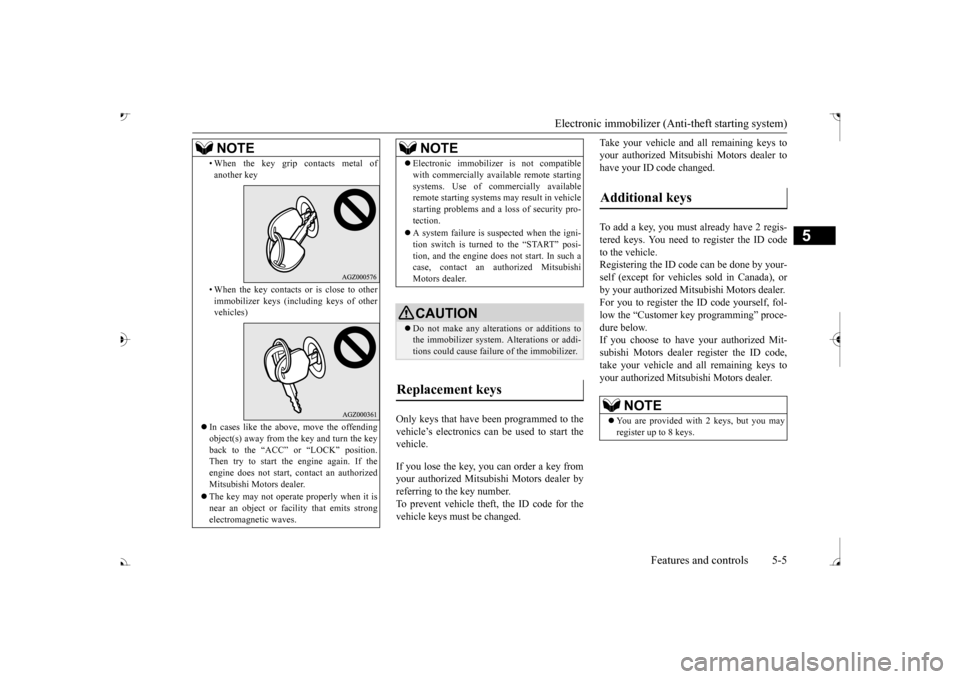
• When the key grip
contacts metal of
another key • When the key contacts
or is close to other
immobilizer keys (inc
luding keys of other
vehicles)
In cases like the a
bove, move the offending
object(s) away from the key and turn the keyback to the “ACC” or “LOCK” position. Then try to start the engine again. If the engine does not start,
contact an authorized
Mitsubishi Motors dealer. The key may not operate
properly when it is
near an object or faci
lity that emits strong
electromagne
tic waves.
NOTE
Electronic immobilize
r is not compatible
with commercially available remote startingsystems. Use of commercially availableremote starting systems may result in vehicle starting problems
and a loss of security pro-
tection. A system failure is suspected when the igni- tion switch is turned to the “START” posi-tion, and the engine does
not start. In such a
case, contact an au
thorized Mitsubishi
Motors dealer.CAUTION Do not make any altera
tions or additions to
the immobilizer system.
Alterations or addi-
tions could cause failure
of the immobilizer.
Replacement keys
NOTE
Additional keys
NOTE
You are provided with 2 keys, but you may register up to 8 keys.
BK0239700US.book 5 ページ 2016年6月16日 木曜日 午前10時58分
Page 87 of 521
Electronic immobilizer (Anti-theft starting system)
5
N00562201149
You can program new keys to the system if you have two valid (alr
eady registered) keys
and blank immobilizer ke
y (specially cut for
your vehicle at your Mitsubishi Motorsdealer) by doing the following: 1. Insert the first valid key into the ignition switch and turn the key to the “ON” posi-tion for 5 seconds. 2. Turn the key to the “OFF” or “LOCK” position and remove the first key.3. Within 30 seconds of removing the first key, insert the second valid key into the ignition and turn it to the “ON” position.About 10 seconds la
ter, the immobilizer
display will start to blink.
4. When the immobilizer display starts blinking, turn the second valid key to the“OFF” or “LOCK” position and remove it. Within 30 seconds after doing so, insert a blank immobilizer ke
y into the ignition
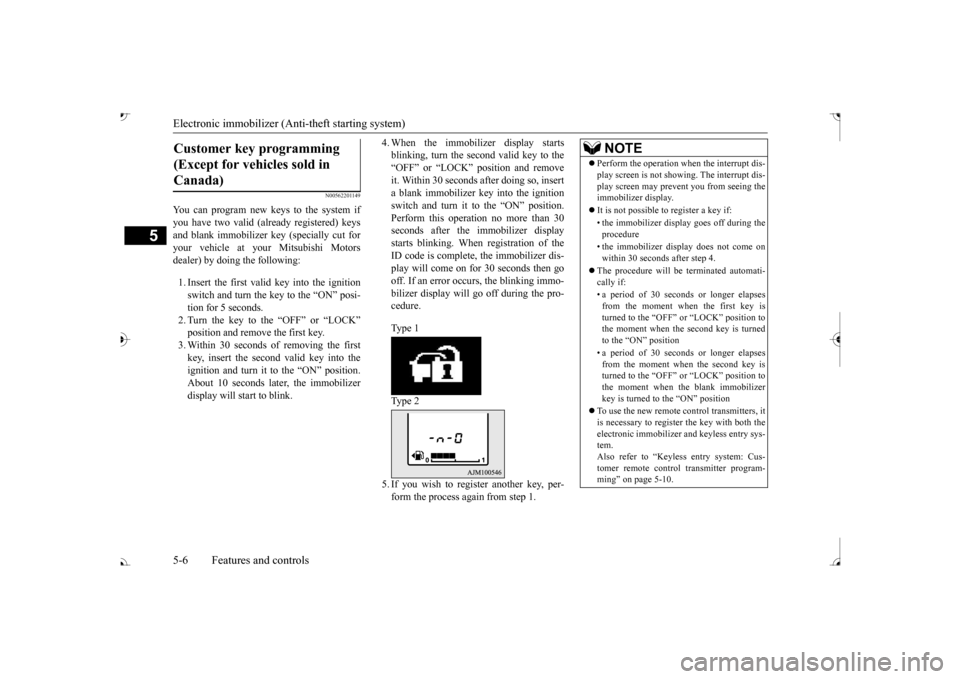
switch and turn it to the “ON” position. Perform this operation no more than 30 seconds after the immobilizer displaystarts blinking. When registration of the ID code is complete, the immobilizer dis- play will come on for 30 seconds then go off. If an error occurs, the blinking immo- bilizer display will
go off during the pro-
cedure. Type 1 Type 2 5. If you wish to register another key, per- form the process again from step 1.
Customer key programming (Except for vehicles sold in Canada)
NOTE
Perform the operation when the interrupt dis- play screen is not show
ing. The interrupt dis-
play screen may prevent you from seeing theimmobilizer display. It is not possible to
register a key if:
• the immobilizer disp
lay goes off during the
procedure • the immobilizer disp
lay does not come on
within 30 seconds after step 4.
The procedure will be terminated automati- cally if: • a period of 30 seconds or longer elapses from the moment when the first key isturned to the “OFF” or “LOCK” position to the moment when the second key is turned to the “ON” position • a period of 30 seconds or longer elapses from the moment when the second key isturned to the “OFF” or “LOCK” position to the moment when the blank immobilizer key is turned to the “ON” position
To use the new remote control transmitters, it is necessary to register
the key with both the
electronic immobilizer
and keyless entry sys-
tem. Also refer to “Keyless entry system: Cus-tomer remote control transmitter program- ming” on page 5-10.
BK0239700US.book 6 ページ 2016年6月16日 木曜日 午前10時58分
Page 88 of 521
Keyless entry system (if so equipped)
Features and controls 5-7
5
N00562301094
Your electronic immo
bilizer operates on a
radio frequency subject to Federal Communi- cations Commission (FCC)
Rules (For vehi-
cles sold in U.S.A.
) and Industry Canada
Rules (For vehicles so
ld in Canada). This
device complies with part 15 of FCC Rulesand Industry Canada
licence-exempt RSS
standard(s). Operation is subject to the following two con- ditions. This device may not
cause harmful inter-
ference. This device must ac
cept any interference
received, including interference that may cause undesired operation.
N00509002028
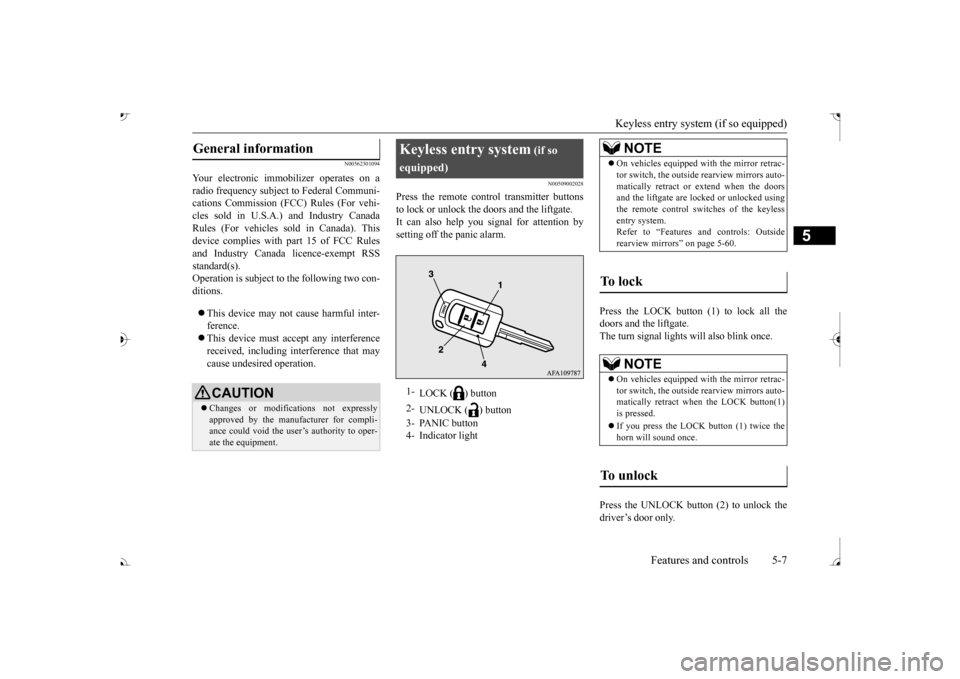
Press the remote control transmitter buttons to lock or unlock the doors and the liftgate. It can also help you signal for attention bysetting off the panic alarm.
Press the LOCK button (1) to lock all the doors and the liftgate.The turn signal lights
will also blink once.
Press the UNLOCK button (2) to unlock the driver’s door only.
General information
CAUTION Changes or modifica
tions not expressly
approved by the manufacturer for compli- ance could void the user’s authority to oper-ate the equipment.
Keyless entry system
(if so
equipped)
LOCK ( ) button
2-
UNLOCK ( ) button
3- PANIC button 4- Indicator light
NOTE
On vehicles equipped wi
th the mirror retrac-
tor switch, the outside rearview mirrors auto-matically retract or extend when the doorsand the liftgate are locked or unlocked using the remote control swit
ches of the keyless
entry system.Refer to “Features and controls: Outside rearview mirrors” on page 5-60.
To l o c k
NOTE
On vehicles equipped wi
th the mirror retrac-
tor switch, the outside rearview mirrors auto- matically retract when
the LOCK button(1)
is pressed. If you press the LOCK button (1) twice the horn will sound once.
To unlock
BK0239700US.book 7 ページ 2016年6月16日 木曜日 午前10時58分