2017 MITSUBISHI LANCER belt
[x] Cancel search: beltPage 57 of 385

Supplemental Restraint System (SRS) - airbag 4-30 Seat and restraint systems
4
The front airbags and driver’s knee airbag may deploy if the underside of the vehicle suffers a moderate to severe impact (under- carriage impact). Some typical situations areshown in the illustrations. Because the front airbags and driver’s knee airbag may deploy in certain types of unex- pected impacts, as shown in the illustrations, and these unexpected impacts can move youout of position, it is important to always wear your seat belts properly. When worn properly, seat belts can help maintain your distancefrom the airbags and driver’s knee airbag when they begin to inflate. The beginning stage of airbag inflatio
n is the most forceful
and can cause serious injury or death if you are close to the deploying airbag.The front airbags and driver’s knee airbag MAY DEPLOY when …
Collision with an elevated median/island or curb Vehicle travels over a deep hole/pothole Vehicle drives down a steep slope and hits the ground
WA R N I N G Do not attach anything to the steering wheel’s padded cover, such as trim mate- rial, badges, etc. These could strike and injure an occupant if the airbag inflates. Do not set anything on, or attach anything to, the instrument panel above the glove compartment. Such items could strike andinjure an occupant if the airbag inflates. WA R N I N G Do not attach accessories to, or put them in front of, the windshield. They couldrestrict the airbag inflation, or strike and injure an occupant, when the airbag inflates.
BK0237700US.bo
ok 30 ページ 2016年4月15日 金曜日 午前11時28分
Page 60 of 385
Supplemental Restraint System (SRS) - airbag
Seat and restraint systems 4-33
4
N00408200507
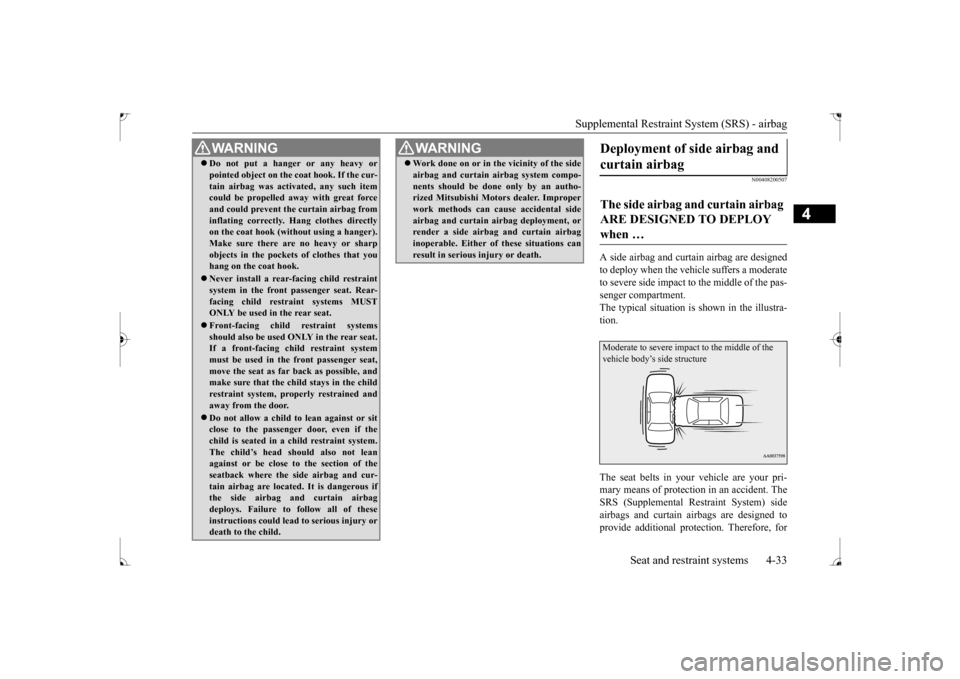
A side airbag and curtain airbag are designed to deploy when the vehicle suffers a moderateto severe side impact to the middle of the pas- senger compartment. The typical situation is shown in the illustra-tion. The seat belts in your vehicle are your pri- mary means of protection in an accident. The SRS (Supplemental Restraint System) sideairbags and curtain airbags are designed to provide additional protection. Therefore, for
WA R N I N G Do not put a hanger or any heavy or pointed object on the coat hook. If the cur- tain airbag was activated, any such item could be propelled away with great force and could prevent the curtain airbag frominflating correctly. Hang clothes directly on the coat hook (without using a hanger). Make sure there are no heavy or sharpobjects in the pockets of clothes that you hang on the coat hook. Never install a rear-facing child restraint system in the front passenger seat. Rear- facing child restraint systems MUSTONLY be used in the rear seat. Front-facing child restraint systems should also be used ONLY in the rear seat. If a front-facing child restraint system must be used in the front passenger seat,move the seat as far back as possible, and make sure that the child stays in the child restraint system, properly restrained andaway from the door. Do not allow a child to lean against or sit close to the passenger door, even if the child is seated in a child restraint system. The child’s head should also not leanagainst or be close to the section of the seatback where the side airbag and cur- tain airbag are located.
It is dangerous if
the side airbag and curtain airbag deploys. Failure to follow all of theseinstructions could lead to serious injury or death to the child.
Work done on or in the vicinity of the side airbag and curtain airbag system compo- nents should be done only by an autho- rized Mitsubishi Motors dealer. Improper work methods can cause accidental sideairbag and curtain airbag deployment, or render a side airbag and curtain airbag inoperable. Either of these situations canresult in serious injury or death.WA R N I N G
Deployment of side airbag and curtain airbag The side airbag and curtain airbag ARE DESIGNED TO DEPLOY when … Moderate to severe impact to the middle of the vehicle body’s side structure
BK0237700US.bo
ok 33 ページ 2016年4月15日 金曜日 午前11時28分
Page 61 of 385
Supplemental Restraint System (SRS) - airbag 4-34 Seat and restraint systems
4
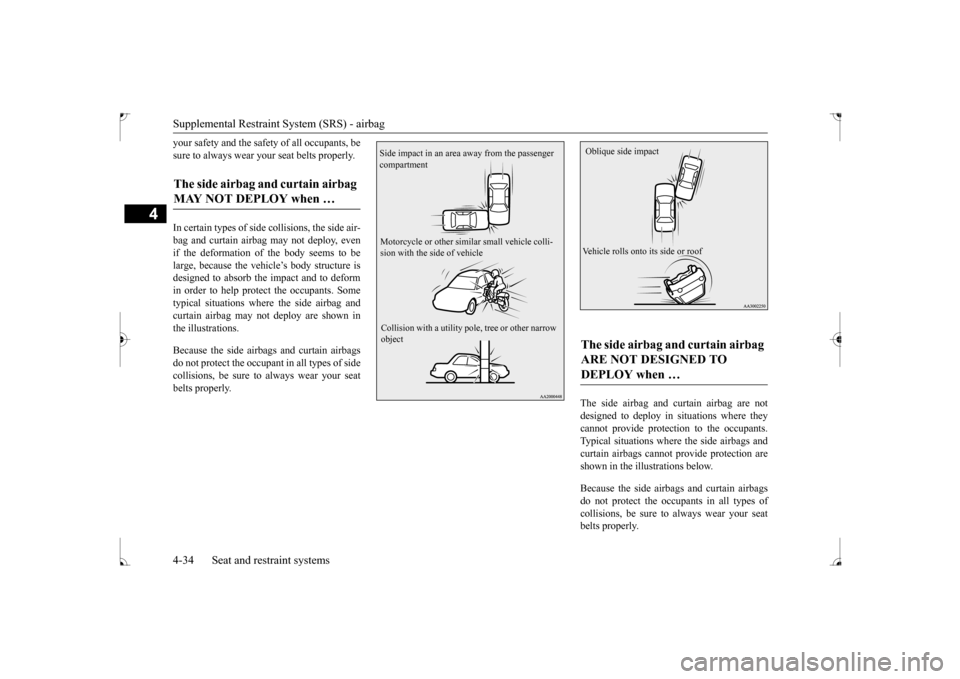
your safety and the safety of all occupants, be sure to always wear your seat belts properly. In certain types of side collisions, the side air- bag and curtain airbag may not deploy, evenif the deformation of the body seems to be large, because the vehicle’s body structure is designed to absorb the impact and to deformin order to help protect the occupants. Sometypical situations where the side airbag and curtain airbag may not deploy are shown in the illustrations. Because the side airbags and curtain airbags do not protect the occupant in all types of side collisions, be sure to always wear your seat belts properly.
The side airbag and curtain airbag are not designed to deploy in situations where they cannot provide protection to the occupants. Typical situations where the side airbags andcurtain airbags cannot provide protection are shown in the illustrations below. Because the side airbags and curtain airbags do not protect the occupants in all types ofcollisions, be sure to always wear your seatbelts properly.
The side airbag and curtain airbag MAY NOT DEPLOY when …
Side impact in an area away from the passenger compartment Motorcycle or other si
milar small vehicle colli-
sion with the side of vehicle Collision with a utility pole
, tree or other narrow
object
The side airbag and curtain airbag ARE NOT DESIGNED TO DEPLOY when … Oblique side impact Vehicle rolls onto its side or roof
BK0237700US.bo
ok 34 ページ 2016年4月15日 金曜日 午前11時28分
Page 62 of 385
Supplemental Restraint System (SRS) - airbag
Seat and restraint systems 4-35
4
N00408500672
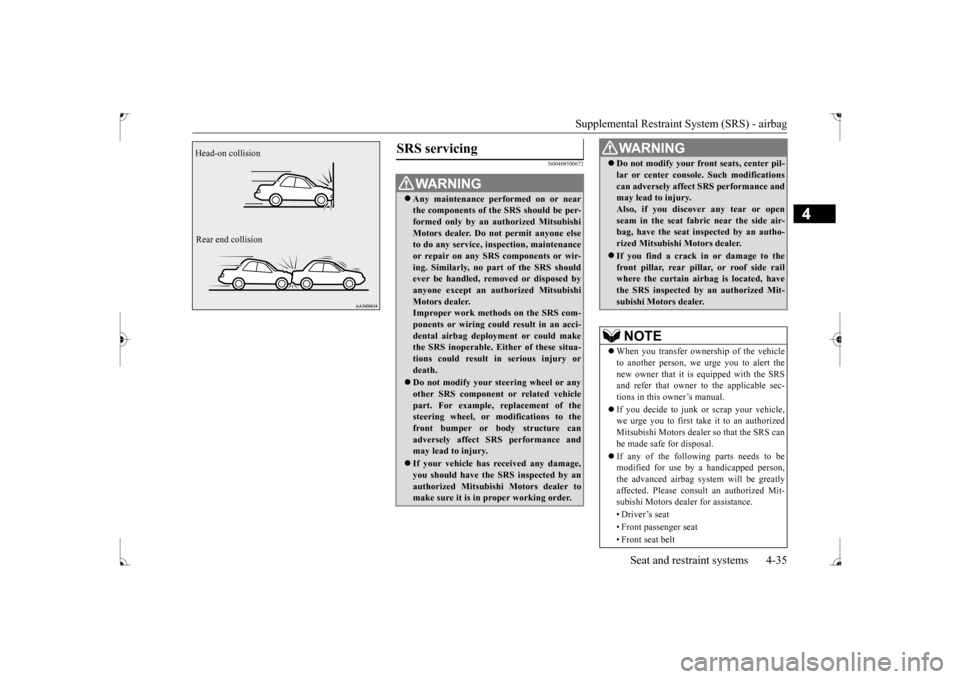
Head-on collision Rear end collision
SRS servicing
WA R N I N G Any maintenance performed on or near the components of the SRS should be per- formed only by an authorized Mitsubishi Motors dealer. Do not permit anyone elseto do any service, inspection, maintenance or repair on any SRS components or wir- ing. Similarly, no part of the SRS shouldever be handled, removed or disposed by anyone except an authorized Mitsubishi Motors dealer.Improper work methods on the SRS com- ponents or wiring could result in an acci- dental airbag deployment or could makethe SRS inoperable. Either of these situa- tions could result in serious injury or death. Do not modify your steering wheel or any other SRS component or related vehiclepart. For example, replacement of the steering wheel, or modifications to the front bumper or body structure canadversely affect SRS performance and may lead to injury. If your vehicle has received any damage, you should have the SRS inspected by an authorized Mitsubishi Motors dealer to make sure it is in proper working order.
Do not modify your front seats, center pil- lar or center console. Such modifications can adversely affect SRS performance and may lead to injury. Also, if you discover any tear or openseam in the seat fabric near the side air- bag, have the seat inspected by an autho- rized Mitsubishi Motors dealer. If you find a crack in or damage to the front pillar, rear pillar, or roof side railwhere the curtain airbag is located, have the SRS inspected by an authorized Mit- subishi Motors dealer.NOTE
When you transfer ownership of the vehicle to another person, we urge you to alert the new owner that it is equipped with the SRS and refer that owner to the applicable sec-tions in this owner’s manual. If you decide to junk
or scrap your vehicle,
we urge you to first take it to an authorized Mitsubishi Motors dealer so that the SRS can be made safe for disposal. If any of the following parts needs to be modified for use by a handicapped person, the advanced airbag system will be greatly affected. Please consult an authorized Mit-subishi Motors dealer for assistance. • Driver’s seat• Front passenger seat • Front seat beltWA R N I N G
BK0237700US.bo
ok 35 ページ 2016年4月15日 金曜日 午前11時28分
Page 86 of 385

Free-hand Advanced Security Transmit
ter (F.A.S.T.-key) (if so equipped)
Features and controls 5-21
5
If the engine will not start because the bat- tery is weak or discharged, refer to “Jump-starting the engine” on page 8-2 for instructions. A longer warm up period will only con- sume extra fuel. The engine is warmed up enough for driving when the bar graph ofthe engine coolant temperature display starts to move. Refer to “Interrupt display screen (With ignition
switch in the “ON”
position)” on page 5-101.
Your vehicle is equipped with an electroni- cally controlled fuel injection system. This isa system that automatically controls fuel injection. There is no need to depress the accelerator pedal when starting the engine.The starter motor should not be run for more than 15 seconds at a time. To prevent battery drain, wait a few secondsbetween attempts to restart the engine. 1. Make sure all occupants are properly seated with seat belts fastened. 2. Make sure the parking brake is applied. 3. Press and hold the brake pedal downfirmly with your right foot. 4. Press and hold the clutch pedal all the way down (manual transaxle). 5. On vehicles with manual transaxle, place the gearshift lever in the “N” (Neutral) position.On vehicles with continuously variable transmission (CVT) make sure the selec- tor lever is in the “P” (PARK) position.
6. While pushing the ignition switch from “LOCK” (PUSH OFF) to “LOCK” (PUSH ON), set the ignition switch to the“ON” position and confirm that all warn-ing lights and warning displays are oper- ating properly. 7. Without pressing the accelerator pedal,slowly turn the ignition switch to the “START” position to start the engine. Release the ignition switch when theengine starts.
After several attempts, you may experience that the engine still does not start.
WA R N I N G Never run the engine in a closed or poorly ventilated area any longer than is needed to move your vehicle out of the area. Car-bon monoxide gas, which is odorless and extremely poisonous, could build up and cause serious injury or death.CAUTION Do not push-start the vehicle.Do not run the engine at high rpms or drive at high speeds until the engine has had a chance to warm up. Release the ignition switch as soon as the engine starts. Otherwise, the starter motorwill be damaged.
Starting the engine
NOTE
For models equipped with a manual trans- axle, the starter will not operate unless the clutch pedal is fully depressed (Clutch inter-lock). This is a safety feature.
NOTE
On vehicles with CVT, the starter will not operate unless the selector lever is in the “P” (PARK) or “N” (NEUTRAL) position. For safety reasons, start the engine in the “P” (PARK) position so that the wheels arelocked.NOTE
Minor noises may be heard on engine start- up. These will disappear as the engine warms up.
When the engine is hard to start
BK0237700US.bo
ok 21 ページ 2016年4月15日 金曜日 午前11時28分
Page 90 of 385

Free-hand Advanced Security Transmit
ter (F.A.S.T.-key) (if so equipped)
Features and controls 5-25
5
Turn the emergency key to the “LOCK” posi- tion. Turn the steering wheel until it is locked. Turn the emergency key to the “ACC” posi- tion while moving the steering wheel slightly. Tips for starting
Do not operate the starter motor continu- ously for longer than 15 seconds as this could run the battery down or damage the starter motor. If the engine does not start,turn the emergency key back to the “LOCK” position, wait a few seconds, and then try again. Trying repeatedly withthe engine or starter motor still turning will damage the starter mechanism. If the engine will not start because the bat- tery is weak or discharged, refer to“Jump-starting the engine” on page 8-2 for instructions. A longer warm up period will only con- sume extra fuel. The engine is warmed up enough for driving when the bar graph of the engine coolant temperature displaystarts to move. Refer to “Interrupt display screen (With ignition switch in the “ON” position)” on page 5-101.
Starting the engine Your vehicle is equipped with an electroni-cally controlled fuel injection system. This is a system that automatically controls the fuel injection. There is no need to depress theaccelerator pedal when starting the engine. The starter motor should not be run for more than 15 seconds at a time.To prevent battery drain, wait a few seconds between attempts to restart the engine. 1. Make sure all occupants are properly seated with seat belts fastened.2. Make sure the parking brake is applied. 3. While pushing the lock release buttons (A), remove the cover of the ignitionswitch.
To l o c k To u n l o c k
CAUTION Remove the emergency key when leaving the vehicle. If your vehicle needs to be towed, turn the emergency key to the “ACC” position tounlock the steering wheel.NOTE
If the front wheels are turned, the anti-theft lock may sometimes make it difficult to turnthe emergency key from “LOCK” to “ACC”. Firmly turn the steering wheel to the left or to the right as you turn the emergency key.
Starting
WA R N I N G Never run the engine in a closed or poorly ventilated area any longer than is needed to move your vehicle out of the area. Car- bon monoxide gas, which is odorless and extremely poisonous, could build up andcause serious injury or death.CAUTION Do not push-start the vehicle.
Do not run the engine
at high rpms or drive
at high speeds until the engine has had a chance to warm up. Release the emergency key as soon as the engine starts. It will damage the starter motor.CAUTION
BK0237700US.bo
ok 25 ページ 2016年4月15日 金曜日 午前11時28分
Page 99 of 385

Door locks 5-34 Features and controls
5
This device may not cause harmful inter- ference. This device must accept any interference received, including interference that maycause undesired operation.
N00561700081
1. Before replacing the battery, remove static electricity from your body by touching a metal grounded object.2. With the Mitsubishi mark facing you, insert the cloth-covered tip of a flat blade screwdriver into the notch in the remotecontrol transmitter case and use it to open the case.
3. Remove the old battery. 4. Install a new battery with the +side (A) up.
5. Close the remote control transmitter case firmly. 6. Check the keyless entry system to see that it works.
N00509200491
CAUTION Changes or modifications not expressly approved by the manufacturer for compli- ance could void the user’s authority to oper-ate the equipment.
Procedure for replacing the remote control transmitter battery
NOTE
Be sure to perform the procedure with the Mitsubishi mark facing you. If the Mitsubi- shi mark is not facing you when you open the remote control transmitter case, the transmit-ter may come out.
+ side - side
Coin type bat- tery CR2032
NOTE
You may purchase a replacement battery at an electric appliance store. Your authorized Mitsubishi Motors dealer can replace the battery for you if you prefer.CAUTION When the remote control transmitter case is opened, be careful to keep water, dust, etc. out. Also, do not touch the internal compo-nents.
Door locks
WA R N I N G Make sure all doors are tightly closed and locked while driving.• Locked doors, in combination with theuse of seat belts, can help reduce the risk of ejection in an accident.• Locked doors can help keep passengers,especially small children, from opening doors and falling out of moving vehicles.
BK0237700US.bo
ok 34 ページ 2016年4月15日 金曜日 午前11時28分
Page 120 of 385

Starting and stopping the engine Features and controls 5-55
5
N00542101096
Do not operate the starter motor continu- ously for longer than
15 seconds as this
could run the battery down or damage thestarter motor. If the engine does not start,turn the ignition switch back to the “LOCK” position, wait a few seconds, and then try again. Trying repeatedly withthe engine or starter motor still turning will damage the starter mechanism. If the engine will not start because the bat- tery is weak or discharged, refer to “Jump-starting the engine” (on page 8-2) for instructions. The engine is warmed up enough for driv- ing when the bar graph of engine coolant temperature display starts to move. A lon-ger warm up period will only consume extra fuel.
N00542201198
[For vehicles equipped with the F.A.S.T.- key.]For information on operation for vehicles equipped with the F.A.S.T.-key, refer to “F.A.S.T.-key: Starting the engine” on page5-20. [Except for vehicles equipped with the F. A . S . T. - k e y. ]Your vehicle is equipped with an electroni- cally controlled fuel injection system, which automatically controls the release of fuel.
There is usually no need to depress the accel- erator pedal when starting the engine. The starter should not be run for more than 15 seconds at a time.To prevent battery drain, wait a few seconds between attempts to restart the engine. 1. Make sure all occupants are properly seated with seat belts fastened 2. Insert the ignition key. 3. Make sure the parking brake is applied.4. Press and hold the brake pedal downfirmly with your right foot. 5. Press and hold the clutch pedal all the way down (manual transaxle). 6. On vehicles with manual transaxle, place the gearshift lever in the “N” (Neutral) position.On vehicles with continuously variable transmission (CVT), make sure the selec- tor lever is in the “P” (PARK) position.
Starting and stopping the engine Tips for starting
WA R N I N G Never run the engine in a closed or poorly ventilated area any longer than is needed to move your vehicle out of the area. Car- bon monoxide gas, which is odorless and extremely poisonous, could build up andcause serious injury or death.CAUTION Do not push-start the vehicle.Do not run the engine
at high rpms or drive
at high speeds until the engine has had a chance to warm up. Release the ignition switch as soon as the engine starts. Otherwise, the starter motorwill be damaged.
Starting the engine
NOTE
For models equipped with a manual trans- axle, the starter will not operate unless the clutch pedal is fully depressed (Clutch inter-lock). This is a safety feature.
BK0237700US.bo
ok 55 ページ 2016年4月15日 金曜日 午前11時28分