2017 MITSUBISHI iMiEV warning
[x] Cancel search: warningPage 29 of 296
Precautions during Charging the
Main Drive Lithium-ion Battery
General information/Charging 3-15
3
N01202601051
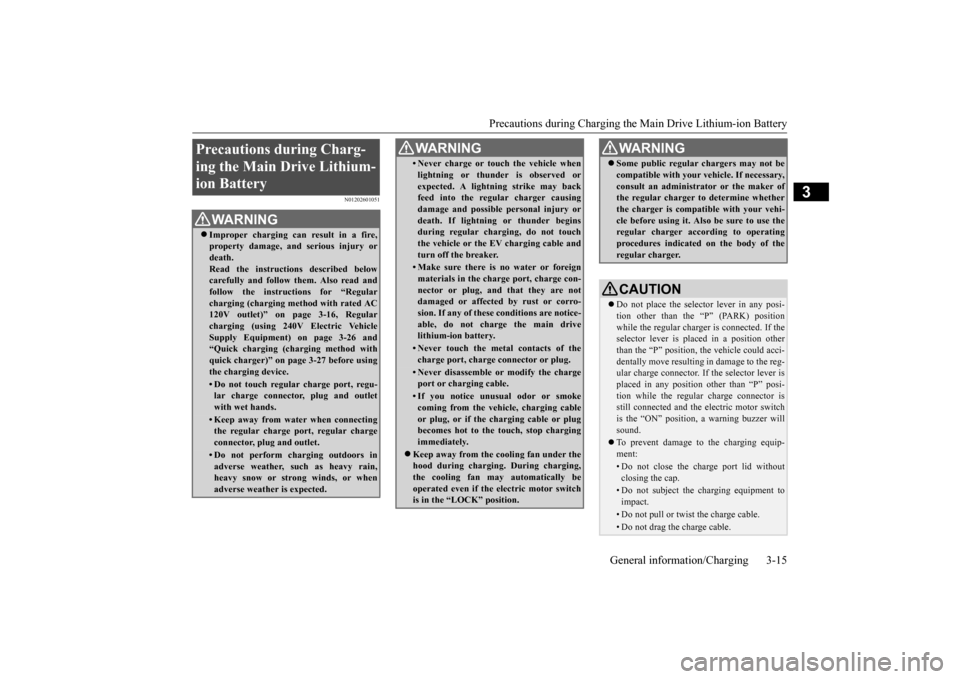
Precautions during Charg- ing the Main Drive Lithium-ion Battery
WA R N I N G Improper charging can result in a fire, property damage, and serious injury ordeath. Read the instructions described below carefully and follow them. Also read andfollow the instructions for “Regular charging (charging method with rated AC 120V outlet)” on page 3-16, Regularcharging (using 240V
Electric Vehicle
Supply Equipment)
on page 3-26 and
“Quick charging (c
harging method with
quick charger)” on p
age 3-27 before using
the charging device.• Do not touch regular charge port, regu-lar charge connecto
r, plug and outlet
with wet hands.• Keep away from wate
r when connecting
the regular charge port, regular chargeconnector, plug and outlet.• Do not perform charging outdoors inadverse weather, su
ch as heavy rain,
heavy snow or strong winds, or when adverse weather is expected.
• Never charge or to
uch the vehicle when
lightning or thunde
r is observed or
expected. A lightning strike may backfeed into the regular charger causing damage and possible
personal injury or
death. If lightnin
g or thunder begins
during regular charging, do not touch the vehicle or the EV
charging cable and
turn off the breaker.• Make sure there is no water or foreignmaterials in the char
ge port, charge con-
nector or plug, and that they are not damaged or affected by rust or corro- sion. If any of these conditions are notice-able, do not charge
the main drive
lithium-ion battery.• Never touch the metal contacts of thecharge port, charge
connector or plug.
• Never disassemble or modify the charge port or charging cable.• If you notice unus
ual odor or smoke
coming from the vehicle, charging cable or plug, or if the ch
arging cable or plug
becomes hot to the touch, stop charging immediately.
Keep away from the cooling fan under the hood during charging. During charging, the cooling fan m
ay automatically be
operated even if the electric motor switch is in the “LOCK” position. WA R N I N G
Some public regular chargers may not be compatible with your vehicle. If necessary,consult an administrator or the maker ofthe regular charger to determine whether the charger is compat
ible with
your vehi-
cle before using it. Also be sure to use theregular charger acco
rding to operating
procedures indicated on the body of the regular charger.CAUTION Do not place the select
or lever in any posi-
tion other than the “P” (PARK) positionwhile the regular charger is connected. If the selector lever is plac
ed in a position other
than the “P” position, the vehicle could acci-dentally move resulting in damage to the reg- ular charge connector. If
the selector lever is
placed in any position other than “P” posi-tion while the regular charge connector is still connected and the
electric motor switch
is the “ON” position,
a warning buzzer will
sound. To prevent damage to the charging equip- ment:• Do not close the charge port lid withoutclosing the cap.• Do not subject the charging equipment toimpact.• Do not pull or twist the charge cable.• Do not drag the charge cable.WA R N I N G
BK0220401US.book 15 ページ 2015年6月3日 水曜日 午前7時42分
Page 45 of 296
Charging troubleshooting guide
General information/Charging 3-31
3
N01202301032
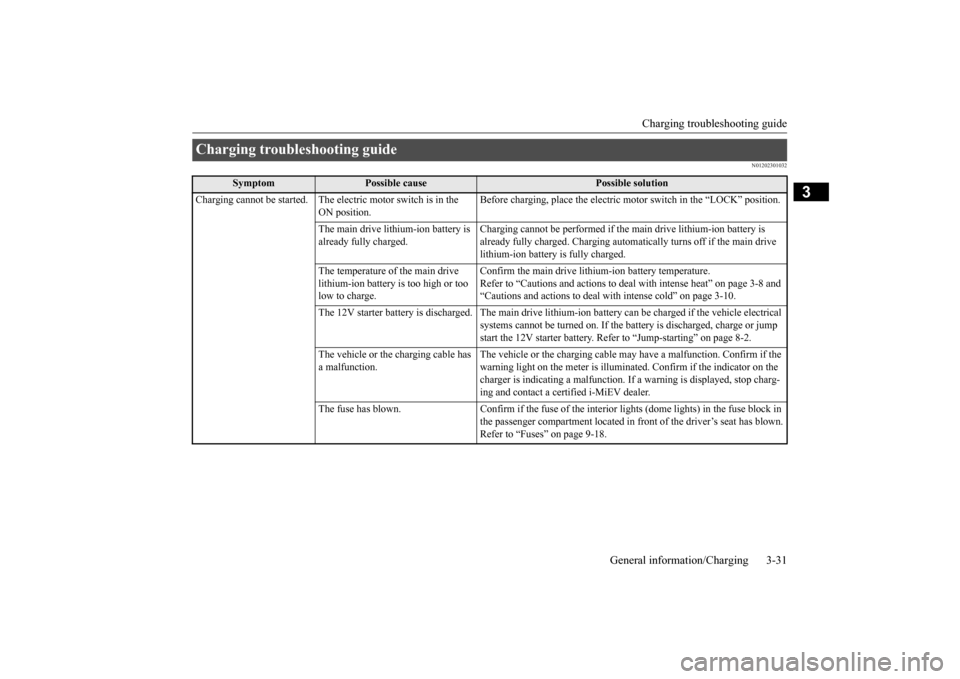
Charging troubleshooting guide
Symptom
Possible cause
Possible solution
Charging cannot be started. The elec
tric motor switch is in the
ON position.
Before charging, place the electric motor switch in the “LOCK” position.
The main drive lithium-ion battery is already fully charged.
Charging cannot be performed if the
main drive lithium-ion battery is
already fully charged. Charging automa
tically turns off if the main drive
lithium-ion battery is fully charged.
The temperature of the main drive lithium-ion battery is too high or too low to charge.
Confirm the main drive lithium-ion battery temperature. Refer to “Cautions and actions to deal
with intense heat” on page 3-8 and
“Cautions and actions to deal with intense cold” on page 3-10.
The 12V starter battery is discharged. The main drive lith
ium-ion battery can be charge
d if the vehicle electrical
systems cannot be turned on. If the batte
ry is discharged, charge or jump
start the 12V starter battery. Refer
to “Jump-starting” on page 8-2.
The vehicle or the charging cable has a malfunction.
The vehicle or the charging cable ma
y have a malfunction. Confirm if the
warning light on the meter is illuminated. Confirm if the indicator on the charger is indicating a malfunction. If
a warning is displayed, stop charg-
ing and contact a cer
tified i-MiEV dealer.
The fuse has blown. Confirm if the fuse of the in
terior lights (dome lights) in the fuse block in
the passenger compartment located in front of the driver’s seat has blown. Refer to “Fuses” on page 9-18.
BK0220401US.book 31 ページ 2015年6月3日 水曜日 午前7時42分
Page 48 of 296
High-Voltage components 3-34 General information/Charging
3
N01205700027
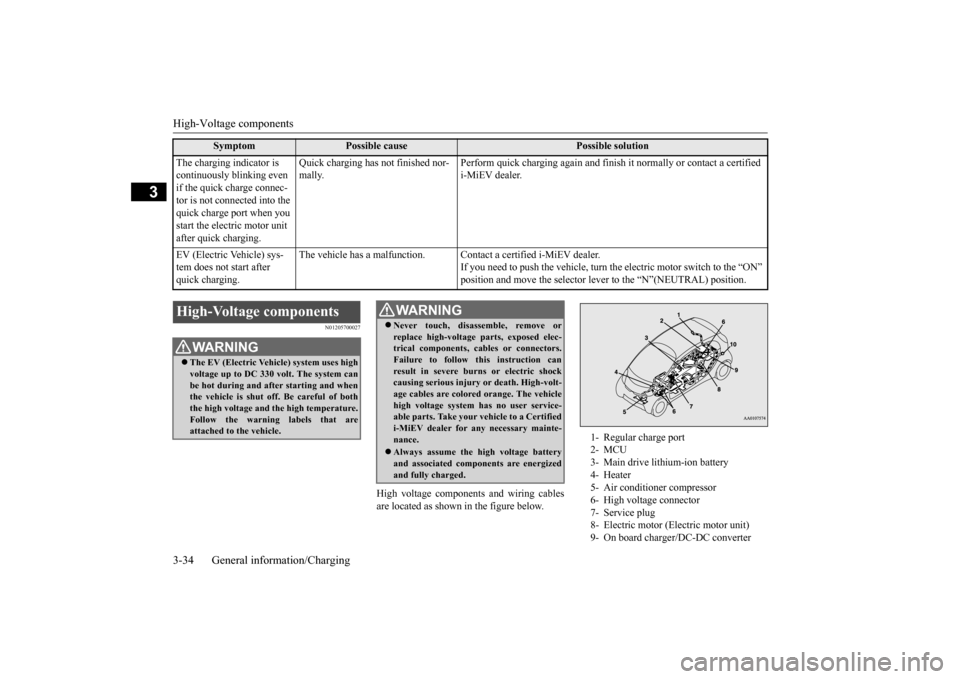
High voltage components and wiring cables are located as shown in the figure below.
The charging indicator is continuously blinking even if the quick charge connec- tor is not connected into the quick charge port when you start the electric motor unit after quick charging.
Quick charging has not finished nor- mally.
Perform quick charging ag
ain and finish it normally
or contact a certified
i-MiEV dealer.
EV (Electric Vehicle) sys- tem does not start after quick charging.
The vehicle has a malfunction. Cont
act a certified i-MiEV dealer.
If you need to push the vehicle, turn the electric motor switch to the “ON”
lector lever to the
“N”(NEUTRAL) position.
Symptom
Possible cause
Possible solution
High-Voltage components
WA R N I N GThe EV (Electric Vehicle) system uses high voltage up to DC 330 volt. The system can be hot during and after starting and when the vehicle is shut off. Be careful of boththe high voltage and
the high temperature.
Follow the warning labels that are attached to the vehicle.
Never touch, disassemble, remove or replace high-voltage parts, exposed elec-trical components, cables or connectors. Failure to follow this instruction can result in severe burns or electric shockcausing serious injury
or death. High-volt-
age cables are colore
d orange. The vehicle
high voltage system has no user service-able parts. Take your
vehicle to a Certified
i-MiEV dealer for any necessary mainte- nance. Always assume the high voltage battery and associated components are energizedand fully charged.WA R N I N G
1- Regular charge port 2- MCU 3- Main drive lithium-ion battery 4- Heater5- Air conditioner compressor 6- High voltage connector 7- Service plug8- Electric motor (Electric motor unit) 9- On board charger/DC-DC converter
BK0220401US.book 34 ページ 2015年6月3日 水曜日 午前7時42分
Page 49 of 296
High-Voltage components
General information/Charging 3-35
3
N01205800031
A crash or impact significant enough to require an emergency response for conven- tional vehicles would
also require the same
response for electric vehicles. Also follow the instru
ctions described below
to avoid severe burns a
nd electrical shock that
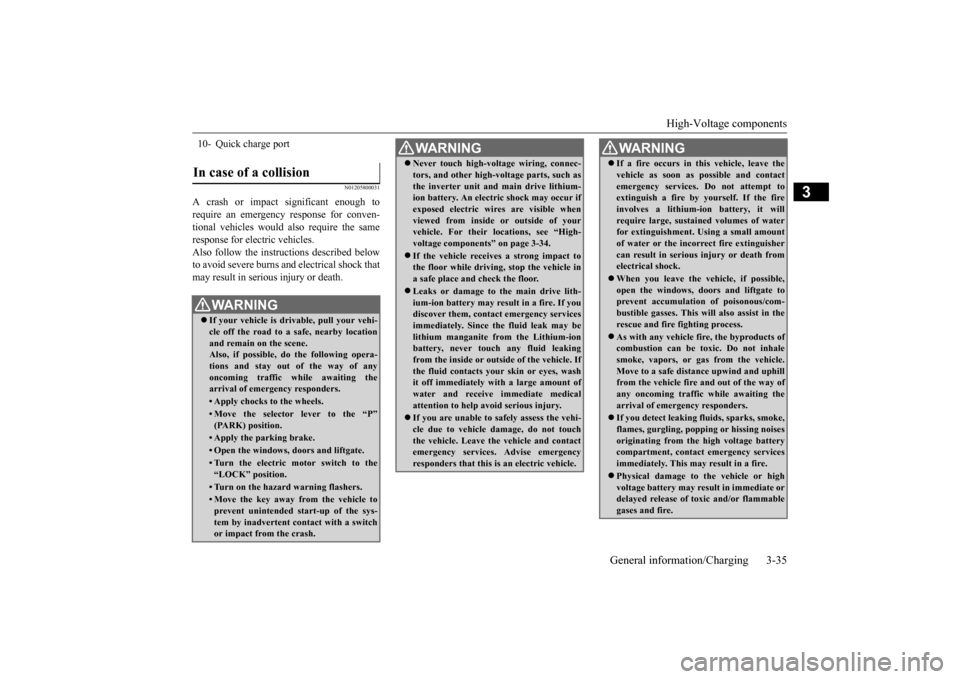
may result in serious injury or death. 10- Quick charge portIn case of a collision
WA R N I N G If your vehicle is dri
vable, pull your vehi-
cle off the road to a safe, nearby locationand remain on the scene. Also, if possible, do the following opera- tions and stay out of the way of anyoncoming traffic while awaiting the arrival of emerge
ncy responders.
• Apply chocks to the wheels.• Move the selector
lever to the “P”
• Apply the parking brake.• Open the windows,
doors and liftgate.
• Turn the electric motor switch to the “LOCK” position.• Turn on the hazard warning flashers.• Move the key away from the vehicle to prevent unintended start-up of the sys- tem by inadvertent co
ntact with a switch
or impact from the crash.
Never touch high-voltage wiring, connec- tors, and other high-vol
tage parts, such as
the inverter unit and main drive lithium-ion battery. An electric shock may occur if exposed electric wires are visible when viewed from inside
or outside of your
vehicle. For their locations, see “High- voltage components” on page 3-34. If the vehicle receives a strong impact to the floor while driving, stop the vehicle in a safe place and check the floor. Leaks or damage to the main drive lith- ium-ion battery may result in a fire. If youdiscover them, contact emergency services immediately. Since the fluid leak may be lithium manganite from the Lithium-ionbattery, never touch any fluid leaking from the inside or outs
ide of the vehicle. If
the fluid contacts you
r skin or eyes, wash
it off immediately with a large amount of water and receive immediate medical attention to help
avoid serious injury.
If you are unable to safely assess the vehi- cle due to vehicle damage, do not touchthe vehicle. Leave the vehicle and contact emergency services. Advise emergency responders that this is
an electric vehicle.
WA R N I N G
If a fire occurs in th
is vehicle,
leave the
vehicle as soon as possible and contactemergency services. Do not attempt toextinguish a fire by yourself. If the fire involves a lithium-ion battery, it will require large, sustained volumes of waterfor extinguishment.
Using a small amount
of water or the incorrect fire extinguisher can result in serious injury or death fromelectrical shock. When you leave the ve
hicle, if possible,
open the windows,
doors and liftgate to
prevent accumulation of poisonous/com- bustible gasses. This will also assist in therescue and fire fighting process. As with any vehicle fi
re, the byproducts of
combustion can be toxic. Do not inhale smoke, vapors, or gas
from the vehicle.
Move to a safe distan
ce upwind and uphill
from the vehicle fire
and out of the way of
any oncoming traffic
while awaiting the
arrival of emerge
ncy responders.
If you detect leaking
fluids, sparks, smoke,
flames, gurgling, popp
ing or hissing noises
originating from the
high voltage battery
compartment, contact emergency services immediately. This may result in a fire. Physical damage to the vehicle or high voltage battery may result in immediate ordelayed release of t
oxic and/or flammable
gases and fire.WA R N I N G
BK0220401US.book 35 ページ 2015年6月3日 水曜日 午前7時42分
Page 50 of 296
MiEV Remote System 3-36 General information/Charging
3
N01203401056
The MiEV Remote System has the following three functions. Charging Timer
P.3-41
When the EV charging cable (regular charger) (Level 1 or Level 2) is con-nected, the batteries will only charge during the pre-set
time period selected
using the MiEV Remote.
Remote Climate Control
P.3-47
When the EV charging cable (regular charger) (Level 1 or Level 2) is con-nected, the air-conditi
oner or heater can
be activated for up to 30 minutes prior to vehicle usage. This feature can beused to cool or heat the car and to acti- vate the front and rear window defroster.
Main Drive Lithium-ion Battery Level Indicator
P.3-50
The charge remaining in the Main Drive Lithium-ion Battery can be con-firmed through the MiEV Remote.
For your quick reference, refer to “Basic operation of the MiEV Remote” on page 3-40.
If your vehicle needs to be towed, trans- port the vehicle on a
flatbed truck or tow
the vehicle either with all wheels or therear wheels (drive
wheels) off the ground.
If the rear wheels are on the ground when towing, this may cause damage to the elec-tric motors. This may also cause a fire, if wiring in the electric motor unit room becomes damaged. Refer to “Towing” onpage 8-11. Do not attempt to repair a damaged elec- tric vehicle yourself. Please contact a cer- tified i-MiEV dealer for service. In the event of an ac
cident that requires
body repair and painting, the vehicle should be delivered
to a Certified i-MiEV
dealer to have the main drive lithium-ion battery and high voltage
parts such as the
inverter, including the attached wiringharness, removed prior to painting. If exposed to heat in the paint booth, the main drive lithium-ion battery will experi-ence battery capacity loss. A damaged main drive lithium-ion battery can also pose safety risks to untrainedmechanics and repair personnel.NOTE
The emergency shut-off
system will be acti-
vated and the high-volta
ge system will auto-
matically turn off under the following conditions:WA R N I N G
• Certain front, side or rear collisions. • Certain EV (Electric Vehicle) system mal- functions.
When the emergency shut
-off system is acti-
vated, the ready indicato
r is turned off. Refer
to “Indicator and warning light package” on page 5-43. If the emergency shut-off system activates, contact a Certifie
d i-MiEV dealer.
MiEV Remote System
NOTE
COOL:Operates in cooling mode intended
for exclusive use with Remote Cli- mate Control (P
re-Cooling Mode).
HEAT:Operates in heating mode intended
for exclusive use with Remote Cli- mate Control (P
re-Heating Mode).
The heated seats can be used while the Remote Climate Control is acti- vated. : Operates in defroster mode intended for exclusive use with Remote Cli- mate Control (Pre-Defroster Mode). The electric rear
window defogger is
activated automatically when theRemote Climate Control is activated in Pre-Defroster Mode.
BK0220401US.book 36 ページ 2015年6月3日 水曜日 午前7時42分
Page 82 of 296
Seat belts 4-10 Seat and restraint systems
4
3. Pull the seat belt out slowly while holding the latch plate. Push the latch plate into the buckle until you hear a “click”. Pull up on the belt to be su
re the latch plate is
locked securely in the buckle.
4. The lap part of the belt must always be worn low and snug across the hips. Pullup on the shoulder portion of the belt to take up any slack
in the lap belt.
5. To release the belt,
press the button on the
buckle and allow the belt to retract. If the belt does not retract smoothly, pull it out and check for kinks or twists in thewebbing. Then make sure it remains untwisted as it retracts.
N00418400371
A tone and warning light are used to remind the driver to fasten the seat belt.
NOTE
If the seat belt locks
up and cannot be pulled
out, pull it once with force and let it retract all the way. Then, pull the belt out
slowly once again.
NOTE
With the exception of the seat belt for the driver, the seat belts in all other seating posi-tions are equipped with an Automatic Lock- ing Retractor (ALR) function. If you pull the seat belt fully out of th
e retractor, the retrac-
tor will switch to its ALR child restraint installation function
(see page 4-18).
When the ALR function has been activated,the seat belt will only re
tract. If this happens,
let the belt fully retract, then pull the seat belt back out, repeating steps 1 through 4.
WA R N I N G Be sure the lap belt portion fits snugly and is worn as low as possible across the hips,not around the waist. Failure to follow thisinstruction will increase the risk of serious injury or death in the
event of an accident.
Be sure the seat belt webbing is not twisted when worn. Twisted webbing may adversely affect seat belt performance.
Driver’s seat belt reminder/warning light
BK0220401US.book 10 ページ 2015年6月3日 水曜日 午前7時42分
Page 83 of 296
Seat belts
Seat and restraint systems 4-11
4
If the electric motor switch is turned to the “ON” position without the driver’s seat beltbeing fastened, a warning light will come on, and a tone will sound for approximately 6 seconds to remind you to fasten your seatbelt. If the seat belt remains unfastened approxi- mately 1 minute later, the warning light willflash and the tone wi
ll sound intermittently
for approximately 90 seconds when the vehi- cle is driven.If the seat belt subse
quently remains unfas-
tened, the warning light
and tone will issue
further warnings each time the vehicle startsmoving from a stop. And if the driver unfas- tens the seat belt while driving, the warning will operate in the same way. When the seatbelt is fastened, the warnings will stop.
N00418300224
The front passenger seat
belt warning light is
located in the instrument panel. When the electric motor switch is turned to the “ON” position, this indicator normally comes on and goes off a few seconds later.
The light comes on when a person sits on the front passenger seat bu
t does not fasten the
seat belt. It goes off when the seat belt is subsequently fastened.
N00406300328
The seat belt anchor height can be adjusted.To move the anchor, pull the lock knob (A) and slide the anchor to the desired position. Release the lock knob to lock the anchor intoposition.
WA R N I N G In order to reduce the risk of serious injury or death in
an accident, always
wear your own seat belt. Do not allow any-one to ride in your ve
hicle unless he or she
is also seated and
wearing a seat belt.
Children should additi
onally be restrained
in a secure child restraint system.
Front passenger seat belt warn- ing light
WA R N I N G When a child booster se
at is used on the
front passenger seat, the front passenger seat belt warning ligh
t will not come on, if
the seat belt is not fastened when thebooster seat is used
. Confirm that the
child is wearing the
seat belt properly.
Do not install any acce
ssory or sticker that
makes the light difficult to see.
Adjustable seat belt shoulder anchor (front seats)
BK0220401US.book 11 ページ 2015年6月3日 水曜日 午前7時42分
Page 85 of 296

Child restraint systems
Seat and restraint systems 4-13
4
the pre-tensioners quickly
draw back seat belt
webbing and increase se
at belt performance.
The seat belt pre-tensioner system includes the following components:
The airbag control unit
monitors the readiness
of the electronic parts of the system wheneverthe electric motor switch is in the “ON” or “START” position. Thes
e include all of the
items listed above a
nd all related wiring.
The pre-tensioner seat
belt system will oper-
ate only when the electric motor switch is in the “ON” or “START” position.When the seat belt pre-tensioners activate, some smoke is released
and a loud noise will
be heard. The smoke is
not harmful, but care
should be taken not to in
tentionally inhale it,
as it may cause some
temporary irritation to
people with respiratory problems. The pre-tensioners activa
te in the event of a
moderate-to-severe front
or side impact, even
if the seat belt is not being worn. The seat belt pre-tensioners may not
activate in certain
frontal collisions, even though the vehiclemay appear to be se
verely damaged. Such
non-activation does not mean something is wrong with the seat belt pre-tensioner system,but rather that the collision forces were not severe enough or not of the type to activate the system.
N00408700124
This warning light tells you if there is a prob-lem involving the SRS airbags and/or the pre- tensioner seat belts. Refer to “SRS warning light” on page 4-26.
N00408900113
In the event of an accident, the seat belt forcelimiter system will help reduce the forceapplied to the driver a
nd front seat passenger.
N00407101795
When transporting infants or small children in your vehicle, an appr
opriate child restraint
system must always be
used. This is required
by law in the U.S. and Canada.
1- SRS warning light 2- Front impact sensors 3- Seat belt pr
e-tensioners
4- Airbag control unit 5- Side impact sensors
WA R N I N G The seat belt pre-tensioner system is designed to work only
once. After the seat
belt pre-tensioners have been activated,they will not work again. They must promptly be replaced and the entire seat belt pre-tensioner system inspected by acertified i-MiEV dealer.
SRS warning light Force limiter system Child restraint systems
BK0220401US.book 13 ページ 2015年6月3日 水曜日 午前7時42分