2017 MERCEDES-BENZ SLC-Class ECU
[x] Cancel search: ECUPage 92 of 294

Automa tica nti-glar emirror s
GWARNIN G
Electrolyt emay escape if th eglassinana uto-
matic anti-glare mirror breaks .The electrolyt e
is harmful and causes irritation .Itmustn ot
come int ocontac twithy our skin, eyes ,res -
piratory organs or clothing or be swallowed.
There is ariskofi njury.
If you come int ocontac twitht he electrolyte,
observ ethe following:
RRins eoff th eelectrolyt efromy our skin
immediately wit hwater.
RImmediately rinse th eelectrolyt eout of
your eyes thoroughly wit hclean water.
RIf th eelectrolyt eisswallowed, immediately
rinse your mout hout thoroughly. Do no t
induce vomiting .
RIf electrolytecom es int ocontac twithy our
skin or hair or is swallowed, see kmedical
attention immediately.
RImmediately chang eout of clothing whic h
has come int ocontac twithe lectrolyte.
RIf an allergic reaction occurs, see kmedical
attention immediately.
The rear-view mirror and th eexter iorm irror on
th ed river's side automatically go int oanti-glare
mod eift hefollowin gconditi onsa re met simul-
taneously:
Rth ei gnition is switched on and
Rinciden tligh tfro mh eadlamp sstrikes th esen-
sor in th erear-view mirror
The mirror sdonotgo int oanti-glare mod eif
revers egear is engage doriftheinterior lighti ng
i
s switched on .
Parking position for th eexteri or mir-
ror on thef ront-passenger side
Setting and stori ng theparki ng position
Usin grevers egear
You can store th eparking position of th eexte-
rio rm irror on th efront-pa ssenger side usin g
memory butto nM ?.T he revers egear mus tnot
be engage dduring th eprocess.
XMak esuret hatthe vehicl eisstationary and
that th eSmartKey is in position 2in th eigni-
tion lock.
XPress butto n; for th eexter iorm irror on th e
front-passenger side .
XEngage reversegear .
The exterio rmirror on th efront-pa ssenger
side moves to th epreset parking position .
XUse adjustmentbutto n= to adjust th eexte-
rio rm irror to aposition that allows you to see
th er ear whee land th ecurb.
The parking position is stored.
iIf you shif tthe transmission to another posi-
tion ,the exterio rmirror on th efront -
passenger side return stothedrivin gposition .
Usingthe memory button
90Mirrors
Seats ,steering wheel and mirrors
Page 101 of 294

XTurn housing cover:counter-clockwise and
pull it out.
XAt the bulb holder, push the bulb upwards,
disconnect it and pull it out of bulb holder ;.
XInsert the new bulb into bulb holder;at the
top, push it down and secure it in place.
XAttach housing cover :and turn it clockwise
until it engages.
Side marker lamp s(halogen head-
lamps)
Due to their location, have the bulbs in the side
marker lamp changed at aqualified specialist
workshop.
Windshield wipers
Switching the windshield wipers
on/off
!
Do not operate the windshield wipers when
the windshield is dry, as this could damage
the wiper blades. Moreover, dust that has col-
lected on the windshield can scratc hthe glass
if wiping takes place when the windshield is
dry.
If it is necessary to switch on the windshield
wipers in dry weather conditions, alwaysu se
washer fluid when operating the windshield
wipers.
!If the windshield wipers leave smears on the
windshield after the vehicle has been washed
in an automatic car wash, wax or other resi-
dues may be the reason for this. Clean the
windshield using washer fluid after washing
the vehicle in an automatic car wash.
!Intermittent wiping with rain sensor: due to
optical influences and the windshield becom-
ing dirty in dry weather conditions, the wind-
shield wipers may be activated inadvertently.
This could then damage the windshield wiper
blades or scratc hthe windshield.
For this reason, you should alwayss witch off
the windshield wipers in dry weather.
Combination switch
1
$ Windshield wiper off
2ÄIntermittent wipe, low (rain sensor set
to low sensitivity)
3Å Intermittent wipe, high (rain sensor
set to high sensitivity)
4° Continuous wipe, slow
5¯Continuous wipe, fast
BíSingle wipe/î Wipes the wind-
shield using washer fluid
If the wiper blades are worn, the windshield will
no longer be wiped properly. This could prevent
you from observing the traffic conditions.
Replacing the wiper blades
Important safety notes
GWARNING
If the windshield wipers begin to move while
you are changing the wiper blades, you could be trapped by the wiper arm. There is arisk of
injury.
Always switch off the windshield wipers and
ignition before changing the wiper blades.
!To avoid damaging the wiper blades, make
sure that you touch only the wiper arm of the
wiper.
!Never open the hood if awindshield wiper
arm has been folded away from the wind-
shield.
Never fold awindshield wiper arm without a
wiper blade back ontot he windshield.
Hold the windshield wiper arm firmly when
you change the wiper blade. If you release the
windshield wiper arm without awiper blade
Windshield wipers99
Lights and windshield wipers
Z
Page 116 of 294

Notesonb reaking-in anew vehicle
Important safety notes
Thes ensors ystemofs omedriving and driving
safety systems adjusts automaticall ywhile a
certai ndistance is being driven after the vehicle
ha sb eend elivere dorafter repairs. Full system
effectiveness is not reache duntilthe end of this
teach-i nprocedure.
New and replaced brake pads and discs only
reach their optimum braking effect after several hundred kilometers of driving. Compensate for
thi sb yapplyin ggreate rforce to the brake pedal.
The first 1000 miles (150 0km)
Them orey ou look after the engine when it is
new ,the mor esatisfied yo uwillbew ithi ts per-
formance in the future.
RYo us houl dtherefore drive at varying vehicle
and engine speeds for the first 1,000 miles
(1,500 km).
RAvoi dheavy loads, e.g .driving at full throttle,
during thi speriod.
RChang egearing oodt ime, befor ethe tach-
ometer needl eisÔ of the wa ytothe red area
of the tachometer.
RDo not manuall yshift to alower gear to brake
the vehicle.
RTry to avoi ddepressing the accelerator pedal
beyond the point of resistanc e(kickdown).
After 1000 mile s(1500 km),y oucan increase
the engine spee dgradually and accelerate the
vehicl etofulls peed.
Yo us houl dalsoo bser ve these note sonbreak-
ing in if the engine or parts of the drive train on
your vehicl ehaveb eenr eplaced.
Alway sobser ve the maximum permissible
speed.
Driving
Important safety notes
GWARNING
Objects in the driver's footwell can restrict the peda ltravel or obstruct adepresse dpedal.
Th eo perating and roa dsafety of the vehicl eis
jeopardized .The re is ariskofana ccident.
Make sure tha tallobjects in the vehicl eare
stowe dcorrectly ,and tha tthe yc annot enter
the driver's footwell .Install the floormats
securel yand as specified in order to ensure
sufficient clearanc efor the pedals .Donot use
loose floormats and do not place floormats on
top of one another.
GWARNING
Unsuitabl efootwear can hinde rcorrec tusage
of the pedals ,e.g.:
Rshoes with thick soles
Rshoes with high heels
Rslippers
There is ariskofana ccident.
Wear suitabl efootwear to ensur ecorrect
usag eoft he pedals.
GWARNING
If yo uswitch off the ignition whil edriving,
safety-relevant functions ar eonlya vailable
with limitations ,ornot at all. This could affect,
for example, the powe rsteering and the brake
boosting effect. Yo uwillr equire considerably
mor eeffort to steer and brake. There is arisk
of an accident.
Do not switch off the ignition whil edriving.
GWARNING
If the parking brake ha snot been fully
releasedw hend riving, the parking brake can:
Roverheat and cause afire
Rlose its hold function.
There is ariskoff irea nd an accident. Release
the parking brake full ybefor ed riving off.
!Do not warm up the engine with the vehicle
stationary. Drive off immediately. Avoi dhigh
engine speeds and driving at full throttle until
the engine ha sreache dits operating temper-
ature.
Onl yshift the automatic transmission to the
desired drive positio nwhent he vehicl eissta-
tionary.
114Driving
Dr iving an dparking
Page 120 of 294

ECO start/stop function
Introduction
The ECO start/sto pfunction switches the
engine off automaticall yifthevehicle is stopped
unde rcertain conditions.
The engine start sautomaticall ywhen th edriver
want stop ull away again.T he ECO start/stop
function therebyh elps you to reducethe fuel
consumptio nand emissionsofy our vehicle.
Important safety notes
GWARNING
If th eengine is switched off automaticall yand
you exi tthe vehicle ,the engine is restarted
automatically. The vehicle may begin moving.
Thereisar isk of accidenta nd injury.
If you wish to exi tthe vehicle ,always tur noff
th ei gnition and secure th evehicle against
rolling away.
General notes
:ECO start/sto pdisplay
The ECO start/sto pfunction is activated when-
ever you switch on th eengine usingt heSmart-
Key or th eStart/Sto pbutton.
If th eengine has been switched off automati-
cally by th eECO start/sto pfunction,t heè
ECO symbol is shownint hemultifunction dis-
play.
Automatic engine switch-off
If th evehicle is braked to astandstil lin D or N,
th eE CO start/sto pfunction switches off the
engine automatically. The ECO start/sto
pfunction is operational
when:
Rth ei ndicator lamp in th eECO butto nislit
green.
Rth eo utside temperatur eiswithin th erange
that is suitable for th esystem.
Rthee ngine is at normal operatin gtem pera-
ture.
Rth es et temperatur efor th evehicle interior
has been reached.
Rth eb attery is sufficiently charged.
Rthes ystem detect sthatthe windshield is not
fogged up when th eair-conditioning system is
switched on.
Rth eh ood is closed.
Rthed river'sd oor is closed and th edriver's
seat belt is fastened.
All of th evehicle's systems remain active when
th ee ngine is stopped automatically.
Automatic engine switch-off can tak eplacea
maximum of four times in arow (initial stop, then
three subsequents tops).
The HOLD function can be activated if the
engine has been switched off automatically. It is
then no tnecessaryt ocontinue applyingt he
brakes durin gthe automatic stop phase.W hen
you depress th eaccelerato rpedal, th eengine
start sautomaticall yand th ebraking effect of
th eH OLDf unction is deactivated.
Automatic engine start
The engine start sautomaticall yif:
Ryou switch off th eECO start/sto pfunction by
pressingt heECO button
Rin transmission position Dor Ntheb rake
pedal is released and th eHOLDfunction is not
active
Ryou depress th eaccelerato rpedal
Ryou engage reverseg earR
Ryou mov ethe transmission out of position P
Ryou switch to driveprogram S+
Ryou unfasten your seat belt or open th edriv-
er'sd oor
Rthev ehicle start storoll
Rtheb rak esystem requires this
Rthet em peratur einthevehicle interiord evi-
ate sfromt heset range
118Driving
Driving and parking
Page 126 of 294

XReleasethe brak epedal .
XReleas ethe electric parking brake.
XSwitc hoff th eignition and leav ethe SmartKey
in th eignition lock.
Engaging drive position D
XWhen th evehicl eiss tationary, depress th e
brak epedal .
XPush th eselector lever bac kpast th efirst
poin tofr esistance.
Transmission positions
BParkposition
This prevents th evehicl efromr ollin g
away when stopped.
Only shif tthe transmission int oposi-
tion Pwhen th evehicl eiss tationary
(
Ypage 122). The parking loc k
should no tbeused as abrak ew hen
parking .Always apply th eelectronic
parking brak einaddition to th epark -
ing loc kinorder to secure th evehi-
cle .
If th eSmartKey is remove dfromt he
ignition lock, th etransmission is
locked.
The automatic transmission shifts
int oP automatically:
Rwhen th eSmartKey is remove d
from th eignition loc k
Rwhen theengineiss witched off
wit hthe transmission in position R
or Dand on eofthedoor sis
opened
If th evehicl eelectronics are malfunc -
tioning ,the transmission may be
locke dinposition P.Havet he vehicl e
electronics checke dimmediately at a
qualified specialist workshop.
CRevers egear
Only shif tthe transmission int oposi-
tion Rwhen th evehicl eiss tationary.
ANeutral
Do no tshif tthe transmission to N
while driving .Otherwise, th eauto -
matic transmission could be dam-
aged.
No powe ristransmitte dfromt he
engin etothedriv ewheels.
Releasing th ebrak epedal will allow
you to mov ethe vehicl efreely, e.g. to
push it or to wit.
If ES P
®is deactivated or faulty: shif t
th et ransmission only to position Nif
th ev ehicl eisind anger of skidding,
e.g. on icy roads.
!Rollin ginneutral Ncan damag e
th ed rivet rain.
7Drive
The automatic transmission changes
gear automatically. All forward gear s
are available.
Driving tips
Changing gear
The automatic transmission shifts to th eindi-
vidual gear sautomatically when it is in trans -
mission position D.This automatic gear shifting
behavior is determine dby:
Rthes elected driv eprogram
Rthep osition of th eaccelerato rpedal
Rther oad spee d
Accelerator pedal position
Your style of driving influence show th eauto -
matic transmission shifts gear :
Rlittlethrottle: earl yupshift s
Rmorethrottle: lat eupshift s
124Automati ctransmission
Driving and parking
Page 129 of 294

accelerate,the automatic transmission auto-
matically shifts up in orde rtoprevent engine
damage.
XTo shif tdown: pull steering wheel paddle
shifter :.
The automatic transmission shifts down to
th en extg ear.
Automatic down shiftin goccurs when coast-
ing.
If th eengine exceeds th emaximum engine
speedw hen shiftin gdown,t heautomatic
transmission protect sagainst engine damage
by no tshiftin gdown.
Mercedes-Ben zSLC 43 AMG
!If manual gearshiftin gispermanently acti-
vated, th eautomatic transmission does not
shiftupa utomatically even when th eengine
limiting speedf or thecurren tgear is reached.
When th eengine limiting speedisr eached,
th ef uel supply is cut to prevent th eengine
from overrevving .Always makes ure that the
engine speedd oes notreac hthe red area of
th et achometer. Thereiso therwise arisk of
engine damage.
XTo shif tup:pull steering wheel paddle
shifter ;.
The automatic transmission shifts up to the
nex tgear.
XTo shif tdown: pull steering wheel paddle
shifter :.
The automatic transmission shifts down to
th en extg ear.
Automatic down shiftin goccurs when coast-
ing.
If th eengine exceeds th emaximum engine
speedw hen shiftin gdown,t heautomatic
transmission protect sagainst engine damage
by no tshiftin gdown.
Shiftr ecommendation
All vehicles (exceptM ercedes-BenzSLC
43 AMG)
The gearshiftr ecommendations assisty ou in
adopting an economical driving style. The rec-
ommended gear is shownint hemultifunction
display.
XShift to recommended gear ;according to
gearshiftr ecommendation :when showni n
th em ultifunction display of th einstrument
cluster.
Mercedes-Ben zSLC 43 AMG
The gearshiftr ecommendations assisty ou in
adopting an economical driving style. The rec-
ommended gear is shownint hemultifunction
display.
XShift to recommended gear ;according to
gearshiftr ecommendation :when showni n
th em ultifunction display of th einstrument
cluster.
Kickdown
XFor maximum acceleration, depress the
accelerato rpedal beyondt hepressure point.
The automatic transmission shifts to alower
gear dependingont heengine speed.
XShift back up once th edesired speedi s
reached.
During kickdown, you canno tshiftg earsu sing
th es teering wheel paddle shifters.
If you apply full throttle ,the automatic trans-
mission shifts up to th enextg ear when the
Automatic transmission127
Driving and parking
Z
Page 133 of 294

Problems with fuel and the fuel tank
ProblemPossible causes/consequences andMSolutions
Fuel is leaking from the
vehicle.The fuel line or the fuel tank is faulty.
GWARNING
Risk of explosion or fire.
XTurn the SmartKey to position 0immediately and remove it
(Ypage 115).
XDo not restart the engine under any circumstances.
XConsult aqualified specialist workshop.
The fuel filler flap cannot
be opened.The fuel filler flap is not unlocked.
XUnlock the vehicle (Ypage 63).
The SmartKey battery is discharged or nearly discharged.
XUnlock the vehicle using the mechanical key (Ypage 65).
The fuel filler flap is unlocked, but the opening mechanism is jammed.
XConsult aqualified specialist workshop.
Parking
Important safety notes
GWARNING
Flammable material such as leaves, grass or
twigs may ignite if they come into contact with
hot parts of the exhaust system or exhaust
gas flow. There is arisk of fire.
Park the vehicle so that no flammable mate-
rials come into contact with parts of the vehi-
cle which are hot. Take particular care not to
park on dry grassland or harvested grain
fields.
GWARNING
If you leave children unsupervised in the vehi-
cle, they could set it in motion by, for example:
Rrelease the parking brake.
Rshift the automatic transmission out of the
parking position P.
Rstart the engine.
In addition, they may operate vehicle equip-
ment and become trapped. There is arisk of
an accident and injury.
When leaving the vehicle, always take the
SmartKey with you and lock the vehicle. Never
leave children unsupervised in the vehicle.
!Always secure the vehicle correctly against
rolling away.O therwise, the vehicle or its driv-
etrain could be damaged.
To ensure that the vehicle is secured against
rolling away unintentionally:
Rthe electric parking brake must be applied.
Rthe transmission must be in position P.
Rthe SmartKey must be removed from the igni-
tion lock.
Rthe front wheels must be turned towards the
curb on steep uphill or downhill gradients.
Switching off the engine
GWARNING
The automatic transmission switches to neu-
tral position Nwhen you switch off the engine.
The vehicle may roll away.T here isarisk of an
accident.
After switching off the engine, always switch
to parking position P.Prevent the parked vehi-
Parking131
Driving and parking
Z
Page 134 of 294
cle from rolling away by applying the parking
brake.
XApplythe electri cparking brake.
XShif tthe transmission to position P
(Ypage 123).
XWith the SmartKey: turn the SmartKey to
position 0in the ignition lock and remove it.
The immobilizer is activated.
XWith KEYLESS-GO: press the KEYLESS-GO
Start/Stop button (Ypage 115).
The engine stopsa nd allthe indicator lamps in
the instrument cluster go out.
Whe nthe driver' sdoorisc losed, this corre-
sponds to SmartKey position 1.W hent he
driver' sdooriso pen, this corresponds to
SmartKey position 0(
Ypage 115).
The engine can be switched off while the vehicle
is in motio nbypressing and holding the Start/
Stop button for aboutt hree seconds. Thisfunc-
tion operate sindependently of the ECO start/
stop automatic engine switch-off function.
Electric parkin gbrake
General notes
GWARNING
If yo ulea ve childre nunsupervised in the vehi-
cle ,they could set it in motio nby,for example:
Rrelease the parking brake.
Rshift the automatic transmission outoft he
parking position P.
Rstartthe engine.
In addition, they may operate vehicle equip-
ment and become trapped .There is arisko f
an accident and injury.
Whe nleaving the vehicle ,alway stake the
SmartKey with yo uand lock the vehicle .Never
leave childre nunsupervised in the vehicle. The function of the electri
cparking brake is
dependent on the on-board voltage .Ifthe on-
board voltage is low or there is amalfunction in
the system, it may not be possible to applyt he
released parking brake.
XIf this is the case ,only park the vehicle on
level ground and secure it to prevent it rolling
away.
XShif tthe automatic transmission to position
P.
It may not be possible to release an applied
parking brake if the on-board voltage is low or
there is amalfunction in the system. Contact a
qualified specialist workshop.
The electri cparking brake performs afunction
test at regula rinterval swhile the engine is
switched off. The sounds that can be heard while
this is occurring are normal.
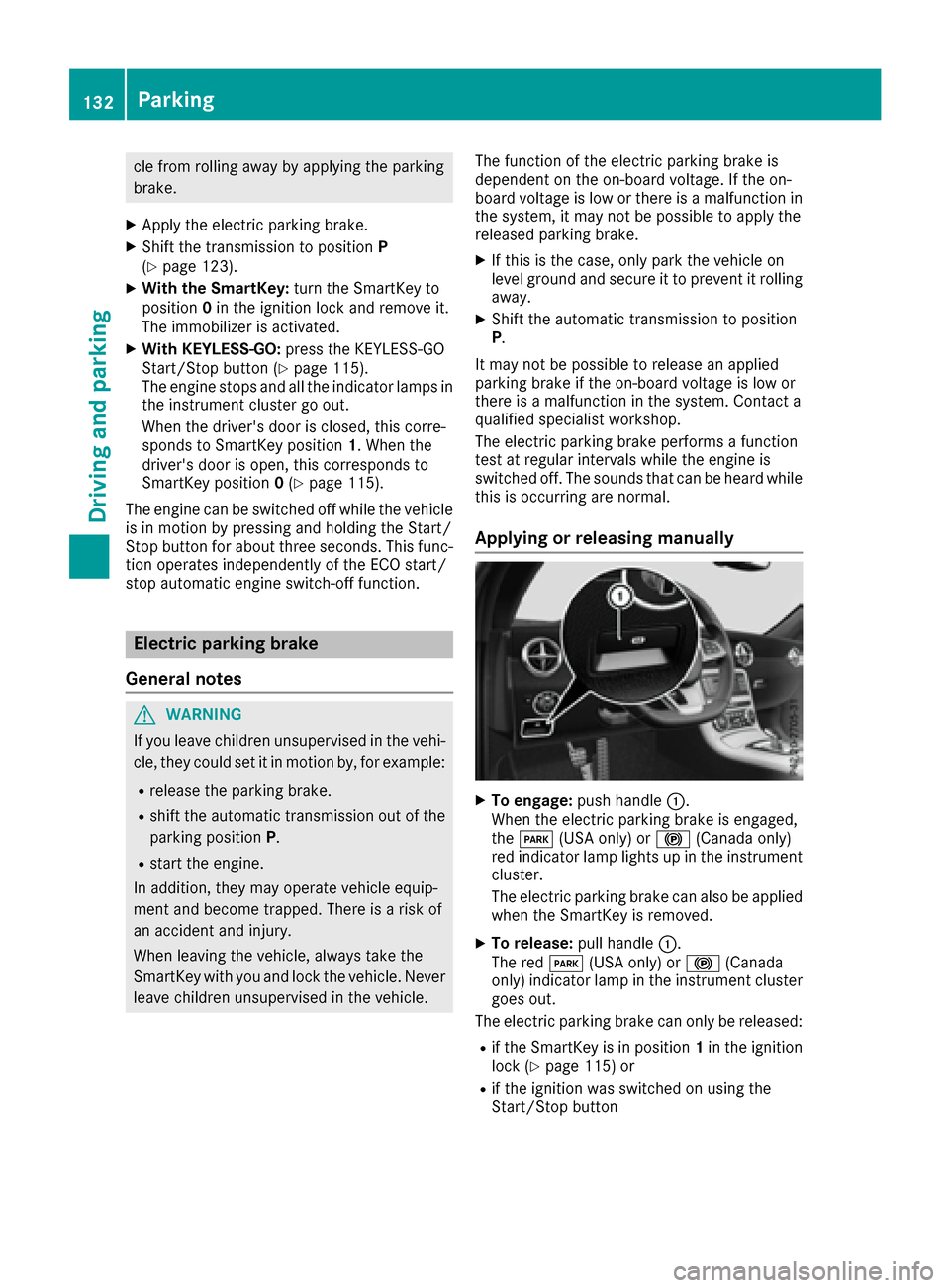
Applyin gorreleasin gmanually
XTo engage: push handle :.
Whe nthe electri cparking brake is engaged,
the F (USA only )or! (Canada only)
red indicator lamp lights up in the instrument
cluster.
The electricp arking brake can also be applied
whe nthe SmartKey is removed.
XTo release: pull handle:.
The red F(USA only )or! (Canada
only )indicator lamp in the instrument cluster
goe sout.
The electricp arking brake can only be released:
Rif the SmartKey is in position 1in the ignition
lock (Ypage 115) or
Rif the ignition wa sswitched on using the
Start/Stop button
132Parking
Drivin gand parking