2017 MERCEDES-BENZ E-Class SEDAN Vehicle data
[x] Cancel search: Vehicle dataPage 305 of 446
It isrecommended that youh ave thet hawe d
batter ychec kedataq ualified specialis twork‐
shop.
All vehicles
* NO
TEDama gecaused bynumerouso r
ex tende dattem ptstos tart thee ngine
Nume rous or extende dattem ptstos tart the
engine ma ydamag ethe catalytic con verter
due tonon-combu sted fuel.
#Av oid numerous and extende dattem pts
to star tt he engine.
Obser vethef ollowing points during starting
assis tance and when chargingt he battery:
ROnlyuse undamaged jumper cables/charg‐
ing cables wit hanadequat ecross-section
and insulated term inal clamps.
RNon- insulated parts of thet erminal clamps
mus tnotcom eintoc ontact wi thother me tal
parts while thej umper cables/charging
cables ar econnected totheb atter yort he
jump-s tart connection point.
RThe jumper cables/charg ing cables mustnot
com eintoc ontac twitha nyparts whic hmay
mo vewhen thee ngine is running.
RAlw aysm akes uret hat neither youn orthe
batter yareelect rostaticall ycharged.
RKeep away from fire and open flames.
RDo no tlean overthe batter y.
RWhencharging: onlyuse batter ychar gers
te sted and appr ovedbyM ercedes-Benza nd
re ad theb atter ycharger's operating instruc‐
tions befor echarging theb atter y.
Obser vethea dditional following point sduring
st artin gassis tance:
RSt artin gassis tance ma yonly be pr ovided
using batteries wit hanominal voltag eof1 2
V.
RThe vehicles mus tnot to uch.
RGasoline engine: Onlyaccep tstartin ga ssis‐
ta nce if thee ngine and exhaus tsystema re
cold.
#Secur ethe vehicle byapplying thee lectric
parking brake.
#Au tomatic transmission: Shiftthet rans‐
mission toposition B.
#Makesuret hat thei gnition and all electrical
consumer sareswitched off.
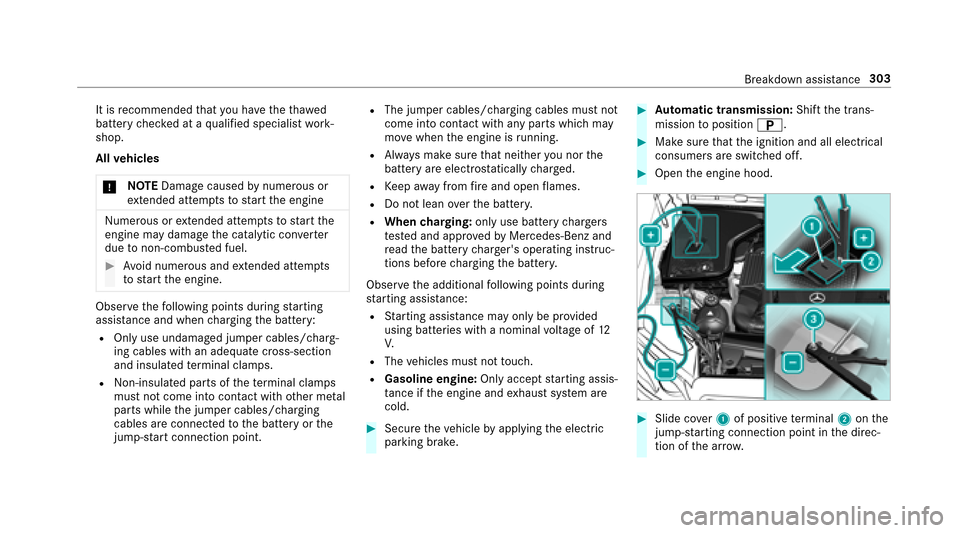
#Open thee ngine hood.
#Slide co ver1 of positiv eterminal 2onthe
jump-s tarting connection point in thed irec‐
tion of thea rrow .
Breakdown assis tance 303
Page 310 of 446

Electrical fuses
Notesone lectrical fuses
&
WARNING Risk of accident and injury
due to ov erloaded lines
If yo um anipulat eorb ridg eaf aulty fuse or if
yo ur eplace it wit hafuse wit hahigher
amperage, thee lectric line could be overloa‐
ded.
This could result in afire.
#Alwa ys replace faulty fuse swiths peci‐
fi ed ne wfuses conta iningthe cor rect
amperage.
* NO
TEDama gecaused byincor rect fuses
Incor rect fuses ma ycause damag etoelectri‐
cal components or sy stems.
#Onl yuse Mercedes-Benz appr oved
fuse switht he cor rect fus erating.
Blow nfuses must bereplaced wit hfuses of the
same rating ,which youc an recognize bythe colo
rand fus erating. Th efuser atings ar eliste d
in thef use assignmen tdiagram.
Fu se assignment diag ram: onthef use bo xin
th et runk (
→pag e310).
* NO
TEDama geor malfunctions caused
by moisture
Moistur emaycause dama getothee lectrical
sy stem or cause it tomalfunction.
#When thef use bo xisopen, mak esure
th at no moistur ecan enter thef use
box.
#When closing thef use box, mak esure
th at thes eal of thel id is positioned cor‐
re ctly on thef use box.
Ifan ewlyinser tedf use also blo ws,have the
cause trace dand rectifie dataq ualified special‐
is tw orks hop.
Ensur ethe following befor ereplacing afuse:
RThe vehicle is secured agains trolling away.
RAll electrica lconsumer sareswitched off.
RThe ignition is switched off. The electrica
lfus es ar eloc ated in various fuse
bo xes:
RFu se bo xinthe engine compartment on the
driver's side (→pag e308)
RFuse bo xont he driver's side of thec ockpit
(→pag e310)
RFuse bo xinthe front-passenge rfootwell
(→pag e310)
RFuse bo xinthe trunk on ther ight-hand side
of thev ehicle, when vie wedint he direction
of tra vel(
→pag e310)
Fu se bo xinthe engine compartment
Prerequisites
Obser vethen otes on electrical fuses
(
→pag e308).
Ha ve thef ollowing readil yavailable:
RAd ryclo th
RAs crew driver
308
Breakdown assis tance
Page 313 of 446

Noise or unusual handling characteristics
Whil edriving ,pay attention tovibrations, noises
and unusual handling characteristics, e.g .pulling
to one side. This ma yindicat ethat thew heels or
tires ar edamaged. If yous uspect that at irei s
defective, reduce your speedi mmediatel y.Stop
th ev ehicle as soon as possible tocheckt he
wheels and tires ford ama ge.H idden tir edam‐
ag ec ould also be causing theu nusual handling
ch aracteristics. If youf ind no sign sofdamage,
ha ve thet ires and wheels checkedataq ualified
specialis tworks hop.
Re gular checking of wheels and tires
&
WARNING Risk of accident from dam‐
aged tires
Dama gedt ires can cause tir epressur eloss.
As aresult, youc ouldlose cont rolofy our
ve hicle.
#Chec kthe tires regularly fors igns of
dama geand replace an ydamaged tires
immediatel y.
&
WARNING Risk of aquaplaning duet o
insuf ficient tir etread
Insuff icienttiret read will result in reduced
tir eg rip. The tir etread is no longer able to
dissipat ewater.
This meanst hat in heavyrain or slush the
ri sk of hydroplaning is increased, in particu‐
lar if vehicle speed is no tadap tedtos uitthe
conditions.
If th et irep ressur eist oo high or tool ow ,
tires ma yexhibit dif fere nt le vels of wear at
dif fere nt locations on thet irec onta ct sur‐
fa ce.
#Thus, yous hould regularly checkt he
tread dep thand thec ondition of thet ire
conta ct surf ace across thee ntir ew idth
of all tires.
Minimum tread dep thfor:
RSummer tires: âin (3 mm)
RM+S tires: ãin (4 mm)
#Fors afet yr easons, replace thet ires
befor ethe legally prescribed limit for
th em inimum tread dep thisreached.
Car ryout thef ollowing checks on all wheels reg‐
ularly ,atleastonce amonthorasr equired, e. g.
prior toalongj ourney or drivin goff-roa d:
RChec kthe tir epressur e(→page312).
RVisual checkofw heels and tires ford ama ge.
RChec kthe valvec aps.
The valves mus tbeprotected agains tmois‐
tur ea nd dir tbythevalvec aps appr oved
especiall yfor your vehicle byMercedes-Benz.
RVisual checkoft he tread dep thand thet ire
conta ct surf ace across thee ntir ew idth.
The minimum tread dep thfors ummer tires is
â in (3 mm) and forw inter tires ãin
(4 mm).
Wheels and tires 31
1
Page 316 of 446

&WARNING Risk of accident caused by
re peated drop in tir epressure
If th et irep ressur edrops repeatedl y,the
wheel, valveort irem aybe damaged.
Insuf ficient tir epressur ecan cause thet ires
to bur st.
#Inspect thet iref or signs of fore ign
objects.
#Chec kwhether thew heel or valveh as a
leak.
#If yo ua reunab leto rectify thed amage,
conta ctaq ualified specialis tworks hop.
Yo uc an find informatio nontirep ressur efor the
ve hicle's factor y-ins talled tires on thef ollowing
labels:
RTi re and Loading Info rmatio nplacar dont he
B‑pi llarofyour vehicle (→pag e319).
RTire pressur etable on thei nside of thef uel
fi ller flap (→pag e314).
Obse rvet he maximum tir epressure
(
→pag e325). Use
asuitable pressur egaug etoc heckthe tire
pressure. The outer appearance of atired oes
no tp ermit an yreliable conclusion about thet ire
pressure.
Ve hicles with atirep ressur emonitoring sys‐
te m: Youc an also checkt he tir epressur eusing
th eo n-boar dcomputer.
Onl ycorrect tir epressur ewhent he tires are
cold. Conditions forc old tires:
RThe vehicle has been par kedw itht he tires
out of direct sunlight foratl east thre eh ours.
RThe vehicle has tr aveled less than 1m ile
(1.6 km).
Ar ise in thet iret emperatur eof18°F( 10°C)
increases thet irep ressur ebya pprox.10k Pa
(0. 1b ar/1.5 psi). Take this int oaccount when
ch ecking thet irep ressur eofw armt ires.
The tire pressure re commendedfori ncreased
load/speedint he tirepressur etable can af fect
th er ide comfort.
&
WARNING Risk of accident from unsuita‐
blea ccessori es onthet irev alves
If yo um ountunsuitable accessories onto tire
va lves, thet irev alves ma ybeoverloaded and
malfunction, whic hcan cause tir epressure
loss. Tire pressur emonitoring sy stems for
re trofitting will cause thet irev alvetor emain
open .This can als oresult in tir epressure
loss.
#Onl yscrew standar dvalvec aps or valve
cap sspecifically appr ovedby
Mercedes-Benzf oryour vehicle onto
th et irev alve.
Tire pressur etable
The tir epressur etable is on thei nside of the
fuel filler flap.
% The dat ashown in thei mages is example
data.
31 4
Wheels and tires
Page 322 of 446

%The dat ashown in thei mag eise xamp le
data.
The Tire and Loading Info rmatio nplacar dshows :
RMaximum number of seats 2according to
th em aximum number of people permitted to
tr ave lint hevehicle
RMaximum permissible load 3comprises the
gross weight of all vehicle occupants, load
and luggage.
RRe commended tir epressure 1forc old
tires. The recommended tir epressures are
va lid fort he maximum permissible load and
up tothem aximum permissible vehicle
speed.
Please also no te:
RInformation on permissible weightsa nd loads
on thev ehicle identification plate
(
→pag e342).
RInformation on tir epressur eint he tir epres‐
sur etable (→pag e314).
Fu rther related subjects:
RDe term inin gthe maximum permissible load
(→pag e320)
RNotesont irep ressur e(→page312)
De term ining them aximum permissible load
The following steps ha vebeen de veloped as
re qu ired of all manufacturer sunder Title 49,
Code of U.S. Federal Regulations, Part57 5, pur‐
suant tothe" Na tional Traf fica nd Mo torV ehicle
Saf etyA ct of 1966".
#Ste p1:Loca tethes tatement" The combined
we ight of occupant sand cargo should ne ver
exc eed XXX kgor XXX lbs." ("The combined
we ight of occupant sand cargo should ne ver
exc eed XXX kgor XXX lbs.") on your vehicle's
tir ea nd loading information table.
#Ste p2:De term ine thec ombined weight of
th ed rive ra nd passenger sthat will be riding
in your vehicle.
#Ste p3:Subtract thec ombined weight of the
driver and passenger sfromX XXkgor
XXX lbs.
#Ste p4:The resulting figur eequals thep er‐
missible load forc argo and lug gage .F or
ex ample: If "XXX"e quals 1400 lbs and there
ar ef iveo ccupantsiny ourvehicle wit ha
we ight of 150lbs each, them aximum cargo
and luggag eload capacity is 650 lbs (1400 -
75 0(5x1 50)= 650 lbs).
#Step5:De term ine thec ombined weight of
luggag eand cargo being car ried in thev ehi‐
cle. Fors afet yr easons, this we ight ma ynot
safel yexceed thea vailable cargo and lug‐
ga ge load capacity calculated in step 4.
320
Wheels and tires
Page 328 of 446

Nevere xceed maximum tir epressure 1speci‐
fi ed fort he tire.
Information on tir echaracteristics
%
The dat ashown in thei mag eise xamp le
data.
This information descri besthet ype of tir ecord
and then umber of la yers in side wall1 and
under tir etread 2.
Tire size designation, load-bearing capacity,
speed ratin ga nd load index
&
WARNING Risk of accident duet o
exc eeding thes tatedt irel oad rating or
th ea ppr ove dspeed rating
Exceeding thes pecified tir eload rating or
th ep ermissible speed rating ma ylea dtot ire
damage andtothet ires bur sting.
#Therefore, onl yuse tir etypes and sizes
appr ovedfor your vehicle model.
#Obser vethet irel oad rating and speed
ra ting requ ired fory our vehicle.
1Preceding letter
2Nominal tir ewidthinm illimeters
3Aspect ratio in %
4Tire code
5Rimd iame ter
6Load-bearing index
7Speed rating
8Loa dind ex
% The dat ashown in thei mag eise xamp le
data.
Info rmatio nabout readingt he tiredatac an be
obtained from an yqualified specialis tworks hop.
326
Wheels and tires
Page 342 of 446

Notesont echnical data
The dat astatedo nly applies tovehicles with
st andar dequipment .You can obtain fur ther
information from an authorized Mercedes-Benz
Center.
Ve hicl eelectronics
Note soni nstalling two-w ayradios
&
WARNING Risk of accident from incor‐
re ctly car ried out workon theRFt rans‐
mitter
The electromagnetic radiation from RF trans‐
mitter scan inter fere wit hthe vehicle elec‐
tronics if RF transmitter saremanipulate dor
re trofitted inco rrectly.
This could jeopardize theo perating saf etyo f
th ev ehicle.
#Yous hould ha veall workon electrical
and electronic componentsc arried out
at aq ualified specialis tworks hop.
&
WARNING Risk of accident from incor‐
re ct ope ratio noft he RF transmitter
If yo uo perat eRFt ransmit ters incor rectl yin
th ev ehicle, thee lectromagnetic radiation
could inter fere wit hthe on-boar delectronics,
e.g.:
Rif th eRFt ransmit terisn otconnected to
an exterior antenna
Rif th ee xterio rantenna is no tcorrectly
mounted or is no talow-reflectio ntype.
This could jeopardize theo perating saf etyo f
th ev ehicle.
#Have thel ow -reflectio nexterior
antenn ainstalled at aqualified special‐
is tw orks hop.
#When operating RF transmitter sinthe
ve hicle, alw aysc onnect them tothe
lo w- reflection exterior antenna.
* NO
TEInva lidation of theo perating per‐
mit due tofailur etoc omply wi th the
instructions fori ns tallation and use
The operatin gpermit ma ybeinvalidated if
th ei nstruction sfor ins tallation and use of RF
transmitter sarenoto bser ved.
#Onl yuse appr oved frequency bands.
#Obser vethem aximum permissible out‐
put po werint hese frequency bands.
#Onlyuse appr oved antenn apositions.
340
Tech nica ldata
Page 343 of 446

1Front roof area
2Re ar roof area
3Re ar fender
4Trunk lid
On vehicles wit hapanoramic sliding sunroof,
ins talling an antenn aonthe front or rear roof
area is no tpermitted. On
ther ear fende rs,itisr ecommende dtoposi‐
tion thea ntenn aonthe side of thev ehicle clos‐
es ttot he center of ther oad.
Use Tech nica lSpecificatio nISO/T S21609 (Road
Ve hicles –EMC guidelines fori ns tallation of
af te rm arke tradio frequency transmittin gequip‐
ment )when retrofitting RF (radio frequency)
transmitters. Co mply wi th th elegal requirements
fo rd etachable parts.
If yo ur vehicle has ins tallation sfor two-w ayradio
equipment ,use thep ower suppl yorantenna
connectionsi ntendedforu se wit hthe basic wir‐
ing. Be sur etoobservethem anufacturer's addi‐
tional instruction swhen ins talling.
The maximum transmission output (PEAK) at the
base of thea ntenn amustn otexc eed thev alues
in thef ollowing table: Fr
equency band and maximum transmission
output
Fr equency band Maximu mtransmis‐
sion output
Sho rtwa ve
3-54M Hz 10
0W
4mb and
74 -88M Hz 30 W
2mb and
14 4-1 74MHz 50 W
Tr unked radio sys‐
te m/T etra
380 -460 MHz 10
W
70 cm band
400 -460 MHz 35 W
Mobile communica‐
tions (2G/3G/4G) 10
W
Tech nica ldata 34
1