2017 MERCEDES-BENZ E-CLASS SALOON belt
[x] Cancel search: beltPage 37 of 497
#
Alw ays ensure that all vehicle occu‐
pants ha vetheir seat belts fastened
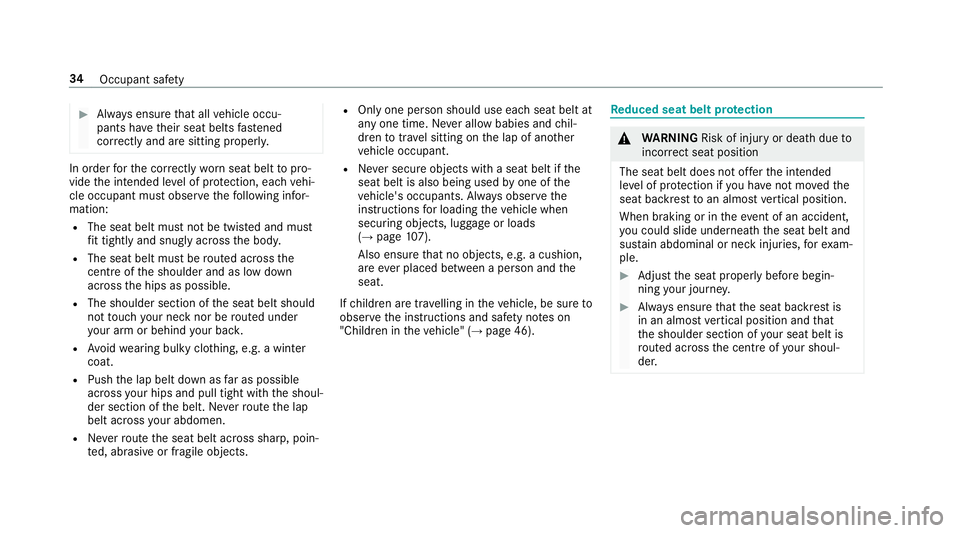
cor rectly and are sitting prope rly. In order
forth e cor rectly wornseat belt topro‐
vide the intended le vel of pr otection, each vehi‐
cle occupant must obser vethefo llowing infor‐
mation:
R The seat belt must not be twis ted and must
fi t tightly and snu gly across the body.
R The seat belt must be routed across the
centre of the shoulder and as low down
across the hips as possible.
R The shoulder section of the seat belt should
not touch your ne cknor be routed under
yo ur arm or behind your bac k.
R Avoid wearing bulky clo thing, e.g. a winter
coat.
R Push the lap belt down as far as possible
across your hips and pull tight with the shoul‐
der section of the belt. Ne verro ute the lap
belt across your abdomen.
R Neverro ute the seat belt across sharp, poin‐
te d, abrasive or fragile objects. R
Only one person should use each seat belt at
any one time. Ne ver allow babies and chil‐
dren totrave l sitting on the lap of ano ther
ve hicle occupant.
R Never secure objects with a seat belt if the
seat belt is also being used byone of the
ve hicle's occupants. Alw ays obser vethe
instructions for loading theve hicle when
securing objects, luggage or loads
(→ page 107).
Also ensure that no objects, e.g. a cushion,
are ever placed between a person and the
seat.
If ch ildren are tra velling in theve hicle, be sure to
obser vethe instructions and saf ety no tes on
"Children in theve hicle" (→ page 46). Re
duced seat belt pr otection &
WARNING Risk of inju ryor death due to
incor rect seat position
The seat belt does not of ferth e intended
le ve l of pr otection if you ha venot mo vedthe
seat backrest toan almost vertical position.
When braking or in theeve nt of an accident,
yo u could slide underneath the seat belt and
sus tain abdominal or neck injuries, forex am‐
ple. #
Adjust the seat proper lybefore begin‐
ning your journe y. #
Alw ays ensure that the seat backrest is
in an almost vertical position and that
th e shoulder section of your seat belt is
ro uted across the cent reofyour shoul‐
der. 34
Occupant saf ety
Page 38 of 497
&
WARNING Risk of inju ryor death when
additional restra int sy stems are not used
fo r persons with a smaller build
Pe rsons under 1.50 m tall cannot wearthe
seat belt cor rectly wi thout a suitable addi‐
tional restra int sy stem.
If th e seat belt is not worncor rectly, it can‐
not per form its intended pr otective function.
In addition, an incor rectly fastened seat belt
can also cause injuries, forex ample, in the
ev ent of an accident or when braking or
ch anging direction sudden ly.#
Alw ays secure persons under 1.50 m
ta ll in a suitable restra int sy stem. &
WARNING Risk of inju ryor death due to
bloc ked seat belt buckle or seat belt
anchorage
Objects next tothe front seat that block the
seat belt buckle or the moving seat belt
anchorage on the front seat impair the func‐
tion of the seat belt tensioners. The seat belt
tensioners may not function as
intended and the seat belt may no longer
pr ov ide the intended pr otection. #
Before starting the journe y,make sure
th at there are no objects around the
seat belt buckle or between the front
seat and door. &
WARNING Risk of inju ryor death due to
damaged or modified seat belts
Seat belts cann otprov ide pr otection in the
fo llowing situations:
R Ifth e seat belts are damaged, modified,
ex treme lydirty, bleached or dyed
R Ifth e seat belt buckle is damaged or
ex treme lydirty
R Ifth e seat belt tensioners, seat belt
anchorages or seat belt retractors ha ve
been modified
Seat belts may be damaged in an accident,
although the damage may not be visible, e.g.
due tosplinters of glass. Modified or damaged seat belts may
tear or
fa il, e.g. in an accident.
Modified seat belt tensioners could acciden‐
ta lly trigger or failto function as intended. #
Never modify the seat belts, seat belt
te nsioners, seat belt anchorages or seat
belt retractors. #
Makesure that the seat belts are
undamaged, not wornand clean. #
Alw ays ha vethe seat belts checked
immediately af ter an accident at a
qu alified specialist workshop. Mercedes-Benz
recommends that you on lyuse
seat belts which ha vebeen appr oved specifically
fo ryo ur vehicle byMercedes-Benz. &
WARNING Risk of inju ryor death from
deplo yedpy rotech nic seat belt tension‐
ers
Py rotech nic seat belt tensioners that ha ve
been deplo yed are no longer operational and
are unable toper form their intended pr otec‐
tive function. Occupant saf
ety35
Page 39 of 497
#
Therefore, ha vedeplo yedpy rotech nic
seat belt tensioners immedia tely
re placed at a qualified specialist work‐
shop. Mercedes-Benz
recommends that you ha vethe
ve hicle towe dto aqu alified specialist workshop
af te r an accident.
* NO
TEDama gecaused bytrapping the
seat belt If an unused seat belt is not fully
retracted, it
may become trapped in the door or in the
seat mechanism. #
Alw ays ensure that an unused seat belt
is fully retracted. In
fo rm ation on the belt airbag in there ar
seat belt The BELTB
AGidentification indicates that a rear
seat belt is equipped with a belt airbag.
When activated, the belt airbag increases the
pr otected area of theve hicle occupant's ribcage. &
WARNING Risk of inju ryor death due to
use of a non-appr ovedch ild restra int sys‐
tem
In an accident, the belt airbag may damage a
non-appr ovedch ild restra int sy stem or a
ch ild restra int sy stem which has not been
appr ovedfo r use in conjunction with the belt
airbag.
As a result, thech ild restra int sy stem may
not be able toprov ide the intended le vel of
pr otection.
Fo r saf etyre asons, Mercedes-Benz recom‐
mends that you on lyuse a child restra int sys‐
te m which has been tested and appr ovedby
Mercedes-Benz in combination with a belt
airbag. Information on
child restra int sy stems
(→ page 61). Fa
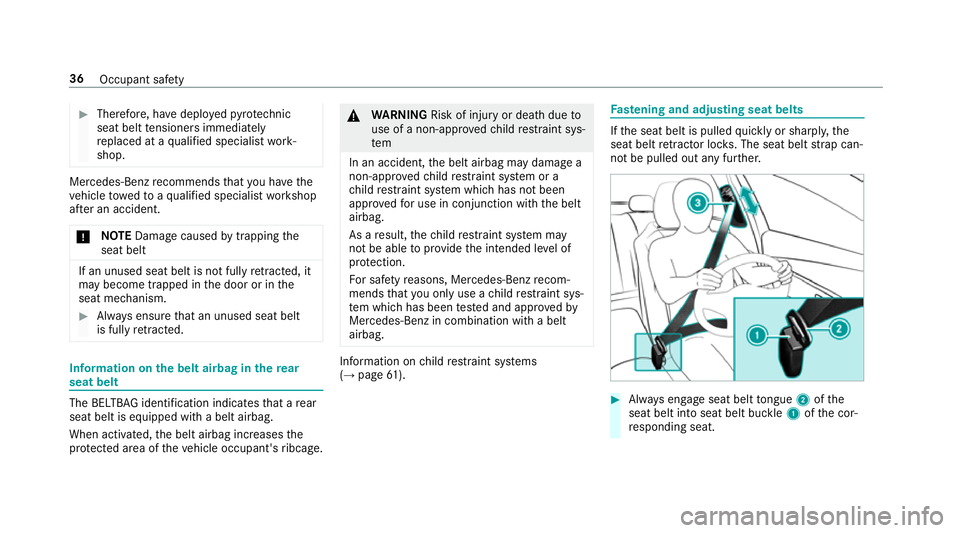
stening and adju sting seat belts If
th e seat belt is pulled quickly or sharpl y,the
seat belt retractor lo cks. The seat belt stra p can‐
not be pulled out any fur ther. #
Alw ays engage seat belt tongue 2ofthe
seat belt into seat belt buckle 1ofthe cor‐
re sponding seat. 36
Occupant saf ety
Page 40 of 497
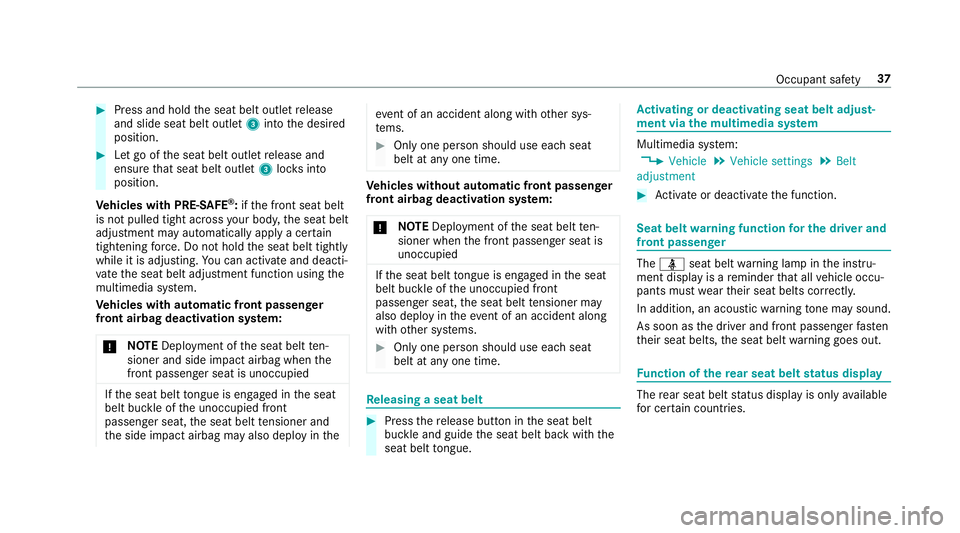
#
Press and hold the seat belt outlet release
and slide seat belt outlet 3into the desired
position. #
Let go of the seat belt outlet release and
ensure that seat belt outlet 3locksinto
position.
Ve hicles with PRE-SAFE ®
:if th e front seat belt
is not pulled tight across your body, the seat belt
adjustment may automatically apply a cer tain
tigh tening forc e. Do not hold the seat belt tightly
while it is adjusting. You can activate and deacti‐
va te the seat belt adjustment function using the
multimedia sy stem.
Ve hicles with automatic front passen ger
front airbag deacti vation sy stem:
* NO
TEDeployment of the seat belt ten‐
sioner and side impact airbag when the
front passenger seat is unoccupied If
th e seat belt tongue is engaged in the seat
belt buckle of the unoccupied front
passenger seat, the seat belt tensioner and
th e side impact airbag may also deploy in the ev
ent of an accident along with other sys‐
te ms. #
Only one person should use each seat
belt at any one time. Ve
hicles without automatic front passen ger
front airbag deacti vation sy stem:
* NO
TEDeployment of the seat belt ten‐
sioner when the front passenger seat is
unoccupied If
th e seat belt tongue is engaged in the seat
belt buckle of the unoccupied front
passenger seat, the seat belt tensioner may
also depl oyintheev ent of an accident along
with other sy stems. #
Only one person should use each seat
belt at any one time. Re
leasing a seat belt #
Press there lease button in the seat belt
buckle and guide the seat belt back with the
seat belt tongue. Ac
tivating or deactivating seat belt adjust‐
ment via the multimedia sy stem Multimedia sy
stem:
, Vehicle .
Vehicle settings .
Belt
adjustment #
Activate or deacti vate the function. Seat belt
warning function for the driver and
front passen ger The
ü seat belt warning lamp in the instru‐
ment display is a reminder that all vehicle occu‐
pants must weartheir seat belts cor rectly.
In addition, an acoustic warning tone may sound.
As soon as the driver and front passenger fasten
th eir seat belts, the seat belt warning goes out. Fu
nction of there ar seat belt status display The
rear seat belt status display is on lyavailable
fo r cer tain countries. Occupant saf
ety37
Page 41 of 497
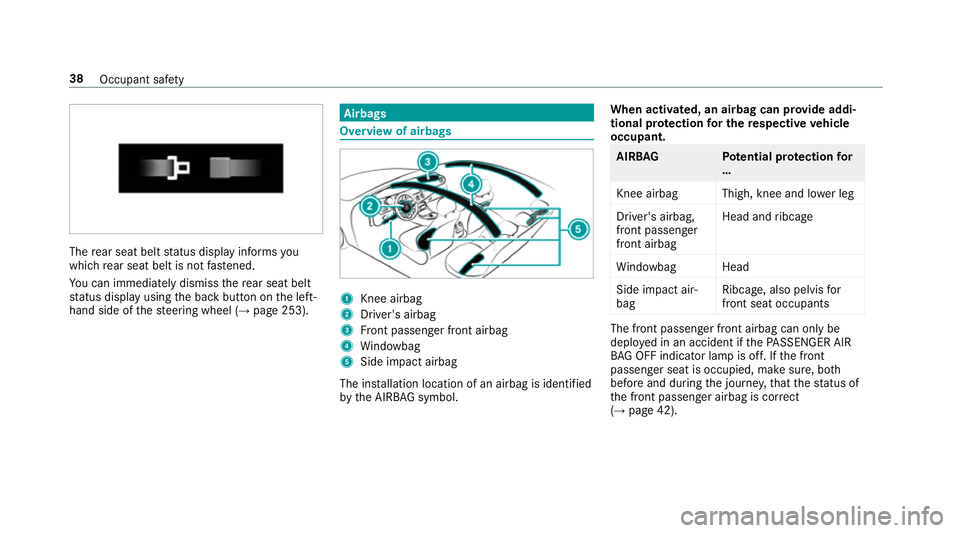
The
rear seat belt status display informs you
which rear seat belt is not fastened.
Yo u can immediately dismiss there ar seat belt
st atus display using the back button on the left-
hand side of thesteering wheel (→ page 253). Airbags
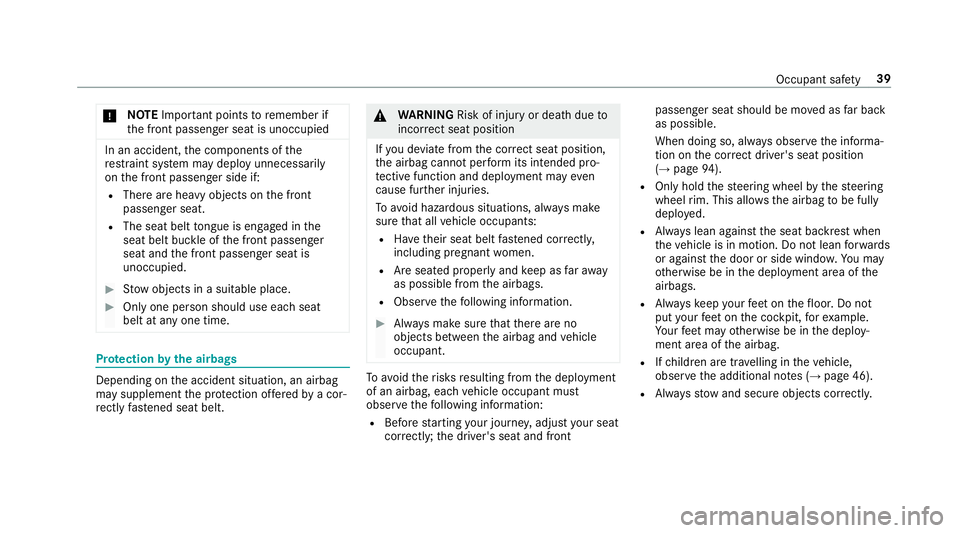
Overview of airbags
1
Knee airbag
2 Driver's airbag
3 Front passenger front airbag
4 Windowbag
5 Side impact airbag
The ins tallation location of an airbag is identified
by the AIRB AGsymbol. When activated, an airbag can pr
ovide addi‐
tional pr otection for the respective vehicle
occupant. AIRB
AG Potential pr otection for
…
Knee airbag Thigh, knee and lo wer leg
Driver's airbag,
front passenger
front airbag Head and
ribcage
Wi ndowbag Head
Side impact air‐
bag Ribca
ge, also pelvis for
front seat occupants The front passenger front airbag can only be
depl
oyed in an accident if thePA SSENGER AIR
BA G OFF indicator lamp is off. If the front
passenger seat is occupied, make sure, bo th
before and during the journe y,that thest atus of
th e front passenger airbag is cor rect
(→ page 42). 38
Occupant saf ety
Page 42 of 497
*
NO
TEImpo rtant points toremember if
th e front passenger seat is unoccupied In an accident,
the components of the
re stra int sy stem may deploy unnecessarily
on the front passenger side if:
R There are heavy objects on the front
passenger seat.
R The seat belt tongue is engaged in the
seat belt buckle of the front passenger
seat and the front passenger seat is
unoccupied. #
Stow objects in a suitable place. #
Only one person should use each seat
belt at any one time. Pr
otection bythe airbags Depending on
the accident situation, an airbag
may supplement the pr otection of fere dby a cor‐
re ctly fastened seat belt. &
WARNING Risk of inju ryor death due to
incor rect seat position
If yo u deviate from the cor rect seat position,
th e airbag cann otper form its intended pro‐
te ctive function and deployment may even
cause fur ther injuries.
To avo id hazardous situations, alw ays make
sure that all vehicle occupants:
R Have their seat belt fastened cor rectly,
including pregnant women.
R Are seated properly and keep as faraw ay
as possible from the airbags.
R Obser vethefo llowing information. #
Alw ays make sure that there are no
objects between the airbag and vehicle
occupant. To
avo idtherisks resulting from the deployment
of an airbag, each vehicle occupant must
obser vethefo llowing information:
R Before starting your journe y,adjust your seat
co rrectly ;th e driver's seat and front passenger seat should be mo
ved as far back
as possible.
When doing so, alw ays obser vethe informa‐
tion on the cor rect driver's seat position
(→ page 94).
R Only hold thesteering wheel bythesteering
wheel rim. This allow sth e airbag tobe fully
deplo yed.
R Alw ays lean against the seat backrest when
th eve hicle is in motion. Do not lean forw ards
or against the door or side windo w.You may
ot herwise be in the deployment area of the
airbags.
R Alw ayske ep your feet on thefloor. Do not
put your feet on the cockpit, forex ample.
Yo ur feet may otherwise be in the deploy‐
ment area of the airbag.
R Ifch ildren are tra velling in theve hicle,
obser vethe additional no tes (→ page 46).
R Alw aysstow and secure objects cor rectly. Occupant saf
ety39
Page 45 of 497

A pe
rson on the front passenger seat must
obser vethefo llowing information:
R Fasten seat belts cor rectl y.
R Sit in an almost up right seat position with
th eir back against the seat backrest.
R Sit with their feet resting on thefloor, if pos‐
sible.
Otherwise, the front passenger airbag may be
disabled bymis take ,fo rex ample in thefo llowing
situations:
R The front passen ger transfers their weight by
supporting themselves on a vehicle armrest.
R The front passenger sits in such a wayth at
th eir weight is raised from the sitting sur‐
fa ce. &
WARNING Risk of inju ryor death due to
deactivated front passenger airbag
If th ePA SSENGER AIRB AGOFF indicator
lamp is lit, the front passenger airbag is disa‐
bled. It will not be deplo yed in theeve nt of
an accident and cannot pe rform its intended
pr otective function. A person in
the front passenger seat could
th en, forex ample, come into con tact wi th
th eve hicle interior, especially if the person is
sitting too close tothe cockpit.
If th e front passenger seat is occupied,
alw ays ensure that:
R The classification of the person in the
front passenger seat is cor rect and the
front passenger airbag is enabled or disa‐
bled in accordance with the person in the
front passenger seat.
R The front passenger seat has been mo ved
as far back as possible.
R The person is seated cor rectl y. #
Ensu re, bo thbefore and during the jour‐
ne y,that thest atus of the front
passenger airbag is cor rect. Fu
nction of thePA SSENGER AIR BAG indica‐
to r lamps Sy
stem self- test
When the ignition is switched on, a sy stem self-
te st is per form ed during which the two
PA SSENGER AIR BAG ON and OFF indicator
lamps light up simultaneousl y.42
Occupant saf ety
Page 47 of 497
&
WARNING Risk of inju ryor death due to
incor rect positioning of thefo rw ard-
fa cing child restra int sy stem
If yo u secure a child in a forw ard-facing child
re stra int sy stem on the front passenger seat
and you position the front passenger seat too
close tothe cockpit, in theeve nt of an acci‐
dent, thech ild could:
R Come into con tact wi th theve hicle inte‐
ri or if thePA SSENGER AIR BAG OFF indi‐
cator lamp is lit, forex ample.
R Bestru ck bythe airbag if thePA SSENGER
AIR BAG OFF indicator lamp is off. #
Alw ays mo vethe front passenger seat
as far back as possible and fully retract
th e seat cushion length adjustment.
Alw ays make sure that the shoulder belt
st ra p is cor rectly routed from the seat
belt outlet on theve hicle tothe shoul‐
der belt guide on thech ild restra int sys‐
te m. The shoulder belt stra p must be
ro uted forw ards and down wards from
th e seat belt outlet. If necessar y,adjust th
e seat belt outlet and the front
passenger seat accordingly. #
Alw ays obser vethech ild restra int sys‐
te m manufacturer's ins tallation instruc‐
tions. When
fitting a child restra int sy stem tothe front
passenger seat, obser vetheve hicle-specific
information .
If a person is sitting in the front passenger
seat: PASSENGER AIR BAG OFF may be lit con‐
tinuously or be off, depending on the person's
st ature.
A person on the front passenger seat must
alw ays obser vethefo llowing information:
R Ifth e front passenger seat is occupied with
an adult or a person with a stature cor re‐
sponding tothat of an adult, thePA SSENGER
AIR BAG OFF indicator lamp must be off. This
indicates that the front passenger airbag is
enabled.
If th ePA SSENGER AIR BAG OFF indicator
lamp is lit continuousl y,an adult or person
with a build cor responding tothat of an adult should not use
the front passenger seat.
Ins tead, they should use a rear seat.
R Ifth e front passenger seat is occupied by a
person of smaller stature (e.g. a teenager or
small adult), thePA SSENGER AIR BAG OFF
indicator lamp either lights up continuously
or remains off, depending on there sult of the
classi fication.
- PASSENGER AIRB AGOFF is off: mo vethe
front passenger seat as far back as possi‐
ble or a person of smaller stature should
use a rear seat.
- Ifth ePA SSENGER AIRB AGOFF indicator
lamp is lit continuously: a person of
smaller stature should not use the front
passenger seat. &
WARNING Risk of inju ryor death when
th ePA SSENGER AIR BAG OFF indicator
lamp is lit
If th ePA SSENGER AIR BAG OFF indicator
lamp remains lit af terth e sy stem self-test,
th e front passenger airbag is disabled. It will
not be deplo yed in theev ent of an accident. 44
Occupant saf ety