Page 470 of 640

4707-3. Do-it-yourself maintenance
RC300h_EE(OM24740E)
WARNING
The engine compartment contains many mechanisms and fluids that may move suddenly, become hot, or become electrically energize d. To avoid death or serious injury, observe the following precautions.
■When working on the engine compartment
●Make sure that the “ACCESSORY” or “IGNITION ON” on the multi-informationdisplay and the “READY” indicator are both off.
●Keep hands, clothing and tools away from the moving fan and engine drive belt.
●Be careful not to touch the engine, radiator, exhaust manifold, etc. right after drivingas they may be hot. Oil and other fluids may also be hot.
●Do not leave anything that may burn easily, such as paper and rags, in the enginecompartment.
●Do not smoke, cause sparks or expose an open flame to fuel. Fuel fumes are flamma-
ble.
●Be extremely cautious when working on the 12-volt battery. It contains poisonous and corrosive sulfuric acid.
●Take care because brake fluid can harm your hands or eyes and damage painted sur- faces. If fluid gets on your hands or in your eyes, flush the affected area with cleanwater immediately.
If you still experience discomfort, consult a doctor.
■When working near the electric cooling fans or radiator grille
Be sure the power switch is off.
With the power switch in ON mode, the electric cooling fans may automatically start to run if the air conditioning is on and/or the coolant temperature is high. ( P. 480)
■Safety glasses
Wear safety glasses to prevent flying or falling material, fluid spray, etc. from getting in your eyes.
NOTICE
■If you remove the air cleaner filter
Driving with the air cleaner filter removed may cause excessive engine wear due to dirt
in the air.
■If the fluid level is low or high
It is normal for the brake fluid level to go down slightly as the brake pads wear or when
the fluid level in the accumulator is high. If the reservoir needs frequent refillin g, it may indicate a serious problem.
Page 499 of 640
4997-3. Do-it-yourself maintenance
7
Maintenance and care
RC300h_EE(OM24740E)
●Stop the vehicle on a hard, flat surface.
●Set the parking brake.
●Shift the shift lever to P.
●Stop the hybrid system.
Replacing the tire
When raising your vehicle with a jack, position the jack correctly.
Improper placement may damage your vehicle or cause injury.
Before jacking up the vehicle
Location of the jack and tools
Jack
Jack handle
Screwdriver
Towing eyelet
Wheel nut wrench
1
2
3
4
5
Page 502 of 640
5027-3. Do-it-yourself maintenance
RC300h_EE(OM24740E)
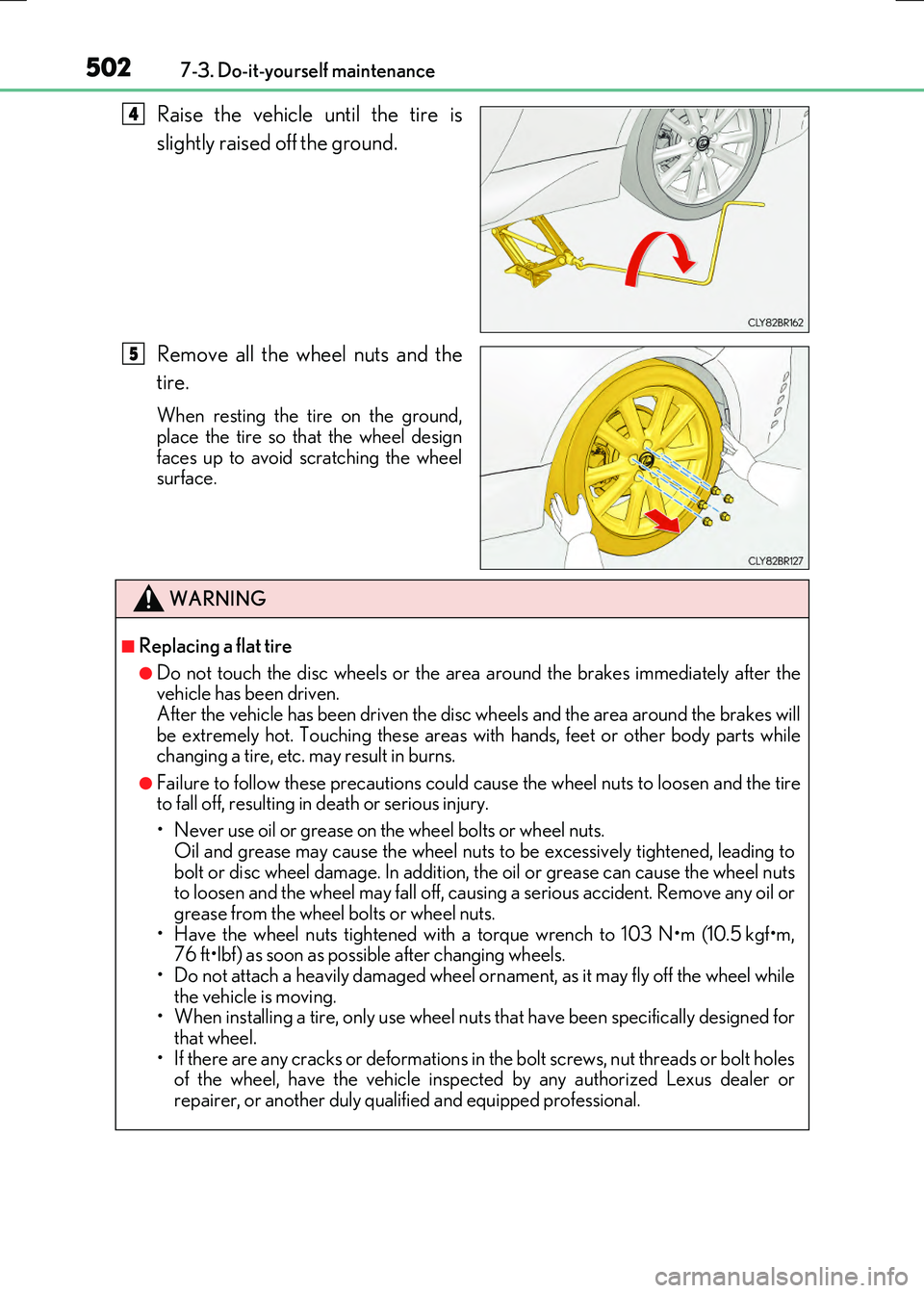
Raise the vehicle until the tire is
slightly raised off the ground.
Remove all the wheel nuts and the
tire.
When resting the tire on the ground,
place the tire so that the wheel design faces up to avoid scratching the wheelsurface.
4
5
WARNING
■Replacing a flat tire
●Do not touch the disc wheels or the area around the brakes immediately after thevehicle has been driven.
After the vehicle has been driven the disc wheels and the area around the brakes will be extremely hot. Touching these areas wi th hands, feet or other body parts while changing a tire, etc. may result in burns.
●Failure to follow these precautions could cause the wheel nuts to loosen and the tireto fall off, resulting in death or serious injury.
• Never use oil or grease on the wheel bolts or wheel nuts.
Oil and grease may cause the wheel nuts to be excessively tightened, leading to bolt or disc wheel damage. In addition, the oil or grease can cause the wheel nuts to loosen and the wheel may fall off, causing a serious accident. Remove any oil or
grease from the wheel bolts or wheel nuts. • Have the wheel nuts tightened with a torque wrench to 103 N•m (10.5 kgf•m,76 ft•lbf) as soon as possible after changing wheels.
• Do not attach a heavily damaged wheel or nament, as it may fly off the wheel while the vehicle is moving.• When installing a tire, only use wheel nuts that have been specifically designed for
that wheel. • If there are any cracks or deformations in the bolt screws, nut threads or bolt holesof the wheel, have the vehicle inspected by any authorized Lexus dealer or
repairer, or another duly qualif ied and equipped professional.
Page 529 of 640
5298-1. Essential information
8
When trouble arises
RC300h_EE(OM24740E)
Steadily step on the brake pedal with both feet and firmly depress it.
Do not pump the brake pedal repeatedly as this will increase the effort required to slow the vehicle.
Shift the shift lever to N.
If the shift lever is shifted to N
After slowing down, stop the vehicle in a safe place by the road.
Stop the hybrid system.
If the shift lever cannot be shifted to N
Keep depressing the brake pedal with both feet to reduce vehicle speed as
much as possible.
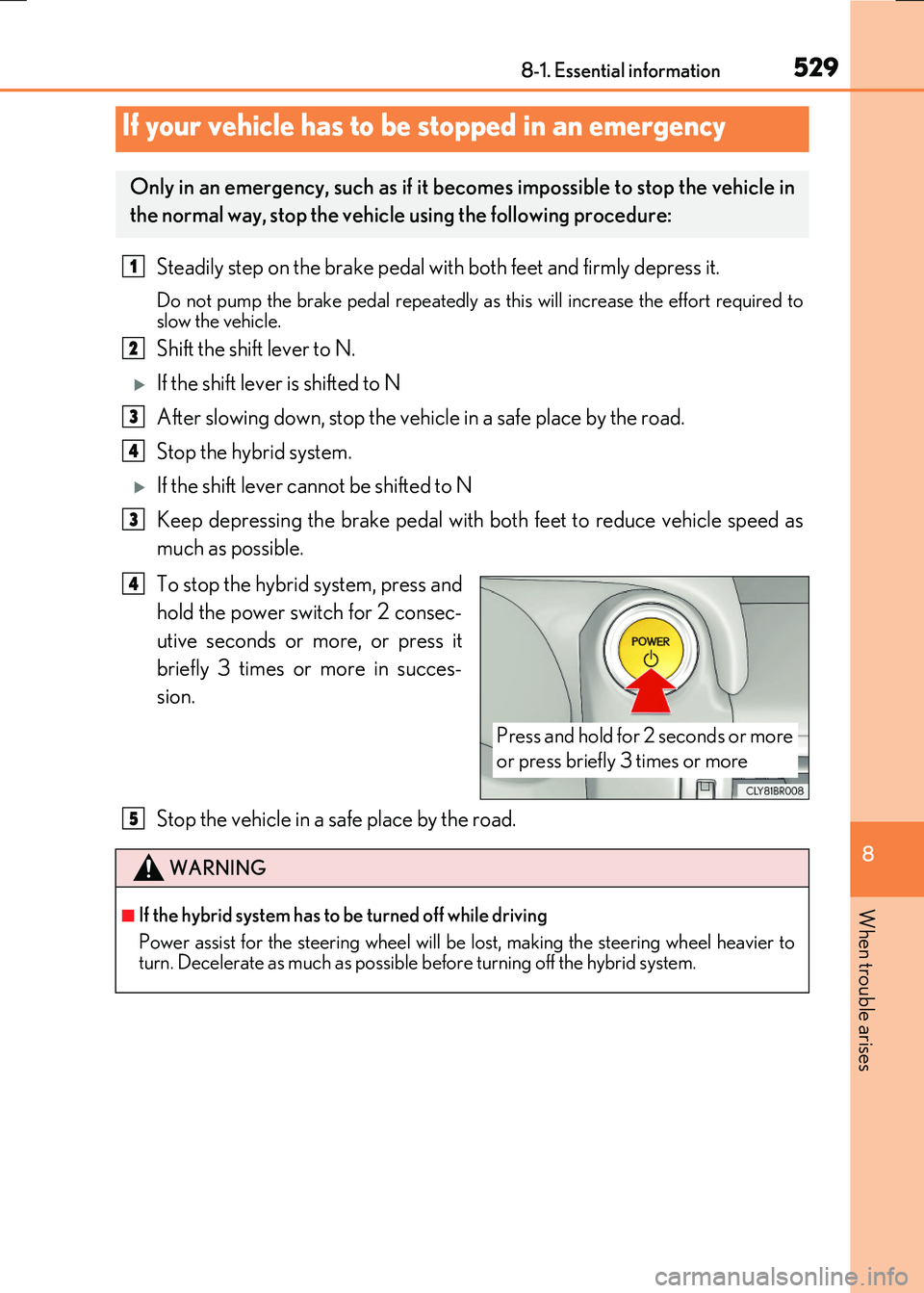
To stop the hybrid system, press and
hold the power switch for 2 consec-
utive seconds or more, or press it
briefly 3 times or more in succes-
sion.
Stop the vehicle in a safe place by the road.
If your vehicle has to be stopped in an emergency
Only in an emergency, such as if it becomes impossible to stop the vehicle in
the normal way, stop the vehicle using the following procedure:
1
2
3
4
3
Press and hold for 2 seconds or more
or press briefly 3 times or more
4
WARNING
■If the hybrid system has to be turned off while driving
Power assist for the steering wheel will be lost, making the steering wheel heavier to turn. Decelerate as much as possible before turning off the hybrid system.
5
Page 532 of 640
5328-2. Steps to take in an emergency
RC300h_EE(OM24740E)
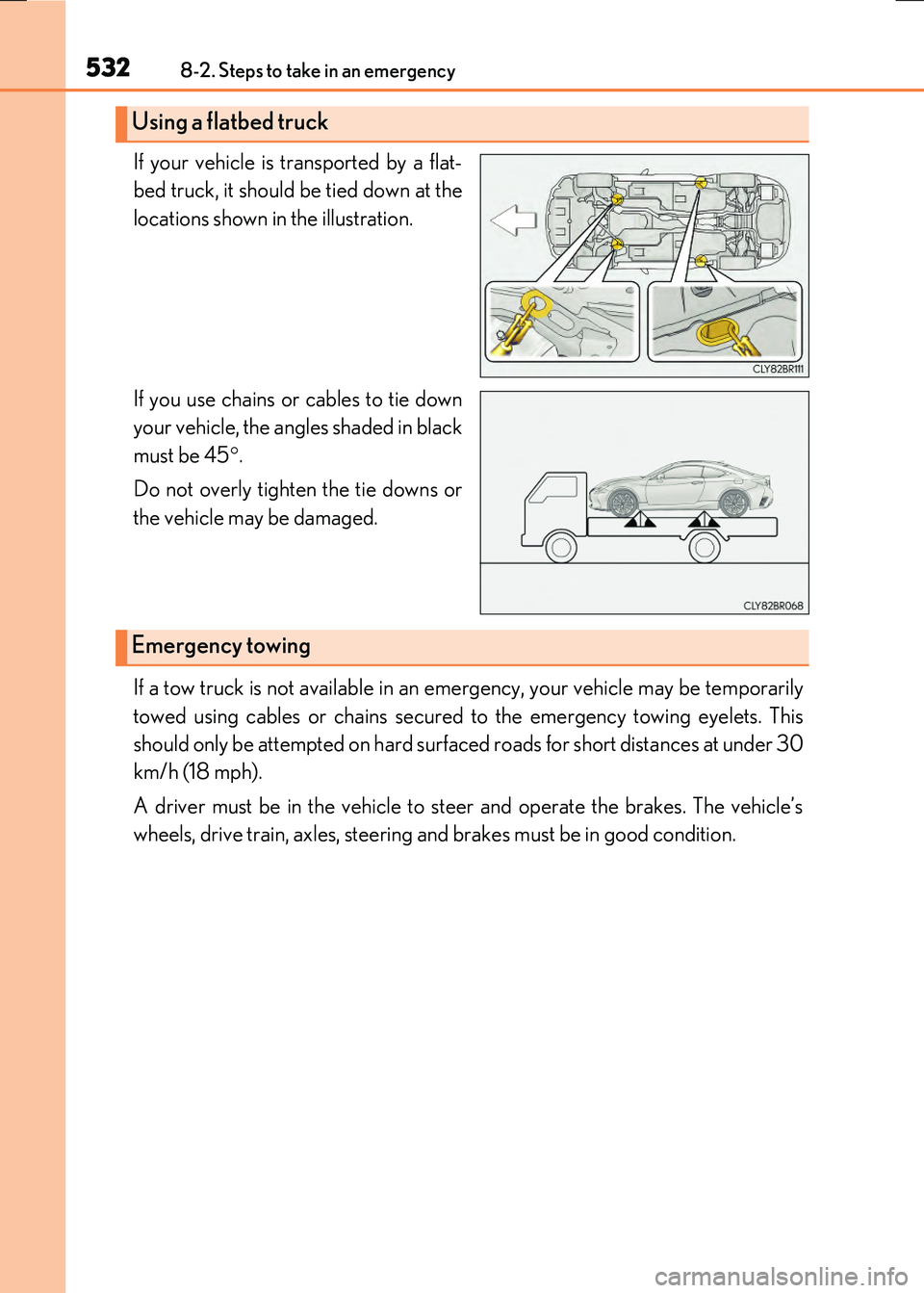
If your vehicle is transported by a flat-
bed truck, it should be tied down at the
locations shown in the illustration.
If you use chains or cables to tie down
your vehicle, the angles shaded in black
must be 45 .
Do not overly tighten the tie downs or
the vehicle may be damaged.
If a tow truck is not available in an emergency, your vehicle may be temporarily
towed using cables or chains secured to the emergency towing eyelets. This
should only be attempted on hard surfaced roads for short distances at under 30
km/h (18 mph).
A driver must be in the vehicle to steer and operate the brakes. The vehicle’s
wheels, drive train, axles, steering and brakes must be in good condition.
Using a flatbed truck
Emergency towing
Page 533 of 640
5338-2. Steps to take in an emergency
8
When trouble arises
RC300h_EE(OM24740E)
Take out the towing eyelet. (P. 565)
Remove the eyelet cover using a flathead screwdriver.
To protect the bodywork, place a rag betw een the screwdriver and the vehicle body as shown in the illustration.
Insert the towing eyelet into the hole
and tighten partially by hand.
Tighten down the towing eyelet
securely using a wheel nut wrench
or hard metal bar.
Securely attach cables or chains to the towing eyelet.
Take care not to damage the vehicle body.
Enter the vehicle being towed and start the hybrid system.
If the hybrid system does not start, turn the power switch to ON mode.
Shift the shift lever to N and release the parking brake.
When the shift lever cannot be shifted: P. 227
Emergency towing procedure
1
2
Except F SPORT modelsF SPORT models
3
4
5
6
7
Page 534 of 640
5348-2. Steps to take in an emergency
RC300h_EE(OM24740E)
■While towing
If the hybrid system is off, the power assist for the brakes and steering will not function, making steering and braking more difficult.
■Wheel nut wrench
Wheel nut wrench is installed in trunk. ( P. 565)
WARNING
Observe the following precautions. Failure to do so may result in death or serious injury.
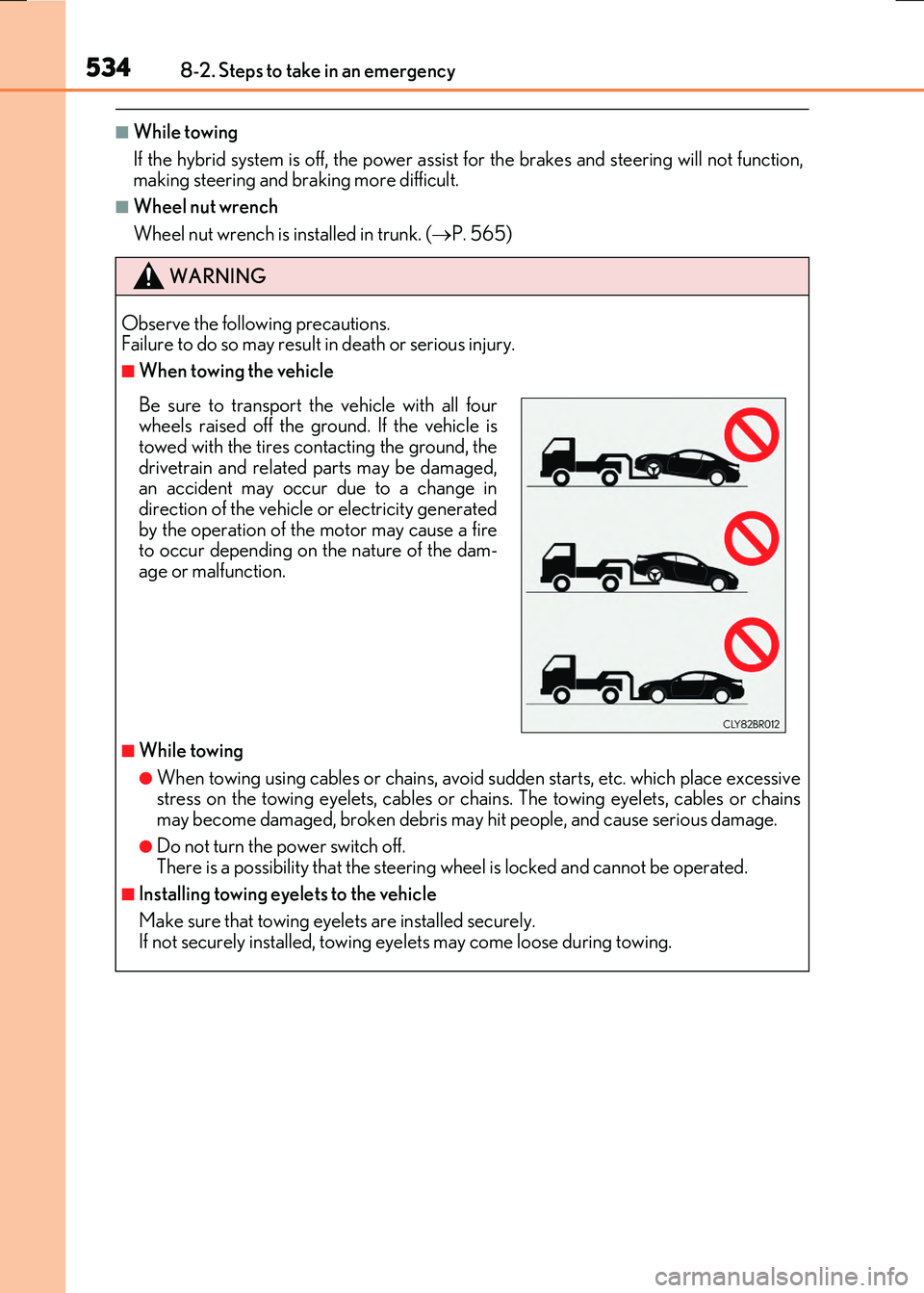
■When towing the vehicle
■While towing
●When towing using cables or chains, avoid sudden starts, etc. which place excessivestress on the towing eyelets, cables or ch ains. The towing eyelets, cables or chains may become damaged, broken debris ma y hit people, and cause serious damage.
●Do not turn the power switch off. There is a possibility that the steering wheel is locked and cannot be operated.
■Installing towing eyelets to the vehicle
Make sure that towing eyelets are installed securely. If not securely installed, towing ey elets may come loose during towing.
Be sure to transport the vehicle with all four wheels raised off the ground. If the vehicle is
towed with the tires contacting the ground, the drivetrain and related parts may be damaged,an accident may occur due to a change in
direction of the vehicle or electricity generated by the operation of the motor may cause a fireto occur depending on the nature of the dam-
age or malfunction.
Page 536 of 640

5368-2. Steps to take in an emergency
RC300h_EE(OM24740E)
●Fluid leaks under the vehicle.
(Water dripping from the air conditioning after use is normal.)
●Flat-looking tires or uneven tire wear
●Engine coolant temperature gauge continually points higher than normal.
●Changes in exhaust sound
●Excessive tire squeal when cornering
●Strange noises related to the suspension system
●Pinging or other noises related to the hybrid system
●Engine missing, stumbling or running roughly
●Appreciable loss of power
●Vehicle pulls heavily to one side when braking
●Vehicle pulls heavily to one side when driving on a level road
●Loss of brake effectiveness, spongy fe eling, pedal almost touches the floor
If you think something is wrong
If you notice any of the following symptoms, your vehicle probably needs
adjustment or repair. Contact any authorized Lexus dealer or repairer, or
another duly qualified an d equipped professional as soon as possible.
Visible symptoms
Audible symptoms
Operational symptoms