2017 Lexus ES350 ECU
[x] Cancel search: ECUPage 477 of 584
475
ES350_OM_OM33C68U_(U)8-1. Essential information
8
When trouble arises
If your vehicle has to be stopped in an emergency
Steadily step on the brake pedal with both feet and firmly depress it.
Do not pump the brake pedal repeatedly as this will increase the effort required to
slow the vehicle.
Shift the shift lever to N.
XIf the shift lever is shifted to N
After slowing down, stop the vehicle in a safe place by the road.
Stop the engine.
XIf the shift lever cannot be shifted to N
Keep depressing the brake pedal with both feet to reduce vehicle speed as
much as possible.
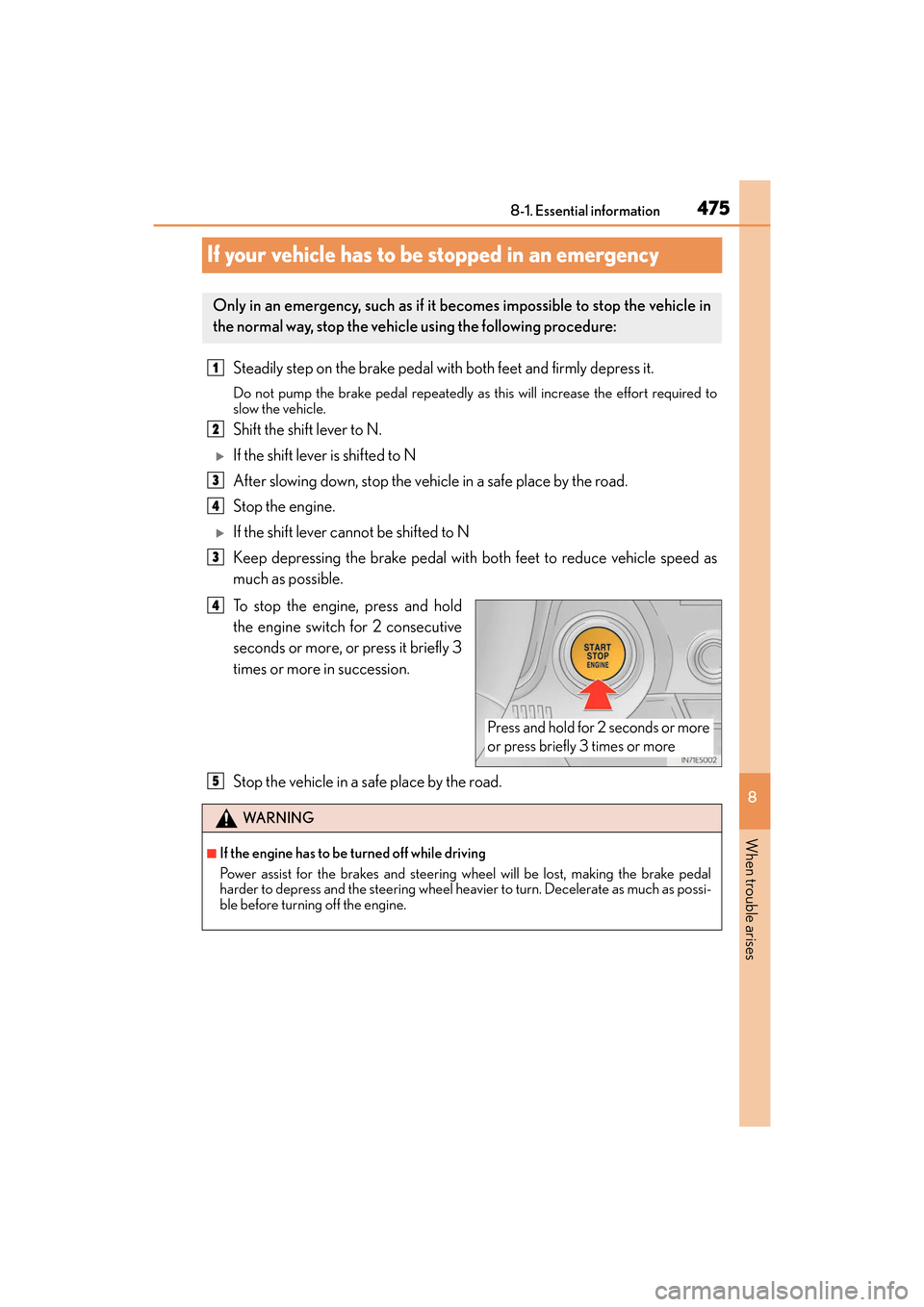
To stop the engine, press and hold
the engine switch for 2 consecutive
seconds or more, or press it briefly 3
times or more in succession.
Stop the vehicle in a safe place by the road.
Only in an emergency, such as if it becomes impossible to stop the vehicle in
the normal way, stop the vehicle using the following procedure:
1
2
3
4
3
Press and hold for 2 seconds or more
or press briefly 3 times or more
4
WA R N I N G
■If the engine has to be turned off while driving
Power assist for the brakes
and steering wheel will be lo st, making the brake pedal
harder to depress and the steering wheel heavier to turn. Decelerate as much as possi-
ble before turning off the engine.
5
Page 479 of 584
4778-2. Steps to take in an emergency
ES350_OM_OM33C68U_(U)
8
When trouble arises
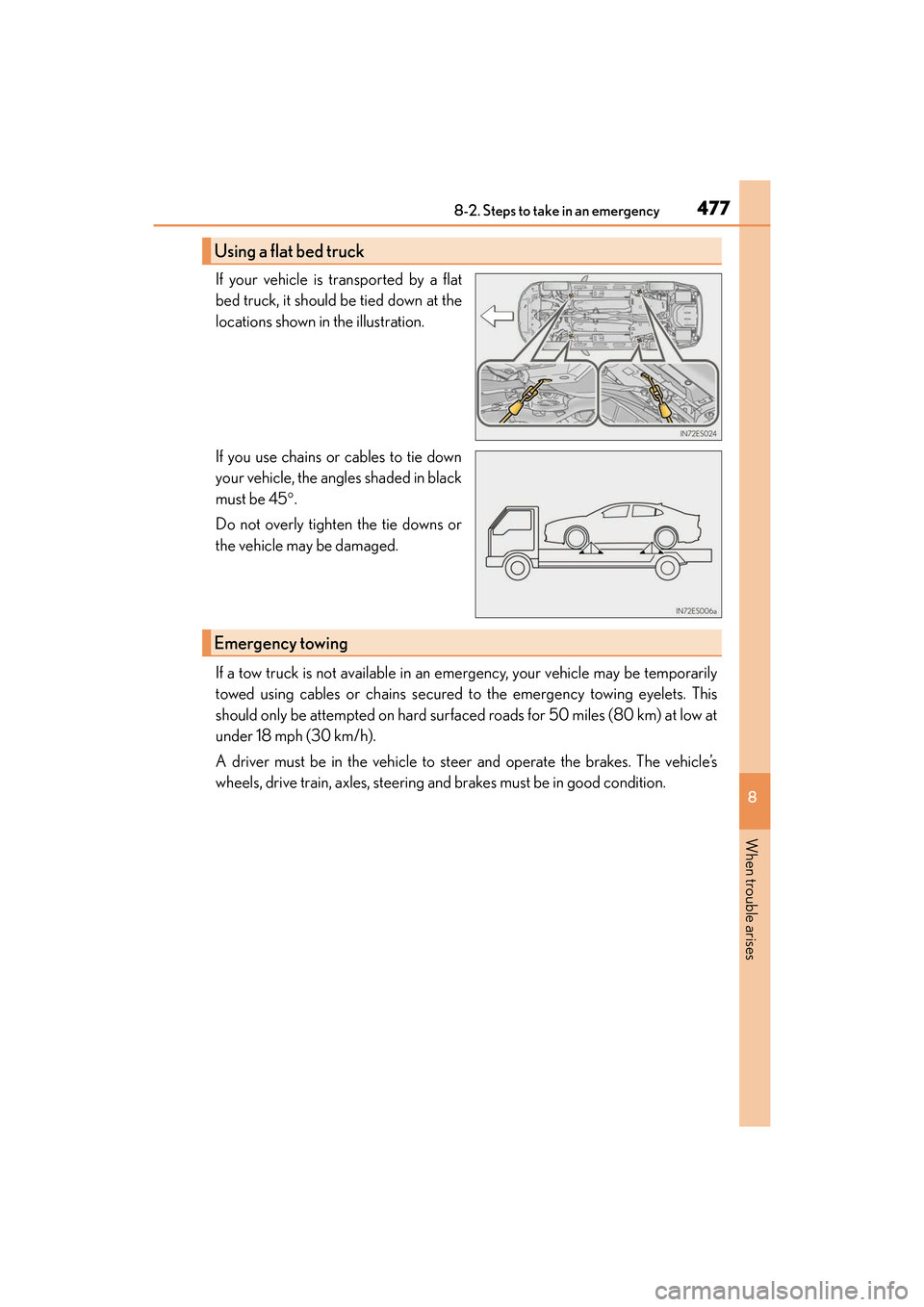
If your vehicle is transported by a flat
bed truck, it should be tied down at the
locations shown in the illustration.
If you use chains or cables to tie down
your vehicle, the angles shaded in black
must be 45 °.
Do not overly tighten the tie downs or
the vehicle may be damaged.
If a tow truck is not available in an emergency, your vehicle may be temporarily
towed using cables or chains secured to the emergency towing eyelets. This
should only be attempted on hard surfaced roads for 50 miles (80 km) at low at
under 18 mph (30 km/h).
A driver must be in the vehicle to steer and operate the brakes. The vehicle’s
wheels, drive train, axles, steering and brakes must be in good condition.
Using a flat bed truck
Emergency towing
Page 480 of 584
4788-2. Steps to take in an emergency
ES350_OM_OM33C68U_(U)
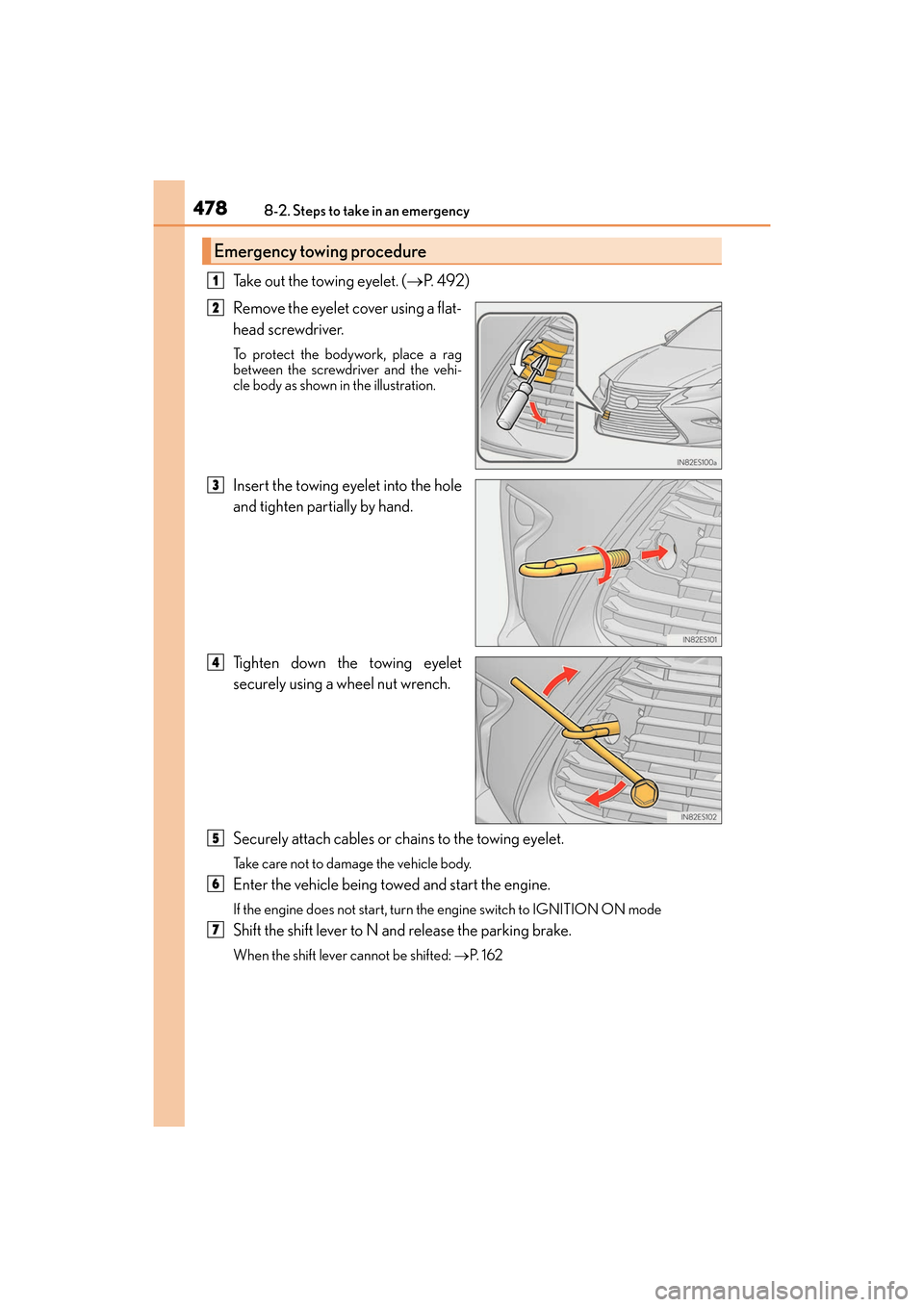
Take out the towing eyelet. (→P. 4 9 2 )
Remove the eyelet cover using a flat-
head screwdriver.
To protect the bodywork, place a rag
between the screwdriver and the vehi-
cle body as shown in the illustration.
Insert the towing eyelet into the hole
and tighten partially by hand.
Tighten down the towing eyelet
securely using a wheel nut wrench.
Securely attach cables or chains to the towing eyelet.
Take care not to damage the vehicle body.
Enter the vehicle being towed and start the engine.
If the engine does not start, turn the engine switch to IGNITION ON mode
Shift the shift lever to N and release the parking brake.
When the shift lever cannot be shifted: →P. 1 6 2
Emergency towing procedure
1
2
3
4
5
6
7
Page 481 of 584
4798-2. Steps to take in an emergency
ES350_OM_OM33C68U_(U)
8
When trouble arises
■While towing
If the engine is not running, the power assist for the brakes and steering will not function,
making steering and braking more difficult.
■Wheel nut wrench
Wheel nut wrench is installed in trunk. ( →P. 4 9 2 )
WA R N I N G
Observe the following precautions.
Failure to do so may result in death or serious injury.
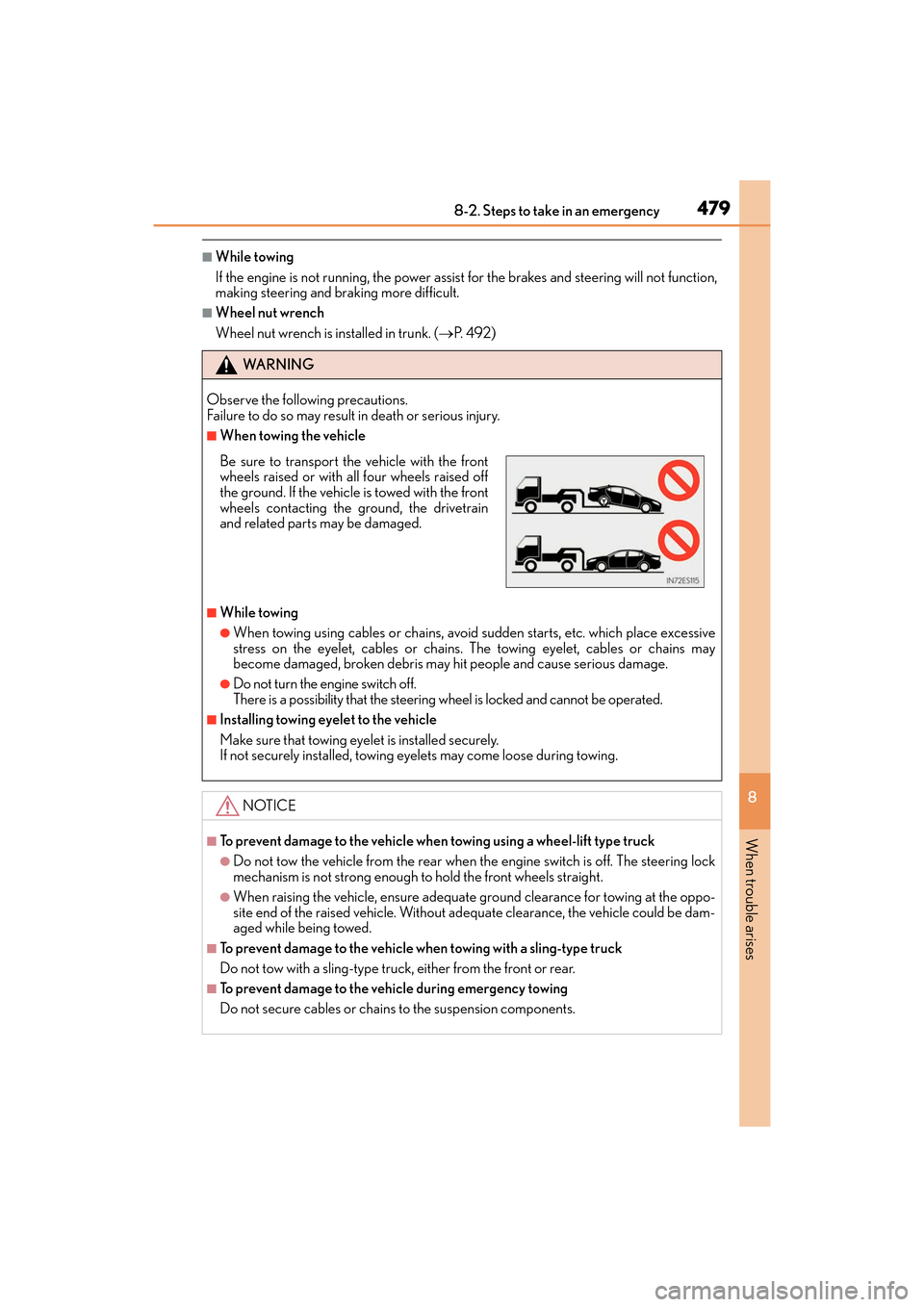
■When towing the vehicle
■While towing
●When towing using cables or chains, avoid sudden starts, etc. which place excessive
stress on the eyelet, cables or chains. The towing eyelet, cables or chains may
become damaged, broken debris may hit people and cause serious damage.
●Do not turn the engine switch off.
There is a possibility that the steering wh eel is locked and cannot be operated.
■Installing towing eyelet to the vehicle
Make sure that towing eyelet is installed securely.
If not securely installed, towing eyelets may come loose during towing.
NOTICE
■To prevent damage to the vehicle when towing using a wheel-lift type truck
●Do not tow the vehicle from the rear when the engine switch is off. The steering lock
mechanism is not strong enough to hold the front wheels straight.
●When raising the vehicle, ensure adequate ground clearance for towing at the oppo-
site end of the raised vehicle. Without adequate clearance, the vehicle could be dam-
aged while being towed.
■To prevent damage to the vehicle when towing with a sling-type truck
Do not tow with a sling-type truck, either from the front or rear.
■To prevent damage to the vehicle during emergency towing
Do not secure cables or chains to the suspension components.
Be sure to transport the vehicle with the front
wheels raised or with all four wheels raised off
the ground. If the vehicle is towed with the front
wheels contacting the ground, the drivetrain
and related parts may be damaged.
Page 486 of 584

4848-2. Steps to take in an emergency
ES350_OM_OM33C68U_(U)
*: Driver’s and front passenger’s seat belt warning buzzer:The driver’s seat belt warning buzzer sounds to alert the driver that his or her seat belt
is not fastened. Once the engine switch is turned to IGNITION ON mode, the
buzzer sounds for 6 seconds. If the vehicle reaches a speed of 12 mph (20 km/h), the
buzzer sounds once. If the seat belt is still unfastened after 30 seconds, the buzzer will
sound intermittently for 10 seconds. Then, if the seat belt is still unfastened, the buzzer
will sound in a different tone for 20 more seconds.
The front passenger’s seat belt warning buzzer sounds to alert the front passenger
that his or her seat belt is not fastened. The buzzer sounds once if the vehicle reaches
a speed of 12 mph (20 km/h). If the seat be lt is still unfastened after 30 seconds, the
buzzer will sound intermittently for 10 seconds. Then, if the seat belt is still unfastened,
the buzzer will sound in a different tone for 20 more seconds.
■SRS warning light
This warning light system monitors the airbag sensor assembly, front impact sensors, side
impact sensors (front door), side impact sensors (front), side impact sensors (rear),
driver’s seat position sensor, driver’s seat belt buckle switch, front passenger occupant
classification system (ECU and sensors), “AIR BAG ON” indicator light, “AIR BAG OFF”
indicator light, front passenger’s seat belt buckle switch, seat belt pretensioner assem-
blies, airbags, inte rconnecting wiring and power sources. ( →P. 3 6 )
Tire pressure warning light
When the light comes on:
Low tire inflation pressure such as
• Natural causes (→ P. 4 8 5 )
•Flat tire ( →P. 4 9 1 )
→ Adjust the tire inflation pressure to the specified level.
The light will turn off after a few minutes. In case the light does
not turn off even if the tire inflation pressure is adjusted, have the
system checked by your Lexus dealer.
When the light comes on after blinking for 1 minute:
Malfunction in the tire pressure warning system ( →P. 4 8 5 )
→ Have the system checked by your Lexus dealer.
(Flashes)
(If equipped)
“A F S O F F ” i n d i c a t o r Indicates a malfunction in the adaptive front-lighting system
→ Have the vehicle inspected by your Lexus dealer immediately.
Warning lightWarning light/Details/Actions
Page 487 of 584

4858-2. Steps to take in an emergency
ES350_OM_OM33C68U_(U)
8
When trouble arises
■Front passenger detection sensor, seat belt reminder and warning buzzer
●If luggage is placed on the front passenger seat, the front passenger detection sensor
may cause the warning light to flash and the warning buzzer to sound even if a passen-
ger is not sitting in the seat.
●If a cushion is placed on the seat, the sensor may not detect a passenger, and the warn-
ing light may not operate properly.
■Electric power steering system warning light (warning buzzer)
When the battery charge becomes insufficient or the voltage temporarily drops, the
electric power steering system warning light may come on and the warning buzzer may
sound.
■If the malfunction indicator lamp comes on while driving
First check the following:
●Is the fuel tank empty?
If it is, fill the fuel tank immediately.
●Is the fuel tank cap loose?
If it is, tighten it securely.
The light will go off after several driving trips.
If the light does not go off even after several trips, contact your Lexus dealer as soon as
possible.
■When the tire pressure warning light comes on
Check the tire inflation pressure and adjust to the appropriate level. Pushing the tire
pressure warning reset switch will not turn off the tire pressure warning light.
■The tire pressure warning light may come on due to natural causes
The tire pressure warning light may come on due to natural causes such as natural air
leaks and tire inflation pressure changes caused by temperature. In this case, adjusting
the tire inflation pressure will turn off the warning light (after a few minutes).
■When a tire is replaced with a spare tire
The compact spare tire is not equipped with a tire pressure warning valve and transmit-
ter. If a tire goes flat, the tire pressure warning light will not turn off even though the flat
tire has been replaced with the spare tire.
■Conditions that the tire pressure warning system may not function properly
→ P. 4 4 6
■If the tire pressure warning light freque ntly comes on after blinking for 1 minute
If the tire pressure warning light frequently comes on after blinking for 1 minute when the
engine switch is turned to IGNITION ON mode, have it checked by your Lexus dealer.
■Warning buzzer
In some cases, the buzzer may not be heard because of noisy place or an audio sound.
Page 497 of 584
4958-2. Steps to take in an emergency
ES350_OM_OM33C68U_(U)
8
When trouble arises
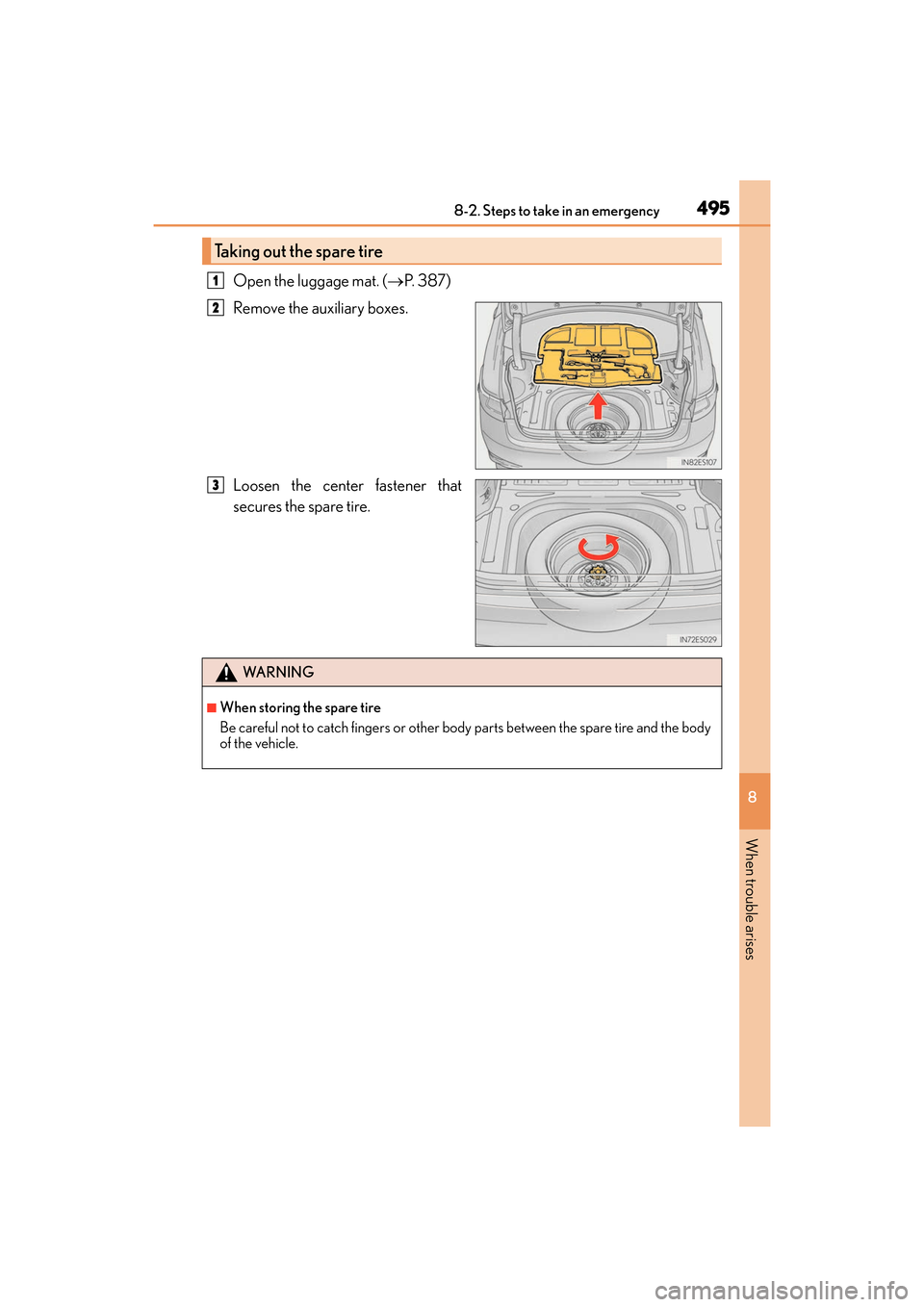
Open the luggage mat. ( →P. 3 8 7 )
Remove the auxiliary boxes.
Loosen the center fastener that
secures the spare tire.
Taking out the spare tire
1
2
3
WA R N I N G
■When storing the spare tire
Be careful not to catch fingers or other body parts between the spare tire and the body
of the vehicle.
Page 503 of 584

5018-2. Steps to take in an emergency
ES350_OM_OM33C68U_(U)
8
When trouble arises
WA R N I N G
■When using the compact spare tire
●Remember that the compact spare tire provid ed is specifically designed for use with
your vehicle. Do not use your compact spare tire on another vehicle.
●Do not use more than one compact spare tire simultaneously.
●Replace the compact spare tire with a standard tire as soon as possible.
●Avoid sudden acceleration, abrupt steering, sudden braking and shifting operations
that cause sudden engine braking.
■When the compact spare tire is attached
The vehicle speed may not be correctly detected, and the following systems may not
operate correctly:
■Speed limit when using the compact spare tire
Do not drive at speeds in excess of 50 mph (80 km/h) when a compact spare tire is
installed on the vehicle.
The compact spare tire is not designed for driving at high speeds. Failure to observe
this precaution may lead to an accident causing death or serious injury.
■After using the tools and jack
Before driving, make sure all the tools and jack are securely in place in their storage
location to reduce the possibility of personal injury during a collision or sudden brak-
ing.
NOTICE
■Driving with tire chains and the compact spare tire
Do not fit tire chains to the compact spare tire.
Tire chains may damage the vehicle body and adversely affect driving performance.
■When replacing the tires
When removing or fitting the wheels, tires or the tire pressure warning valve and trans-
mitter, contact your Lexus dealer as the tire pressure warning valve and transmitter
may be damaged if not handled correctly.
• ABS & Brake assist
•VSC
•TRAC
•Cruise control
• Dynamic radar cruise control (if equipped)
•PCS (if equipped) •EPS
• LDA (Lane Departure Alert with
steering control) (if equipped)
• Lexus parking assist monitor
• Intuitive parking assist (if equipped)
• Navigation system (if equipped)