2017 KIA Sportage Battery
[x] Cancel search: BatteryPage 437 of 595
75
What to do in an emergency
EMERGENCY STARTING
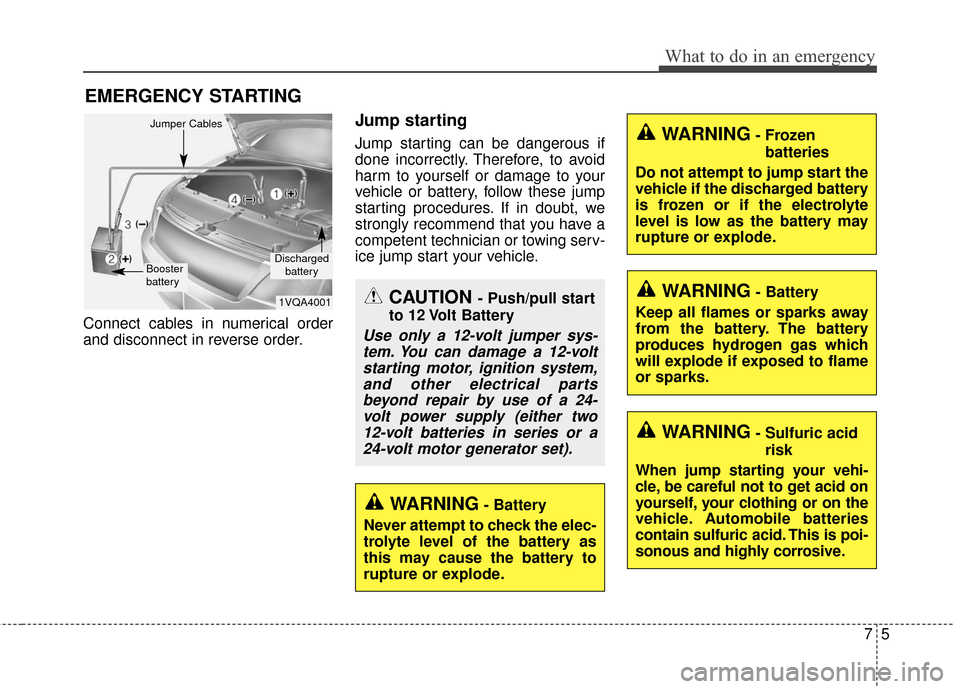
Connect cables in numerical order
and disconnect in reverse order.
Jump starting
Jump starting can be dangerous if
done incorrectly. Therefore, to avoid
harm to yourself or damage to your
vehicle or battery, follow these jump
starting procedures. If in doubt, we
strongly recommend that you have a
competent technician or towing serv-
ice jump start your vehicle.
CAUTION - Push/pull start
to 12 Volt Battery
Use only a 12-volt jumper sys- tem. You can damage a 12-voltstarting motor, ignition system,and other electrical partsbeyond repair by use of a 24-volt power supply (either two12-volt batteries in series or a24-volt motor generator set).
WARNING- Battery
Never attempt to check the elec-
trolyte level of the battery as
this may cause the battery to
rupture or explode.
1VQA4001
Discharged battery
Jumper Cables
Booster
battery
WARNING- Frozenbatteries
Do not attempt to jump start the
vehicle if the discharged battery
is frozen or if the electrolyte
level is low as the battery may
rupture or explode.
WARNING- Sulfuric acid risk
When jump starting your vehi-
cle, be careful not to get acid on
yourself, your clothing or on the
vehicle. Automobile batteries
contain sulfuric acid. This is poi-
sonous and highly corrosive.
WARNING- Battery
Keep all flames or sparks away
from the battery. The battery
produces hydrogen gas which
will explode if exposed to flame
or sparks.
Page 438 of 595
What to do in an emergency
67
Jump starting procedure
1. Make sure the booster battery is12-volt and that its negative termi-
nal is grounded.
2. If the booster battery is in another vehicle, do not allow the vehicles
to come in contact.
3. Turn off all unnecessary electrical loads.
4. Connect the jumper cables in the exact sequence shown in the illus-
tration. First connect one end of a
jumper cable to the positive termi-
nal of the discharged battery (1),
then connect the other end to the
positive terminal of the booster
battery (2). Proceed to connect
one end of the other jumper cable
to the negative terminal of the
booster battery (3), then the other
end to a solid, stationary, metallic
point (for example, the engine lift-
ing bracket) away from the battery
(4). Do not connect it to or near
any part that moves when the
engine is cranked. Do not allow the jumper cables to
contact anything except the correct
battery terminals or the correct
ground. Do not lean over the bat-
tery when making connections.
5. Start the engine of the vehicle with the booster battery and let it run at
2,000 rpm, then start the engine of
the vehicle with the discharged
battery.
If the cause of your battery discharg-ing is not apparent, you should haveyour vehicle checked by an author-ized Kia dealer.
Push-starting
Vehicles equipped with automatic
transaxle lock system cannot be
push-started.
Follow the directions in this section
for jump-starting.
WARNING - Tow starting
vehicle
Never tow a vehicle to start it.
When the engine starts, the
vehicle can suddenly surge for-
ward and could cause a colli-
sion with the tow vehicle.
WARNING - Battery cables
Do not connect the jumper cable
from the negative terminal of the
booster battery to the negative
terminal of the discharged bat-
tery. This can cause the dis-
charged battery to overheat and
crack, releasing battery acid.
Page 457 of 595
725
What to do in an emergency
It is possible that some tires, espe-
cially with larger punctures or dam-
age to the sidewall, cannot be sealed
completely.
Air pressure loss in the tire may
adversely affect tire performance.
For this reason, you should avoid
abrupt steering or other driving
maneuvers, especially if the vehicle
is heavily loaded or if a trailer is in
use.
The Tire Mobility Kit is not designed
or intended as a permanent tire
repair method and is to be used for
one tire only.
This instruction shows you step by
step procedure to temporarily seal
the puncture.
Read the section "Notes on the safe
use of the Tire Mobility Kit".Notes on the safe use of the
Tire Mobility Kit
Park your car at the side of theroad so that you can work with the
Tire Mobility Kit away from moving
traffic.
To be sure your vehicle will not move, even when you're on fairly
level ground, always set your park-
ing brake.
Only use the Tire Mobility Kit for sealing/inflation passenger car
tires. Only punctured areas located
within the tread region of the tire
can be sealed using the tire mobil-
ity kit.
Do not use on motorcycles, bicy- cles or any other type of tires.
When the tire and wheel are dam- aged, do not use Tire Mobility Kit
for your safety.
Use of the Tire Mobility Kit may not be effective for tire damage larger
than approximately 6 mm (0.24 in).
Please contact the nearest Kia
dealership if the tire cannot be
made roadworthy with the Tire
Mobility Kit. Do not use the Tire Mobility Kit if a
tire is severely damaged by driving
run flat or with insufficient air pres-
sure.
Do not remove any foreign objects such as nails or screws that have
penetrated the tire.
Provided the car is outdoors, leave the engine running. Otherwise
operating the compressor may
eventually drain the car battery.
Never leave the Tire Mobility Kit unattended while it is being used.
Do not leave the compressor run- ning for more than 10 min. at a time
or it may overheat.
Do not use the Tire Mobility Kit if the ambient temperature is below -
-30°C (22°F).
Page 469 of 595
Maintenance
Engine compartment . . . . . . . . . . . . . . . . . . . . . . . . 8-3
Maintenance services . . . . . . . . . . . . . . . . . . . . . . . . 8-4
• Owner’s responsibility . . . . . . . . . . . . . . . . . . . . . . . . . 8-4
• Owner maintenance precautions . . . . . . . . . . . . . . . . . 8-5
Owner maintenance . . . . . . . . . . . . . . . . . . . . . . . . . 8-6
• Owner maintenance schedule. . . . . . . . . . . . . . . . . . . . 8-6
Scheduled maintenance service. . . . . . . . . . . . . . . . 8-8
Explanation of scheduled maintenance items . . . 8-24
Engine oil. . . . . . . . . . . . . . . . . . . . . . . . . . . . . . . . . 8-28
• Checking the engine oil level . . . . . . . . . . . . . . . . . . . 8-28
• Changing the engine oil and filter . . . . . . . . . . . . . . . 8-29
Engine coolant . . . . . . . . . . . . . . . . . . . . . . . . . . . . 8-30
• Checking the coolant level . . . . . . . . . . . . . . . . . . . . . 8-30
• Changing the coolant . . . . . . . . . . . . . . . . . . . . . . . . . 8-33
Brake fluid . . . . . . . . . . . . . . . . . . . . . . . . . . . . . . . 8-34
• Checking the brake fluid level . . . . . . . . . . . . . . . . . . 8-34
Washer fluid . . . . . . . . . . . . . . . . . . . . . . . . . . . . . . 8-35
• Checking the washer fluid level . . . . . . . . . . . . . . . . . 8-35
Parking brake . . . . . . . . . . . . . . . . . . . . . . . . . . . . . 8-36
• Checking the parking brake. . . . . . . . . . . . . . . . . . . . 8-36
Air cleaner. . . . . . . . . . . . . . . . . . . . . . . . . . . . . . . . 8-37
• Filter replacement . . . . . . . . . . . . . . . . . . . . . . . . . . . . 8-37
Climate control air filter . . . . . . . . . . . . . . . . . . . . 8-39
• Filter inspection . . . . . . . . . . . . . . . . . . . . . . . . . . . . . . 8-39
Wiper blades . . . . . . . . . . . . . . . . . . . . . . . . . . . . . . 8-41
• Blade inspection . . . . . . . . . . . . . . . . . . . . . . . . . . . . . . 8-41
• Blade replacement . . . . . . . . . . . . . . . . . . . . . . . . . . . . 8-41
Battery . . . . . . . . . . . . . . . . . . . . . . . . . . . . . . . . . . . 8-\
44
• For best battery service . . . . . . . . . . . . . . . . . . . . . . . 8-44
• Recharging the battery . . . . . . . . . . . . . . . . . . . . . . . . 8-45
• Reset items . . . . . . . . . . . . . . . . . . . . . . . . . . . . . . . . . . 8-46\
Tires and wheels . . . . . . . . . . . . . . . . . . . . . . . . . . . 8-47
• Tire care . . . . . . . . . . . . . . . . . . . . . . . . . . . . . . . . . . . . \
8-47
• Recommended cold tire inflation pressures . . . . . . . 8-47
• Tire pressure . . . . . . . . . . . . . . . . . . . . . . . . . . . . . . . . 8-48
• Checking tire inflation pressure. . . . . . . . . . . . . . . . . 8-48
• Tire rotation . . . . . . . . . . . . . . . . . . . . . . . . . . . . . . . . . 8-49
• Wheel alignment and tire balance . . . . . . . . . . . . . . . 8-50
• Tire replacement . . . . . . . . . . . . . . . . . . . . . . . . . . . . . 8-51
• Wheel replacement . . . . . . . . . . . . . . . . . . . . . . . . . . . 8-52
• Tire traction . . . . . . . . . . . . . . . . . . . . . . . . . . . . . . . . . 8-52
• Tire maintenance . . . . . . . . . . . . . . . . . . . . . . . . . . . . . 8-52
• Tire sidewall labeling . . . . . . . . . . . . . . . . . . . . . . . . . 8-52
• All season tires . . . . . . . . . . . . . . . . . . . . . . . . . . . . . . . 8-59
• Summer tires . . . . . . . . . . . . . . . . . . . . . . . . . . . . . . . . 8-59
• Snow tires . . . . . . . . . . . . . . . . . . . . . . . . . . . . . . . . . . . 8-\
59
• Radial-ply tires . . . . . . . . . . . . . . . . . . . . . . . . . . . . . . 8-59
• Low aspect ratio tire . . . . . . . . . . . . . . . . . . . . . . . . . . 8-60
8
Page 471 of 595
83
Maintenance
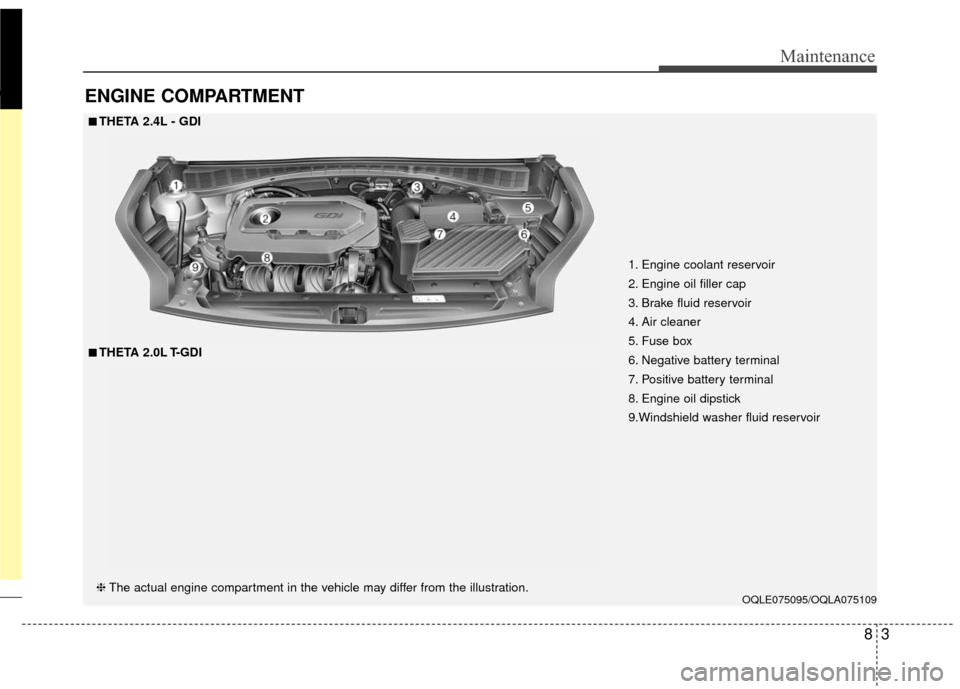
ENGINE COMPARTMENT
OQLE075095/OQLA075109
■ ■THETA 2.4L - GDI
❈ The actual engine compartment in the vehicle may differ from the illustration.
■ ■THETA 2.0L T-GDI 1. Engine coolant reservoir
2. Engine oil filler cap
3. Brake fluid reservoir
4. Air cleaner
5. Fuse box
6. Negative battery terminal
7. Positive battery terminal
8. Engine oil dipstick
9.Windshield washer fluid reservoir
Page 475 of 595
87
Maintenance
At least monthly:
Check the coolant level in theengine coolant reservoir.
Check the operation of all exterior lights, including the stoplights, turn
signals and hazard warning flash-
ers.
Check the inflation pressures of all tires including the spare.
At least twice a year
(i.e., every Spring and Fall) :
Check the radiator, heater and air conditioning hoses for leaks or
damage.
Check the windshield washer spray and wiper operation. Clean
the wiper blades with clean cloth
dampened with washer fluid.
Check the headlight alignment.
Check the muffler, exhaust pipes, shields and clamps.
Check the lap/shoulder belts for wear and function.
Check for worn tires and loose wheel lug nuts.
At least once a year :
Clean the body and door drainholes.
Lubricate the door hinges and check the hood hinges.
Lubricate the door and hood locks and latches.
Lubricate the door rubber weather- strips.
Check the air conditioning system.
Inspect and lubricate automatic transaxle linkage and controls.
Clean the battery and terminals.
Check the brake fluid level.
Page 477 of 595
89
Maintenance
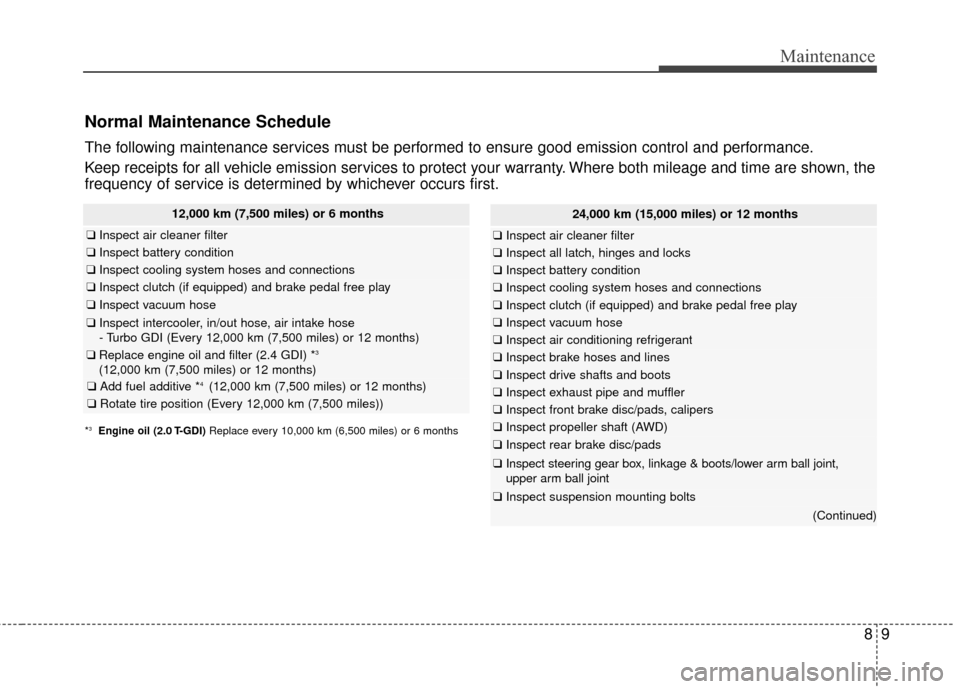
Normal Maintenance Schedule
The following maintenance services must be performed to ensure good emission control and performance.
Keep receipts for all vehicle emission services to protect your warranty. Where both mileage and time are shown, the
frequency of service is determined by whichever occurs first.
12,000 km (7,500 miles) or 6 months
❑Inspect air cleaner filter
❑Inspect battery condition
❑Inspect cooling system hoses and connections
❑Inspect clutch (if equipped) and brake pedal free play
❑Inspect vacuum hose
❑Inspect intercooler, in/out hose, air intake hose
- Turbo GDI (Every 12,000 km (7,500 miles) or 12 months)
❑Replace engine oil and filter (2.4 GDI) *3
(12,000 km (7,500 miles) or 12 months)
❑ Add fuel additive *4 (12,000 km (7,500 miles) or 12 months)
❑Rotate tire position (Every 12,000 km (7,500 miles))
24,000 km (15,000 miles) or 12 months
❑Inspect air cleaner filter
❑Inspect all latch, hinges and locks
❑Inspect battery condition
❑Inspect cooling system hoses and connections
❑Inspect clutch (if equipped) and brake pedal free play
❑Inspect vacuum hose
❑Inspect air conditioning refrigerant
❑Inspect brake hoses and lines
❑Inspect drive shafts and boots
❑Inspect exhaust pipe and muffler
❑Inspect front brake disc/pads, calipers
❑Inspect propeller shaft (AWD)
❑Inspect rear brake disc/pads
❑Inspect steering gear box, linkage & boots/lower arm ball joint,
upper arm ball joint
❑ Inspect suspension mounting bolts
(Continued)
*3Engine oil (2.0 T-GDI) Replace every 10,000 km (6,500 miles) or 6 months
Page 478 of 595
Maintenance
10
8
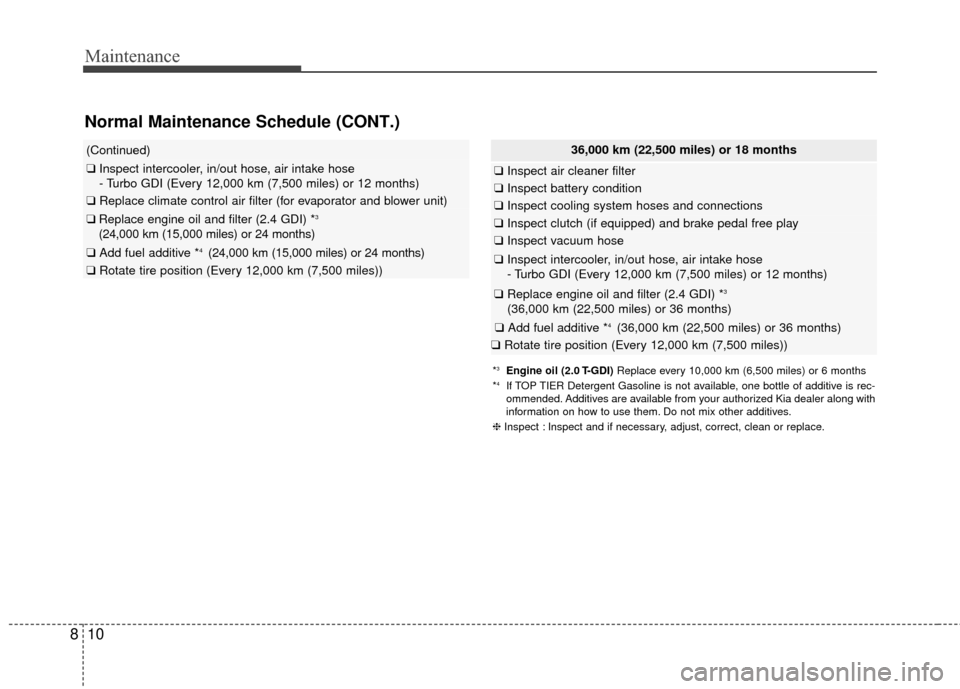
36,000 km (22,500 miles) or 18 months
❑ Inspect air cleaner filter
❑Inspect battery condition
❑Inspect cooling system hoses and connections
❑Inspect clutch (if equipped) and brake pedal free play
❑Inspect vacuum hose
❑Inspect intercooler, in/out hose, air intake hose
- Turbo GDI (Every 12,000 km (7,500 miles) or 12 months)
❑Replace engine oil and filter (2.4 GDI) *3
(36,000 km (22,500 miles) or 36 months)
❑ Add fuel additive *4 (36,000 km (22,500 miles) or 36 months)
❑Rotate tire position (Every 12,000 km (7,500 miles))
*3Engine oil (2.0 T-GDI) Replace every 10,000 km (6,500 miles) or 6 months
*4If TOP TIER Detergent Gasoline is not available, one bottle of additive is rec-
ommended. Additives are available from your authorized Kia dealer along with
information on how to use them. Do not mix other additives.
❈ Inspect : Inspect and if necessary, adjust, correct, clean or replace.
(Continued)
❑Inspect intercooler, in/out hose, air intake hose
- Turbo GDI (Every 12,000 km (7,500 miles) or 12 months)
❑ Replace climate control air filter (for evaporator and blower unit)
❑Replace engine oil and filter (2.4 GDI) *3
(24,000 km (15,000 miles) or 24 months)
❑ Add fuel additive *4 (24,000 km (15,000 miles) or 24 months)
❑Rotate tire position (Every 12,000 km (7,500 miles))
Normal Maintenance Schedule (CONT.)