2017 KIA SOUL Tail light
[x] Cancel search: Tail lightPage 323 of 589
Driving your vehicle
46
Before entering vehicle
• Be sure that all windows, outsidemirror(s), and outside lights are
clean.
Check the condition of the tires.
Check under the vehicle for any sign of leaks.
Be sure there are no obstacles behind you if you intend to back up.
Necessary inspections
Fluid levels, such as engine oil,
engine coolant, brake fluid, and
washer fluid should be checked on a
regular basis, at the exact interval
depending on the fluid. Further
details are provided in chapter 8,
“Maintenance”.
Before starting
Close and lock all doors.
Position the seat so that all con-trols are easily reached.
Buckle your seat belt.
Adjust the inside and outside rearview mirrors.
Be sure that all lights work.
Check all gauges.
Check the operation of warning lights when the ignition switch is
turned to the ON position.
Release the parking brake and make sure the brake warning light
goes out.
For safe operation, be sure you are
familiar with your vehicle and its
equipment.
BEFORE DRIVING
WARNING
Driving while distracted can
result in a loss of vehicle con-
trol, that may lead to an acci-
dent, severe personal injury,
and death. The driver’s primary
responsibility is in the safe and
legal operation of a vehicle, and
use of any handheld devices,
other equipment, or vehicle sys-
tems which take the driver’s
eyes, attention and focus away
from the safe operation of a
vehicle or which are not permis-
sible by law should never be
used during operation of the
vehicle.
Page 388 of 589
669
Driving your vehicle
Your vehicle's fuel economy depends
mainly on your style of driving, where
you drive and when you drive.
Each of these factors affects how
many miles (kilometers) you can get
from a gallon (liter) of fuel. To operate
your vehicle as economically as pos-
sible, use the following driving sug-
gestions to help save money in both
fuel and repairs:
Drive smoothly. Accelerate at amoderate rate. Don't make "jack-
rabbit" starts or full-throttle shifts
and maintain a steady cruising
speed. Don't race between stop-
lights. Try to adjust your speed to
the traffic so you don't have to
change speeds unnecessarily.
Avoid heavy traffic whenever pos-
sible. Always maintain a safe dis-
tance from other vehicles so you
can avoid unnecessary braking.
This also reduces brake wear.
Drive at a moderate speed. The faster you drive, the more fuel your
vehicle uses. Driving at a moderate
speed, especially on the highway,
is one of the most effective ways to
reduce fuel consumption. Don't "ride" the brake or clutch
pedal. This can increase fuel con-
sumption and also increase wear
on these components. In addition,
driving with your foot resting on the
brake pedal may cause the brakes
to overheat, which reduces their
effectiveness and may lead to
more serious consequences.
Take care of your tires. Keep them inflated to the recommended pres-
sure. Incorrect inflation, either too
much or too little, results in unnec-
essary tire wear. Check the tire
pressures at least once a month.
Be sure that the wheels are aligned correctly. Improper align-
ment can result from hitting curbs
or driving too fast over irregular
surfaces. Poor alignment causes
faster tire wear and may also result
in other problems as well as
greater fuel consumption. Keep your vehicle in good condi-
tion. For better fuel economy and
reduced maintenance costs, main-
tain your vehicle in accordance
with the maintenance schedule in
section 8. If you drive your vehicle
in severe conditions, more frequent
maintenance is required (see sec-
tion 8 for details).
Keep your vehicle clean. For maxi- mum service, your vehicle should
be kept clean and free of corrosive
materials. It is especially important
that mud, dirt, ice, etc. not be
allowed to accumulate on the
underside of the vehicle. This extra
weight can result in increased fuel
consumption and also contribute to
corrosion.
Travel lightly. Don't carry unneces- sary weight in your vehicle. Weight
reduces fuel economy.
Don't let the engine idle longer than necessary. If you are waiting
(and not in traffic), turn off your
engine and restart only when
you're ready to go.
ECONOMICAL OPERATION
Page 531 of 589
Maintenance
90
8
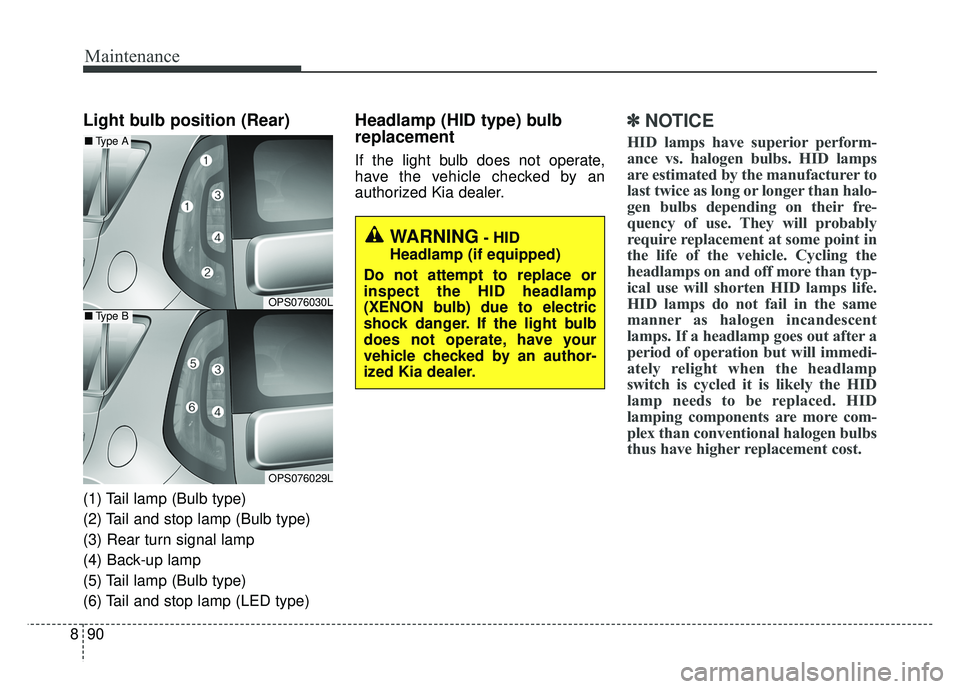
Light bulb position (Rear)
(1) Tail lamp (Bulb type)
(2) Tail and stop lamp (Bulb type)
(3) Rear turn signal lamp
(4) Back-up lamp
(5) Tail lamp (Bulb type)
(6) Tail and stop lamp (LED type)
Headlamp (HID type) bulb
replacement
If the light bulb does not operate,
have the vehicle checked by an
authorized Kia dealer.
✽ ✽
NOTICE
HID lamps have superior perform-
ance vs. halogen bulbs. HID lamps
are estimated by the manufacturer to
last twice as long or longer than halo-
gen bulbs depending on their fre-
quency of use. They will probably
require replacement at some point in
the life of the vehicle. Cycling the
headlamps on and off more than typ-
ical use will shorten HID lamps life.
HID lamps do not fail in the same
manner as halogen incandescent
lamps. If a headlamp goes out after a
period of operation but will immedi-
ately relight when the headlamp
switch is cycled it is likely the HID
lamp needs to be replaced. HID
lamping components are more com-
plex than conventional halogen bulbs
thus have higher replacement cost.
OPS076030L
OPS076029L
■ Type A
■Type B
WARNING- HID
Headlamp (if equipped)
Do not attempt to replace or
inspect the HID headlamp
(XENON bulb) due to electric
shock danger. If the light bulb
does not operate, have your
vehicle checked by an author-
ized Kia dealer.
Page 562 of 589

Specifications, Consumer information, Reporting safety defects
49
BULB WATTAGE
* If equippedLight Bulb Wattage Bulb type
Front Headlamps (Low/High) 55/60 H13
Headlamps (Low) 55 H7SLL
Headlamps (Low)-HID type* 35 D3S
Headlamps (High) 55 H7LL
Front turn signal lamps 28 PY28/8W
Front position lamps 8 (Opt : LED) PY28/8W (Opt : LED)
Front fog lamps* 35 H8L
Front side marker 5 W5W
Side Repeater lamps (Outside Mirror)* LED LED
Rear Bulb Type
Rear Stop/Tail lamps (Bottom) 28/8 P28/8W
Rear tail lamps (Mid) 5 W5W
Rear tail lamps & side marker (Top) 5 W5W
LED Type Rear Stop lamps LED LED
Rear Tail lamps & side marker LED LED
Rear turn signal lamps 27 PY27W
Back-up lamps 16 W16W
High mounted stop lamps 5 (Opt :LED*) W5W (Opt : LED*)
License plate lamps 5 W5W
Interior Map lamps 8 FESTOON
Room lamps 8 FESTOON
Personal lamps LED LED
Vanity mirror lamps 5 FESTOON
Glove box lamps 5 FESTOON
Luggage lamp 8 FESTOON
Page 583 of 589

I9
Index
Front turn signal lamp bulb replacement . . . . . . . . . 8-93
Front side marker bulb replacement. . . . . . . . . . . . . 8-95
Position lamp + DRL (LED type) bulb replacement 8-96
Front fog lamp bulb replacement . . . . . . . . . . . . . . . 8-96
Side repeater lamp (LED type) bulb replacement . 8-97
Rear turn signal lamp bulb Replacement . . . . . . . . . 8-98
Stop and tail lamp bulb replacement . . . . . . . . . . . 8-99
Back-up lamp bulb replacement . . . . . . . . . . . . . . 8-100
Stop and tail lamp (LED type) bulb replacement . . 8-101
High mounted stop lamp bulb replacement . . . . . . 8-101
High mounted stop lamp (LED type) bulb replacement . . . . . . . . . . . . . . . . . . . . . . . . . . . . . 8-102
License plate lamp bulb replacement . . . . . . . . . . 8-102
Map lamp bulb replacement. . . . . . . . . . . . . . . . . . 8-102
Room lamp bulb replacement . . . . . . . . . . . . . . . . 8-103
Glove box lamp bulb replacement . . . . . . . . . . . . . 8-104
Luggage lamp bulb replacement . . . . . . . . . . . . . . 8-104
Vanity mirror lamp bulb replacement . . . . . . . . . . 8-105
Lighting. . . . . . . . . . . . . . . . . . . . . . . . . . . . . . . . . . . . \
. 4-88 Battery saver function . . . . . . . . . . . . . . . . . . . . . . . 4-88
Headlight (Headlamp) escort function . . . . . . . . . . . 4-88
Daytime running light . . . . . . . . . . . . . . . . . . . . . . . 4-88
Parking light position . . . . . . . . . . . . . . . . . . . . . . . . 4-89
Auto light position . . . . . . . . . . . . . . . . . . . . . . . . . . 4-90
Headlight position . . . . . . . . . . . . . . . . . . . . . . . . . . 4-89
High - beam operation . . . . . . . . . . . . . . . . . . . . . . . 4-90
Turn signals . . . . . . . . . . . . . . . . . . . . . . . . . . . . . . . 4-91
Front fog light . . . . . . . . . . . . . . . . . . . . . . . . . . . . . 4-92 Loss of the smart key . . . . . . . . . . . . . . . . . . . . . . . . . . 4-13
Lubricants and capacities . . . . . . . . . . . . . . . . . . . . . . . . 9-7
Luggage box . . . . . . . . . . . . . . . . . . . . . . . . . . . . . . . . 4-135
Luggage lamp bulb replacement. . . . . . . . . . . . . . . . . 8-104
Luggage room lamp . . . . . . . . . . . . . . . . . . . . . . . . . . . 4-98
Maintenance
Engine compartment . . . . . . . . . . . . . . . . . . . . . . . . . 8-3
Maintenance services . . . . . . . . . . . . . . . . . . . . . . . . . 8-5
Owner maintenance . . . . . . . . . . . . . . . . . . . . . . . . . . 8-8
Scheduled maintenance service . . . . . . . . . . . . . . . . 8-10
Explanation of scheduled maintenance items . . . . . 8-34
Tire maintenance . . . . . . . . . . . . . . . . . . . . . . . . . . . 8-64
Maintenance schedule. . . . . . . . . . . . . . . . . . . . . . . . . . 8-10 Normal Maintenance Schedule . . . . . . . . . . . . . . . . 8-11
Maintenance Under Severe Usage Conditions. . . . . 8-32
Maintenance services . . . . . . . . . . . . . . . . . . . . . . . . . . . 8-5 Owner’s responsibility . . . . . . . . . . . . . . . . . . . . . . . . 8-5
Owner maintenance precautions . . . . . . . . . . . . . . . . 8-6
Manual Climate Control system . . . . . . . . . . . . . . . . . 4-103 Heating and air conditioning . . . . . . . . . . . . . . . . . 4-104
System operation . . . . . . . . . . . . . . . . . . . . . . . . . . 4-109
Climate control air filter. . . . . . . . . . . . . . . . . . . . . 4-111
Air Conditioning refrigerant label . . . . . . . . . . . . . 4-112
Manual transaxle . . . . . . . . . . . . . . . . . . . . . . . . . . . . . 6-14 Manual transaxle operation . . . . . . . . . . . . . . . . . . . 6-14
M