36
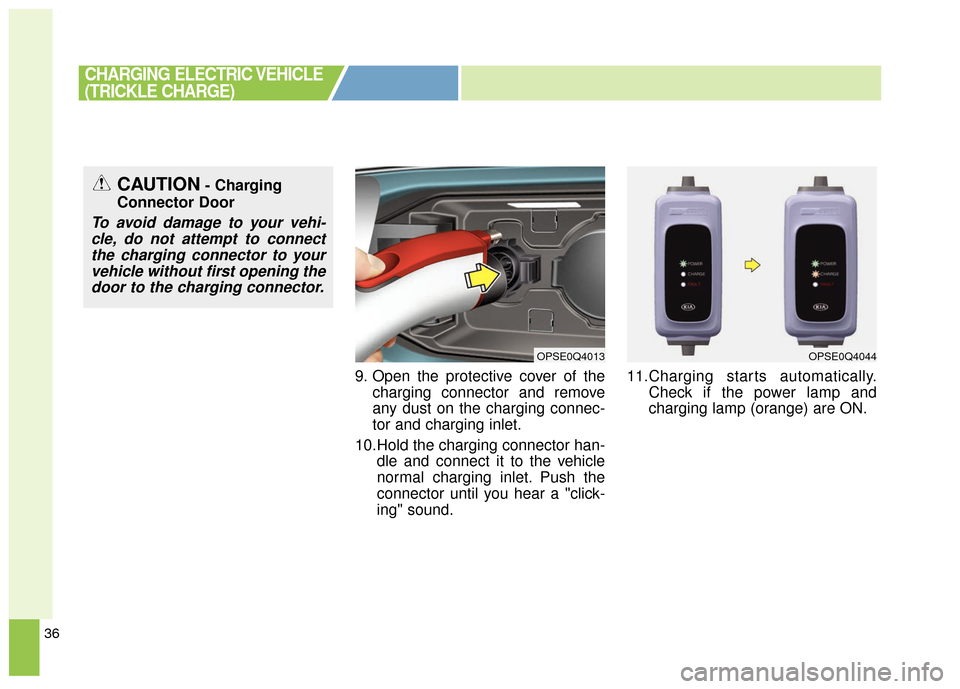
9. Open the protective cover of thecharging connector and remove
any dust on the charging connec-
tor and charging inlet.
10.Hold the charging connector han- dle and connect it to the vehicle
normal charging inlet. Push the
connector until you hear a "click-
ing" sound. 11.Charging starts automatically.
Check if the power lamp and
charging lamp (orange) are ON.
CHARGING ELECTRIC VEHICLE
(TRICKLE CHARGE)
CAUTION- Charging
Connector Door
To avoid damage to your vehi- cle, do not attempt to connectthe charging connector to yourvehicle without first opening thedoor to the charging connector.
OPSE0Q4013OPSE0Q4044
47
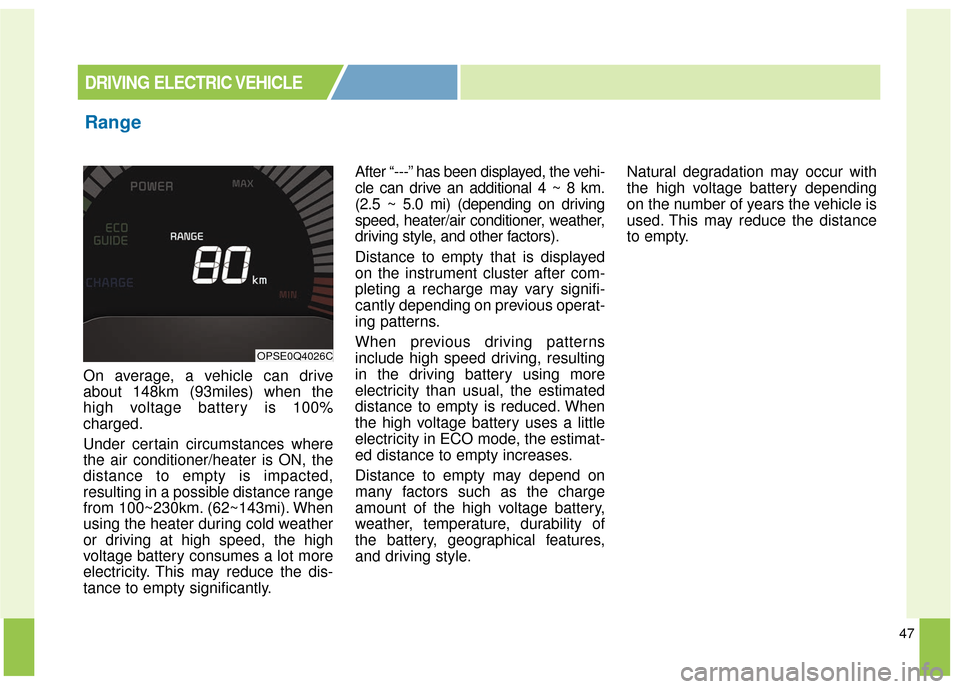
On average, a vehicle can drive
about 148km (93miles) when the
high voltage battery is 100%
charged.
Under certain circumstances where
the air conditioner/heater is ON, the
distance to empty is impacted,
resulting in a possible distance range
from 100~230km. (62~143mi). When
using the heater during cold weather
or driving at high speed, the high
voltage battery consumes a lot more
electricity. This may reduce the dis-
tance to empty significantly.After “---” has been displayed, the vehi-
cle can drive an additional 4 ~ 8 km.
(2.5 ~ 5.0 mi) (depending on driving
speed, heater/air conditioner, weather,
driving style, and other factors).
Distance to empty that is displayed
on the instrument cluster after com-
pleting a recharge may vary signifi-
cantly depending on previous operat-
ing patterns.
When previous driving patterns
include high speed driving, resulting
in the driving battery using more
electricity than usual, the estimated
distance to empty is reduced. When
the high voltage battery uses a little
electricity in ECO mode, the estimat-
ed distance to empty increases.
Distance to empty may depend on
many factors such as the charge
amount of the high voltage battery,
weather, temperature, durability of
the battery, geographical features,
and driving style.
Natural degradation may occur with
the high voltage battery depending
on the number of years the vehicle is
used. This may reduce the distance
to empty.
Range
DRIVING ELECTRIC VEHICLE
OPSE0Q4026C
56
When a vehicle accident occurs,
move the vehicle to a safe place, turn
OFF the vehicle and remove the aux-
iliary battery (12 V) terminal to pre-
vent high voltage electricity from
flowing. Remove the auxiliary battery
(12 V) terminal and turn it OFF.When you suspect leakage of inflam-
mable gas and other harmful gases,
open the windows and evacuate to a
safe place. If any leaked fluid comes
in contact with your eyes or skin,
immediately clean the affected area
thoroughly with tap water or saline
solution and have doctors inspect it
as soon as possible.
SAFETY PRECAUTIONS FOR
ELECTRIC VEHICLE
Responding to Vehicle Accidents in your
Electric Vehicle
WARNING- Exposed
Wires & Electrical
Components
Do not touch electric wires that
may become exposed from
inside or outside the vehicle,
high voltage electric wires
(orange), connectors and all
electric components and
devices. Doing so may result in
electric shock and lead to
injuries.
WARNING- Damaged battery
Do not touch harmful gas and
electrolytes which may leak if
the high voltage battery is dam-
aged in an accident.WARNING- Vehicle fires
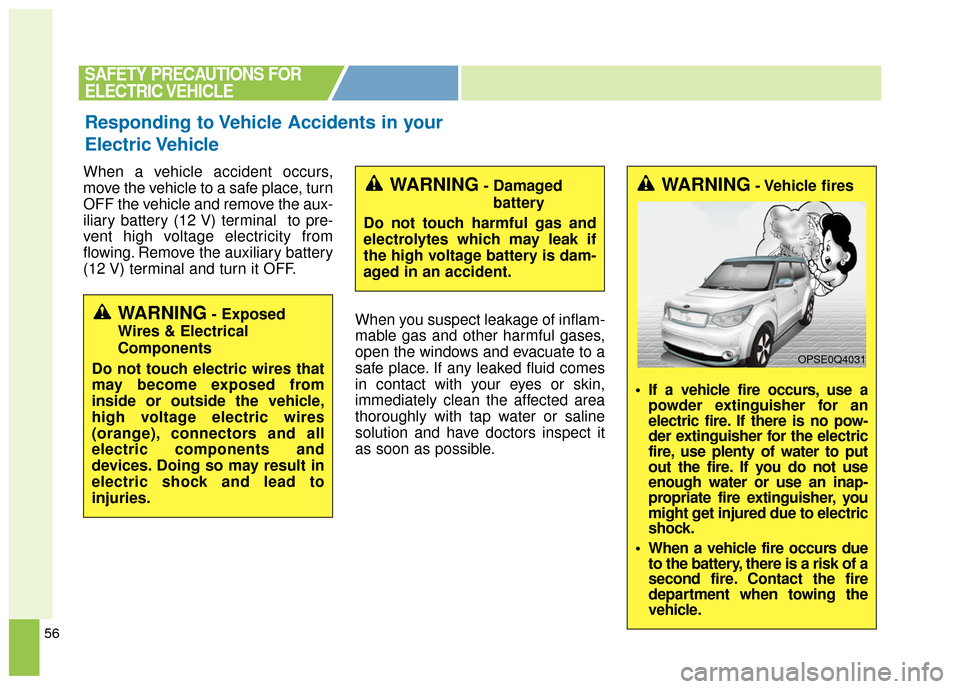
If a vehicle fire occurs, use a powder extinguisher for an
electric fire. If there is no pow-
der extinguisher for the electric
fire, use plenty of water to put
out the fire. If you do not use
enough water or use an inap-
propriate fire extinguisher, you
might get injured due to electric
shock.
When a vehicle fire occurs due to the battery, there is a risk of a
second fire. Contact the fire
department when towing the
vehicle.
OPSE0Q4031