Page 24 of 449
39
Safety features of your vehicle
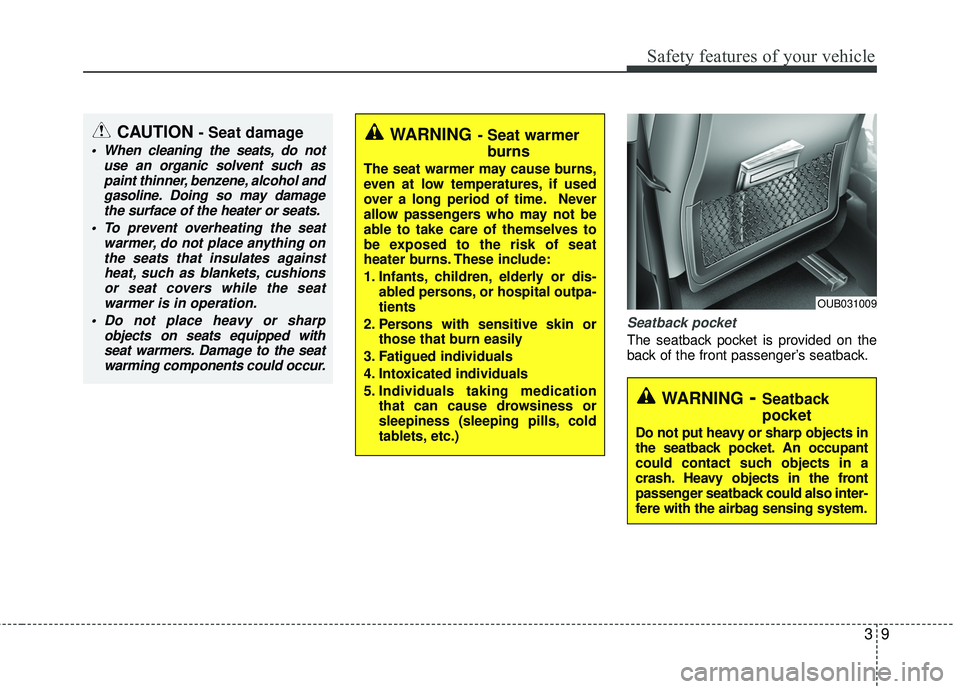
Seatback pocket
The seatback pocket is provided on the
back of the front passenger’s seatback.
WARNING- Seat warmerburns
The seat warmer may cause burns,
even at low temperatures, if used
over a long period of time. Never
allow passengers who may not be
able to take care of themselves to
be exposed to the risk of seat
heater burns. These include:
1. Infants, children, elderly or dis-
abled persons, or hospital outpa-
tients
2. Persons with sensitive skin or those that burn easily
3. Fatigued individuals
4. Intoxicated individuals
5. Individuals taking medication that can cause drowsiness or
sleepiness (sleeping pills, cold
tablets, etc.)
WARNING- Seatback
pocket
Do not put heavy or sharp objects in
the seatback pocket. An occupant
could contact such objects in a
crash. Heavy objects in the front
passenger seatback could also inter-
fere with the airbag sensing system.
OUB031009
CAUTION - Seat damage
When cleaning the seats, do not use an organic solvent such aspaint thinner, benzene, alcohol andgasoline. Doing so may damagethe surface of the heater or seats.
To prevent overheating the seat warmer, do not place anything onthe seats that insulates againstheat, such as blankets, cushionsor seat covers while the seatwarmer is in operation.
Do not place heavy or sharp objects on seats equipped withseat warmers. Damage to the seatwarming components could occur.
Page 26 of 449
311
Safety features of your vehicle
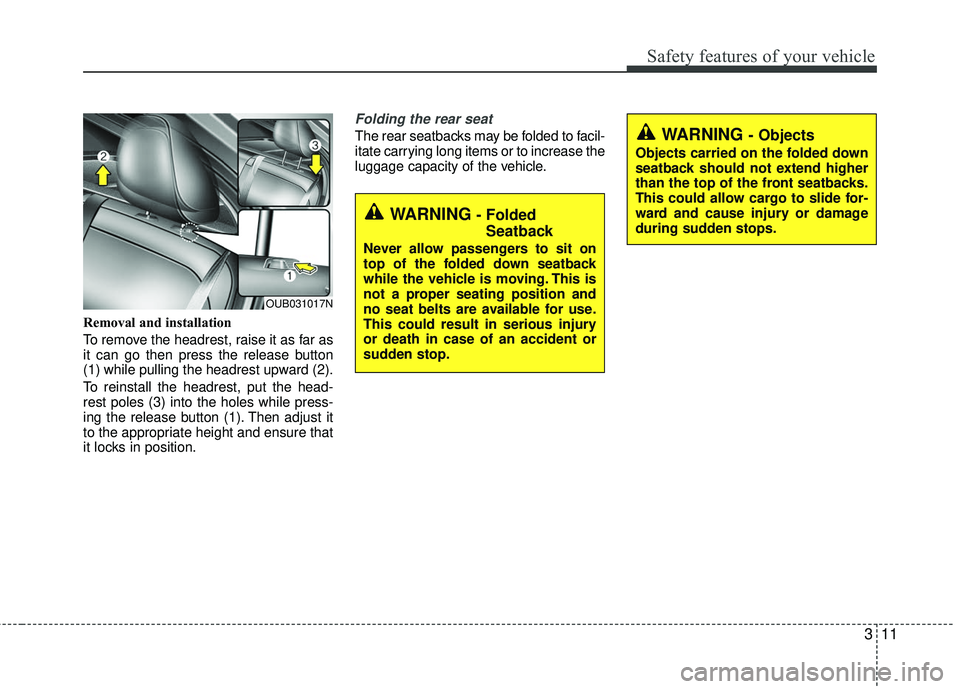
Removal and installation
To remove the headrest, raise it as far as
it can go then press the release button
(1) while pulling the headrest upward (2).
To reinstall the headrest, put the head-
rest poles (3) into the holes while press-
ing the release button (1). Then adjust it
to the appropriate height and ensure that
it locks in position.
Folding the rear seat
The rear seatbacks may be folded to facil-
itate carrying long items or to increase the
luggage capacity of the vehicle.
OUB031017N
WARNING - Objects
Objects carried on the folded down
seatback should not extend higher
than the top of the front seatbacks.
This could allow cargo to slide for-
ward and cause injury or damage
during sudden stops.
WARNING- FoldedSeatback
Never allow passengers to sit on
top of the folded down seatback
while the vehicle is moving. This is
not a proper seating position and
no seat belts are available for use.
This could result in serious injury
or death in case of an accident or
sudden stop.
Page 28 of 449
313
Safety features of your vehicle
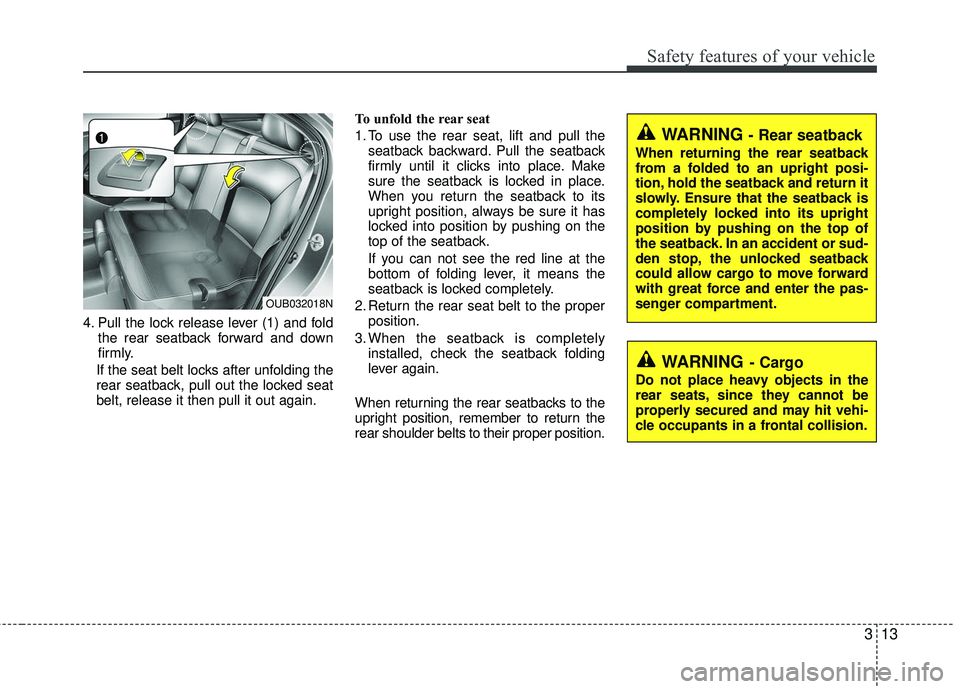
4. Pull the lock release lever (1) and foldthe rear seatback forward and down
firmly.
If the seat belt locks after unfolding the
rear seatback, pull out the locked seat
belt, release it then pull it out again. To unfold the rear seat
1. To use the rear seat, lift and pull the
seatback backward. Pull the seatback
firmly until it clicks into place. Make
sure the seatback is locked in place.
When you return the seatback to its
upright position, always be sure it has
locked into position by pushing on the
top of the seatback.
If you can not see the red line at the
bottom of folding lever, it means the
seatback is locked completely.
2. Return the rear seat belt to the proper position.
3. When the seatback is completely installed, check the seatback folding
lever again.
When returning the rear seatbacks to the
upright position, remember to return the
rear shoulder belts to their proper position.
OUB032018N
WARNING - Rear seatback
When returning the rear seatback
from a folded to an upright posi-
tion, hold the seatback and return it
slowly. Ensure that the seatback is
completely locked into its upright
position by pushing on the top of
the seatback. In an accident or sud-
den stop, the unlocked seatback
could allow cargo to move forward
with great force and enter the pas-
senger compartment.
WARNING- Cargo
Do not place heavy objects in the
rear seats, since they cannot be
properly secured and may hit vehi-
cle occupants in a frontal collision.
Page 29 of 449
Safety features of your vehicle
14
3
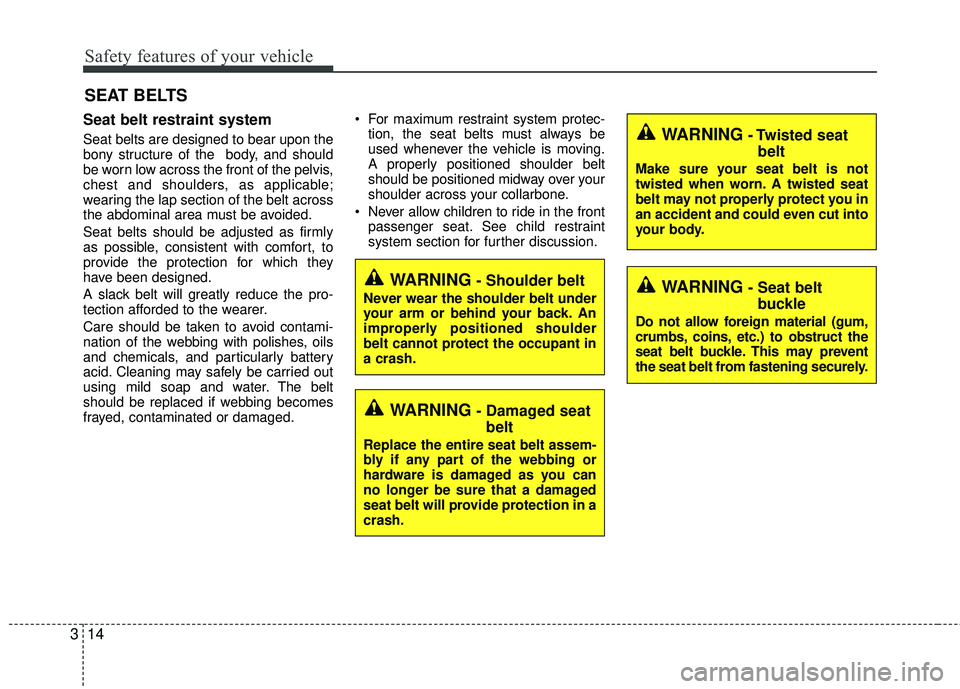
Seat belt restraint system
Seat belts are designed to bear upon the
bony structure of the body, and should
be worn low across the front of the pelvis,
chest and shoulders, as applicable;
wearing the lap section of the belt across
the abdominal area must be avoided.
Seat belts should be adjusted as firmly
as possible, consistent with comfort, to
provide the protection for which they
have been designed.
A slack belt will greatly reduce the pro-
tection afforded to the wearer.
Care should be taken to avoid contami-
nation of the webbing with polishes, oils
and chemicals, and particularly battery
acid. Cleaning may safely be carried out
using mild soap and water. The belt
should be replaced if webbing becomes
frayed, contaminated or damaged. For maximum restraint system protec-
tion, the seat belts must always be
used whenever the vehicle is moving.
A properly positioned shoulder belt
should be positioned midway over your
shoulder across your collarbone.
Never allow children to ride in the front passenger seat. See child restraint
system section for further discussion.
SEAT BELTS
WARNING- Shoulder belt
Never wear the shoulder belt under
your arm or behind your back. An
improperly positioned shoulder
belt cannot protect the occupant in
a crash.
WARNING- Damaged seatbelt
Replace the entire seat belt assem-
bly if any part of the webbing or
hardware is damaged as you can
no longer be sure that a damaged
seat belt will provide protection in a
crash.
WARNING- Twisted seatbelt
Make sure your seat belt is not
twisted when worn. A twisted seat
belt may not properly protect you in
an accident and could even cut into
your body.
WARNING- Seat belt buckle
Do not allow foreign material (gum,
crumbs, coins, etc.) to obstruct the
seat belt buckle. This may prevent
the seat belt from fastening securely.
Page 30 of 449
315
Safety features of your vehicle
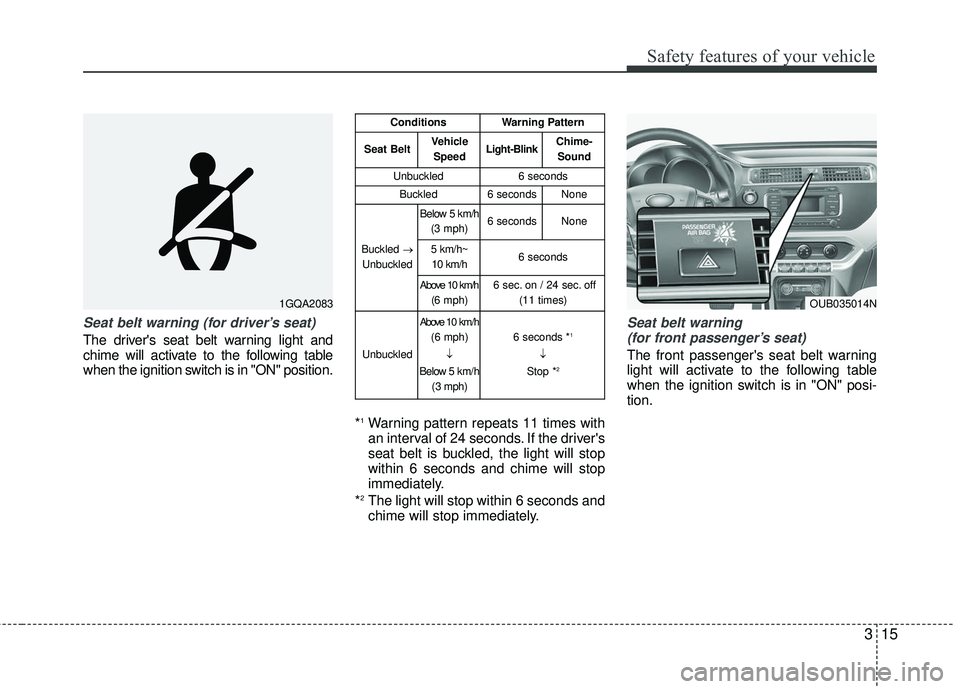
Seat belt warning (for driver’s seat)
The driver's seat belt warning light and
chime will activate to the following table
when the ignition switch is in "ON" position.*
1Warning pattern repeats 11 times with
an interval of 24 seconds. If the driver's
seat belt is buckled, the light will stop
within 6 seconds and chime will stop
immediately.
*
2The light will stop within 6 seconds and
chime will stop immediately.
Seat belt warning (for front passenger’s seat)
The front passenger's seat belt warning
light will activate to the following table
when the ignition switch is in "ON" posi-
tion.
1GQA2083
ConditionsWarning Pattern
Seat BeltVehicle
SpeedLight-BlinkChime-Sound
Unbuckled6 seconds
Buckled6 secondsNone
Buckled →
Unbuckled
Below 5 km/h (3 mph)6 secondsNone
5 km/h~10 km/h6 seconds
Above 10 km/h(6 mph)6 sec. on / 24 sec. off (11 times)
Unbuckled
Above 10 km/h(6 mph)
↓
Below 5 km/h
(3 mph)6 seconds *1
↓
Stop *2
OUB035014N
Page 31 of 449

Safety features of your vehicle
16
3
*1The seat belt warning light will go off if
the vehicle speed decreases below 5
km/h (3 mph). If the vehicle speed
increases above 5 km/h (3 mph), the
warning light will blink again.
You can find the front passenger's seat belt warning light on the center fascia
panel.
Although the front passenger seat is not occupied, the seat belt warning
light will blink for 6 seconds.
The seat belt warning light can blink when a briefcase or purse is placed on
the front passenger seat. Riding in an improper position adversely
affects the front passenger's seat belt
warning system. It is important for the
driver to instruct the passenger as to the
proper seating instructions as contained
in this manual.Seat belt - Driver's 3-point system
with emergency locking retractor
To fasten your seat belt:
To fasten your seat belt, pull it out of the
retractor and insert the metal tab (1) into
the buckle (2). There will be an audible
"click" when the tab locks into the buckle.
The seat belt automatically adjusts to the
proper length only after the lap belt por-
tion is adjusted manually so that it fits
snugly around your hips. If you lean for-
ward in a slow, easy motion, the belt will
extend and let you move around. If there
is a sudden stop or impact, however, the
belt will lock into position. It will also lock
if you try to lean forward too quickly.
ConditionsWarning Pattern
Seat BeltVehicle
SpeedLight-Blink
Unbuckled6 seconds
UnbuckledAbove 10 km/h (6mph)Continuously
Buckled6 seconds
Buckled →
Unbuckled
Above 10 km/h (6mph)Continuously *1
Below 10 km/h(6mph)NoneB180A01NF-1
Page 32 of 449
317
Safety features of your vehicle
If you are not able to pull out the seat belt
from the retractor, firmly pull the belt out
and release it. Then you will be able to
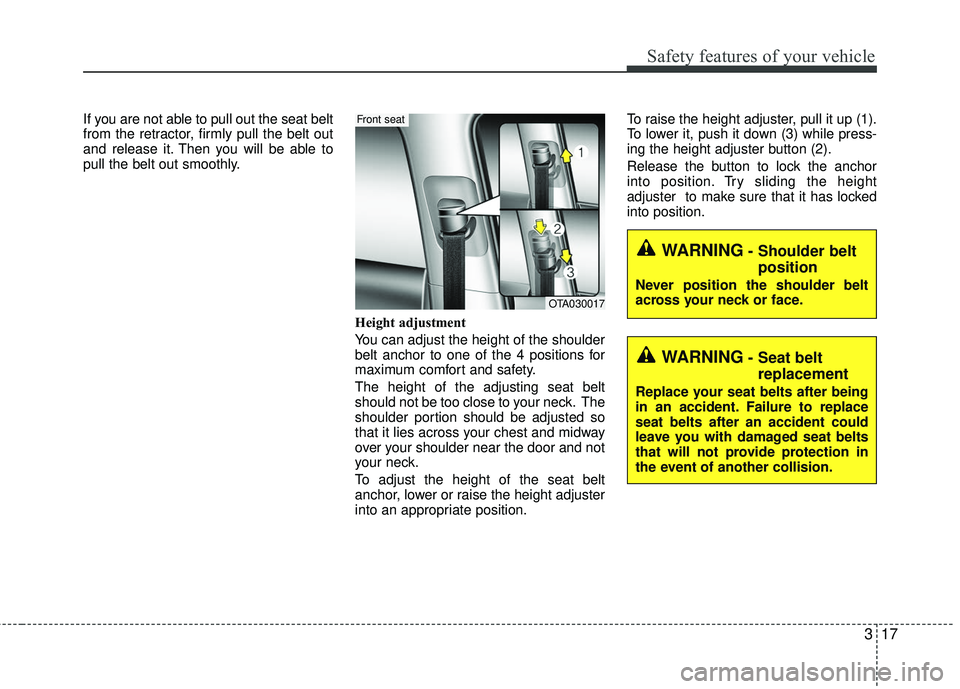
pull the belt out smoothly.Height adjustment
You can adjust the height of the shoulder
belt anchor to one of the 4 positions for
maximum comfort and safety.
The height of the adjusting seat belt
should not be too close to your neck. The
shoulder portion should be adjusted so
that it lies across your chest and midway
over your shoulder near the door and not
your neck.
To adjust the height of the seat belt
anchor, lower or raise the height adjuster
into an appropriate position.To raise the height adjuster, pull it up (1).
To lower it, push it down (3) while press-
ing the height adjuster button (2).
Release the button to lock the anchor
into position. Try sliding the height
adjuster to make sure that it has locked
into position.
OTA030017
Front seat
WARNING- Shoulder belt
position
Never position the shoulder belt
across your neck or face.
WARNING- Seat beltreplacement
Replace your seat belts after being
in an accident. Failure to replace
seat belts after an accident could
leave you with damaged seat belts
that will not provide protection in
the event of another collision.
Page 35 of 449
Safety features of your vehicle
20
3
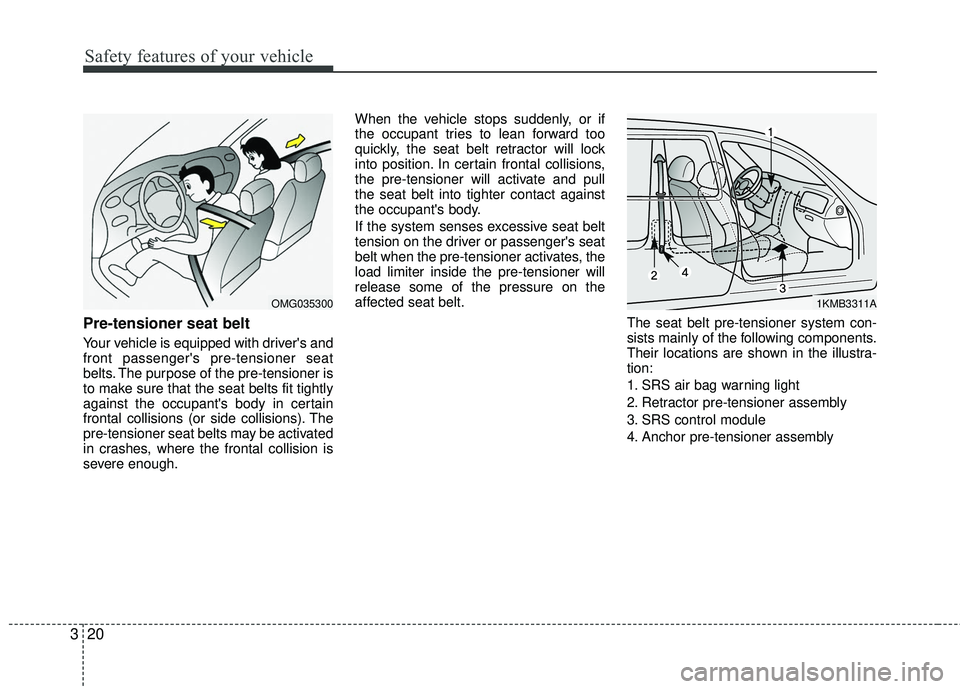
Pre-tensioner seat belt
Your vehicle is equipped with driver's and
front passenger's pre-tensioner seat
belts. The purpose of the pre-tensioner is
to make sure that the seat belts fit tightly
against the occupant's body in certain
frontal collisions (or side collisions). The
pre-tensioner seat belts may be activated
in crashes, where the frontal collision is
severe enough. When the vehicle stops suddenly, or if
the occupant tries to lean forward too
quickly, the seat belt retractor will lock
into position. In certain frontal collisions,
the pre-tensioner will activate and pull
the seat belt into tighter contact against
the occupant's body.
If the system senses excessive seat belt
tension on the driver or passenger's seat
belt when the pre-tensioner activates, the
load limiter inside the pre-tensioner will
release some of the pressure on the
affected seat belt.
The seat belt pre-tensioner system con-
sists mainly of the following components.
Their locations are shown in the illustra-
tion:
1. SRS air bag warning light
2. Retractor pre-tensioner assembly
3. SRS control module
4. Anchor pre-tensioner assembly
1KMB3311AOMG035300