2017 KIA OPTIMA PLUG-IN HYBRID brake light
[x] Cancel search: brake lightPage 516 of 686

SPECIAL DRIVING CONDITIONS
Hazardous driving conditions
When hazardous driving conditions are
encountered such as water, snow, ice, mud, sand, or similar hazards, follow
these suggestions: • Drive cautiously and allow extra dis‐ tance for braking.
• Avoid sudden braking or steering.
• When braking with non-ABS brakes pump the brake pedal with a light up-
and-down motion until the vehicle is stopped.
WARNING
nABS
Do not pump the brake pedal on avehicle equipped with ABS.
• If stalled in snow, mud, or sand, use second gear. Accelerate slowly to
avoid spinning the drive wheels.
• Use sand, rock salt, tire chains, or other non-slip material under the
drive wheels to provide traction when
stalled in ice, snow, or mud.
WARNING
nDownshifting
Downshifting with an automatictransaxle, while driving on slipperysurfaces can cause an accident. Thesudden change in tire speed couldcause the tires to skid. Be carefulwhen downshifting on slippery sur‐faces.
Rocking the vehicle
If it is necessary to rock the vehicle to
free it from snow, sand, or mud, first turn the steering wheel right and left
to clear the area around your front
wheels. Then, shift back and forth be‐ tween 1 (First) and R (Reverse) in vehi‐
cles equipped with a manual transaxle
or R (Reverse) and any forward gear in vehicles equipped with an Automatic
Transaxle / Dual clutch transmission. Do
not race the engine, and spin the wheels as little as possible. If you are
still stuck after a few tries, have the
vehicle pulled out by a tow vehicle to
avoid engine overheating and possible
damage to the transaxle.
CAUTION
Prolonged rocking may cause engineover-heating, transaxle damage orfailure, and tire damage.
WARNING
nSpinning tires
Do not spin the wheels, especially atspeeds more than 56 km/h(35 mph). Spinning the wheels athigh speeds when the vehicle is sta‐tionary could cause a tire to over‐heat which could result in tire dam‐age that may injure bystanders.
NOTICE
The ESC system should be turned
OFF prior to rocking the vehicle.
7-99
7
Driving your vehicle
Page 518 of 686
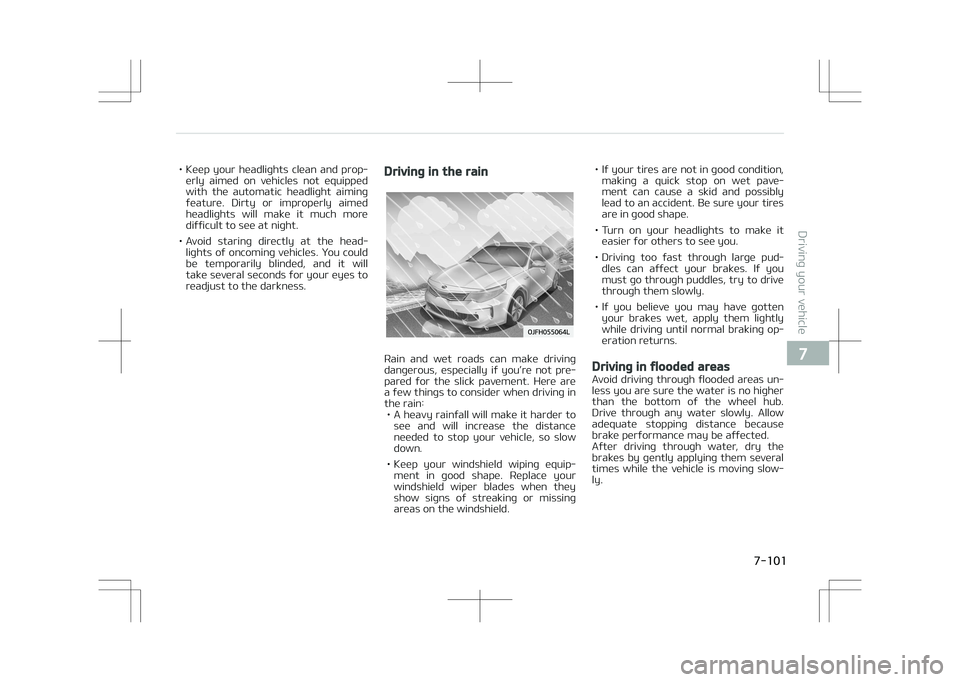
• Keep your headlights clean and prop‐erly aimed on vehicles not equipped
with the automatic headlight aiming feature. Dirty or improperly aimed
headlights will make it much more
difficult to see at night.
• Avoid staring directly at the head‐ lights of oncoming vehicles. You could
be temporarily blinded, and it will take several seconds for your eyes to
readjust to the darkness.Driving in the rain
Rain and wet roads can make driving
dangerous, especially if you’re not pre‐ pared for the slick pavement. Here are
a few things to consider when driving in
the rain: • A heavy rainfall will make it harder to see and will increase the distanceneeded to stop your vehicle, so slow
down.
• Keep your windshield wiping equip‐ ment in good shape. Replace your
windshield wiper blades when they show signs of streaking or missing
areas on the windshield. • If your tires are not in good condition,
making a quick stop on wet pave‐
ment can cause a skid and possibly
lead to an accident. Be sure your tires are in good shape.
• Turn on your headlights to make it easier for others to see you.
• Driving too fast through large pud‐ dles can affect your brakes. If you
must go through puddles, try to drive
through them slowly.
• If you believe you may have gotten your brakes wet, apply them lightly
while driving until normal braking op‐
eration returns.Driving in flooded areas
Avoid driving through flooded areas un‐
less you are sure the water is no higher than the bottom of the wheel hub.
Drive through any water slowly. Allow
adequate stopping distance because brake performance may be affected.
After driving through water, dry the
brakes by gently applying them several
times while the vehicle is moving slow‐ ly.
7-101
7
Driving your vehicle
Page 523 of 686

Use approved window washer
anti-freeze in system
To keep the water in the window wash‐er system from freezing, add an ap‐
proved window washer anti-freeze sol‐
ution in accordance with instructions on the container. Window washer anti-
freeze is available from an authorized
Kia dealer and most auto parts outlets. Do not use engine coolant or other
types of anti-freeze as these may
damage the paint finish.
Don't let your parking brake
freeze
Under some conditions your parking
brake can freeze in the engaged posi‐ tion. This is most likely to happen when
there is an accumulation of snow or ice
around or near the rear brakes or if the brakes are wet. If there is a risk the
parking brake may freeze, apply it only
temporarily while you put the shift lev‐ er in P (Automatic Transaxle / Dual
clutch transmission) or in first or re‐
verse gear (manual transaxle) and block
the rear wheels so the vehicle cannot roll. Then release the parking brake.
Don't let ice and snow
accumulate underneath
Under some conditions, snow and ice can build up under the fenders and in‐
terfere with the steering. When driving
in severe winter conditions where this may happen, you should periodically
check underneath the vehicle to be sure
the movement of the front wheels and the steering components is not ob‐
structed.
Carry emergency equipment
Depending on the severity of the
weather, you should carry appropriate emergency equipment. Some of the
items you may want to carry include
tire chains, tow straps or chains, flash‐ light, emergency flares, sand, shovel,
jumper cables, window scraper, gloves,
ground cloth, coveralls, blanket, etc.
Driving your vehicle
7-106
Page 529 of 686

IF THE ENGINE WILL NOT START
If engine doesn't turn over or
turns over slowly
1. Be sure the shift lever is in N (Neu‐tral) or P (Park) and the emergency
brake is set.
2. Check the battery connections to be sure they are clean and tight.
3. Turn on the interior light. If the light dims or goes out when you
operate the starter, the battery is
discharged.
4. Check the starter connections to be sure they are securely tightened.
5. Do not push or pull the vehicle to start it. See instructions for L
Page 538 of 686

You may not be able to identify a low
tire by simply looking at it. Always use a good quality tire pressure gauge to
measure the tire's inflation pressure.
Please note that a tire that is hot (from being driven) will have a higher pres‐
sure measurement than a tire that is
cold (from sitting stationary for at least 3 hours and driven less than
1.6 km (1 mile) during that 3 hour peri‐
od).
Allow the tire to cool before measuring the inflation pressure. Always be sure
the tire is cold before inflating to the
recommended pressure.
A cold tire means the vehicle has been sitting for 3 hours and driven for less
than 1.6 km (1 mile) in that 3 hour peri‐od.
CAUTION
We recommend that you use thesealant approved by Kia if your vehi‐cle is equipped with a Tire PressureMonitoring System. The liquid seal‐ant can damage the tire pressuresensors.
WARNING
nTPMS
•The TPMS cannot alert you to se‐vere and sudden tire damagecaused by external factors such asnails or road debris.
•If you feel any vehicle instability,immediately take your foot off theaccelerator, apply the brakes grad‐ually and with light force, andslowly move to a safe position offthe road.
WARNING
nProtecting TPMS
Tampering with, modifying, or disa‐bling the Tire Pressure MonitoringSystem (TPMS) components may in‐terfere with the system's ability towarn the driver of low tire pressureconditions and/or TPMS malfunc‐tions. Tampering with, modifying, ordisabling the Tire Pressure Monitor‐ing System (TPMS) components mayvoid the warranty for that portion ofthe vehicle.
WARNING
nFor EUROPE
•Do not modify the vehicle, it mayinterfere with the TPMS function.
•The wheels on the market do nothave a TPMS sensor.For your safety, we recommendthat you use parts for replace‐ment from an authorized Kia deal‐er.
•If you use the wheels on the mar‐ket, use a TPMS sensor approvedby a Kia dealer.If your vehicle is not equipped witha TPMS sensor or TPMS does notwork properly, you may fail theperiodic vehicle inspection conduc‐ted in your country.❈All vehicles sold in the EUROPEmarket during below periodmust be equipped with TPMS.-New model vehicle:Nov. 1, 2012 ~
-Current model vehicle:Nov. 1, 2014 ~ (Based on vehi‐cle registrations)
8-13
8
What to do in an emergency
Page 638 of 686

APPEARANCE CARE
Exterior care
Exterior general caution
It is very important to follow the label
directions when using any chemical cleaner or polish. Read all warning and
caution statements that appear on the
label.
Finish maintenance
Washing
To help protect your vehicle’s finish
from rust and deterioration, wash it thoroughly and frequently at least once
a month with lukewarm or cold water.
If you use your vehicle for off-road
driving, you should wash it after each off-road trip. Pay special attention to
the removal of any accumulation of
salt, dirt, mud, and other foreign mate‐ rials. Make sure the drain holes in the
lower edges of the doors and rocker
panels are kept clear and clean.
Insects, tar, tree sap, bird droppings, in‐ dustrial pollution and similar deposits
can damage your vehicle’s finish if not
removed immediately.
Even prompt washing with plain water
may not completely remove all these
deposits. A mild soap, safe for use on
painted surfaces, may be used. After washing, rinse the vehicle thor‐
oughly with lukewarm or cold water. Do
not allow soap to dry on the finish.
CAUTION
•Do not use strong soap, chemicaldetergents or hot water, and donot wash the vehicle in direct sun‐light or when the body of the vehi‐cle is warm.
•Be careful when washing the sidewindows of your vehicle.Especially, with high-pressure wa‐ter, water may leak through thewindows and wet the interior.
•To prevent damage to the plasticparts and lamps, do not clean withchemical solvents or strong deter‐gents.
WARNING
nWet brakes
After washing the vehicle, test thebrakes while driving slowly to see if
(Continued)
(Continued)
they have been affected by water. Ifbraking performance is impaired, drythe brakes by applying them lightlywhile maintaining a slow forwardspeed.
High-pressure washing
• When using high-pressure washers, make sure to maintain sufficient dis‐
tance from the vehicle.
Insufficient clearance or excessive pressure can lead to component
damage or water penetration.
• Do not spray the camera, sensors or its surrounding area directly with a
high pressure washer. Shock applied
from high pressure water may cause the device to not operate normally.
• Do not bring the nozzle tip close to boots (rubber or plastic covers) or
connectors as they may be damaged
if they come into contact with high
pressure water.
9-85
9
Maintenance
Page 640 of 686

Underbody maintenance
Corrosive materials used for ice and
snow removal and dust control may
collect on the underbody. If these ma‐ terials are not removed, accelerated
rusting can occur on underbody parts
such as the fuel lines, frame, floor pan and exhaust system, even though they
have been treated with rust protection.
Thoroughly flush the vehicle underbody
and wheel openings with lukewarm or cold water once a month, after off-
road driving and at the end of each
winter. Pay special attention to these areas because it is difficult to see all
the mud and dirt. It will do more harm
than good to wet down the road grime without removing it. The lower edges
of the doors, rocker panels, and frame
members have drain holes that should not clog with dirt; trapped water in
these areas can cause rusting.
WARNING
After washing the vehicle, test thebrakes while driving slowly to see ifthey have been affected by water. Ifbraking performance is impaired, dry
(Continued)
(Continued)
the brakes by applying them lightlywhile maintaining a slow forwardspeed.
Aluminum wheel maintenance
The aluminum wheels are coated with a
clear protective finish. • Do not use any abrasive cleaner, pol‐ ishing compound, solvent, or wirebrushes on aluminum wheels. They
may scratch or damage the finish.
• Clean the wheel when it has cooled.
• Use only a mild soap or neutral deter‐ gent, and rinse thoroughly with wa‐
ter. Also, be sure to clean the wheels
after driving on salted roads. This helps prevent corrosion.
• Avoid washing the wheels with high- speed car wash brushes.
• Do not use any alkaline or acid deter‐ gent. It may damage and corrode the
aluminum wheels coated with a clear
protective finish.
Corrosion protection
Protecting your vehicle from corrosion
By using the most advanced design and
construction practices to combat corro‐ sion, we produce vehicles of the highest
quality. However, this is only part of
the job. To achieve the long-term cor‐ rosion resistance your vehicle can deliv‐
er, the owner's cooperation and assis‐
tance is also required.
Common causes of corrosion
The most common causes of corrosion on your vehicle are: • Road salt, dirt and moisture that is allowed to accumulate underneath
the vehicle.
• Removal of paint or protective coat‐ ings by stones, gravel, abrasion or
minor scrapes and dents which leave unprotected metal exposed to corro‐
sion.
High-corrosion areas
If you live in an area where your vehicle
is regularly exposed to corrosive mate‐ rials, corrosion protection is particularly
important. Some of the common cau‐
ses of accelerated corrosion are road salts, dust control chemicals, ocean air
and industrial pollution.
9-87
9
Maintenance