2017 KIA CEED tire pressure
[x] Cancel search: tire pressurePage 565 of 653
747
Maintenance
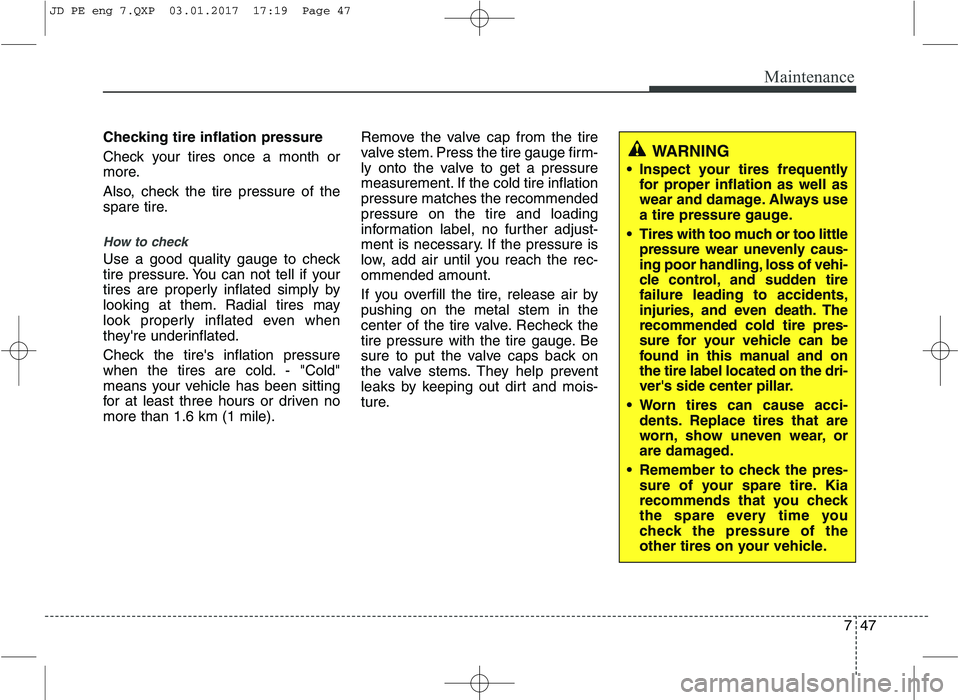
Checking tire inflation pressure
Check your tires once a month or
more.
Also, check the tire pressure of the
spare tire.
How to check
Use a good quality gauge to check
tire pressure. You can not tell if your
tires are properly inflated simply by
looking at them. Radial tires may
look properly inflated even when
they're underinflated.
Check the tire's inflation pressure
when the tires are cold. - "Cold"
means your vehicle has been sitting
for at least three hours or driven nomore than 1.6 km (1 mile).Remove the valve cap from the tire
valve stem. Press the tire gauge firm-
ly onto the valve to get a pressure
measurement. If the cold tire inflationpressure matches the recommendedpressure on the tire and loading
information label, no further adjust-
ment is necessary. If the pressure is
low, add air until you reach the rec-ommended amount.
If you overfill the tire, release air by pushing on the metal stem in the
center of the tire valve. Recheck the
tire pressure with the tire gauge. Be
sure to put the valve caps back on
the valve stems. They help prevent
leaks by keeping out dirt and mois-
ture.
WARNING
Inspect your tires frequently for proper inflation as well as
wear and damage. Always use
a tire pressure gauge.
Tires with too much or too little pressure wear unevenly caus-
ing poor handling, loss of vehi-
cle control, and sudden tirefailure leading to accidents,
injuries, and even death. Therecommended cold tire pres-
sure for your vehicle can be
found in this manual and onthe tire label located on the dri-
ver's side center pillar.
Worn tires can cause acci- dents. Replace tires that are
worn, show uneven wear, or
are damaged.
Remember to check the pres- sure of your spare tire. Kia
recommends that you check
the spare every time you
check the pressure of the
other tires on your vehicle.
JD PE eng 7.QXP 03.01.2017 17:19 Page 47
Page 566 of 653

Maintenance
48
7
Tire rotation
To equalize tread wear, it is recom- mended that the tires be rotated
every 12,000 km (7,500 miles) or
sooner if irregular wear develops.
During rotation, check the tires for
correct balance.
When rotating tires, check for uneven
wear and damage. Abnormal wear is
usually caused by incorrect tire pres-
sure, improper wheel alignment, out-
of-balance wheels, severe braking or
severe cornering. Look for bumps or
bulges in the tread or side of tire.
Replace the tire if you find either of
these conditions. Replace the tire if
fabric or cord is visible. After rotation,
be sure to bring the front and rear tire
pressures to specification and check
lug nut tightness.
Refer to “Tire and wheels” in chapter 8.Disc brake pads should be inspected
for wear whenever tires are rotated.
✽✽ NOTICE
Rotate radial tires that have an
asymmetric tread pattern only from
front to rear and not from right to
left.
WARNING
Do not use the compact spare tire for tire rotation.
Do not mix bias ply and radial ply tires under any circum-
stances. This may cause
unusual handling characteris-tics that could result in death,
severe injury, or property
damage.
S2BLA790
S2BLA790A
CBGQ0707A
■Without a spare tire
■
With a full-size spare tire (if equipped)
■ Directional tires (if equipped)
JD PE eng 7.QXP 03.01.2017 17:19 Page 48
Page 571 of 653

753
Maintenance
3. Checking tire life (TIN : Tire Identification Number)
Any tires that are over 6 years, based
on the manufacturing date, tire
strength and performance, decline
with age naturally (even unused
spare tires). Therefore, the tires(including the spare tire) should be
replaced by new ones. You can find
the manufacturing date on the tire
sidewall (possibly on the inside of the
wheel), displaying the DOT Code.
The DOT Code is a series of num-
bers on a tire consisting of numbers
and English letters. The manufactur-
ing date is designated by the last four
digits (characters) of the DOT code.
DOT : XXXX XXXX OOOO
The front part of the DOT means a
plant code number, tire size and tread
pattern and the last four numbers indi-
cate week and year manufactured.
For example:
DOT XXXX XXXX 1617 represents
that the tire was produced in the 16th
week of 2017.
4. Tire ply composition and material
The number of layers or plies of rub-
ber-coated fabric are in the tire. Tire
manufacturers also must indicate the
materials in the tire, which include
steel, nylon, polyester, and others.
The letter "R" means radial ply con-
struction; the letter "D" means diago-
nal or bias ply construction; and theletter "B" means belted-bias ply con-
struction.
5. Maximum permissible inflationpressure
This number is the greatest amount of air pressure that should be put in
the tire. Do not exceed the maximum
permissible inflation pressure. Refer
to the Tire and Loading Information
label for recommended inflation
pressure.
6. Maximum load rating
This number indicates the maximum
load in kilograms and pounds that can
be carried by the tire. When replacing
the tires on the vehicle, always use a
tire that has the same load rating as
the factory installed tire.
WARNING - Tire age
Tires degrade over time, even
when they are not being used.
Regardless of the remaining
tread, it is recommended that
tires generally be replaced after
six (6) years of normal service.
Heat caused by hot climates orfrequent high loading condi-
tions can accelerate the aging
process. Failure to follow this
Warning can result in sudden
tire failure, which could lead to
a loss of control and an acci-
dent involving serious injury ordeath.
JD PE eng 7.QXP 03.01.2017 17:19 Page 53
Page 573 of 653
755
Maintenance
Low aspect ratio tire (if equipped)
Low aspect ratio tires, whose aspect
ratio is lower than 50, are provided
for sporty looks.
Because the low aspect ratio tires
are optimized for handling and brak-
ing, it may be more uncomfortable to
ride in and there is more noise com-
pare with normal tires.CAUTION
Because the sidewall of the lowaspect ratio tire is shorter thanthe normal, the wheel and tire of the low aspect ratio tire is easi-er to be damaged. So, follow theinstructions below.
- When driving on a rough road or off road, drive cautiouslybecause tires and wheels maybe damaged. And after driving,inspect tires and wheels.
- When passing over a pothole, speed bump, manhole, or curbstone, drive slowly so that thetires and wheels are not dam-aged.
- If the tire is impacted, we rec- ommend that you inspect thetire condition or contact anauthorized Kia dealer.
- To prevent damage to the tire, inspect the tire condition andpressure every 3,000km.
CAUTION
It is not easy to recognize the tire damage with your owneyes. But if there is the slight- est hint of tire damage, eventhough you cannot see the tiredamage with your own eyes, have the tire checked orreplaced because the tiredamage may cause air leak- age from the tire.
If the tire is damaged by driv- ing on a rough road, off road,pothole, manhole, or curbstone, it will not be covered by the warranty.
You can find out the tire infor- mation on the tire sidewall.
JD PE eng 7.QXP 03.01.2017 17:19 Page 55
Page 582 of 653

Maintenance
64
7
No.Fuse ratingSymbolFuse NameProtected component
257.5AMEMORY2MEMORY 2Immobilizer Module (W/O Smart Key)
267.5AMEMORY1MEMORY 1
Driver/Passenger Outside Mirror (Folding), Driver/Passenger Smart Key Outside Handle, Driver IMS Module, Center Facia Switch, Instrument Cluster, Tire Pressure Monitoring Module,
BCM, A/C Control Module, ICM Relay Box (Outside Mirror Folding/Unfolding Relay),
Ignition Key ILL. & Door Warning Switch, Rear Parking Assist Switch,
Data Link Connector, Buzzer
2710ABRAKE
SWITCHBRAKE
SWITCHSmart Key Control Module, Stop Lamp Switch
287.5ACLUSTERCLUSTERInstrument Cluster, Digital Clock
297.5A1POWER
STEERINGEPS Unit
307.5ASPARESPARE-
317.5ASTARTStart Relay, ECU, Ignition Lock Switch, Transaxle Range Switch,
TCU, Smart Key Control Module
3215AMULTI
MEDIAMULTI MEDIAA/V & Navigation Head Unit (W/O ISG), Audio (W/O ISG),
DC-DC Convertor (With ISG), Digital Clock
3310ASPARESPARE-
3425A1PDM 1Smart Key Control Module
3515APOWER
OUTLET1P/OUTLET 1Front Power Outlet
JD PE eng 7.QXP 03.01.2017 17:20 Page 64
Page 583 of 653

765
Maintenance
No.Fuse ratingSymbolFuse NameProtected component
367.5AINDA/BAG INDInstrument Cluster
3710AMODULE1MODULE 1BCM, Tire Pressure Monitoring Module, AT Lever,
Audio, Adaptive Front Lighting Module, LDWS Unit
3815AA/BAGSRS Control Module
JD PE eng 7.QXP 03.01.2017 17:20 Page 65
Page 618 of 653

Maintenance
100
7
APPEARANCE CARE
Exterior care
Exterior general caution
It is very important to follow the label
directions when using any chemical clean-
er or polish. Read all warning and cautionstatements that appear on the label.
Finish maintenance
Washing
To help protect your vehicle’s finish from
rust and deterioration, wash it thoroughlyand frequently at least once a month with
lukewarm or cold water.
If you use your vehicle for off-road driv-
ing, you should wash it after each off-
road trip. Pay special attention to the
removal of any accumulation of salt, dirt,
mud, and other foreign materials. Ensure
drain holes in the lower edges of the
doors and rocker panels are kept clean.
Insects, tar, tree sap, bird droppings,
industrial pollution and similar deposits
can damage your vehicle’s finish if not
removed immediately.
Even prompt washing with plain water may
not completely remove all these deposits.
A mild soap, safe for use on painted sur-
faces, may be used.
After washing, rinse the vehicle thor-
oughly with lukewarm or cold water. Do
not allow soap to dry on the finish. High-pressure washing
When using the High Pressure car wash
system for cleaning the exterior of your
vehicle, be aware that without following
the proper precautions, it may damage
your car.
Never let the high pressure car wash
nozzle come too close to the windows,
soft materials, light system (headlights,
taillights and such), camera, sensors,
bumpers, rubber (including tires), and
also the underside of the vehicle.
The high pressure could damage these parts especially if injected from a
short distance.
Never clean a specific point on the
vehicle for a prolonged time. Applying
the high pressure car wash nozzle fora prolonged time it could damage and
harm the vehicle.
Even while the high pressure car wash nozzle is applied from a distance for a
limited time only, always bear in mind
that a direct stream would greatly
affect the surface of the vehicle.
Always use high pressure car washes which supply jet spray nozzle system,not direct stream nozzle system
WARNING - Wet brakes
After washing the vehicle, test the
brakes while driving slowly to see if
they have been affected by water. If
braking performance is impaired,
dry the brakes by applying them
lightly while maintaining a slow for-
ward speed.
CAUTION
Do not use strong soap, chemical detergents or hot water, and donot wash the vehicle in directsunlight or when the body of the
vehicle is warm.
Be careful when washing the side windows of your vehicle.Especially, with high-pressurewater, water may leak through the
windows and wet the interior.
To prevent damage to the plastic parts and lamps, do not cleanwith chemical solvents or strongdetergents.
JD PE eng 7.QXP 03.01.2017 17:24 Page 100
Page 629 of 653
Specifications & Consumer information
Dimensions . . . . . . . . . . . . . . . . . . . . . . . . . . . . . . . . 8-2
Engine . . . . . . . . . . . . . . . . . . . . . . . . . . . . . . . . . . . . 8-3
Air conditioning system . . . . . . . . . . . . . . . . . . . . . . 8-4
Gross vehicle weight . . . . . . . . . . . . . . . . . . . . . . . . 8-5
Luggage volume . . . . . . . . . . . . . . . . . . . . . . . . . . . . 8-5
Bulb wattage . . . . . . . . . . . . . . . . . . . . . . . . . . . . . . . 8-6
Tires and wheels . . . . . . . . . . . . . . . . . . . . . . . . . . . . 8-8
Recommended lubricants and capacities . . . . . . . 8-9 Recommended SAE viscosity number . . . . . . . . . . . . 8-12
Vehicle identification number (VIN) . . . . . . . . . . . 8-13
Vehicle certification label . . . . . . . . . . . . . . . . . . . . 8-13
Tire specification and pressure label . . . . . . . . . . . 8-14
Engine number . . . . . . . . . . . . . . . . . . . . . . . . . . . . . 8-14
Air conditioner compressor label . . . . . . . . . . . . . . 8-15
Refrigerant label . . . . . . . . . . . . . . . . . . . . . . . . . . . 8-15
Declaration of conformity . . . . . . . . . . . . . . . . . . . . 8-15
8