2017 KIA CARENS RHD check oil
[x] Cancel search: check oilPage 542 of 723

6107
Driving your vehicle
When you are ready to leave after
parking on a hill
1.With the manual transaxle inNeutral or automatic transaxle /
dual clutch transmission in P
(Park), apply your brakes and hold
the brake pedal down whilst you:
and
2.Slowly remove your foot from the brake pedal.
3.Drive slowly until the trailer is clear of the chocks.
4.Stop and have someone pick up and store the chocks. Maintenance when trailer tow- ing
Your vehicle will need service more
often when you regularly pull a trail-
er. Important items to pay particularattention to include engine oil,
transaxle fluid, axle lubricant and
cooling system fluid. Brake condition
is another important item to frequent-
ly check. Each item is covered in this
manual, and the Index will help you
find them quickly. If you’re trailering, it
is a good idea to review these sec-
tions before you start your trip.
Do not forget to also maintain your
trailer and hitch. Follow the mainte-nance schedule that accompanied
your trailer and check it periodically.
Preferably, conduct the check at the
start of each day’s driving. Most
importantly, all hitch nuts and boltsshould be tight.CAUTION
Due to higher load during
trailer usage, overheatingmight occur in hot days or during uphill driving. If thecoolant gauge indicates over-heating, switch off the air con- ditioner and stop the vehiclein a safe area to cool down theengine.
When towing check transaxle fluid more frequently.
If your vehicle is not equipped with an air conditioner, youshould install a condenser fanto improve engine perform-ance when towing a trailer.
Page 554 of 723
What to do in an emergency
4
7
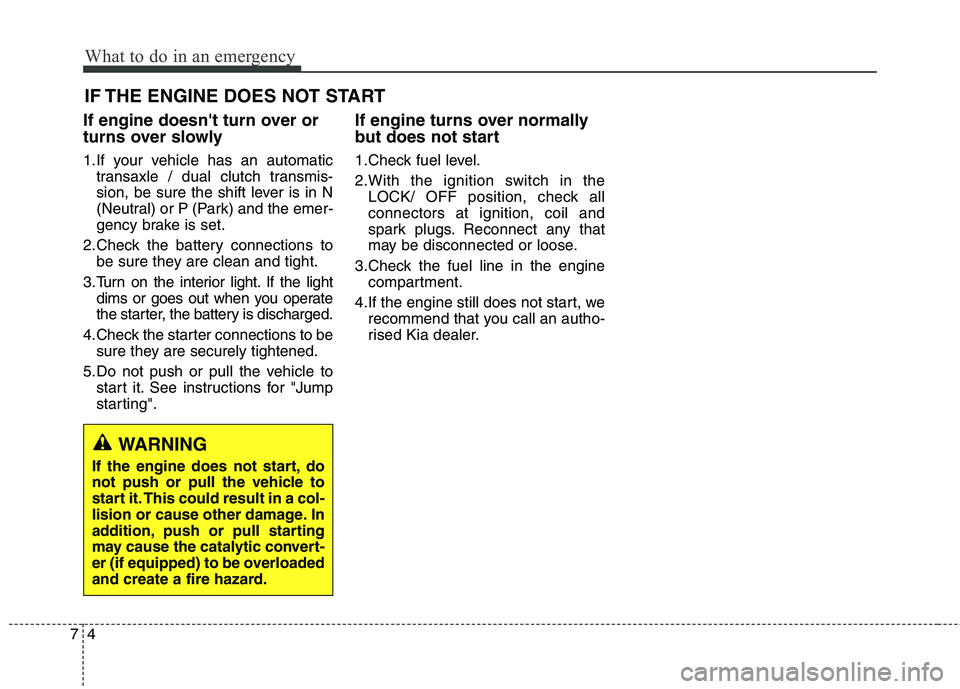
IF THE ENGINE DOES NOT START
If engine doesn't turn over or
turns over slowly
1.If your vehicle has an automatic transaxle / dual clutch transmis-
sion, be sure the shift lever is in N
(Neutral) or P (Park) and the emer-
gency brake is set.
2.Check the battery connections to be sure they are clean and tight.
3.Turn on the interior light. If the light dims or goes out when you operate
the starter, the battery is discharged.
4.Check the starter connections to be sure they are securely tightened.
5.Do not push or pull the vehicle to start it. See instructions for "Jump
starting". If engine turns over normally
but does not start
1.Check fuel level.
2.With the ignition switch in the
LOCK/ OFF position, check all connectors at ignition, coil and
spark plugs. Reconnect any that
may be disconnected or loose.
3.Check the fuel line in the engine compartment.
4.If the engine still does not start, we recommend that you call an autho-
rised Kia dealer.
WARNING
If the engine does not start, do
not push or pull the vehicle to
start it. This could result in a col-
lision or cause other damage. In
addition, push or pull starting
may cause the catalytic convert-
er (if equipped) to be overloaded
and create a fire hazard.
Page 595 of 723
Maintenance
8
8
WARNING - Diesel Engine
Never work on injection system with engine running or within 30seconds after shutting off
engine. High-pressure pump,
rail, injectors and high-pressurepipes are subject to high pres-
sure even after the engine
stopped. The fuel jet produced by
fuel leaks may cause serious
injury, if it touches the body.
People using pacemakers
should not move than 30cm clos-er to the ECU or wiring harness
within the engine room whilst
engine is running, since the high
currents in the electronic engine
control system produce consid-
erable magnetic fields.CAUTION
Do not put heavy objects or apply excessive force on top ofthe engine cover (if equipped)or fuel related parts.
When you inspect the fuel system (fuel lines and fuelinjection devices), we recom- mend that you contact anauthorised Kia dealer.
Do not drive long time with the engine cover (if equipped)removed.
When checking the engine room, do not go near fire.
Fuel, washer fluid, etc. areflammable oils that may cause fire.
Before touching the battery, ignition cables and electricalwiring, you should disconnectthe battery "-" terminal. You may get an electric shockfrom the electric current.
(Continued)
(Continued) When you remove the interior trim cover with a flat head (-)driver, be careful not to dam-age the cover.
Be careful when you replace and clean bulbs to avoidburns or electrical shock.
Page 596 of 723
89
Maintenance
OWNER MAINTENANCE
We recommend that the following
lists are vehicle checks and inspec-
tions that should be performed by the
owner or an authorised Kia dealer atthe frequencies indicated to help
ensure safe, dependable operation
of your vehicle.
If you have any question, we recom-
mend that you consult an authorised
Kia dealer.
These Owner Maintenance Checks
are generally not covered by war-
ranties and you may be charged for
labour, parts and lubricants used. Owner maintenance schedule
When you stop for fuel:
Check the engine oil level.
Check coolant level in coolant
reservoir.
Check the windscreen washer fluid level.
Look for low or under-inflated tyres.
Check the radiator and condenser. Check if the front of the radiator and condenser are clean and not
blocked with leaves, dirt or insectsetc.
If any of the above parts are
extremely dirty or you are not sure
of their condition, we recommend
that you contact an authorised Kia
dealer.
Whilst operating your vehicle:
Note any changes in the sound ofthe exhaust or any smell of
exhaust fumes in the vehicle.
Check for vibrations in the steering wheel. Notice any increased steer-
ing effort or looseness in the steer-
ing wheel, or change in its straight-ahead position.
Notice if your vehicle constantly turns slightly or “pulls” to one side
when travelling on smooth, levelroad.
When stopping, listen and check for unusual sounds, pulling to one
side, increased brake pedal travel
or “hard-to-push” brake pedal.
If any slipping or changes in the operation of your transaxle occurs,
check the transaxle fluid level.
Check manual transaxle operation, including clutch operation.
WARNING
Be careful when checking your
engine coolant level when the
engine is hot. Scalding hot
coolant and steam may blow out
under pressure. This could cause
burns or other serious injury.
Page 599 of 723

Maintenance
12
8
Normal Maintenance Schedule - For Europe (Except Russia)
The following maintenance services must be performed to ensure good emission control and performance. Keep
receipts for all vehicle emission services to protect your warranty. Where both mileage and time are shown, the fre-
quency of service is deter mined by whichever occurs first.
NO.ITEMREMARK
*1Coolant (Engine)
When adding coolant, use only deionized water or soft water for your vehicle and never
mix hard water in the coolant filled at the factory. An improper coolant mixture can result
in serious malfunction or engine damage.
*2Drive belts (Engine)Inspect drive belt tensioner, idler and alternator pulley and if necessary correct or replace.
*3Transaxle fluidManual transaxle fluid and dual clutch transmission fluid should be changed anytime they
have been submerged in water.
*4Engine oil and engine oil filter
Check the engine oil level and leak every 500 km (350 miles) or before starting a long trip.
15,000 km or 12 months for GDI engine.
Operating with an insufficient amount of oil can damage the engine, and such damage is not cov-
ered by warranty.
*5Engine oil and engine oil filter (For Diesel Engine)
20,000 km or 12 months.
Operating with an insufficient amount of oi can damage the engine, and such damage is not cov-
ered by warranty.
It is applicable only when using a qualified fuel <"EN590 or equivalent">. If the diesel fuel specifications don't meet the
EN590, it must be replaced according to the severe maintenance schedule.
Page 601 of 723

Maintenance
14
8
Normal Maintenance Schedule - For Europe (Except Russia) (Continue)
I : Inspect and if necessary, adjust, correct, clean or replace.
R : Replace or change.
MAINTENANCE
INTERVALS
MAINTENANCE ITEMNumber of months or driving distance, whichever comes first
Months24487296120144168192
Miles×1,00020406080100120140160
Km×1,000306090120150180210240
Engine oil and engine oil filter(Petrol,Diesel) * 4RRRRRRRR
Coolant (Engine) *1At first, Replace 210,000 km (140,000 miles) or 120 months
after that, Replace every 30,000 km (20,000 miles) or 24 months
Drive belts (Engine) * 2
PetrolAt first, Inspect 90,000 km (60,000 miles) or 72 months
after that, Inspect every 30,000 km (20,000 miles) or 24months
DieselAt first, Inspect 90,000 km (60,000 miles) or 48months
after that, Inspect every 30,000 km (20,000 miles) or 24months
Valve clearance (Except for Nu 2.0 Engine) * 8--I--I--
Spark plugs (Petrol - Iridium) *9Replace every 160,000 km (104,000 miles) or 120months
Automatic transaxle fluid (if equipped)No check, No service required
Manual transaxle fluid (if equipped) * 3-I-I-I-I
Dual clutch transmission fluid (if equipped) * 3-I-I-I-I
Drive shafts and bootsIIIIIIII
Fuel additives (Petrol) *6Add every 15,000 km (10,000 miles) or 12 months
Fuel filter cartridge (Diesel) * 7RRRRRRRR
Page 608 of 723
821
Maintenance
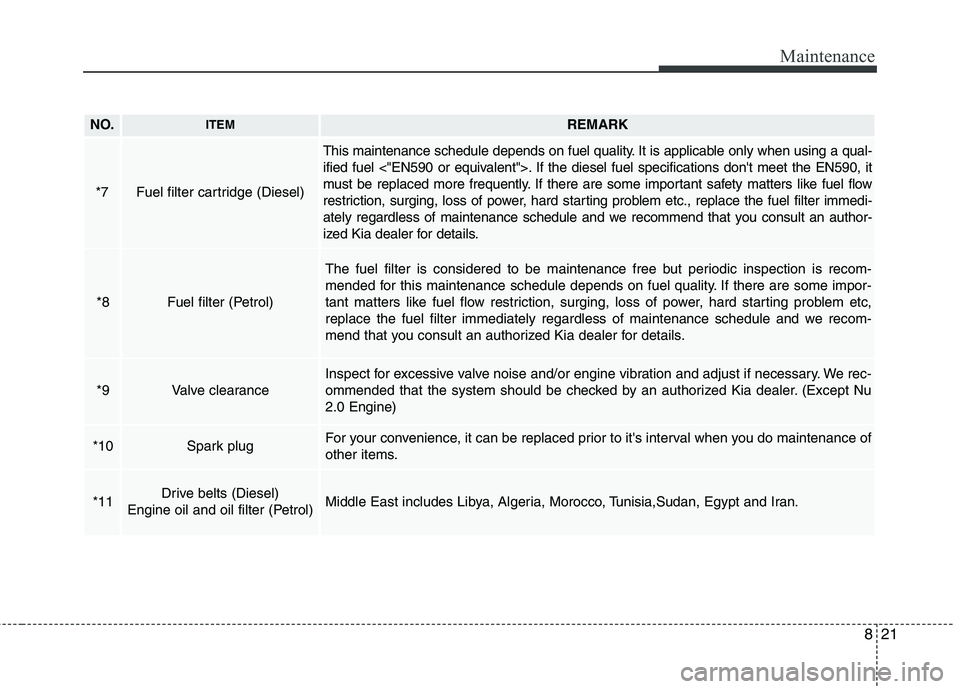
NO.ITEMREMARK
*7Fuel filter cartridge (Diesel)
This maintenance schedule depends on fuel quality. It is applicable only when using a qual-
ified fuel <"EN590 or equivalent">. If the diesel fuel specifications don't meet the EN590, it
must be replaced more frequently. If there are some important safety matters like fuel flow
restriction, surging, loss of power, hard starting problem etc., replace the fuel filter immedi-
ately regardless of maintenance schedule and we recommend that you consult an author-
ized Kia dealer for details.
*8Fuel filter (Petrol)
The fuel filter is considered to be maintenance free but periodic inspection is recom-
mended for this maintenance schedule depends on fuel quality. If there are some impor-
tant matters like fuel flow restriction, surging, loss of power, hard starting problem etc,
replace the fuel filter immediately regardless of maintenance schedule and we recom-
mend that you consult an authorized Kia dealer for details.
*9Valve clearance
Inspect for excessive valve noise and/or engine vibration and adjust if necessary. We rec-
ommended that the system should be checked by an authorized Kia dealer. (Except Nu2.0 Engine)
*10Spark plugFor your convenience, it can be replaced prior to it's interval when you do maintenance of
other items.
*11Drive belts (Diesel)
Engine oil and oil filter (Petrol)Middle East includes Libya, Algeria, Morocco, Tunisia,Sudan, Egypt and Iran.
Page 615 of 723
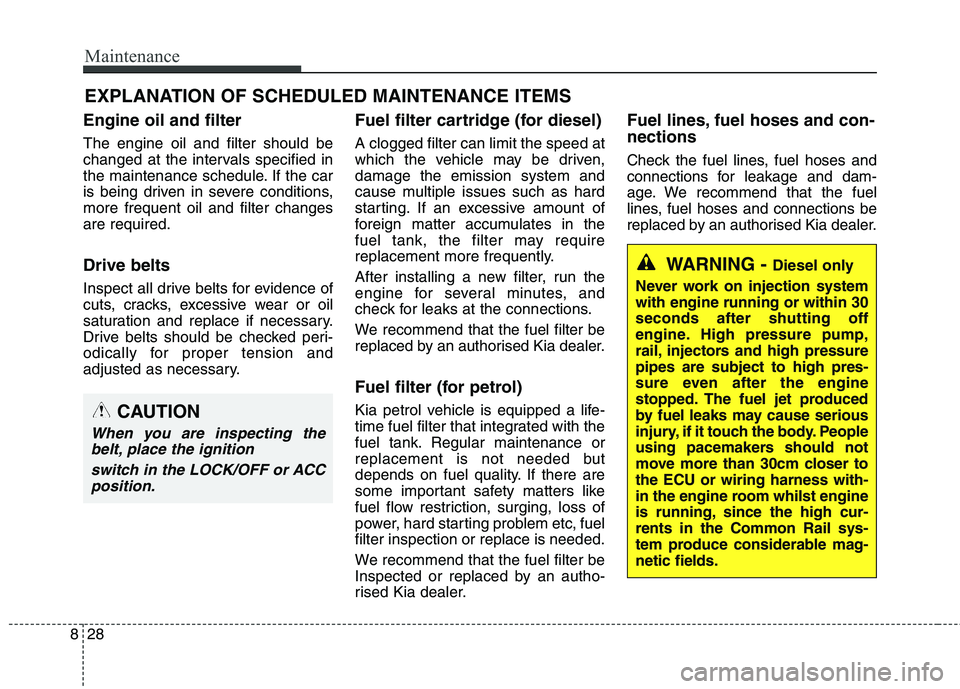
Maintenance
28
8
EXPLANATION OF SCHEDULED MAINTENANCE ITEMS
Engine oil and filter The engine oil and filter should be
changed at the intervals specified in
the maintenance schedule. If the car
is being driven in severe conditions,more frequent oil and filter changesare required. Drive belts
Inspect all drive belts for evidence of
cuts, cracks, excessive wear or oil
saturation and replace if necessary.
Drive belts should be checked peri-
odically for proper tension and
adjusted as necessary. Fuel filter cartridge (for diesel) A clogged filter can limit the speed at
which the vehicle may be driven,damage the emission system and
cause multiple issues such as hard
starting. If an excessive amount of
foreign matter accumulates in the
fuel tank, the filter may require
replacement more frequently.
After installing a new filter, run the
engine for several minutes, and
check for leaks at the connections.
We recommend that the fuel filter be
replaced by an authorised Kia dealer.
Fuel filter (for petrol)
Kia petrol vehicle is equipped a life-
time fuel filter that integrated with the
fuel tank. Regular maintenance or
replacement is not needed but
depends on fuel quality. If there are
some important safety matters like
fuel flow restriction, surging, loss of
power, hard starting problem etc, fuelfilter inspection or replace is needed.
We recommend that the fuel filter be
Inspected or replaced by an autho-
rised Kia dealer.Fuel lines, fuel hoses and con- nections
Check the fuel lines, fuel hoses and
connections for leakage and dam-
age. We recommend that the fuel
lines, fuel hoses and connections be
replaced by an authorised Kia dealer.
WARNING -
Diesel only
Never work on injection system with engine running or within 30seconds after shutting off
engine. High pressure pump,
rail, injectors and high pressurepipes are subject to high pres-
sure even after the engine
stopped. The fuel jet produced
by fuel leaks may cause serious
injury, if it touch the body. People
using pacemakers should not
move more than 30cm closer tothe ECU or wiring harness with-
in the engine room whilst engine
is running, since the high cur-rents in the Common Rail sys-
tem produce considerable mag-netic fields.
CAUTION
When you are inspecting the belt, place the ignition
switch in the LOCK/OFF or ACCposition.