Page 362 of 516

Tire Service Kit Usage Precautions
WARNING!
•Do not attempt to seal a tire on the side of the vehicle
closest to traffic. Pull far enough off the road to avoid
the danger of being hit when using the Tire Service
Kit.
• Do not use Tire Service Kit or drive the vehicle under
the following circumstances:
– If the puncture in the tire tread is approximately 1/4 inch (6 mm) or larger.
– If the tire has any sidewall damage.
– If the tire has any damage from driving with extremely low tire pressure.
– If the tire has any damage from driving on a flat tire.
– If the wheel has any damage.
– If you are unsure of the condition of the tire or the wheel.
• Keep Tire Service Kit away from open flames or heat
source.
• A loose Tire Service Kit thrown forward in a collision
or hard stop could endanger the occupants of the
(Continued)
WARNING! (Continued)
vehicle. Always stow the Tire Service Kit in the place
provided. Failure to follow these warnings can result
in injuries that are serious or fatal to you, your
passengers, and others around you.
• Take care not to allow the contents of Tire Service Kit
to come in contact with hair, eyes, or clothing. Tire
Service Kit sealant is harmful if inhaled, swallowed,
or absorbed through the skin. It causes skin, eye, and
respiratory irritation. Flush immediately with plenty
of water if there is any contact with eyes or skin.
Change clothing as soon as possible, if there is any
contact with clothing.
• Tire Service Kit Sealant solution contains latex. In
case of an allergic reaction or rash, consult a physi-
cian immediately. Keep Tire Service Kit out of reach
of children. If swallowed, rinse mouth immediately
with plenty of water and drink plenty of water. Do
not induce vomiting! Consult a physician immedi-
ately.
Replacing The Sealant
NOTE: Replace the sealant canister prior to the expiration
date at your authorized dealer.
360 IN CASE OF EMERGENCY
Page 368 of 516
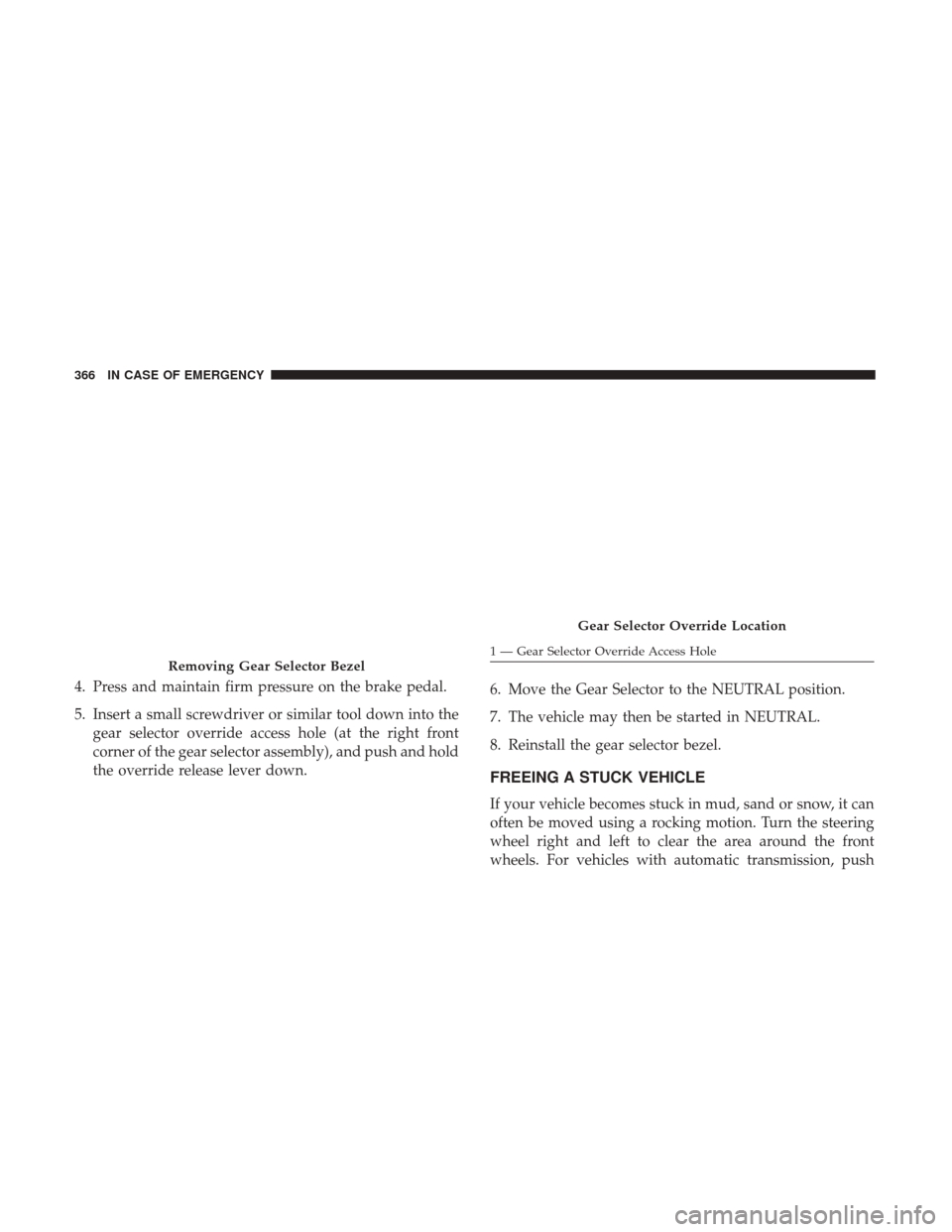
4. Press and maintain firm pressure on the brake pedal.
5. Insert a small screwdriver or similar tool down into thegear selector override access hole (at the right front
corner of the gear selector assembly), and push and hold
the override release lever down. 6. Move the Gear Selector to the NEUTRAL position.
7. The vehicle may then be started in NEUTRAL.
8. Reinstall the gear selector bezel.
FREEING A STUCK VEHICLE
If your vehicle becomes stuck in mud, sand or snow, it can
often be moved using a rocking motion. Turn the steering
wheel right and left to clear the area around the front
wheels. For vehicles with automatic transmission, push
Removing Gear Selector Bezel
Gear Selector Override Location
1 — Gear Selector Override Access Hole
366 IN CASE OF EMERGENCY
Page 369 of 516

and hold the lock button on the gear selector. Then shift
back and forth between DRIVE and REVERSE (with auto-
matic transmission) or SECOND GEAR and REVERSE
(with manual transmission), while gently pressing the
accelerator.
Use the least amount of accelerator pedal pressure that will
maintain the rocking motion without spinning the wheels
or racing the engine.
For Vehicles With Automatic Transmission:
Shifts between DRIVE and REVERSE can only be achieved
at wheel speeds of 5 mph (8 km/h) or less. Whenever the
transmission remains in NEUTRAL for more than two
seconds, you must press the brake pedal to engage DRIVE
or REVERSE.
NOTE:Push the �ESC Off� switch (if necessary), to place
the Electronic Stability Control (ESC) system in �Partial Off�
mode, before rocking the vehicle. Refer to “Electronic
Brake Control” in “Safety” for further information. Once
the vehicle has been freed, push the �ESC Off�switch again
to restore �ESC On�mode.WARNING!
Fast spinning tires can be dangerous. Forces generated
by excessive wheel speeds may cause damage, or even
failure, of the axle and tires. A tire could explode and
injure someone. Do not spin your vehicle’s wheels
faster than 30 mph (48 km/h) or for longer than 30
seconds continuously without stopping when you are
stuck and do not let anyone near a spinning wheel, no
matter what the speed.
CAUTION!
•Racing the engine or spinning the wheels may lead
to transmission overheating and failure. Allow the
engine to idle with the transmission in NEUTRAL
for at least one minute after every five rocking-
motion cycles. This will minimize overheating and
reduce the risk of clutch or transmission failure
during prolonged efforts to free a stuck vehicle.
• When “rocking” a stuck vehicle by shifting between
DRIVE/ SECOND gear and REVERSE, do not spin
the wheels faster than 15 mph (24 km/h), or drive-
train damage may result.
(Continued)
7
IN CASE OF EMERGENCY 367
Page 370 of 516
CAUTION!(Continued)
•Revving the engine or spinning the wheels too fast
may lead to transmission overheating and failure. It
can also damage the tires. Do not spin the wheels
above 30 mph (48 km/h) while in gear (no transmis-
sion shifting occurring).
TOWING A DISABLED VEHICLE
This section describes procedures for towing a disabled
vehicle using a commercial towing service.
Towing Condition Wheels OFF The Ground FWD MODELS
FOUR WHEEL DRIVE
Flat Tow NONE NOT ALLOWED NOT ALLOWED
Wheel Lift Or Dolly Tow Rear
NOT ALLOWED NOT ALLOWED
Front OK NOT ALLOWED
Flatbed ALLBEST METHOD OK
368 IN CASE OF EMERGENCY
Page 371 of 516

Proper towing or lifting equipment is required to prevent
damage to your vehicle. Use only tow bars and other
equipment designed for this purpose, following equipment
manufacturer ’s instructions. Use of safety chains is man-
datory. Attach a tow bar or other towing device to main
structural members of the vehicle, not to bumpers or
associated brackets. State and local laws regarding vehicles
under tow must be observed.
NOTE:
•Vehicles with a discharged battery or total electrical
failure when the Electric Park Brake (EPB) is engaged,
will need a wheel dolly or jack to raise the rear wheels
off the ground when moving the vehicle onto a flatbed.
• You must ensure that the Auto Park Brake feature is
disabled before towing this vehicle, to avoid inadvertent
Electric Park Brake engagement. The Auto Park Brake
feature is enabled or disabled via the customer program-
mable features in the Uconnect Settings.
If you must use the accessories (wipers, defrosters, etc.)
while being towed, the ignition must be in the RUN mode.
If the key fob is unavailable, or the vehicle’s battery is
discharged, refer to “Gear Selector Override” in this section for instructions on shifting the transmission out of PARK so
that the vehicle can be moved.
CAUTION!
•
Do not use sling type equipment when towing.
Vehicle damage may occur.
• When securing the vehicle to a flat bed truck, do not
attach to front or rear suspension components. Dam-
age to your vehicle may result from improper towing.
Front Wheel Drive (FWD)
The manufacturer recommends towing your vehicle with
all four wheels OFF the ground on a flatbed.
If flatbed equipment is not available, this vehicle must
towed with the front wheels OFF the ground (using a
towing dolly, or wheel lift equipment with the front wheels
raised).
NOTE: Ensure that the Electric Park Brake is released, and
remains released, while being towed.
7
IN CASE OF EMERGENCY 369
Page 372 of 516

CAUTION!
Towing this vehicle in violation of the above require-
ments can cause severe transmission damage. Damage
from improper towing is not covered under the New
Vehicle Limited Warranty.
Four-Wheel Drive (4WD)
The manufacturer requires towing with all four wheels
OFF the ground. Acceptable methods are to tow the vehicle
on a flatbed, or with one end of the vehicle raised and the
opposite end on a towing dolly.
CAUTION!
•DO NOT tow this vehicle with ANY of its wheels on
the ground. Damage to the drivetrain will result.
•
Front or rear wheel lifts must not be used. Internal
damage to the transmission or power transfer unit will
occur if a front or rear wheel lift is used when towing.
• Towing this vehicle in violation of the above require-
ments can cause severe transmission and/or power
transfer unit damage. Damage from improper towing
is not covered under the New Vehicle Limited War-
ranty.
Emergency Tow Hooks — If Equipped
If your vehicle is equipped with tow hooks, there will be
one in the rear and two mounted on the front of the vehicle.
The rear hook will be located on the driver’s side of the
vehicle.
NOTE: For off-road recovery, it is recommended to use
both of the front tow hooks to minimize the risk of damage
to the vehicle.
Front Tow Hook Locations
370 IN CASE OF EMERGENCY
Page 375 of 516

SERVICING AND MAINTENANCE
CONTENTS
�SCHEDULED SERVICING .................375
▫ Maintenance Plan ...................... .376
� ENGINE COMPARTMENT .................382
▫ 1.4L Turbo Engine ..................... .382
▫ 2.4L Engine .......................... .383
▫ Checking Oil Level .....................383
▫ Cooling System ....................... .384
▫ Adding Washer Fluid ...................385
▫ Maintenance-Free Battery .................385
� DEALER SERVICE ...................... .386
▫ Engine Oil .......................... .386
▫ Engine Oil Filter ...................... .388
▫ Engine Air Cleaner Filter .................388
▫ Air Conditioner Maintenance ..............389▫
Body Lubrication ..................... .390
▫ Windshield Wiper Blades .................390
▫ Exhaust System ....................... .392
▫ Cooling System ....................... .393
▫ Brake System ........................ .398
▫ Manual Transmission — If Equipped ........400
▫ Automatic Transmission — If Equipped ......400
� RAISING THE VEHICLE ..................402
� TIRES ............................... .403
▫ Tire Safety Information ..................403
▫ Tires — General Information ..............410
▫ Tire Types ........................... .416
▫ Spar
e Tires — If Equipped ................418
▫ Wheel And Wheel Trim Care ..............419
8
Page 416 of 516
See the tire pressure monitoring section for more informa-
tion.
Tire Spinning
When stuck in mud, sand, snow, or ice conditions, do not
spin your vehicle’s wheels above 30 mph (48 km/h) or for
longer than 30 seconds continuously without stopping.
Refer to “Freeing A Stuck Vehicle” in “In Case Of Emer-
gency” for further information.
WARNING!
Fast spinning tires can be dangerous. Forces generated
by excessive wheel speeds may cause tire damage or
failure. A tire could explode and injure someone. Do
not spin your vehicle’s wheels faster than 30 mph
(48 km/h) for more than 30 seconds continuously when
you are stuck, and do not let anyone near a spinning
wheel, no matter what the speed.
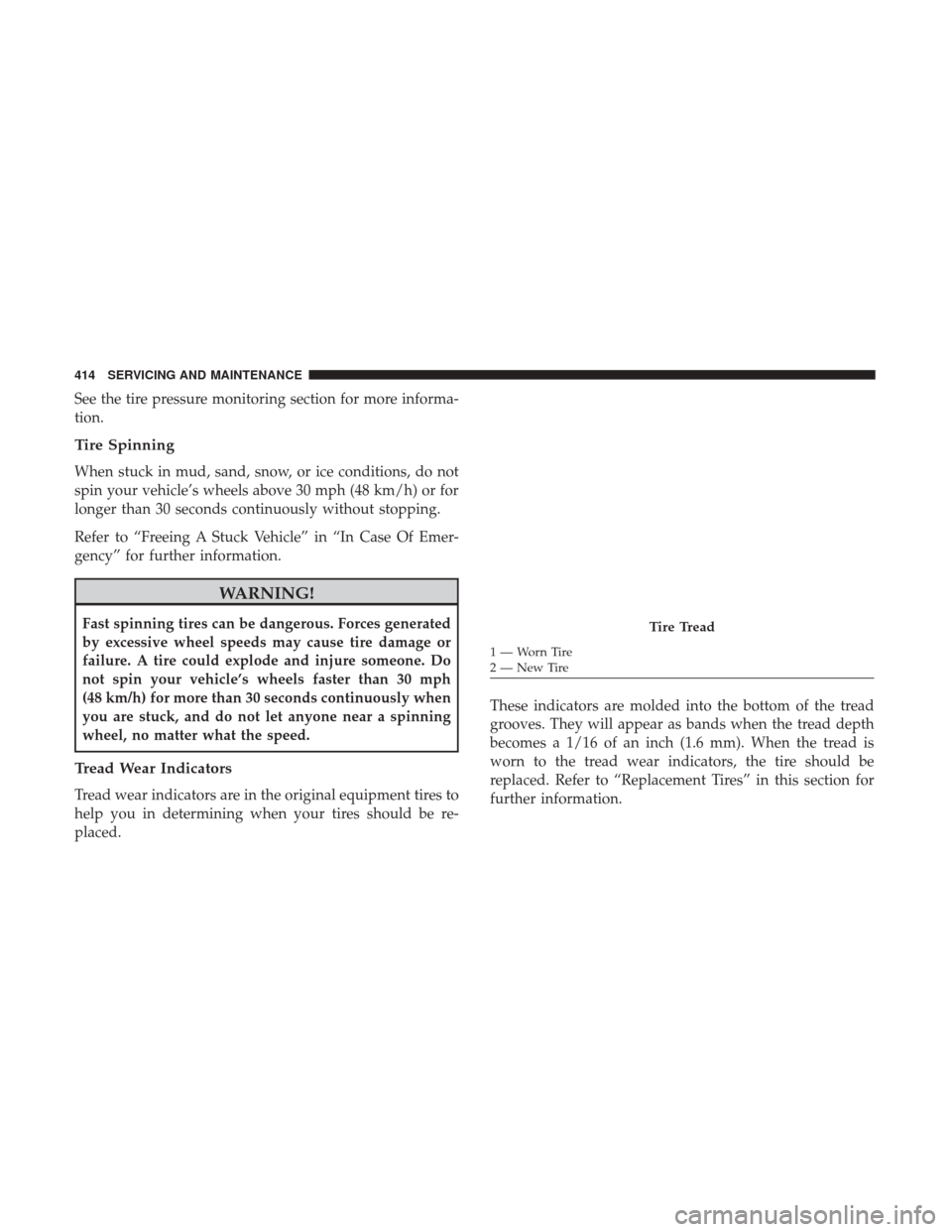
Tread Wear Indicators
Tread wear indicators are in the original equipment tires to
help you in determining when your tires should be re-
placed.These indicators are molded into the bottom of the tread
grooves. They will appear as bands when the tread depth
becomes a 1/16 of an inch (1.6 mm). When the tread is
worn to the tread wear indicators, the tire should be
replaced. Refer to “Replacement Tires” in this section for
further information.
Tire Tread
1—WornTire
2—NewTire
414 SERVICING AND MAINTENANCE