Page 348 of 516
CavityMini FuseDescription
F31 7.5 Amp BrownFlashes/Electrical Movement Front
Seats/Fan Air Conditioning
F33 20 Amp YellowPower Window Front (Driver Side)
F34 20 Amp YellowPower Window Front (Passenger
Side)
F36 15 Amp BlueSupply Uconnect System, Air Condi-
tioning, Alarm, Power Folding Out-
side Mirrors, USB Port
F37 10 Amp RedSystem Power Forward Collision
Warning Plus, All Wheel Drive
(AWD), IPC
F38 20 Amp YellowCentral Locking
F42 7.5 Amp BrownPower Under Lock and Key
F43 20 Amp YellowBi-directional Pump Washer
F47 20 Amp YellowPower Rear Window (Driver Side)
F48 20 Amp YellowPower Rear Window (Passenger Side)
F49 7.5 Amp BrownSupply ParkSense, Spot Lights Front
Dome, Mirror, Electric Motor Retract-
able Roof, Heated Front Seats, Stabi-
lizer Battery, ESC System, ESL
F50 7.5 Amp BrownSupply Air Bag
346 IN CASE OF EMERGENCY
Page 358 of 516

6. Remove the wheel bolts and tire.
7. Mount the spare tire.
CAUTION!
Be sure to mount the spare tire with the valve stem
facing outward. The vehicle could be damaged if the
spare tire is mounted incorrectly.NOTE:
•Your vehicle may be equipped with a compact spare
tire or a limited — use spare tire. For further informa-
tion refer to “Tires — General Information” in “Servic-
ing And Maintenance”.
• For vehicles so equipped, do not attempt to install a
center cap or wheel cover on the compact spare.
8. Install the wheel bolts with the threaded end of the wheel bolt toward the wheel. Lightly tighten the wheel
bolts.
WARNING!
To avoid the risk of forcing the vehicle off the jack, do
not fully tighten the wheel bolts until the vehicle has
been lowered. Failure to follow this warning may
result in serious injury.
9. Lower the vehicle to the ground by turning the jack handle counterclockwise.
10. Finish tightening the wheel bolts. Push down on the wrench while at the end of the handle for increased
leverage. Tighten the wheel bolts in a star pattern until
each wheel bolt has been tightened twice. Refer to
Mounting Spare Tire
356 IN CASE OF EMERGENCY
Page 359 of 516
“Torque Specifications” in “Technical Specifications”
for the proper lug bolt torque. If in doubt about the
correct tightness, have them checked with a torque
wrench by your authorized dealer or at a service
station.
11. Securely stow the jack, tools, chocks, and flat tire.WARNING!
A loose tire or jack thrown forward in a collision or
hard stop could endanger the occupants of the vehicle.
Always stow the jack parts and the spare tire in the
places provided. Have the deflated (flat) tire repaired
or replaced immediately.
Road Tire Installation
1. Mount the road tire on the axle.
2. Install the remaining wheel bolts with the threaded end of the wheel bolt toward the wheel. Lightly tighten the
wheel bolts.
WARNING!
To avoid the risk of forcing the vehicle off the jack, do
not fully tighten the wheel bolts until the vehicle has
been lowered. Failure to follow this warning may
result in serious injury.
Properly Stowed Tire
7
IN CASE OF EMERGENCY 357
Page 364 of 516
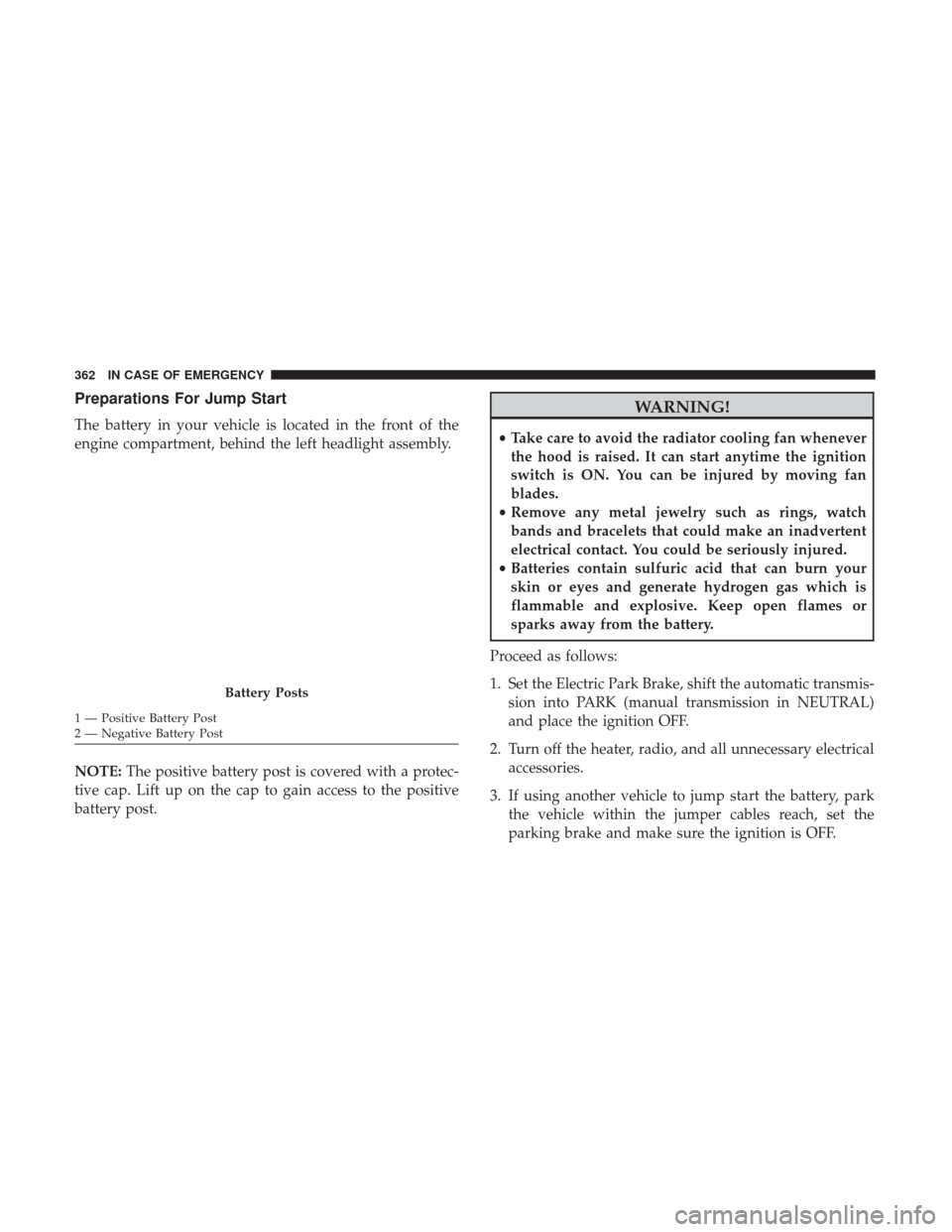
Preparations For Jump Start
The battery in your vehicle is located in the front of the
engine compartment, behind the left headlight assembly.
NOTE:The positive battery post is covered with a protec-
tive cap. Lift up on the cap to gain access to the positive
battery post.
WARNING!
• Take care to avoid the radiator cooling fan whenever
the hood is raised. It can start anytime the ignition
switch is ON. You can be injured by moving fan
blades.
• Remove any metal jewelry such as rings, watch
bands and bracelets that could make an inadvertent
electrical contact. You could be seriously injured.
• Batteries contain sulfuric acid that can burn your
skin or eyes and generate hydrogen gas which is
flammable and explosive. Keep open flames or
sparks away from the battery.
Proceed as follows:
1. Set the Electric Park Brake, shift the automatic transmis- sion into PARK (manual transmission in NEUTRAL)
and place the ignition OFF.
2. Turn off the heater, radio, and all unnecessary electrical accessories.
3. If using another vehicle to jump start the battery, park the vehicle within the jumper cables reach, set the
parking brake and make sure the ignition is OFF.
Battery Posts
1 — Positive Battery Post
2 — Negative Battery Post 362 IN CASE OF EMERGENCY
Page 379 of 516
Mileage or time passed
(whichever comes first)
10,000
20,000
30,000
40,000
50,000
60,000
70,000
80,000
90,000
100,000
110,000
120,000
130,000
140,000
150,000
Or Years: 1 2 3 4 5 6 7 8 9 10 11 12 13 14 15
Or Kilometers:
16,000
32,000
48,000
64,000
80,000
96,000
112,000
128,000
144,000
160,000
176,000
192,000
208,000
224,000
240,000
Check operation of lighting sys-
tem (headlamps, direction indi-
cators, hazard warning lights,
luggage compartment, passen-
ger compartment, glove com-
partment, instrument panel
warning lights, etc.). •••••••••••••••
Check and, if necessary, top up
fluid levels (brakes/hydraulic
clutch, windshield washer, bat-
tery, engine coolant, etc.). •••••••••••••••
Check engine control system
operation (via diagnostic tool). •••••••••••••••
Visually inspect condition of:
exterior bodywork, underbody
protection, pipes and hoses (ex-
haust - fuel system - brakes),
rubber elements (boots,
sleeves, bushings, etc.). •••• • • •
8
SERVICING AND MAINTENANCE 377
Page 383 of 516

* The oil and oil filter replacement must be carried out
when indicated by a warning light or message on the
instrument panel, or in any case should not exceed 1 year
or 10,000 miles (16,000 km).
** The spark plug change is distance based only, yearly
intervals do not apply. The following are essential to ensure
correct operation and prevent serious damage to the en-
gine:
•Only use spark plugs of the same make and type which
are specially certified for such engines (refer to “Fluids
and Lubricants” in “Technical Specifications” for further
information).
• Strictly comply with the spark plug replacement interval
given in the “Maintenance Schedule” for spark plug
replacement.
• Contact your authorized dealer if you have any ques-
tions.
*** The brake fluid change interval is time based only,
mileage intervals do not apply.WARNING!
• You can be badly injured working on or around a
motor vehicle. Do only service work for which you
have the knowledge and the right equipment. If you
have any doubt about your ability to perform a
service job, take your vehicle to a competent me-
chanic.
• Failure to properly inspect and maintain your vehicle
could result in a component malfunction and effect
vehicle handling and performance. This could cause
an accident.
8
SERVICING AND MAINTENANCE 381
Page 400 of 516

MS.90032) and distilled water for proper corrosion pro-
tection of your engine which contains aluminum com-
ponents.
• Keep the front of the radiator clean. If your vehicle is
equipped with air conditioning, keep the front of the
condenser clean.
• Do not change the thermostat for Summer or Winter
operation. If replacement is ever necessary, install ONLY
the correct type thermostat. Other designs may result in
unsatisfactory engine coolant (antifreeze) performance,
poor gas mileage, and increased emissions.
Brake System
In order to assure brake system performance, all brake
system components should be inspected periodically. Refer
to the “Maintenance Plan” in this section for the proper
maintenance intervals.
WARNING!
Riding the brakes can lead to brake failure and possi-
bly a collision. Driving with your foot resting or riding
on the brake pedal can result in abnormally high brake
(Continued)
WARNING! (Continued)
temperatures, excessive lining wear, and possible
brake damage. Riding the brakes may also reduce
braking capacity in an emergency.
Brake Master Cylinder
The fluid level in the master cylinder should be checked
when performing under hood services, or immediately if
the “Brake Warning Light” is on.
Be sure to clean the top of the master cylinder area before
removing the cap. If necessary, add fluid to bring the fluid
level up to the requirements described on the brake fluid
reservoir. Fluid level can be expected to fall as the brake
pads wear. The brake fluid level should be checked when
the pads are replaced. However, low fluid level may be
caused by a leak and a checkup may be needed.
398 SERVICING AND MAINTENANCE
Page 417 of 516

Life Of Tire
The service life of a tire is dependent upon varying factors
including, but not limited to:
•Driving style.
• Tire pressure - Improper cold tire inflation pressures can
cause uneven wear patterns to develop across the tire
tread. These abnormal wear patterns will reduce tread
life, resulting in the need for earlier tire replacement.
• Distance driven.
• Performance tires, tires with a speed rating of V or
higher, and Summer tires typically have a reduced tread
life. Rotation of these tires per the vehicle maintenance
schedule is highly recommended.
WARNING!
Tires and the spare tire should be replaced after six
years, regardless of the remaining tread. Failure to
follow this warning can result in sudden tire failure.
You could lose control and have a collision resulting in
serious injury or death. Keep dismounted tires in a cool, dry place with as little
exposure to light as possible. Protect tires from contact with
oil, grease, and gasoline.
Replacement Tires
The tires on your new vehicle provide a balance of many
characteristics. They should be inspected regularly for
wear and correct cold tire inflation pressures. The manu-
facturer strongly recommends that you use tires equivalent
to the originals in size, quality and performance when
replacement is needed. Refer to the paragraph on “Tread
Wear Indicators” in this section. Refer to the Tire and
Loading Information placard or the Vehicle Certification
Label for the size designation of your tire. The Load Index
and Speed Symbol for your tire will be found on the
original equipment tire sidewall.
See the Tire Sizing Chart example found in the “Tire Safety
Information” section of this manual for more information
relating to the Load Index and Speed Symbol of a tire.
It is recommended to replace the two front tires or two rear
tires as a pair. Replacing just one tire can seriously affect
your vehicle’s handling. If you ever replace a wheel, make
sure that the wheel’s specifications match those of the
original wheels.
8
SERVICING AND MAINTENANCE 415


