Page 268 of 429

WARNING!
Tire Service Kit is not a permanent flat tire repair. Have
the tire inspected and repaired or replaced after using
Tire Service Kit. Do not exceed 55 mph (90 km/h) until
the tire is repaired or replaced. Failure to follow this
warning can result in injuries that are serious or fatal
to you, your passengers, and others around you.
(E) After Driving:
Pull over to a safe location. Refer to “Whenever You Stop to
Use Tire Service Kit” before continuing.
1. Push in the Mode Select Knob (5) and turn to the AirMode position.
2. Uncoil the power plug and insert the plug into the vehicle’s 12 Volt power outlet.
3. Uncoil the Air Pump Hose (7) (black in color) and screw the fitting at the end of hose (7) onto the valve stem.
4. Check the pressure in the tire by reading the Pressure Gauge (3). If tire pressure is less than 19 psi (1.3 Bar):
The tire is too badly damaged. Do not attempt to drive the
vehicle further. Call for assistance.
If the tire pressure is 19 psi (1.3 Bar) or higher:
1. Push the Power Button (4) to turn on Tire Service Kit
and inflate the tire to the pressure indicated on the tire
and loading information label on the driver-side door
opening.
NOTE: If the tire becomes over-inflated, push the Deflation
Button to reduce the tire pressure to the recommended
inflation pressure before continuing.
2. Disconnect the Tire Service Kit from the valve stem, reinstall the cap on the valve stem and unplug from 12
Volt outlet.
3. Place the Tire Service Kit in its proper storage area in the vehicle.
4. Have the tire inspected and repaired or replaced at the earliest opportunity at an authorized dealer or tire
service center.
5. Remove the Speed Limit sticker from the instrument panel after the tire has been repaired.
266 IN CASE OF EMERGENCY
Page 269 of 429

6. Replace the Sealant Bottle (1) and Sealant Hose (6)assembly at your authorized dealer as soon as possible.
Refer to (F) “Sealant Bottle and Hose Replacement”.
NOTE: When having the tire serviced, advise the autho-
rized dealer or service center that the tire has been sealed
using the Tire Service Kit.
(F) Sealant Bottle And Hose Replacement:
1. Uncoil the Sealant Hose (6) (clear in color).
2. Locate the round Sealant Bottle release button in the recessed area under the sealant bottle.
3. Push the Sealant Bottle release button. The Sealant Bottle (1) will pop up. Remove the bottle and dispose of it
accordingly.
4. Clean any remaining sealant from the Tire Service Kit housing.
5. Position the new Sealant Bottle (1) in the housing so that the Sealant Hose (6) aligns with the hose slot in the front
of the housing. Push the bottle into the housing. An
audible click will be heard indicating the bottle is locked
into place. 6. Verify that the cap is installed on the fitting at the end of
the Sealant Hose (6) and return the hose to its storage
area (located on the bottom of the air pump).
7. Return the Tire Service Kit to its storage location in the vehicle.
JUMP-STARTING PROCEDURES
If your vehicle has a discharged battery, it can be jump-
started using a set of jumper cables and a battery in another
vehicle or by using a portable battery booster pack. Jump-
starting can be dangerous if done improperly so please
follow the procedures in this section carefully.
NOTE: When using a portable battery booster pack follow
the manufacturer ’s operating instructions and precautions.
WARNING!
Do not attempt jump-starting if the battery is frozen. It
could rupture or explode and cause personal injury.
7
IN CASE OF EMERGENCY 267
Page 279 of 429
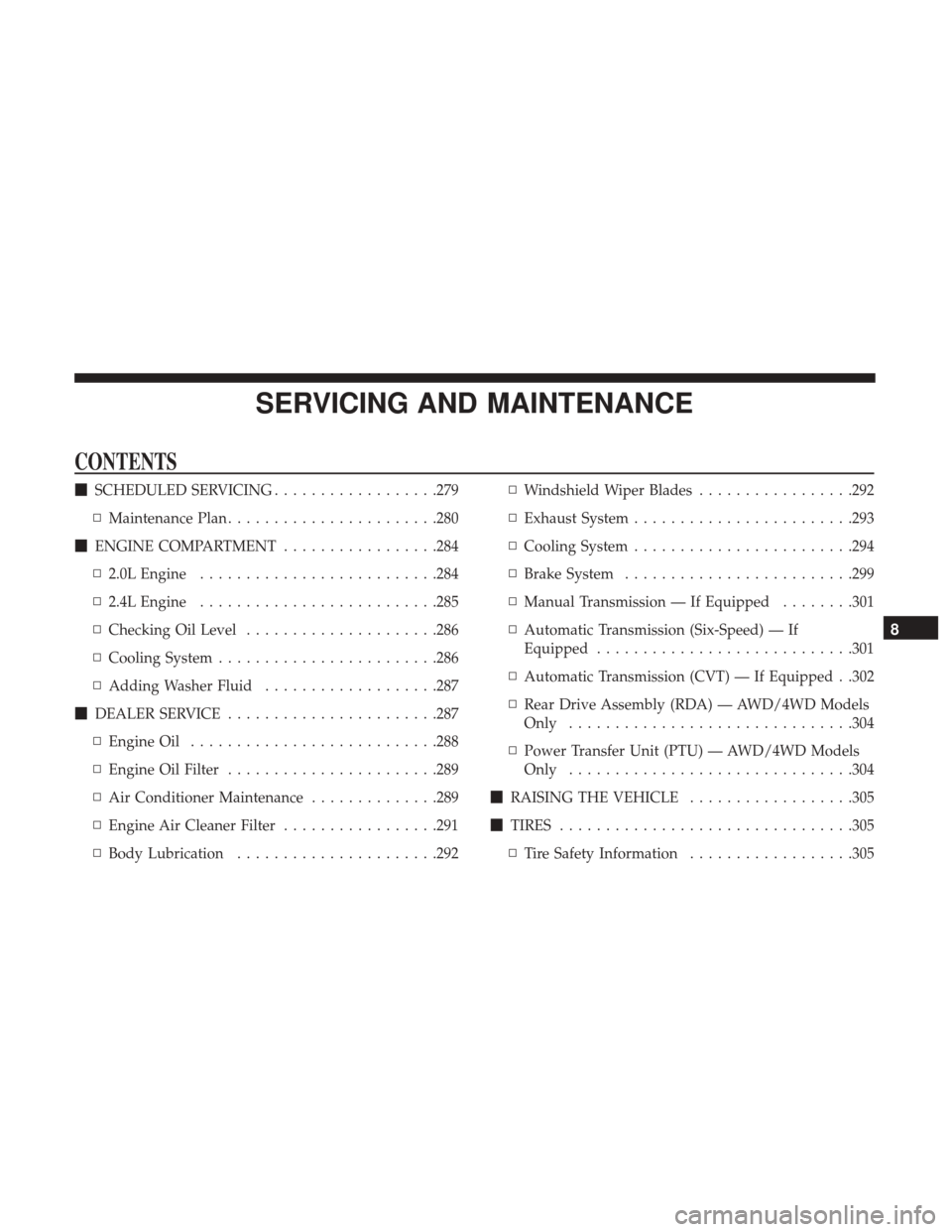
SERVICING AND MAINTENANCE
CONTENTS
�SCHEDULED SERVICING ..................279
▫ Maintenance Plan .......................280
� ENGINE COMPARTMENT .................284
▫ 2.0L Engine ..........................284
▫ 2.4L Engine ..........................285
▫ Checking Oil Level .....................286
▫ Cooling System ........................286
▫ Adding Washer Fluid ...................287
� DEALER SERVICE .......................287
▫ Engine Oil .......................... .288
▫ Engine Oil Filter .......................289
▫ Air Conditioner Maintenance ..............289
▫ Engine Air Cleaner Filter .................291
▫ Body Lubrication ..................... .292▫
Windshield Wiper Blades .................292
▫ Exhaust System ........................293
▫ Cooling System ........................294
▫ Brake System ........................ .299
▫ Manual Transmission — If Equipped ........301
▫ Automatic Transmission (Six-Speed) — If
Equipped ............................301
▫ Automatic Transmission (CVT) — If Equipped . .302
▫ Rear Drive Assembly (RDA) — AWD/4WD Models
Only ...............................304
▫ Power Transfer Unit (PTU) — AWD/4WD Models
Only ...............................304
� RAISING THE VEHICLE ..................305
� TIRES ............................... .305
▫ Tire Safety Information ..................305
8
Page 281 of 429

SCHEDULED SERVICING
Your vehicle is equipped with an automatic oil change
indicator system. The oil change indicator system will
remind you that it is time to take your vehicle in for
scheduled maintenance.
Based on engine operation conditions, the oil change
indicator message will illuminate. This means that service
is required for your vehicle. Operating conditions such as
frequent short-trips, trailer tow, extremely hot or cold
ambient temperatures will influence when the “Change
Oil” or “Oil Change Required” message is displayed.
Severe Operating Conditions can cause the change oil
message to illuminate as early as 3,500 miles (5,600 km)
since last reset. Have your vehicle serviced as soon as
possible, within the next 500 miles (805 km).
On instrument cluster display equipped vehicles, “Oil
Change Required” will be displayed in the cluster and a
single chime will sound, indicating that an oil change is
necessary.
On non-instrument cluster display equipped vehicles,
“Change Oil” will flash in the odometer and a single chime
will sound, indicating that an oil change is necessary.Your authorized dealer will reset the oil change indicator
message after completing the scheduled oil change. If a
scheduled oil change is performed by someone other than
your authorized dealer, the message can be reset by
referring to the steps described under “Warning And
Indicator Lights” or “Instrument Cluster Display” in “Get-
ting To Know Your Instrument Panel” for further informa-
tion.
NOTE:
Under no circumstances should oil change inter-
vals exceed 10,000 miles (16,000 km), twelve months or 350
hours of engine run time, whichever comes first. The 350
hours of engine run or idle time is generally only a concern
for fleet customers.
Severe Duty All Models
Change Engine Oil at 4,000 miles (6,500 km) if the vehicle
is operated in a dusty and off road environment or is
operated predominately at idle or only very low engine
RPM’s. This type of vehicle use is considered Severe Duty.
8
SERVICING AND MAINTENANCE 279
Page 282 of 429

Once A Month Or Before A Long Trip:
•Check engine oil level
• Check windshield washer fluid level
• Check the tire inflation pressures and look for unusual
wear or damage
• Check the fluid levels of the coolant reservoir, brake
master cylinder, power steering and fill as needed
• Check function of all interior and exterior lights
Maintenance Plan
Required Maintenance Intervals.
Refer to the “Maintenance Plan” on the following pages for
the required maintenance intervals.
At Every Oil Change Interval As Indicated By Oil
Change Indicator System:
•Change oil and filter.
• Rotate the tires. Rotate at the first sign of irregular
wear, even if it occurs before the oil indicator
system turns on.
• Inspect battery and clean and tighten terminals as
required.
• Inspect brake pads, shoes, rotors, drums, hoses and
park brake.
• Inspect engine cooling system protection and hoses.
• Inspect exhaust system.
• Inspect engine air cleaner if using in dusty or
off-road conditions.
280 SERVICING AND MAINTENANCE
Page 286 of 429
ENGINE COMPARTMENT
2.0L Engine
1 — Washer Fluid Reservoir6 — Air Cleaner Filter
2 — Power Steering Fluid Reservoir 7 — Battery
3 — Engine Oil Fill 8 — Coolant Pressure Cap
4 — Brake Fluid Reservoir 9 — Engine Oil Dipstick
5 — Integrated Power Module (Fuses) 10 — Engine Coolant Reservoir
284 SERVICING AND MAINTENANCE
Page 287 of 429
2.4L Engine
1 — Washer Fluid Reservoir6 — Air Cleaner Filter
2 — Power Steering Fluid Reservoir 7 — Battery
3 — Engine Oil Fill 8 — Coolant Pressure Cap
4 — Brake Fluid Reservoir 9 — Engine Oil Dipstick
5 — Integrated Power Module (Fuses) 10 — Engine Coolant Reservoir
8
SERVICING AND MAINTENANCE 285
Page 288 of 429

Checking Oil Level
To assure proper engine lubrication, the engine oil must be
maintained at the correct level. Check the oil level at
regular intervals, such as every fuel stop. The best time to
check the engine oil level is about five minutes after a fully
warmed engine is shut off. Do not check oil level before
starting the engine after it has sat overnight. Checking
engine oil level when the engine is cold will give you an
incorrect reading.
Checking the oil while the vehicle is on level ground and
only when the engine is hot, will improve the accuracy of
the oil level readings. Maintain the oil level between the
range markings on the dipstick. The range markings will
consist of a crosshatch zone which depicts the MIN at the
low end of the range and MAX at the high end of the range.
Adding 1 quart (1 liter) of oil when the reading is at the low
end of the indicated range will result in the oil level at the
full end of the indicator range.
CAUTION!
Do not overfill the engine. Overfilling the engine will
cause oil aeration, which can lead to loss of oil pressure
and an increase in oil temperature. This could damage
your engine. Also, be sure the oil fill cap is replaced
and tightened after adding oil.
Cooling System
WARNING!
•When working near the radiator cooling fan, discon-
nect the fan motor lead or turn the ignition switch to
the OFF position. The fan is temperature controlled
and can start at any time the ignition switch is in the
ON position.
• You or others can be badly burned by hot engine
coolant (antifreeze) or steam from your radiator. If
you see or hear steam coming from under the hood,
do not open the hood until the radiator has had time
to cool. Never try to open a cooling system pressure
cap when the radiator is hot.
286 SERVICING AND MAINTENANCE

