Page 241 of 429
![JEEP COMPASS 2017 2.G Owners Manual low (L Off-Road [if equipped]) with the 4WD LOCK
engaged and proceed with caution maintaining your mo-
mentum as you climb the hill.
Driving Up Hill
Once you have determined your ability to proceed an](/manual-img/16/7084/w960_7084-240.png "JEEP COMPASS 2017 2.G Owners Manual low (L Off-Road [if equipped]) with the 4WD LOCK
engaged and proceed with caution maintaining your mo-
mentum as you climb the hill.
Driving Up Hill
Once you have determined your ability to proceed an")
low (L Off-Road [if equipped]) with the 4WD LOCK
engaged and proceed with caution maintaining your mo-
mentum as you climb the hill.
Driving Up Hill
Once you have determined your ability to proceed and
have shifted into the appropriate gear, line your vehicle up
for the straightest possible run. Accelerate with an easy
constant throttle and apply more power as you start up the
hill. Do not race forward into a steep grade; the abrupt
change of grade could cause you to lose control. If the front
end begins to bounce, ease off the throttle slightly to bring
all four tires back on the ground. As you approach the crest
of the hill, ease off the throttle and slowly proceed over the
top. If the wheels start to slip as you approach the crest of
a hill, ease off the accelerator and maintain headway by
turning the steering wheel no more than a 1/4 turn quickly
back and forth. This will provide a fresh�bite�into the
surface and will usually provide enough traction to com-
plete the climb. If you do not make it to the top, place the
vehicle in REVERSE and back straight down the grade
using engine resistance along with the vehicle brakes.WARNING!
Never attempt to climb a hill at an angle or turn around
on a steep grade. Driving across an incline increases
the risk of a rollover, which may result in severe injury.
Driving Down Hill
Before driving down a steep hill you need to determine if
it is too steep for a safe descent. What is the surface
traction? Is the grade too steep to maintain a slow con-
trolled descent? Are there obstacles? Is it a straight descent?
Is there plenty of distance at the base of the hill to regain
control if the vehicle descends to fast? If you feel confident
in your ability to proceed then make sure you are in low (L
Off-Road [if equipped] ) with the 4WD LOCK engaged and
proceed with caution. Allow engine and hill descent brak-
ing to control the descent and apply your brakes if neces-
sary, but do not allow the tires to lock.
WARNING!
Do not descend a steep grade in NEUTRAL. Use
vehicle brakes in conjunction with engine braking.
Descending a grade too fast could cause you to lose
control and be seriously injured or killed.
6
STARTING AND OPERATING 239
Page 242 of 429

Driving Across An Incline
If at all possible avoid driving across an incline. If it is
necessary, know your vehicle’s abilities. Driving across an
incline places more weight on the down-hill wheels, which
increases the possibilities of a down-hill slide or rollover.
Make sure the surface has good traction with firm and
stable soils. If possible transverse the incline at an angle
heading slightly up or down.
WARNING!
Driving across an incline increases the risk of a roll-
over, which may result in severe injury.
If You Stall Or Begin To Lose Headway
If you stall or begin to lose headway while climbing a steep
hill, allow your vehicle to come to a stop and immediately
apply the brake. Restart the engine and shift to REVERSE.
Back slowly down the hill allowing engine and hill descent
braking to control the descent and apply your brakes if
necessary, but do not allow the tires to lock.
WARNING!
If the engine stalls or you lose headway or cannot
make it to the top of a steep hill or grade, never attempt
to turn around. To do so may result in tipping and
rolling the vehicle, which may result in severe injury.
Always back carefully straight down a hill in RE-
VERSE gear. Never back down a hill in NEUTRAL
using only the vehicle brakes. Never drive diagonally
across a hill, always drive straight up or down.
Driving Through Water
Extreme care should be taken crossing any type of water.
Water crossings should be avoided if possible, and only be
attempted when necessary in a safe responsible manner.
You should only drive through areas which are designated
and approved. You should tread lightly and avoid damage
to the environment. You should know your vehicles abili-
ties and be able to recover it if something goes wrong. You
should never stop or shut a vehicle off when crossing deep
water unless you ingested water into the engine air intake.
If the engine stalls, do not attempt to restart it. Determine
if it has ingested water first. The key to any crossing is low
and slow. You want to use low (L Off-Road [if equipped] )
with the 4WD LOCK engaged and proceed very slowly
240 STARTING AND OPERATING
Page 248 of 429
Exterior Bulbs
Bulb Number
Low Beam/High Beam Headlamp H13
Front Park/Turn Signal/Side Marker Lamp 3757KA
Front Fog Lamp PSX24W
Center High Mounted Stop Lamp (CHMSL) LED Assembly (Serviced At Authorized Dealer)
Rear Tail/Turn/Stop Lamp 3157
Backup Lamp W16W (921)
License Lamp W5W
Replacing Exterior Bulbs
Headlamps
1. Raise the hood and locate the connector behind the
headlamp.
2. Reach into the engine compartment and pull the red lock out at the green connector.
3. Remove green connector from back of bulb by pulling straight back.
4. Twist the bulb to the left.
5. Pull bulb outward from assembly. NOTE:
These are halogen bulbs. Take care not to touch the
bulb with your fingers. Body oils from your fingers could
cause excessive heat buildup which reduces bulb life.Fog Lamps
1. Access lamp through the lower fascia cutout.
2. Remove electrical connector from bulb.
3. Remove bulb from housing.
246 IN CASE OF EMERGENCY
Page 249 of 429
Rear Turn Signal And Backup Lamp
1. Remove the two push-pins from the taillamp housing.
2. Grasp the taillamp and pull firmly to disengage thelamp from the aperture panel.
3. Twist and remove socket from lamp.
4. Remove bulb from socket and replace.
License Lamps
1. Use a screw driver to gently pry against the side of the snap tab to remove the lamp from the liftgate.
2. Rotate the socket 1/4 turn counterclockwise.
3. Pull bulb from socket.
Center High-Mounted Stoplamp
This light is an LED assembly. See your authorized dealer
for replacement.
FUSES
WARNING!
• When replacing a blown fuse, always use an appro-
priate replacement fuse with the same amp rating as
the original fuse. Never replace a fuse with another
fuse of higher amp rating. Never replace a blown
fuse with metal wires or any other material. Failure
to use proper fuses may result in serious personal
injury, fire and/or property damage.
(Continued)
Taillamp Push-Pins
7
IN CASE OF EMERGENCY 247
Page 250 of 429

WARNING!(Continued)
•Before replacing a fuse, make sure that the ignition is
off and that all the other services are switched off
and/or disengaged.
• If the replaced fuse blows again, contact an autho-
rized dealer.
• If a general protection fuse for safety systems (air
bag system, braking system), power unit systems
(engine system, gearbox system) or steering system
blows, contact an authorized dealer.
Integrated Power Module (IPM)
The Integrated Power Module is located in the engine
compartment near the air cleaner assembly. This center
contains cartridge fuses and mini-fuses. A label that iden-
tifies each component may be printed on the inside of the cover. Refer to “Engine Compartment” in “Maintaining
Your Vehicle” for further information.
Cavity
Cartridge Fuse Mini-FuseDescription
1 20 Amp Blue –Trailer Tow – If Equipped
2 – 15 Amp Lt Blue AWD/4WD Control Module –
If Equipped
3 – 10 Amp RedRear Center Brake Light Switch
4 – 10 Amp RedIgnition Switch/Clock Spring
5 – 15 Amp Lt Blue Battery Feed For Power Tech
Integrated Power Module
248 IN CASE OF EMERGENCY
Page 251 of 429
CavityCartridge Fuse Mini-FuseDescription
6 – 10 Amp RedPower Mirror/Steering Control
Satellite Radio/Hands-Free Phone
7 – 30 Amp Green Ignition Off Draw
8 – 30 Amp Green Ignition Off Draw
9 40 Amp Green –Power Seats
10 – 20 Amp YellowPower Locks/Interior Lighting
11 – 15 Amp Lt Blue Power Outlet
12 – 20 Amp Yellow 115V AC Inverter – If Equipped
13 – 20 Amp Yellow Cigar Lighter
14 – 10 Amp Red Instrument Cluster
15 40 Amp Green –Radiator Fan
16 – 15 Amp Lt Blue Dome Lamp/Sunroof/Rear
Wiper Motor
17 – 10 Amp RedWireless Control Module
18 40 Amp Green –Auto Shutdown Relay
19 – 20 Amp Yellow Radio Amplifiers
20 – 15 Amp Lt Blue Radio
21 – 10 Amp RedIntrusion Module/Siren – If
Equipped
7
IN CASE OF EMERGENCY 249
Page 252 of 429
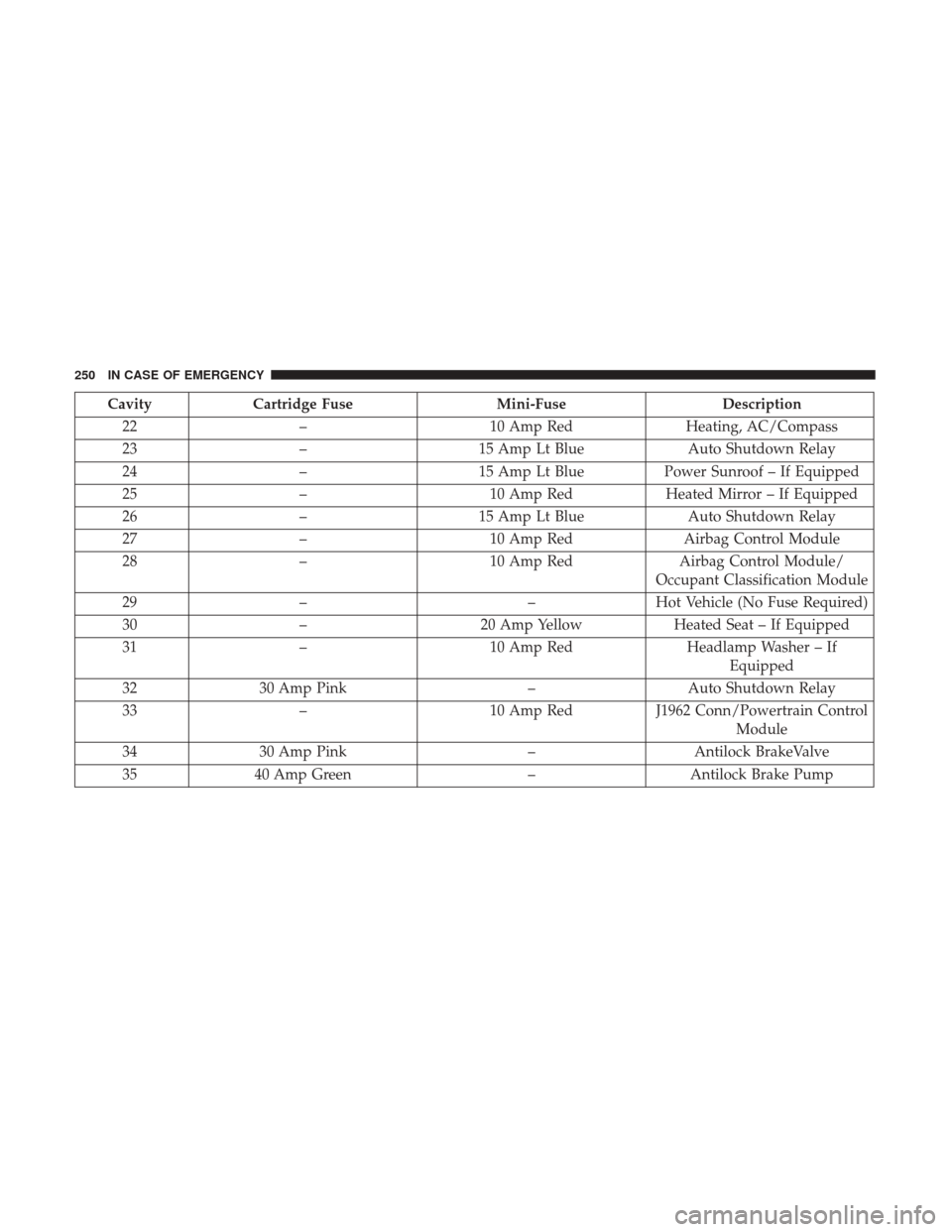
CavityCartridge Fuse Mini-FuseDescription
22 – 10 Amp Red Heating, AC/Compass
23 – 15 Amp Lt Blue Auto Shutdown Relay
24 – 15 Amp Lt Blue Power Sunroof – If Equipped
25 – 10 Amp RedHeated Mirror – If Equipped
26 – 15 Amp Lt Blue Auto Shutdown Relay
27 – 10 Amp Red Airbag Control Module
28 – 10 Amp RedAirbag Control Module/
Occupant Classification Module
29 – –Hot Vehicle (No Fuse Required)
30 – 20 Amp Yellow Heated Seat – If Equipped
31 – 10 Amp Red Headlamp Washer – If
Equipped
32 30 Amp Pink –Auto Shutdown Relay
33 – 10 Amp RedJ1962 Conn/Powertrain Control
Module
34 30 Amp Pink –Antilock BrakeValve
35 40 Amp Green –Antilock Brake Pump
250 IN CASE OF EMERGENCY
Page 255 of 429

6. Block both the front and rear of the wheel diagonallyopposite of the jacking position. For ex-
ample, if changing the right front tire, block
the left rear wheel.
NOTE: Passengers should not remain in the vehicle while
the vehicle is being jacked.
Jacking Instructions
WARNING!
Carefully follow these tire changing warnings to help
prevent personal injury or damage to your vehicle:
• Always park on a firm, level surface as far from the
edge of the roadway as possible before raising the
vehicle.
• Turn on the Hazard Warning flasher.
• Block the wheel diagonally opposite the wheel to be
raised.
• Set the parking brake firmly and set an automatic
transmission in PARK; a manual transmission in
REVERSE.
(Continued)
WARNING! (Continued)
•Never start or run the engine with the vehicle on a
jack.
• Do not let anyone sit in the vehicle when it is on a
jack.
• Do not get under the vehicle when it is on a jack. If
you need to get under a raised vehicle, take it to a
service center where it can be raised on a lift.
• Only use the jack in the positions indicated and for
lifting this vehicle during a tire change.
• If working on or near a roadway, be extremely
careful of motor traffic.
• To assure that spare tires, flat or inflated, are securely
stowed, spares must be stowed with the valve stem
facing the ground.
7
IN CASE OF EMERGENCY 253