2017 JEEP CHEROKEE transmission service
[x] Cancel search: transmission servicePage 6 of 615

INTRODUCTION
Congratulations on selecting your new FCA US LLC ve-
hicle. Be assured that it represents precision workmanship,
distinctive styling, and high quality.
This is a specialized utility vehicle. It can go places and
perform tasks that conventional passenger cars are not
intended. It handles and maneuvers differently from many
passenger cars both on-road and off-road, so take time to
become familiar with your vehicle.
The two-wheel drive version of this vehicle was designed
for on-road use only. It is not intended for off-road driving
or use in other severe conditions suited for a four-wheel
drive vehicle.
Before you start to drive this vehicle, read the Owner’s
Manual. Be sure you are familiar with all vehicle controls,
particularly those used for braking, steering, transmission,
and transfer case shifting. Learn how your vehicle handles
on different road surfaces. Your driving skills will improve
with experience. When driving off-road or working the
vehicle, don’t overload the vehicle or expect the vehicle to
overcome the natural laws of physics. Always observe fed-
eral, state, provincial and local laws wherever you drive.
As with other vehicles of this type, failure to operate this
vehicle correctly may result in loss of control or a collision.
Refer to “Driving Tips” in “Starting And Operating” for
further information.
This Owner’s Manual has been prepared with the assis-
tance of service and engineering specialists to acquaint you
with the operation and maintenance of your vehicle. It is
supplemented by Warranty Information, and various
customer-oriented documents. Please take the time to read
these publications carefully. Following the instructions and
recommendations in this manual will help assure safe and
enjoyable operation of your vehicle.
NOTE: After reviewing the owner information, it should
be stored in the vehicle for convenient referencing and
remain with the vehicle when sold.
When it comes to service, remember that your authorized
dealer knows your Jeep® vehicle best, has factory-trained
technicians and genuine MOPAR® parts, and cares about
your satisfaction.
4 INTRODUCTION
Page 149 of 615
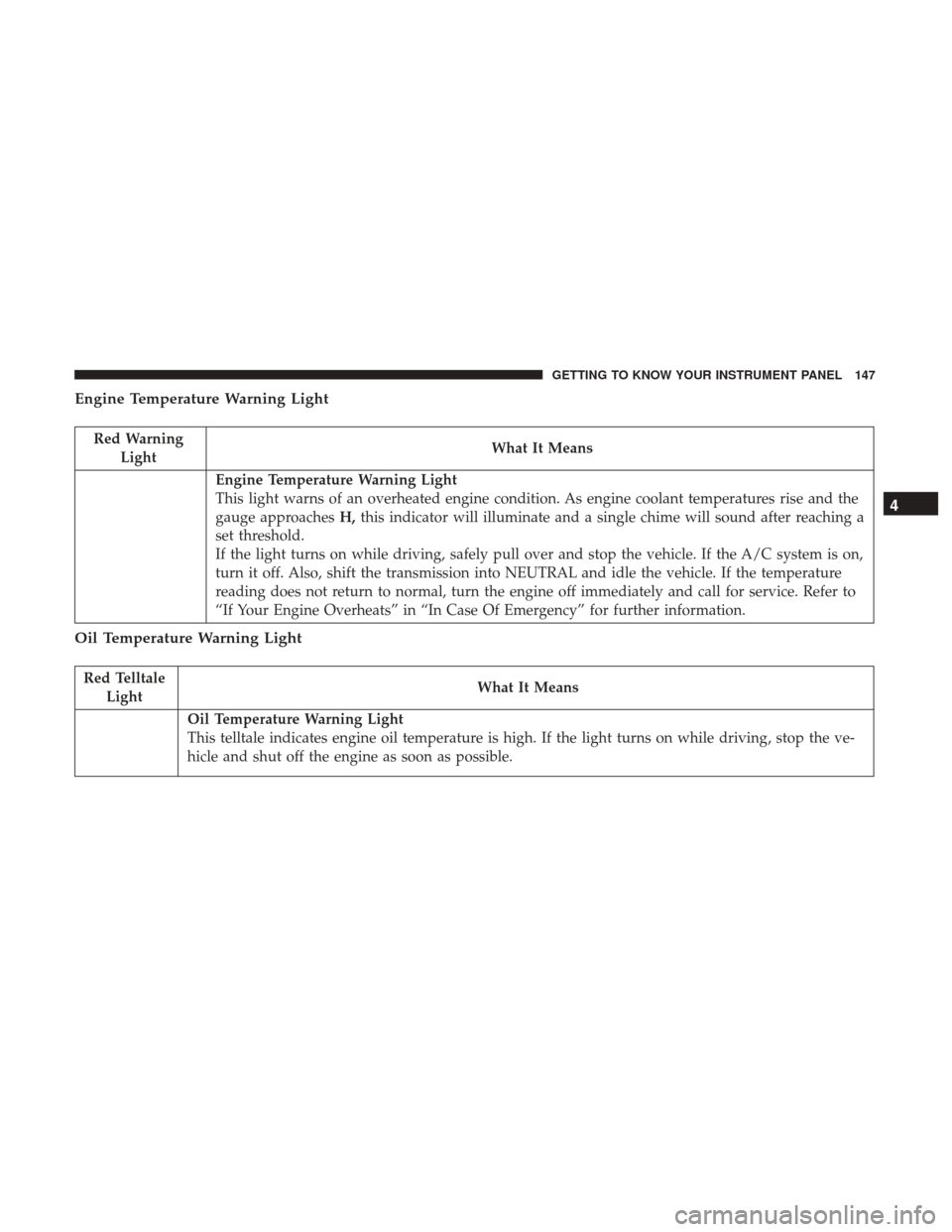
Engine Temperature Warning Light
Red WarningLight What It Means
Engine Temperature Warning Light
This light warns of an overheated engine condition. As engine coolant temperatures rise and the
gauge approaches
H,this indicator will illuminate and a single chime will sound after reaching a
set threshold.
If the light turns on while driving, safely pull over and stop the vehicle. If the A/C system is on,
turn it off. Also, shift the transmission into NEUTRAL and idle the vehicle. If the temperature
reading does not return to normal, turn the engine off immediately and call for service. Refer to
“If Your Engine Overheats” in “In Case Of Emergency” for further information.
Oil Temperature Warning Light
Red Telltale Light What It Means
Oil Temperature Warning Light
This telltale indicates engine oil temperature is high. If the light turns on while driving, stop the ve-
hicle and shut off the engine as soon as possible.
4
GETTING TO KNOW YOUR INSTRUMENT PANEL 147
Page 150 of 615

Battery Charge Warning Light
Red TelltaleLight What It Means
Battery Charge Warning Light
This light illuminates when the battery is not charging properly. If it stays on while the engine is run-
ning, there may be a malfunction with the charging system. Contact your authorized dealer as soon
as possible. This indicates a possible problem with the electrical system or a related component.
If jump starting is required, refer to “Jump-Starting” in “In Case Of Emergency.”
Electronic Throttle Control (ETC) Warning Light
Red Telltale
Light What It Means
Electronic Throttle Control (ETC) Warning LightThis light informs you of a problem with the Electronic Throttle Control (ETC) system. If a problem
is detected while the engine is running, the light will either stay on or flash depending on the nature
of the problem. Cycle the ignition key when the vehicle is safely and completely stopped and the
transmission is placed in the PARK position. The light should turn off. If the light remains on with
the vehicle under power, your vehicle will usually be drivable; however, see an authorized dealer
for service as soon as possible.
If the light continues to flash when the engine vehicle under power, immediate service is required
and you may experience reduced performance, and your vehicle may require towing. The light will
come on when the ignition is placed in the ON/RUN position and remain on briefly as a bulb
check. If the light does not come on during starting, have the system checked by an authorized
dealer.
148 GETTING TO KNOW YOUR INSTRUMENT PANEL
Page 152 of 615

Yellow Telltale Lights
Engine Malfunction Warning Light
Yellow TelltaleLight What It Means
Engine Check/Malfunction Indicator Light (MIL)
The Engine Check/Malfunction Indicator Light (MIL) is a part of an Onboard Diagnostic System
called OBD II that monitors engine and automatic transmission control systems. The light will
illuminate when the ignition is in the ON position before engine start. If the bulb does not come
on when turning the key from OFF to ON/RUN, have the condition checked promptly.
Certain conditions, such as a loose or missing gas cap, poor quality fuel, etc., may illuminate the
light after engine start. The vehicle should be serviced if the light stays on through several typical
driving styles. In most situations, the vehicle will drive normally and will not require towing.
When the engine is running, the MIL may flash to alert serious conditions that could lead to im-
mediate loss of power or severe catalytic converter damage. The vehicle should be serviced as
soon as possible if this occurs.
150 GETTING TO KNOW YOUR INSTRUMENT PANEL
Page 266 of 615
ENGINE BREAK-IN RECOMMENDATIONS
A long break-in period is not required for the engine and
drivetrain (transmission and axle) in your vehicle.
Drive moderately during the first 300 miles (500 km). After
the initial 60 miles (100 km), speeds up to 50 or 55 mph (80
or 90 km/h) are desirable.
While cruising, brief full-throttle acceleration within the
limits of local traffic laws contributes to a good break-in.
Wide-open throttle acceleration in low gear can be detri-
mental and should be avoided.
The engine oil installed in the engine at the factory is a
high-quality energy conserving type lubricant. Oil changes
should be consistent with anticipated climate conditions
under which vehicle operations will occur. For the recom-
mended viscosity and quality grades, refer to “Dealer
Service” in “Servicing And Maintenance”.
CAUTION!
Never use Non-Detergent Oil or Straight Mineral Oil
in the engine or damage may result.NOTE:
A new engine may consume some oil during its
first few thousand miles (kilometers) of operation. This
should be considered a normal part of the break-in and not
interpreted as a problem.
PARKING BRAKE
Electric Park Brake (EPB)
Your vehicle is equipped with an Electric Park Brake
System (EPB) that offers simple operation, and some
additional features that make the parking brake more
convenient and useful.
The parking brake is primarily intended to prevent the
vehicle from rolling while parked. Before leaving the
vehicle, make sure that the park brake is applied. Also, be
certain to leave the transmission in PARK.
You can engage the park brake in two ways:
• Manually, by applying the park brake switch.
• Automatically, by enabling the Auto Park Brake feature
in the customer programmable features section of the
Uconnect settings.
264 STARTING AND OPERATING
Page 268 of 615

NOTE:When parking on a hill, it is important to turn the
front wheels toward the curb on a downhill grade and
away from the curb on an uphill grade. Apply the park
brake before placing the gear selector in PARK, otherwise
the load on the transmission locking mechanism may make
it difficult to move the gear selector out of PARK. The
parking brake should always be applied whenever the
driver is not in the vehicle.
WARNING!
• Never use the PARK position as a substitute for the
parking brake. Always apply the parking brake fully
when parked to guard against vehicle movement and
possible injury or damage.
• When leaving the vehicle, always remove the key fob
from the ignition and lock your vehicle.
• Never leave children alone in a vehicle, or with
access to an unlocked vehicle. Allowing children to
be in a vehicle unattended is dangerous for a number
of reasons. A child or others could be seriously or
fatally injured. Children should be warned not to
touch the parking brake, brake pedal or the gear
selector.
(Continued)
WARNING! (Continued)
•Do not leave the key fob in or near the vehicle, or in
a location accessible to children, and do not leave a
vehicle equipped with Keyless Enter-N-Go in the
ACC or ON/RUN mode. A child could operate power
windows, other controls, or move the vehicle.
• Be sure the parking brake is fully disengaged before
driving; failure to do so can lead to brake failure and
a collision.
• Always fully apply the parking brake when leaving
your vehicle, or it may roll and cause damage or
injury. Also be certain to leave the transmission in
PARK. Failure to do so may allow the vehicle to roll
and cause damage or injury.
CAUTION!
If the Brake System Warning Light remains on with the
parking brake released, a brake system malfunction is
indicated. Have the brake system serviced by an au-
thorized dealer immediately.
266 STARTING AND OPERATING
Page 269 of 615

If exceptional circumstances should make it necessary to
engage the park brake while the vehicle is in motion,
maintain upward pressure on the electric park brake
switch for as long as engagement is desired. The BRAKE
telltale light will illuminate, and a continuous chime will
sound. The rear stop lamps will also be illuminated auto-
matically while the vehicle remains in motion.
To disengage the park brake while the vehicle is in motion,
release the switch. If the vehicle is brought to a complete
stop using the parking brake, when the vehicle reaches
approximately 3 mph, (5 km/h) the parking brake will
remain engaged.
WARNING!
Driving the vehicle with the parking brake engaged, or
repeated use of the parking brake to slow the vehicle
may cause serious damage to the brake system. Be sure
the parking brake is fully disengaged before driving;
failure to do so can lead to brake failure and a collision.
In the unlikely event of a malfunction of the Electric Park
Brake system, a yellow EPB fault light will illuminate. This
may be accompanied by the BRAKE telltale light flashing. In this event, urgent service of the electric park brake
system is required. Do not rely on the parking brake to
hold the vehicle stationary.
Auto Park Brake
The electric park brake can be programmed to be applied
automatically whenever the vehicle is at a standstill and
the automatic transmission is placed in PARK, whenever
the ignition is turned “OFF”. Auto Park Brake is enabled
and disabled by customer selection through the customer
programmable features section of the Uconnect Settings.
Any single auto park brake application can be bypassed by
pushing the EPB switch to the release position while the
transmission is placed in PARK.
SafeHold
SafeHold is a safety feature of the Electric Park Brake
System that will engage the park brake automatically if the
vehicle is left unsecured while the ignition is in RUN.
For automatic transmissions, the park brake will automati-
cally engage if all of the following conditions are met:
•
The vehicle is at a standstill.
• There is no attempt to depress the brake pedal or
accelerator pedal.
6
STARTING AND OPERATING 267
Page 270 of 615

•The seat belt is unbuckled.
• The driver door is open.
SafeHold can be temporarily bypassed by pushing the
Electric Park Brake Switch while the driver door is open.
Once manually bypassed, SafeHold will be enabled again
once the vehicle reaches 12 mph (20 km/h) or the ignition
is turned to the OFF position and back to ON again.
Brake Service Mode
We recommend having your brakes serviced by your autho-
rized dealer. You should only make repairs for which you
have the knowledge and the right equipment. You should
only enter Brake Service Mode during brake service.
When servicing your rear brakes, it may be necessary for
you or your technician to push the rear piston into the rear
caliper bore. With the electric park brake system, this can
only be done after retracting the Electric Park Brake
actuator. Fortunately, actuator retraction can be done easily
by entering the Brake Service Mode through the Uconnect
Settings in your vehicle. This menu based system will
guide you through the steps necessary to retract the EPB
actuator in order to perform rear brake service. Service Mode has requirements that must be met in order
to be activated:
•
The vehicle must be at a standstill.
• The park brake must be unapplied.
• The transmission must be in Park or Neutral.
While in service mode, the Electric Park Brake fault lamp
will flash continuously while the ignition is ON.
When brake service work is complete, the following steps
must be followed to reset the park brake system to normal
operation:
• Ensure the vehicle is at a standstill.
• Press the brake pedal with moderate force.
• Apply the Electric Park Brake Switch.
WARNING!
You can be badly injured working on or around a
motor vehicle. Do only that service work for which you
have the knowledge and the right equipment. If you
have any doubt about your ability to perform a service
job, take your vehicle to a competent mechanic.
268 STARTING AND OPERATING