2017 Hyundai Sonata heating
[x] Cancel search: heatingPage 264 of 563
4-16
(Continued)
• Park the vehicle when connectingthe head unit with the mobile phone.
• Bluetooth
®connection may become
intermittently disconnected in some
mobile phones. Follow these steps to
try again.
1. Within the mobile phone, turn the Bluetooth
®function off/on and try
again.
2. Turn the mobile phone power Off/On and try again.
3. Completely remove the mobile phone battery, reboot, and then
again.
4. Reboot the Audio System and try again.
5. Delete all paired devices, pair and try again.
• Handsfree call quality and volume may differ depending on the model
of your mobile phone.
Information - Using the voicerecognition
• When using the voice recognition feature, only commands listed with-
in the user's manual are supported.
• Be aware that during the operation of the voice recognition system,
pressing any key other than the
key terminate voice recognition
mode.
• For superior voice recognition per- formance, position the microphone
used for voice recognition above the
head of the driver’s seat and main-
tain a proper position when saying
commands.
• Within the following situations, voice recognition may not function
properly due to external sound.
- When the windows and sunroofare open
- When the wind of the cooling / heating device is strong
- When entering and passing through tunnels
(Continued)(Continued)
- When driving on rugged anduneven roads
- During severe rain (heavy rains, windstorms)
• Phone related voice commands can be used only when a Bluetooth
®
Wireless Technology device is con-
nected.
• When making calls by stating a name, the corresponding contact
must be downloaded and stored
within the audio system.
• After downloading the Bluetooth
®
Wireless Technology phone book, it
takes some times to convert the
phone book data into voice informa-
tion. During this time, voice recogni-
tion may not properly operate.
• Pronounce the voice commands nat- urally and clearly as if in a normal
conversation.
i
Multimedia System
Page 334 of 563

5-26
Driving your vehicle
Parking
Always come to a complete stop and
continue to depress the brake pedal.
Move the shift lever into the P (Park)
position, apply the parking brake,
and place the ignition switch in the
LOCK/OFF position. Take the Key
with you when exiting the vehicle.
Good Driving Practices
Never move the shift lever from P(Park) or N (Neutral) to any other
position with the accelerator pedal
depressed.
Never move the shift lever into P (Park) when the vehicle is in
motion.
Be sure the vehicle is completely
stopped before you attempt to shift
into R (Reverse) or D (Drive).
Do not move the shift lever to N (Neutral) when driving. Doing so
may result in an accident because
of a loss of engine braking and the
transmission could be damaged.
Do not drive with your foot resting on the brake pedal. Even light, but
consistent pedal pressure can
result in the brakes overheating,
brake wear and possibly even
brake failure.
Depressing both accelerator and brake pedals at the same time can
trigger logic for engine power
reduction to assure vehicle decel-
eration. Vehicle acceleration will
resume after the brake pedal is
released. When driving in Manual shift mode,
slow down before shifting to a
lower gear. Otherwise, the lower
gear may not be engaged if the
engine rpms are outside of the
allowable range.
Always apply the parking brake when leaving the vehicle. Do not
depend on placing the transmis-
sion in P (Park) to keep the vehicle
from moving.
Exercise extreme caution when driving on a slippery surface. Be
especially careful when braking,
accelerating or shifting gears. On a
slippery surface, an abrupt change
in vehicle speed can cause the
drive wheels to lose traction and
may cause loss of vehicle control
resulting in an accident.
Optimum vehicle performance and economy is obtained by smoothly
depressing and releasing the
accelerator.
When you stay in the vehicle
with the engine running, be
careful not to depress the accel-
erator pedal for a long period of
time. The engine or exhaust
system may overheat and start
a fire.
The exhaust gas and the
exhaust system are very hot.
Keep away from the exhaust
system components.
Do not stop or park over flam-
mable materials, such as dry
grass, paper or leaves. They
may ignite and cause a fire.
WARNING
Page 355 of 563
5-47
Driving your vehicle
5
Good Braking Practices Wet brakes can be dangerous! The
brakes may get wet if the vehicle is
driven through standing water or if it
is washed. Your vehicle will not stop
as quickly if the brakes are wet. Wet
brakes may cause the vehicle to pull
to one side.
To dry the brakes, apply the brakes
lightly until the braking action returns
to normal, taking care to keep the
vehicle under control at all times. If
the braking action does not return to
normal, stop as soon as it is safe to
do so and call an authorized
HYUNDAI dealer for assistance.
DO NOT drive with your foot resting
on the brake pedal. Even light, but
constant pedal pressure can result in
the brakes overheating, brake wear,
and possibly even brake failure.
If a tire goes flat while you are driv-
ing, apply the brakes gently and
keep the vehicle pointed straight
ahead while you slow down. When
you are moving slowly enough for it
to be safe to do so, pull off the road
and stop in a safe location.Keep your foot firmly on the brake
pedal when the vehicle is stopped to
prevent the vehicle from rolling for-
ward.
Whenever leaving the vehicle or
parking, always come to a com-
plete stop and continue to
depress the brake pedal. Move
the shift lever into the P (Park)
position, then apply the parking
brake, and place the ignition
switch in the OFF position.
Vehicles with the parking brake
not fully engaged are at risk for
moving inadvertently and caus-
ing injury to yourself or others.
WARNING
Page 402 of 563
5-94
Driving your vehicle
If you are still stuck after rocking
the vehicle a few times, have the
vehicle pulled out by a tow vehicle
to avoid engine overheating, pos-
sible damage to the transmission,
and tire damage. See "Towing" in
chapter 6.
To prevent damage to the trans-
mission, turn OFF the ESC prior to
rocking the vehicle.
Smooth Cornering
Avoid braking or gear changing in
corners, especially when roads are
wet. Ideally, corners should always
be taken under gentle acceleration.
Driving at Night
Night driving presents more hazards
than driving in the daylight. Here are
some important tips to remember:
Slow down and keep more dis- tance between you and other vehi-
cles, as it may be more difficult to
see at night, especially in areas
where there may not be any street
lights.
Adjust your mirrors to reduce the glare from other driver’s head-
lamps.
Keep your headlamps clean and properly aimed. Dirty or improperly
aimed headlamps will make it
much more difficult to see at night.
Avoid staring directly at the head- lamps of oncoming vehicles. You
could be temporarily blinded, and it
will take several seconds for your
eyes to readjust to the darkness.
NOTICE
Page 420 of 563
6-7
What to do in an emergency
6
If your temperature gauge indicates
overheating, you experience a loss
of power, or hear loud pinging or
knocking, the engine may be over-
heating. If this happens, you should:
1. Pull off the road and stop as soonas it is safe to do so.
2. Place the shift lever in P (Park) and set the parking brake. If the air
conditioning is ON, turn it OFF.
3. If engine coolant is running out under the vehicle or steam is com-
ing out from the hood, stop the
engine. Do not open the hood until
the coolant has stopped running
or the steaming has stopped. If
there is no visible loss of engine
coolant and no steam, leave the
engine running and check to be
sure the engine cooling fan is
operating. If the fan is not running,
turn the engine off. 4. Check for coolant leaking from the
radiator, hoses or under the vehi-
cle. (If the air conditioning had
been in use, it is normal for cold
water to be draining from it when
you stop.)
5. If engine coolant is leaking out, stop the engine immediately and
call the nearest authorized
HYUNDAI dealer for assistance.
I IF
F
T
T H
H E
E
E
E N
N G
GI
IN
N E
E
O
O V
VE
ER
R H
H E
EA
A T
TS
S
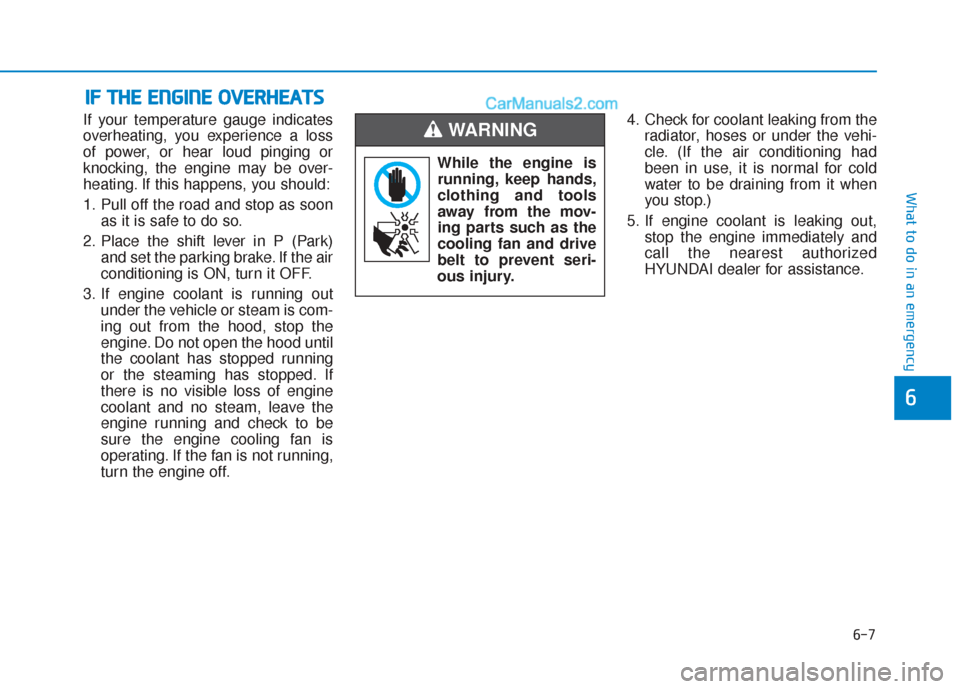
While the engine is
running, keep hands,
clothing and tools
away from the mov-
ing parts such as the
cooling fan and drive
belt to prevent seri-
ous injury.
WARNING
Page 421 of 563
6-8
What to do in an emergency6. If you cannot find the cause of theoverheating, wait until the engine
temperature has returned to nor-
mal. Then, if coolant has been
lost, carefully add coolant to the
reservoir to bring the fluid level in
the reservoir up to the halfway
mark.
7. Proceed with caution, keeping alert for further signs of overheat-
ing. If overheating happens again,
call an authorized HYUNDAI deal-
er for assistance.
Serious loss of coolant indi-
cates a leak in the cooling sys-
tem and should be checked as
soon as possible by an author-
ized HYUNDAI dealer.
CAUTION
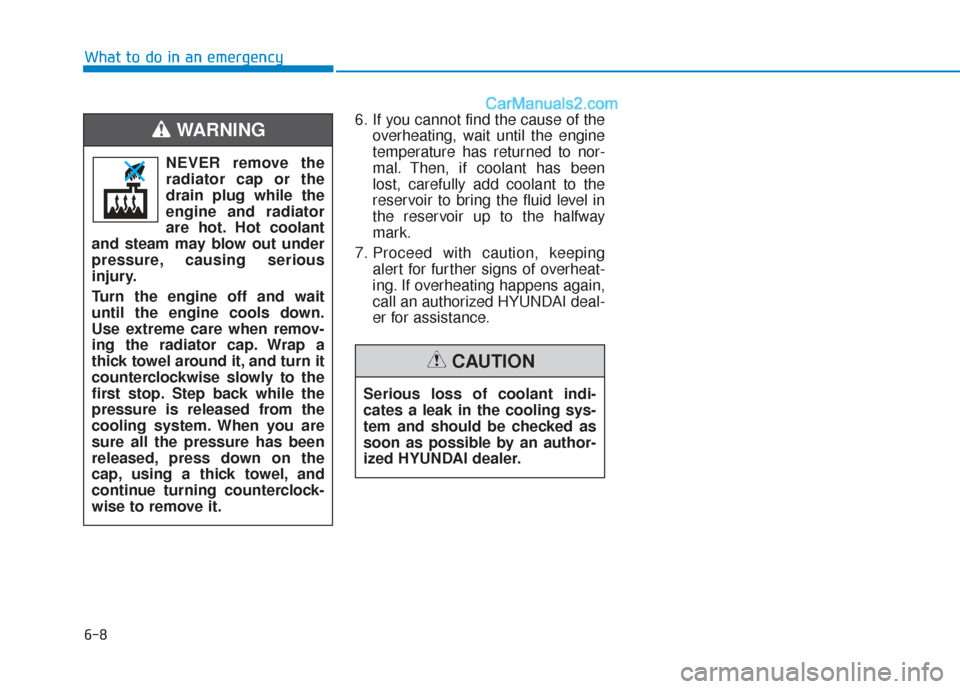
NEVER remove the
radiator cap or the
drain plug while the
engine and radiator
are hot. Hot coolant
and steam may blow out under
pressure, causing serious
injury.
Turn the engine off and wait
until the engine cools down.
Use extreme care when remov-
ing the radiator cap. Wrap a
thick towel around it, and turn it
counterclockwise slowly to the
first stop. Step back while the
pressure is released from the
cooling system. When you are
sure all the pressure has been
released, press down on the
cap, using a thick towel, and
continue turning counterclock-
wise to remove it.
WARNING
Page 553 of 563
 .....................3-116
Air bag warning labels ....................")
I-2
A/V mode ........................................................................\
3-77
AFLS (Adaptive Front Lighting System) .....................3-116
Air bag warning labels ....................................................2-68
Air bags ........................................................................\
...2-45Additional safety precautions .....................................2-67
Air bag collision sensors ............................................2-61
Air bag inflation conditions .......................................2-63
Air bag non-inflation conditions ................................2-64
Air bag warning labels ...............................................2-68
Curtain air bags ..........................................................2-49
Do not install a child restraint on the front passenger seat ...........................................................2-60
Driver’s front air bag..................................................2-47
Driver’s knee air bag ..................................................2-47
How does the air bag system operate? .......................2-51
Occupant classification system (OCS) .......................2-56
Passenger’s front air bag ............................................2-47
Side air bags ...............................................................2-48
SRS Care ....................................................................2-66\
SRS warning light ......................................................2-51
What to expect after an air bag inflates .....................2-55
Why didn’t my air bag go off in a collision ..............2-61
Air cleaner.......................................................................7\
-32
Air conditioner compressor label ...................................8-10
Air conditioning system (Refrigerant/Compressor) .........8-5
Air ventilation seats ........................................................2-21 Airconditioning system
Automatic climate control system............................3-139
Manual climate control system ................................3-129
Alarm system ..................................................................3-19
Antenna ........................................................................\
.....4-2
Anti-lock brake system (ABS) .......................................5-40
Appearance care..............................................................7-82 Exterior care ...............................................................7-82
Interior care ................................................................7-87
Armrest ........................................................................\
...2-14
Auto door lock/unlock features ......................................3-17
Auto hold ........................................................................\
5-37
Auto light position ........................................................3-109
Automatic climate control system ................................3-139 Air conditioning .......................................................3-146
Automatic heating and air conditioning ...................3-140
Climate control air filter...................................3-137, 149
Manual heating and air conditioning .......................3-141
Automatic transmission ..................................................5-14 Manual shift mode......................................................5-17
Automatic transmission shift indicator ...........................3-73
Automatic emergency braking (AEB) ............................5-81 System setting and activation .....................................5-81
AEB warning message and system control................5-83
Sensor to detect the distance from the vehicle in front (front radar) ................................................5-86
System malfunction ....................................................5-87
Limitation of the system ............................................5-89
AUX, USB and iPod
®port ...............................................4-2
Index
A
Page 559 of 563
 mode .......................")
I-8
SCC/LDWS mode ......................................................3-77
Trip computer modes..................................................3-76\
Turn by turn (TBT) mode ..........................................3-77
User settings mode .....................................................3-80
Warning messages ......................................................3-85
LCD Display Control......................................................3-70
LCD modes .....................................................................3-7\
5
Light ........................................................................\
......3-109 AFLS (Adaptive Front Lighting System) ................3-116
Auto light position....................................................3-109
Battery saver function ..............................................3-115
Daytime running light ..............................................3-116
Headlamp delay function..........................................3-115
Headlamp position ....................................................3-110
High - beam operation ..............................................3-111
Interior lights ............................................................3-118
Parking lamp position...............................................3-110
Smart high beam .......................................................3-111
Turn signals ..............................................................3-114
Light bulbs ......................................................................7-\
69
Lubricants and capacities..................................................8-6
Luggage net holder .......................................................3-163
Main fuse ........................................................................\
7-60
Maintenance Explanation of scheduled maintenance items ............7-21
Maintenance services ...................................................7-6 Owner maintenance ......................................................7-7
Scheduled maintenance service....................................7-9
Tire maintenance ........................................................7-47
Maintenance schedule .......................................................7-9 Maintenance under severe usage conditions ..............7-20
Normal maintenance schedule ...................................7-10
Maintenance services ........................................................7-6
Manual climate control system .....................................3-129 Air conditioning .......................................................3-134
Climate control air filter ...........................................3-137
Heating and air conditioning ....................................3-130
Manual shift mode ....................................................5-17, 23
Map lamp ......................................................................3-\
118
Mirrors ........................................................................\
....3-25 Blind spot mirror ........................................................3-41
Day/night rearview mirror..........................................3-25
Electric chromic mirror (ECM) with compass and HomeLink
®system ..................................................3-33
Electric chromic mirror (ECM) with HomeLink®
system, compass and Blue Link®.............................3-26
Folding the side view mirrors ....................................3-42
Inside rearview mirror ................................................3-25
Side view mirrors .......................................................3-42
Reverse parking aid function ....................................3-43
Moonroof, see panorama sunroof ...................................3-52
Multi box.......................................................................3\
-156
Multi fuse ........................................................................\
7-60
Index
M