2017 HYUNDAI IX20 washer fluid
[x] Cancel search: washer fluidPage 17 of 456
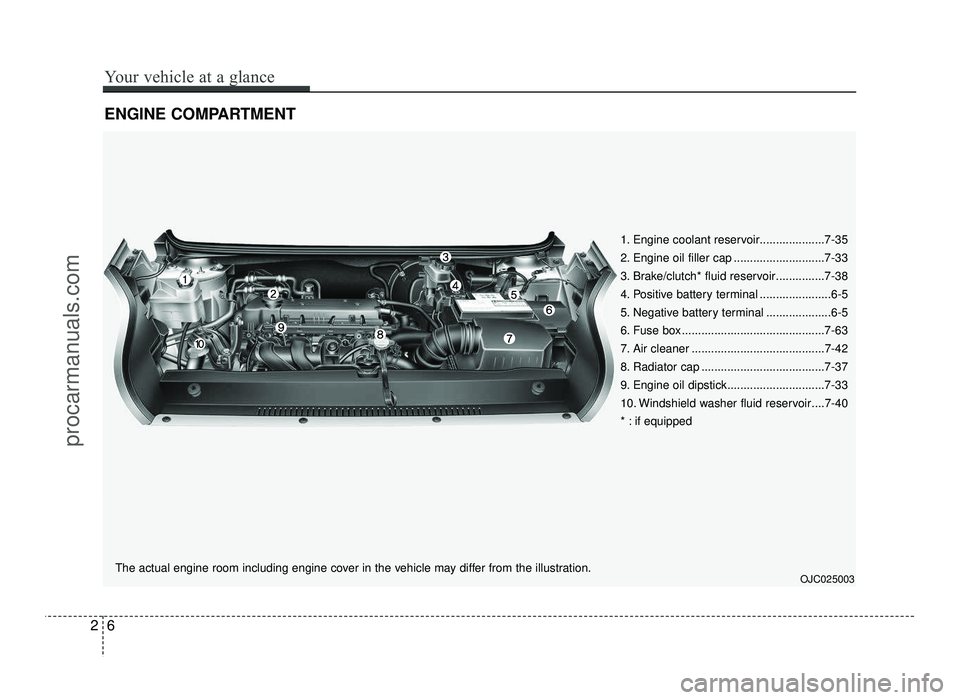
ENGINE COMPARTMENT
The actual engine room including engine cover in the vehicle may differ from the illustration.OJC025003
26
Your vehicle at a glance
1. Engine coolant reservoir....................7-35
2. Engine oil filler cap ............................7-33
3. Brake/clutch* fluid reservoir...............7-38
4. Positive battery terminal ......................6-5
5. Negative battery terminal ....................6-5
6. Fuse box ............................................7-63
7. Air cleaner .........................................7-42
8. Radiator cap ......................................7-37
9. Engine oil dipstick..............................7-33
10. Windshield washer fluid reservoir ....7-40
* : if equipped
procarmanuals.com
Page 156 of 456
Features of your vehicle
78
4
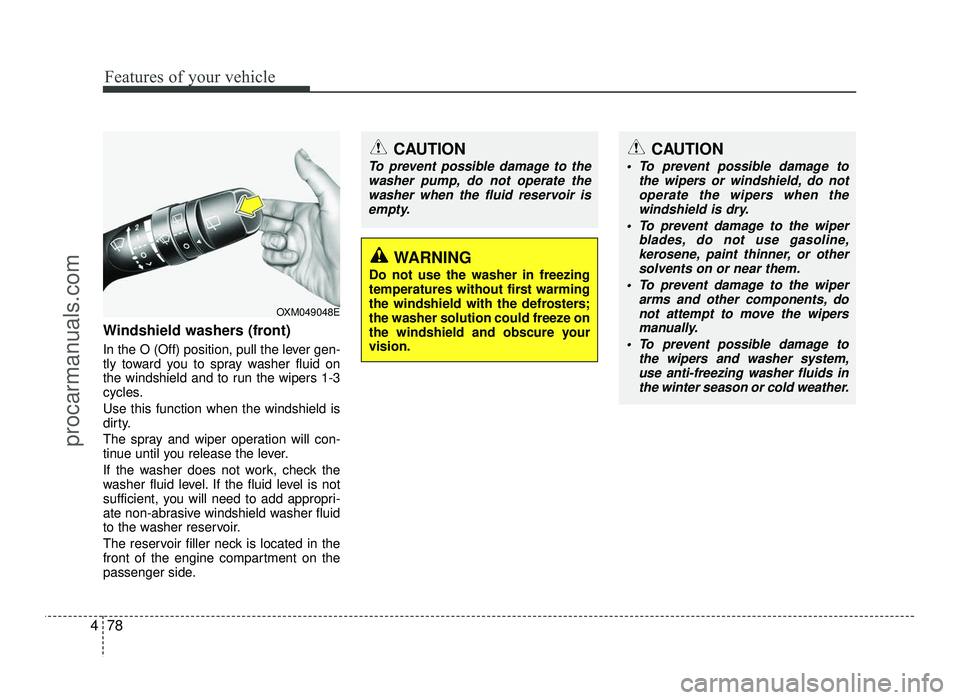
Windshield washers (front)
In the O (Off) position, pull the lever gen-
tly toward you to spray washer fluid on
the windshield and to run the wipers 1-3
cycles. Use this function when the windshield is
dirty.
The spray and wiper operation will con-
tinue until you release the lever.
If the washer does not work, check the
washer fluid level. If the fluid level is not
sufficient, you will need to add appropri-
ate non-abrasive windshield washer fluid
to the washer reservoir.
The reservoir filler neck is located in the
front of the engine compartment on the
passenger side.
OXM049048E
WARNING
Do not use the washer in freezing
temperatures without first warming
the windshield with the defrosters;
the washer solution could freeze on
the windshield and obscure yourvision.
CAUTION
To prevent possible damage to the wipers or windshield, do notoperate the wipers when the
windshield is dry.
To prevent damage to the wiper blades, do not use gasoline,
kerosene, paint thinner, or othersolvents on or near them.
To prevent damage to the wiper arms and other components, donot attempt to move the wipers
manually.
To prevent possible damage to the wipers and washer system,
use anti-freezing washer fluids inthe winter season or cold weather.
CAUTION
To prevent possible damage to the
washer pump, do not operate thewasher when the fluid reservoir is
empty.
procarmanuals.com
Page 157 of 456
479
Features of your vehicle
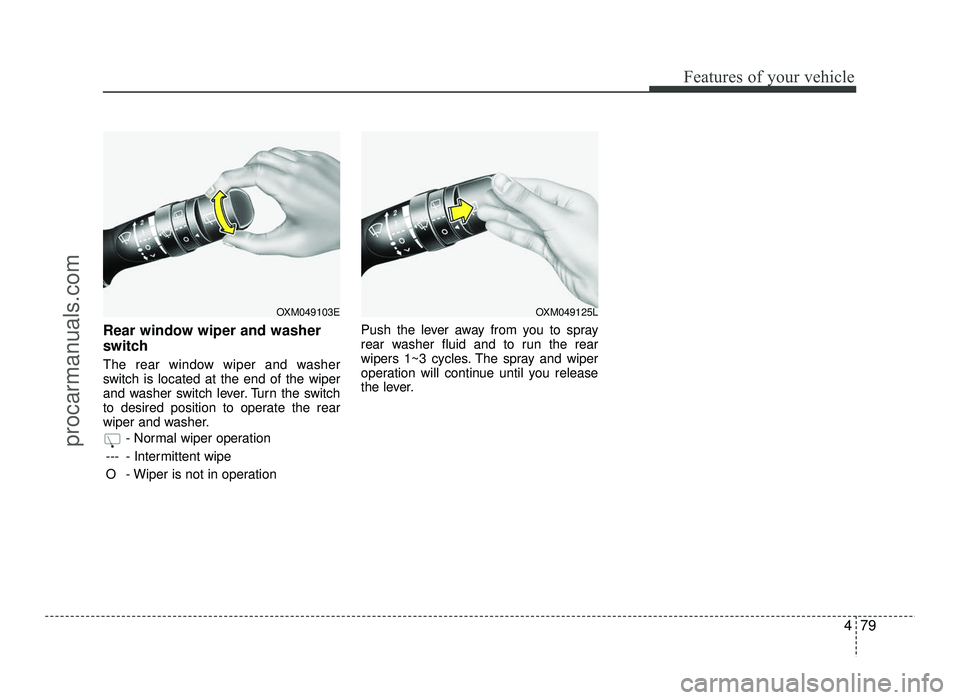
Rear window wiper and washer
switch
The rear window wiper and washer
switch is located at the end of the wiper
and washer switch lever. Turn the switch
to desired position to operate the rear
wiper and washer.- Normal wiper operation
--- - Intermittent wipe
O - Wiper is not in operation Push the lever away from you to spray
rear washer fluid and to run the rear
wipers 1~3 cycles. The spray and wiper
operation will continue until you release
the lever.
OXM049103EOXM049125L
procarmanuals.com
Page 234 of 456
Before entering vehicle
• Be sure that all windows, outside mir-ror(s), and outside lights are clean.
Check the condition of the tires.
Check under the vehicle for any sign of leaks.
Be sure there are no obstacles behind you if you intend to back up. Necessary inspections
Fluid levels, such as engine oil, engine
coolant, brake fluid, and washer fluid
should be checked on a regular basis,
with the exact interval depending on the
fluid. Further details are provided in sec-
tion 7, “Maintenance”.
Before starting
Close and lock all doors.
Position the seat so that all controls are
easily reached.
Adjust the inside and outside rearview mirrors.
Be sure that all lights work.
Check all gauges.
Check the operation of warning lights when the ignition switch is turned to the ON position.
Release the parking brake and make sure the brake warning light goes out.
For safe operation, be sure you are famil-
iar with your vehicle and its equipment.
53
Driving your vehicle
BEFORE DRIVING
WARNING
All passengers must be properly
belted whenever the vehicle is mov-
ing. Refer to “Seat belts” in section
3 for more information on their
proper use.
WARNING
Always check the surrounding
areas near your vehicle for people,
especially children, before putting a
car into D (Drive) or R (Reverse).
WARNING
Driving while distracted can result
in a loss of vehicle control, that
may lead to an accident, severe
personal injury, and death. The dri-
ver’s primary responsibility is in
the safe and legal operation of a
vehicle, and use of any handheld
devices, other equipment, or vehi-
cle systems which take the driver’s
eyes, attention and focus away
from the safe operation of a vehicle
or which are not permissible by law
should never be used during oper-
ation of the vehicle.
procarmanuals.com
Page 287 of 456

Driving your vehicle
56
5
To keep locks from freezing
To keep the locks from freezing, squirt an
approved de-icer fluid or glycerine into
the key opening. If a lock is covered with
ice, squirt it with an approved de-icing
fluid to remove the ice. If the lock is
frozen internally, you may be able to thaw
it out by using a heated key. Handle the
heated key with care to avoid injury.
Use approved window washer
anti-freeze in system
To keep the water in the window washer
system from freezing, add an approved
window washer anti-freeze solution in
accordance with instructions on the con-
tainer. Window washer anti-freeze is
available from an authorized HYUNDAI
dealer and most auto parts outlets. Donot use engine coolant or other types of
anti-freeze as these may damage thepaint finish. Don't let your parking brake
freeze
Under some conditions your parking
brake can freeze in the engaged position.
This is most likely to happen when there
is an accumulation of snow or ice around
or near the rear brakes or if the brakes
are wet. If there is a risk the parking
brake may freeze, apply it only temporar-
ily while you put the shift lever in P (auto-
matic transaxle) or in first or reverse gear
(manual transaxle) and block the rear
wheels so the vehicle cannot roll. Then
release the parking brake.
Don't let ice and snow accumu- late underneath
Under some conditions, snow and ice
can build up under the fenders and inter-
fere with the steering. When driving in
severe winter conditions where this may
happen, you should periodically check
underneath the car to be sure the move-
ment of the front wheels and the steering
components is not obstructed.Carry emergency equipment
Depending on the severity of the weath-
er, you should carry appropriate emer-
gency equipment. Some of the items you
may want to carry include tire chains, tow
straps or chains, flashlight, emergency
flares, sand, shovel, jumper cables, win-
dow scraper, gloves, ground cloth, cover-
alls, blanket, etc.
Don't place foreign objects or
materials in the engine compart-ment
Placement of foreign objects or materials
which prevent cooling of the engine, in
the engine compartment, may cause a
failure or combustion. The manufacturer
is not responsible for the damage caused
by such placement.
procarmanuals.com
Page 340 of 456
7
Engine compartment / 7-2
Maintenance services / 7-3
Owner maintenance / 7-5
Scheduled maintenance service / 7-7
Explanation of scheduled maintenance items / 7-30
Engine oil / 7-33
Engine coolant / 7-35
Brake/clutch fluid / 7-38
Washer fluid / 7-40
Parking brake / 7-40
Fuel filter / 7-41
Air cleaner / 7-42
Climate control air filter / 7-43
Wiper blades / 7-45
Battery / 7-48
Tires and wheels / 7-52
Fuses / 7-63
Light bulbs / 7-74
Appearance care / 7-84
Emission control system / 7-92
Maintenance
procarmanuals.com
Page 341 of 456
Maintenance
2
7
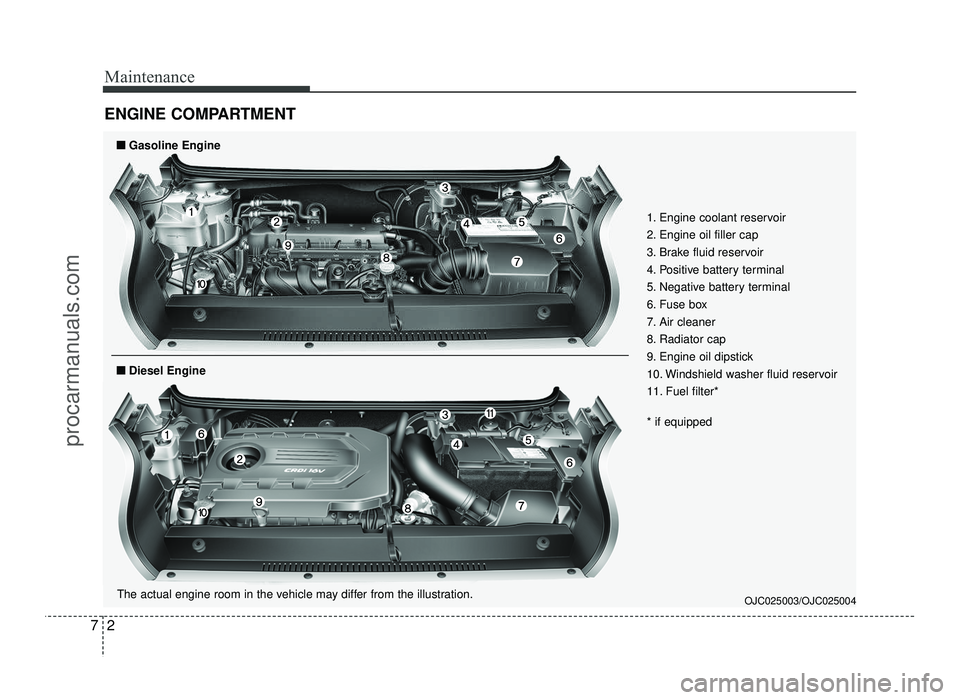
ENGINE COMPARTMENT
OJC025003/OJC025004
1. Engine coolant reservoir
2. Engine oil filler cap
3. Brake fluid reservoir
4. Positive battery terminal
5. Negative battery terminal
6. Fuse box
7. Air cleaner
8. Radiator cap
9. Engine oil dipstick
10. Windshield washer fluid reservoir
11. Fuel filter* * if equipped
■■
Gasoline Engine
■■Diesel Engine
The actual engine room in the vehicle may differ from the illustration.
procarmanuals.com
Page 343 of 456
Maintenance
4
7
WARNING - Maintenance
work
Performing maintenance work on a vehicle can be dangerous. You
can be seriously injured while
performing some maintenance
procedures. If you lack sufficient
knowledge and experience or the
proper tools and equipment to do
the work, we recommend that the
system be serviced by an author-
ized HYUNDAI dealer.
Working under the hood with the engine running is dangerous. It
becomes even more dangerous
when you wear jewelry or loose
clothing. These can become
entangled in moving parts and
result in injury. Therefore, if you
must run the engine while work-
ing under the hood, make certain
that you remove all jewelry (espe-
cially rings, bracelets, watches,
and necklaces) and all neckties,
scarves, and similar loose cloth-
ing before getting near theengine or cooling fans.WARNING - Diesel Engine
Never work on injection system with the engine running or within30 seconds after shutting off the
engine. High-pressure pump, rail,
injectors and high-pressure pipes
are subject to high pressure even
after the engine stopped. The fuel
jet produced by fuel leaks may
cause serious injury, if it touches
the body. People using pacemakers
should not move than 30cm closerto the ECU or wiring harness within
the engine room while engine is
running, since the high currents in
the electronic engine control sys-
tem produce considerable magnet-ic fields.CAUTION
Do not put heavy objects or apply excessive force on top of theengine cover (if equipped) or fuel
related parts.
When you inspect the fuel system (fuel lines and fuel injection
devices), we recommend that youcontact an authorized HYUNDAI
dealer.
Do not drive long time with the engine cover (if equipped)
removed.
When checking the engine room, do not go near fire.
Fuel, washer fluid, etc. are flam-mable oils that may cause fire.
Before touching the battery, igni- tion cables and electrical wiring,
you should disconnect the bat- tery "-" terminal. You may get an
electric shock from the electriccurrent.
When you remove the interior trim cover with a flat head (-) driv-er, be careful not to damage the
cover.
Be careful when you replace and clean bulbs to avoid burns or
electrical shock.
procarmanuals.com