2017 HYUNDAI IX20 service
[x] Cancel search: servicePage 399 of 456
Maintenance
60
7
3. Checking tire life (TIN : Tire
Identification Number)
Any tires that are over 6 years old,
based on the manufacturing date,(including the spare tire) should be
replaced by new ones. You can find
the manufacturing date on the tire
sidewall (possibly on the inside of the
wheel), displaying the DOT Code.
The DOT Code is a series of num-
bers on a tire consisting of numbers
and English letters. The manufactur-
ing date is designated by the last four
digits (characters) of the DOT code.
DOT : XXXX XXXX OOOO
The front part of the DOT means a
plant code number, tire size and
tread pattern and the last four num-
bers indicate week and year manu-
factured.
For example:
DOT XXXX XXXX 1617 represents
that the tire was produced in the 16th
week of 2017.
4. Tire ply composition and material
The number of layers or plies of rub-
ber-coated fabric in the tire. Tire
manufacturers also must indicate the
materials in the tire, which include
steel, nylon, polyester, and others.
The letter "R" means radial ply con-
struction; the letter "D" means diago-
nal or bias ply construction; and theletter "B" means belted-bias ply con-
struction.
5. Maximum permissible inflation
pressure
This number is the greatest amount of air pressure that should be put in the
tire. Do not exceed the maximum per-
missible inflation pressure. Refer to
the Tire and Loading Information label
for recommended inflation pressure.
6. Maximum load rating
This number indicates the maximum
load in kilograms and pounds that can
be carried by the tire. When replacing
the tires on the vehicle, always use a
tire that has the same load rating as
the factory installed tire.
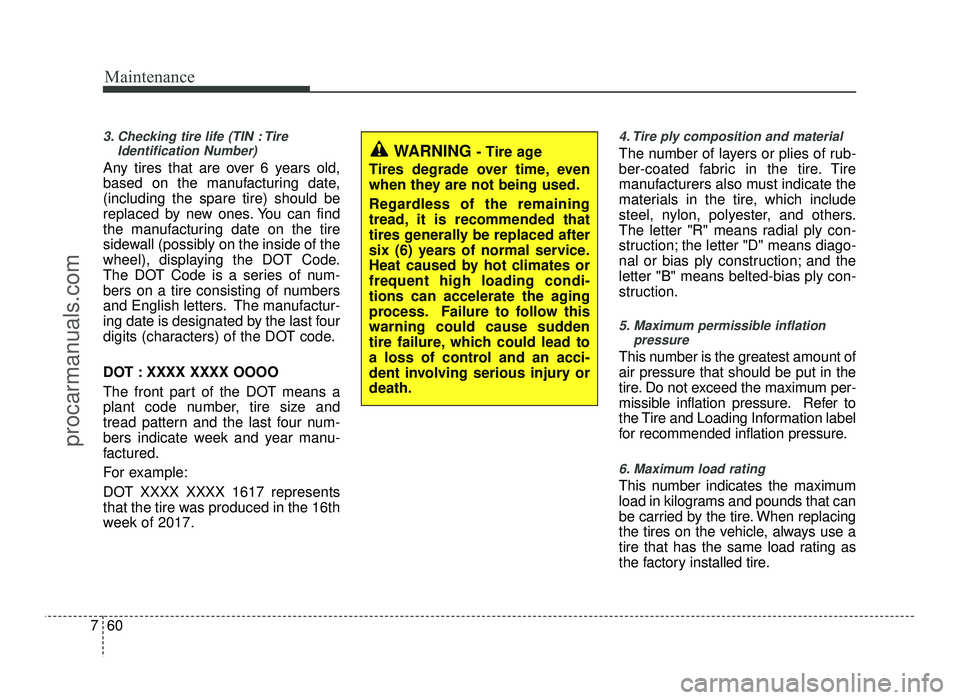
WARNING - Tire age
Tires degrade over time, even
when they are not being used.
Regardless of the remaining
tread, it is recommended that
tires generally be replaced after
six (6) years of normal service.
Heat caused by hot climates orfrequent high loading condi-
tions can accelerate the aging
process. Failure to follow this
warning could cause sudden
tire failure, which could lead to
a loss of control and an acci-
dent involving serious injury ordeath.
procarmanuals.com
Page 400 of 456
761
Maintenance
7. Uniform tire quality grading
Quality grades can be found where
applicable on the tire sidewall
between tread shoulder and maxi-
mum section width.
For example:
TREAD wear 200
TRACTION AA
TEMPERATURE A
Tread wear
The tread wear grade is a compara-
tive rating based on the wear rate ofthe tire when tested under controlled
conditions on a specified govern-
ment test course. For example, a tire
graded 150 would wear one-and-a-
half times (1½) as well on the gov-
ernment course as a tire graded 100.
The relative performance of tires depends upon the actual conditions
of their use, however, and may
depart significantly from the norm
due to variations in driving habits,
service practices and differences in
road characteristics and climate.These grades are molded on the
side-walls of passenger vehicle tires.
The tires available as standard or
optional equipment on your vehicle
may vary with respect to grade.
Traction - AA, A, B & C
The traction grades, from highest to
lowest, are AA, A, B and C. Those
grades represent the tire’s ability to
stop on wet pavement measuredunder controlled conditions on spec-
ified government test surfaces of
asphalt and concrete. A tire marked
C may have poor traction perform-
ance. Temperature -A, B & C
The temperature grades are A (the
highest), B, and C, representing the
tire’s resistance to the generation ofheat and its ability to dissipate heatwhen tested under controlled condi-
tions on a specified indoor laboratory
test wheel. Sustained high tempera-
ture can cause the material of the tire
to degenerate and reduce tire life,
and excessive temperature can lead
to sudden tire failure. Grades B and
A represent higher levels of perform-
ance on the laboratory test wheel
than the minimum required by law.
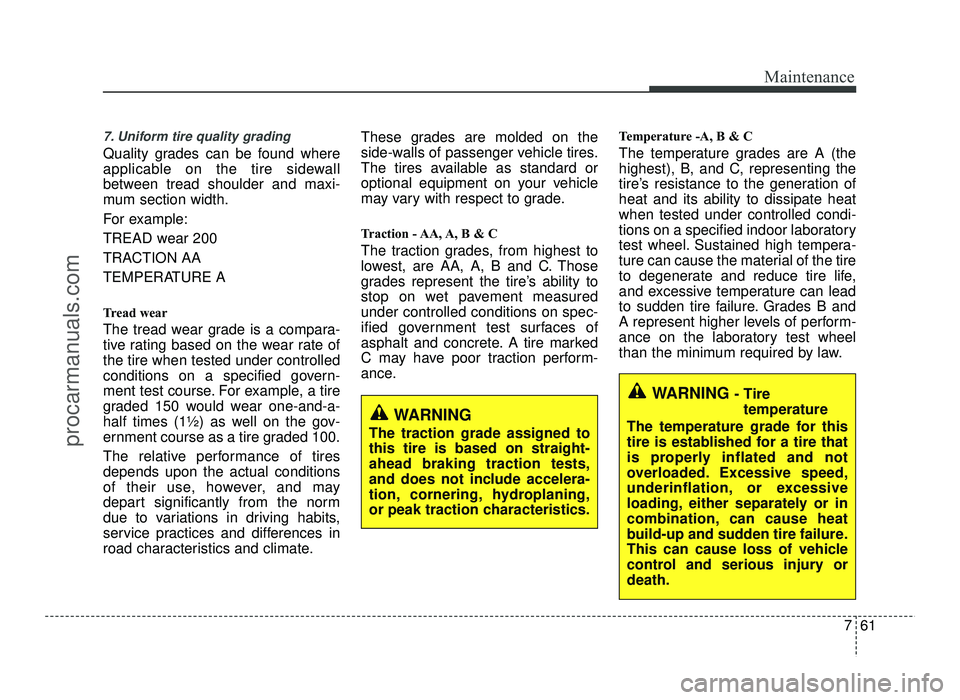
WARNING
The traction grade assigned to this tire is based on straight-ahead braking traction tests,
and does not include accelera-
tion, cornering, hydroplaning,
or peak traction characteristics.
WARNING - Tire
temperature
The temperature grade for this
tire is established for a tire that
is properly inflated and not
overloaded. Excessive speed,
underinflation, or excessive
loading, either separately or in
combination, can cause heat
build-up and sudden tire failure.
This can cause loss of vehicle
control and serious injury ordeath.
procarmanuals.com
Page 431 of 456
Maintenance
92
7
EMISSION CONTROL SYSTEM
The emission control system of your
vehicle is covered by a written limited
warranty. Please see the warranty infor-
mation contained in the Service Passport
in your vehicle.
Your vehicle is equipped with an emis- sion control system to meet all emission
regulations. There are three emission control sys-
tems which are as follows.
(1) Crankcase emission control system
(2) Evaporative emission control system(3) Exhaust emission control system In order to assure the proper function of
the emission control systems, it is recom-
mended that you have your vehicle
inspected and maintained by an author-
ized HYUNDAI dealer in accordance with
the maintenance schedule in this manual. Caution for the Inspection and
Maintenance Test (With Electronic
Stability Control (ESC) system)
To prevent the vehicle from misfir-
ing during dynamometer testing,
turn the Electronic Stability Control
(ESC) system off by pressing the
ESC switch.
After dynamometer testing is com- pleted, turn the ESC system back on
by pressing the ESC switch again. 1. Crankcase emission control
system
The positive crankcase ventilation sys-
tem is employed to prevent air pollution
caused by blow-by gases being emitted
from the crankcase. This system supplies
fresh filtered air to the crankcase through
the air intake hose. Inside the crankcase,
the fresh air mixes with blow-by gases,
which then pass through the PCV valveinto the induction system.
2. Evaporative emission control system
The Evaporative Emission Control
System is designed to prevent fuel
vapors from escaping into the atmos-
phere.
procarmanuals.com
Page 440 of 456
Specifications & Consumer information
6
8
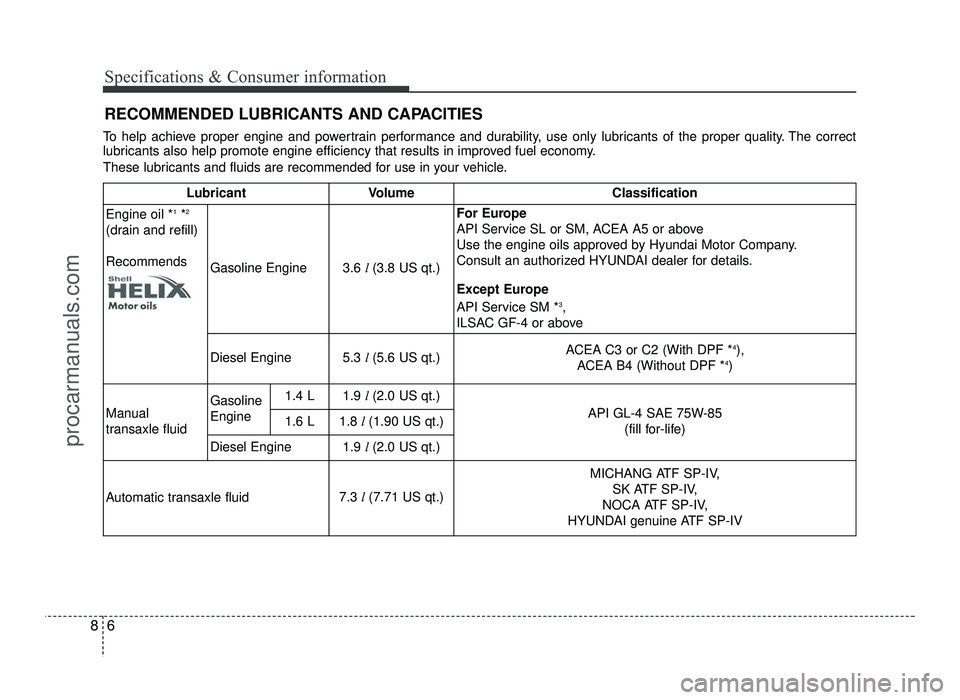
RECOMMENDED LUBRICANTS AND CAPACITIES
To help achieve proper engine and powertrain performance and durability, use only lubricants of the proper quality. The correct
lubricants also help promote engine efficiency that results in improved fuel economy.
These lubricants and fluids are recommended for use in your vehicle.
Lubricant Volume Classification
Engine oil * 1
*2
(drain and refill) Recommends Gasoline Engine 3.6
l (3.8 US qt.) For Europe
API Service SL or SM, ACEA A5 or above
Use the engine oils approved by Hyundai Motor Company.
Consult an authorized HYUNDAI dealer for details.
Except Europe
API Service SM *
3
,
ILSAC GF-4 or above
Diesel Engine 5.3
l (5.6 US qt.) ACEA C3 or C2 (With DPF *
4
),
ACEA B4 (Without DPF * 4
)
Manual
transaxle fluid GasolineEngine
1.4 L
1.9
l (2.0 US qt.)
API GL-4 SAE 75W-85(fill for-life)
1.6 L1.8l (1.90 US qt.)
Diesel Engine 1.9
l (2.0 US qt.)
Automatic transaxle fluid 7.3
l (7.71 US qt.) MICHANG ATF SP-IV,
SK ATF SP-IV,
NOCA ATF SP-IV,
HYUNDAI genuine ATF SP-IV
procarmanuals.com
Page 441 of 456
87
Specifications & Consumer information
*1
: Refer to the recommended SAE viscosity numbers on the next page.
* 2
: Engine oils labeled Energy Conserving Oil are now available. Along with other additional benefits, they contribute to fuel economy by reducing
the amount of fuel necessary to overcome engine friction. Often, these improvements are difficult to measure in everyday driving, but in a year’s
time, they can offer significant cost and energy savings.
* 3
: If the API service SM engine oil is not available in your country, you are able to use API service SL.
* 4
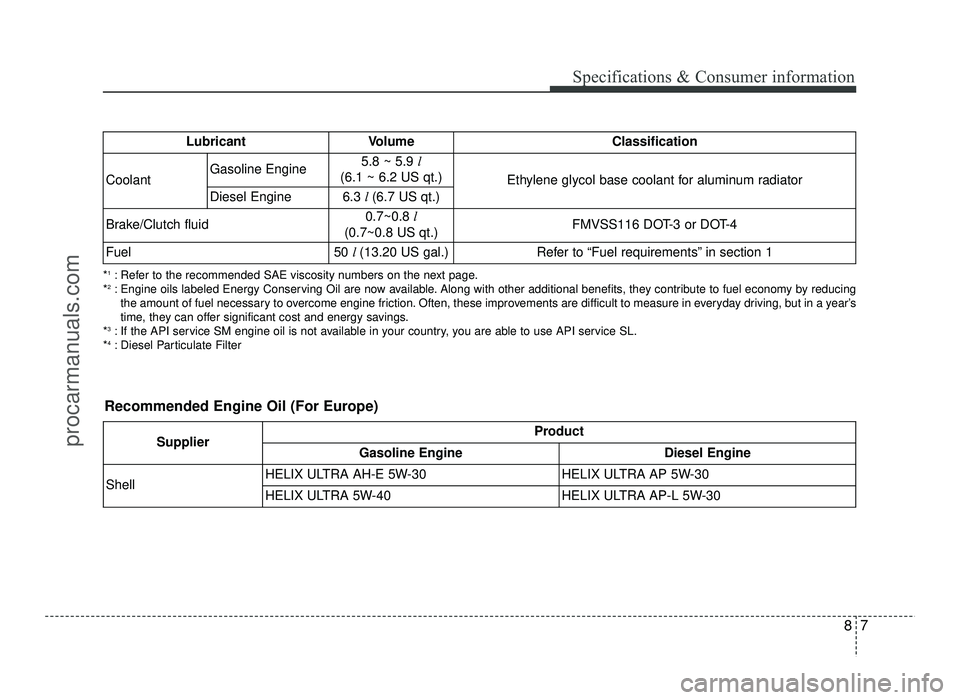
: Diesel Particulate Filter Lubricant Volume Classification
CoolantGasoline Engine5.8 ~ 5.9
l
(6.1 ~ 6.2 US qt.)
Ethylene glycol base coolant for aluminum radiator
Diesel Engine6.3 l (6.7 US qt.)
Brake/Clutch fluid0.7~0.8 l
(0.7~0.8 US qt.)FMVSS116 DOT-3 or DOT-4
Fuel50 l (13.20 US gal.)Refer to “Fuel requirements” in section 1
Recommended Engine Oil (For Europe)
Supplier Product
Gasoline Engine Diesel Engine
Shell HELIX ULTRA AH-E 5W-30 HELIX ULTRA AP 5W-30
HELIX ULTRA 5W-40 HELIX ULTRA AP-L 5W-30
procarmanuals.com
Page 442 of 456
Specifications & Consumer information
8
8
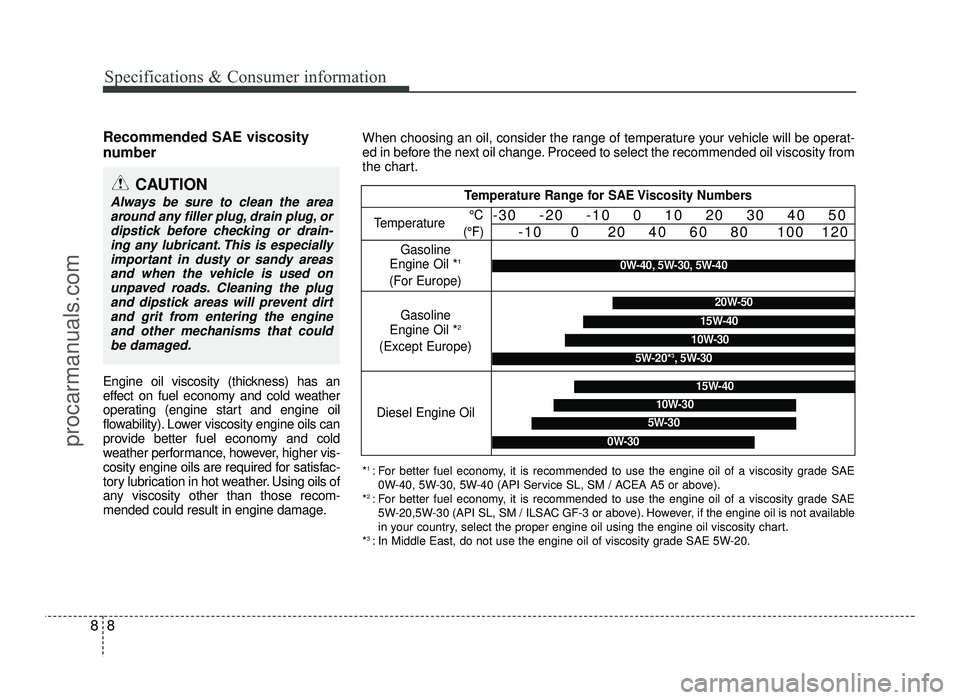
Recommended SAE viscosity
number
Engine oil viscosity (thickness) has an
effect on fuel economy and cold weather
operating (engine start and engine oil
flowability). Lower viscosity engine oils can
provide better fuel economy and cold
weather performance, however, higher vis-
cosity engine oils are required for satisfac-
tory lubrication in hot weather. Using oils of
any viscosity other than those recom-
mended could result in engine damage.
CAUTION
Always be sure to clean the area
around any filler plug, drain plug, or
dipstick before checking or drain-ing any lubricant. This is especially
important in dusty or sandy areasand when the vehicle is used onunpaved roads. Cleaning the plug
and dipstick areas will prevent dirtand grit from entering the engine
and other mechanisms that couldbe damaged.Temperature Range for SAE Viscosity Numbers
Temperature
Gasoline
Engine Oil * 1
(For Europe) °C
(°F)-30 -20 -10 0 10 20 30 40 50 -10 0 20 40 60 80 100 120
0W-40, 5W-30, 5W-40
Gasoline
Engine Oil * 2
(Except Europe)20W-50
10W-30
15W-40
5W-20* 3
, 5W-30
* 1
: For better fuel economy, it is recommended to use the engine oil of a viscosity grade SAE
0W-40, 5W-30, 5W-40 (API Service SL, SM / ACEA A5 or above).
* 2
: For better fuel economy, it is recommended to use the engine oil of a viscosity grade SAE
5W-20,5W-30 (API SL, SM / ILSAC GF-3 or above). However, if the engine oil is not available
in your country, select the proper engine oil using the engine oil viscosity chart.
* 3
: In Middle East, do not use the engine oil of viscosity grade SAE 5W-20.
Diesel Engine Oil5W-30
15W-40
10W-30
0W-30
When choosing an oil, consider the range of temperature your vehicle will be operat-
ed in before the next oil change. Proceed to select the recommended oil viscosity from
the chart.
procarmanuals.com
Page 445 of 456
811
Specifications & Consumer information
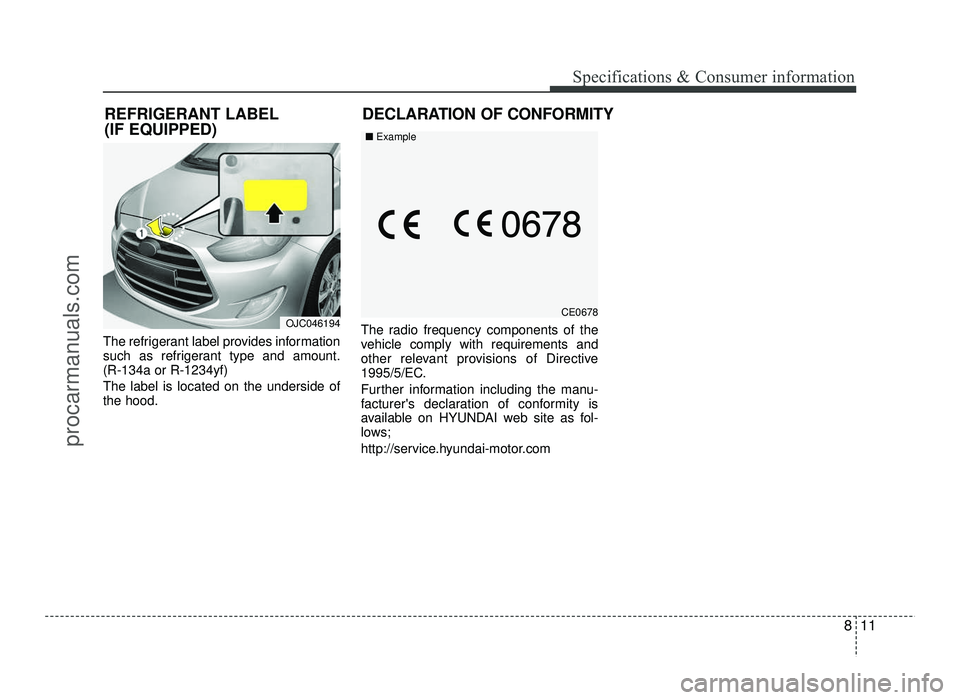
The refrigerant label provides information
such as refrigerant type and amount.(R-134a or R-1234yf) The label is located on the underside of the hood.The radio frequency components of the
vehicle comply with requirements and
other relevant provisions of Directive
1995/5/EC.
Further information including the manu-
facturer's declaration of conformity is
available on HYUNDAI web site as fol-
lows;
http://service.hyundai-motor.com
REFRIGERANT LABEL
(IF EQUIPPED)
DECLARATION OF CONFORMITY
CE0678
■
ExampleOJC046194
procarmanuals.com
Page 452 of 456
I7
Index
Rear fog light bulb replacement································7-82
Side repeater light bulb replacement·························7-78
Smart cornering light bulb replacement····················7-76
Static bending light bulb replacement·······················7-76
Turn signal light bulb replacement ···························7-77
Lighting ··········································································4-70 Battery saver function ··············································4-70
Daytime running light ···············································4-74
Front fog light ···························································4-74
Headlight escort function ··········································4-70
Headlight leveling device··········································4-75
Lighting control·························································4-71
Rear fog light ····························································4-74
Smart cornering light ················································4-70
Turn signals and lane change signals ························4-73
Lubricants and capacities ·················································8-6
Luggage boad ································································4-110
Luggage net (holder) ····················································4-110
Luggage room lamp ························································4-18 Main fuse ········································································7-66
Maintenance
Explanation of scheduled maintenance items ···········7-30Maintenance services ················································· 7-3
Maintenance under severe usage conditions ···7-17, 7-28 Normal maintenance schedule ···························7-8, 7-19
Owner maintenance ····················································7-5
Scheduled maintenance service ·································7-7
Tire maintenance ······················································7-58
Maintenance services ·······················································7-3
Manual climate control system ······································4-82 Air conditioning ·······················································4-87
Climate control air filter ··········································4-89
Heating and air conditioning ····································4-83
Manual heating and air conditioning ·····························4-93
Manual transaxle ····························································5-19
Map lamp ········································································4-80
Memory fuse ··································································7-65
Mirrors ···········································································4-36 Day/night rearview mirror ·······································4-36
Electric chromic mirror (ECM) ·······························4-36
Inside rearview mirror ··············································4-36
Outside rearview mirror ···········································4-37
Moonroof, see panorama sunroof ··································4-29
Multi fuse ·······································································7-63M
procarmanuals.com