Page 10 of 582
H3
Electric Vehicle
An electric vehicle is driven using a
battery and an electric motor. While
general vehicles use an internal
combustion engine and gasoline as
fuel, electric vehicles use electricalenergy that is charged inside the
high voltage battery. As a result,
electric vehicles are eco-friendly in
that they do not require fuel and do
not emit exhaust gases.
Characteristics of Electric
Vehicles
1.It is driven using the electricalenergy that is charged inside the
high voltage battery. This method
prevents air pollution since fuel,
like gasoline, is not required,
negating the emission of exhaust
gases.
2.A high performance motor is used in the vehicle as well. Compared to
standard, internal combustion
engine vehicles, engine noise and
vibrations are much more minimal
when driving.
3.When decelerating or driving downhill, regenerative braking is
utilized to charge the high voltage
battery. This minimizes energy lossand increases the distance to
empty.
4.When the battery charge is not suf- ficient, normal charge, quick
charge and trickle charge are avail-
able. (Refer to “Charge Types for
Electric Vehicle” for details.) Information
What does regenerative braking do?
It uses an electric motor when deceler-
ating and braking and transforms
kinetic energy to electrical energy in
order to charge the high voltage bat-
tery. (Torque is applied in the opposite
direction when decelerating to gener-
ate braking force and electric energy.)
Battery Information
The vehicle is composed of a high voltage battery that drives the
motor and air-conditioner, and an
auxiliary battery (12 V) that drives
the lamps, wipers, and audio sys-tem.
The auxiliary battery is automati- cally charged when the vehicle is in
the ready ( ) mode or the high
voltage battery is being charged.
i
EELLEE CCTT RR IICC VV EEHH IICC LLEE
Page 11 of 582
H4
MMAAIINN CC OO MM PPOO NNEENN TTSS OO FF EE LLEE CCTT RR IICC VV EEHH IICC LLEE
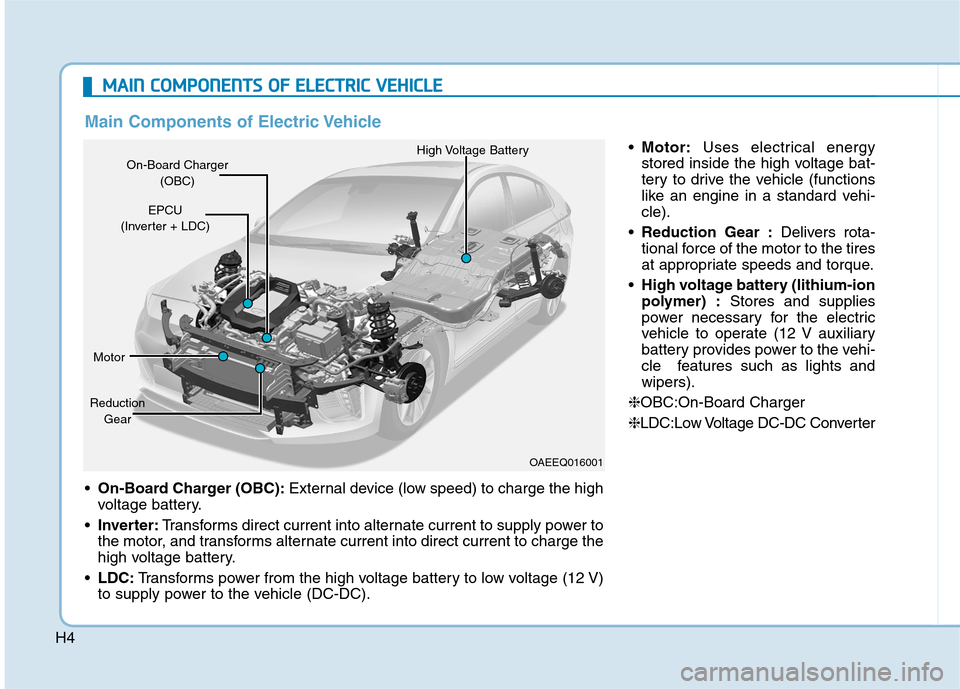
On-Board Charger (OBC): External device (low speed) to charge the high
voltage battery.
Inverter: Transforms direct current into alternate current to supply power to
the motor, and transforms alternate current into direct current to charge the
high voltage battery.
LDC: Transforms power from the high voltage battery to low voltage (12 V)
to supply power to the vehicle (DC-DC).
On-Board Charger (OBC) High Voltage Battery
EPCU
(Inverter + LDC)
Motor
Reduction Gear
Main Components of Electric Vehicle
Motor: Uses electrical energy
stored inside the high voltage bat-
tery to drive the vehicle (functions
like an engine in a standard vehi-cle).
Reduction Gear : Delivers rota-
tional force of the motor to the tires
at appropriate speeds and torque.
High voltage battery (lithium-ion
polymer) : Stores and supplies
power necessary for the electric
vehicle to operate (12 V auxiliary
battery provides power to the vehi-
cle features such as lights andwipers).
❈ OBC:On-Board Charger
❈ LDC:Low Voltage DC-DC Converter
OAEEQ016001
Page 22 of 582
H15
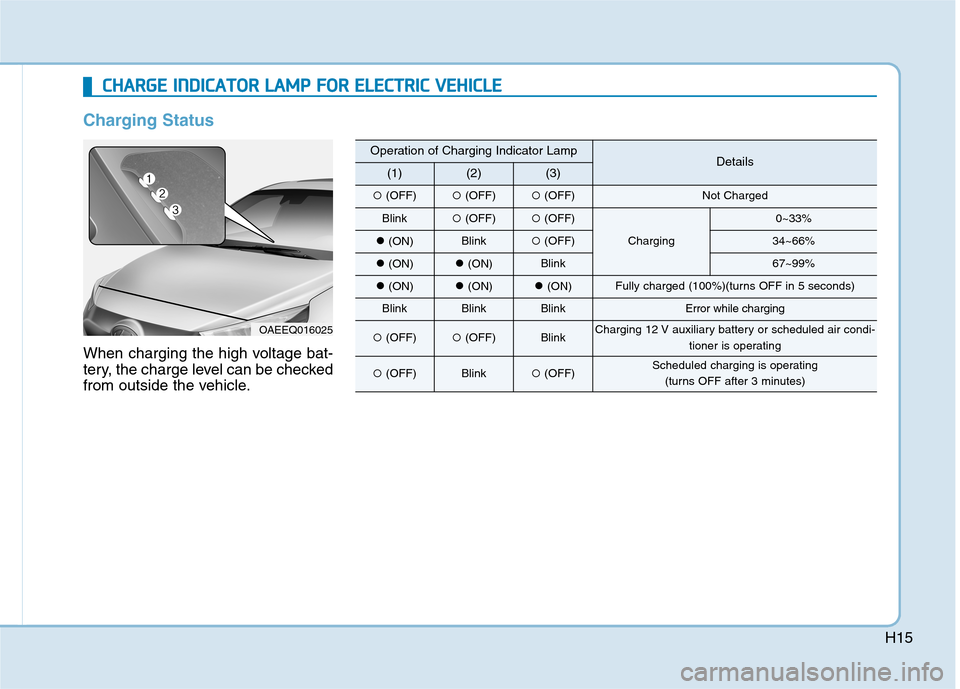
Charging Status
When charging the high voltage bat-
tery, the charge level can be checked
from outside the vehicle.
CCHH AARRGG EE IINN DDIICC AA TTOO RR LL AA MM PP FF OO RR EE LLEE CCTT RR IICC VV EEHH IICC LLEE
OAEEQ016025
Operation of Charging Indicator LampDetails(1)(2)(3)
(OFF) (OFF)(OFF)Not Charged
Blink (OFF)(OFF)
Charging
0~33%
(ON)Blink (OFF)34~66%
(ON)(ON)Blink67~99%
(ON)(ON)(ON)Fully charged (100%)(turns OFF in 5 seconds)
BlinkBlinkBlinkError while charging
(OFF) (OFF)BlinkCharging 12 V auxiliary battery or scheduled air condi-
tioner is operating
(OFF)Blink(OFF)Scheduled charging is operating
(turns OFF after 3 minutes)
Page 30 of 582
H23
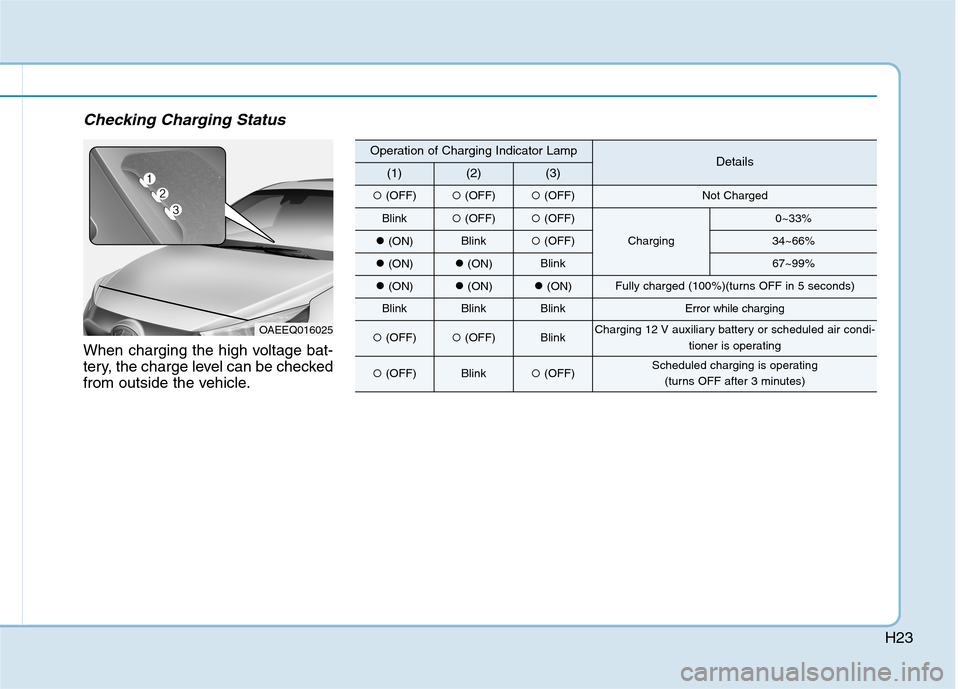
Checking Charging Status
When charging the high voltage bat-
tery, the charge level can be checked
from outside the vehicle.
OAEEQ016025
Operation of Charging Indicator LampDetails(1)(2)(3)
(OFF) (OFF)(OFF)Not Charged
Blink (OFF)(OFF)
Charging
0~33%
(ON)Blink (OFF)34~66%
(ON)(ON)Blink67~99%
(ON)(ON)(ON)Fully charged (100%)(turns OFF in 5 seconds)
BlinkBlinkBlinkError while charging
(OFF) (OFF)BlinkCharging 12 V auxiliary battery or scheduled air condi-
tioner is operating
(OFF)Blink(OFF)Scheduled charging is operating
(turns OFF after 3 minutes)
Page 36 of 582
H29
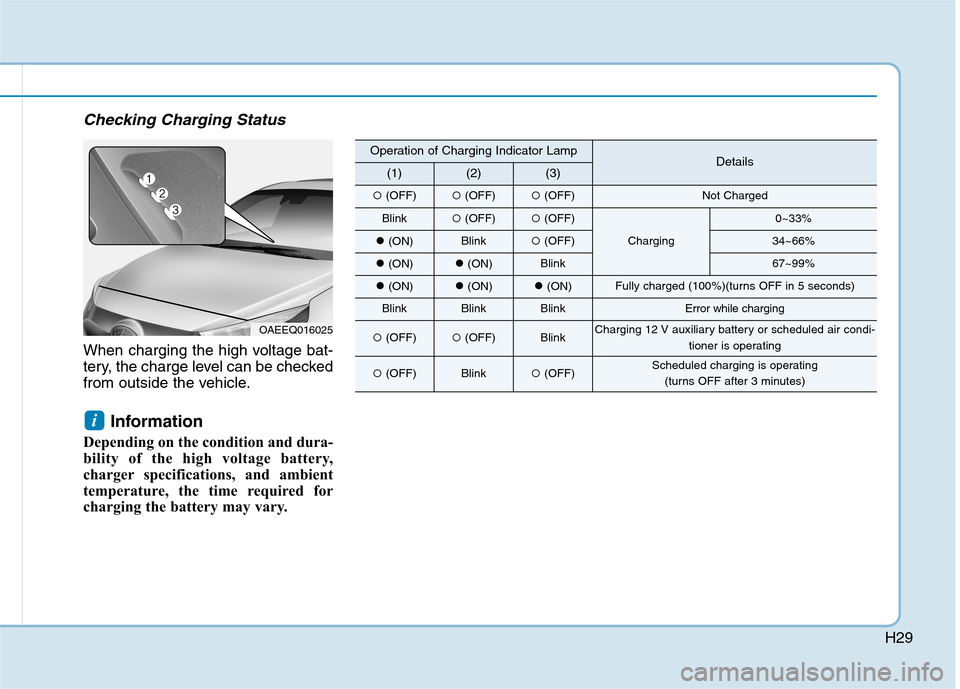
Checking Charging Status
When charging the high voltage bat-
tery, the charge level can be checked
from outside the vehicle.Information
Depending on the condition and dura-
bility of the high voltage battery,
charger specifications, and ambient
temperature, the time required for
charging the battery may vary.
i
Operation of Charging Indicator LampDetails(1)(2)(3)
(OFF) (OFF)(OFF)Not Charged
Blink (OFF)(OFF)
Charging
0~33%
(ON)Blink (OFF)34~66%
(ON)(ON)Blink67~99%
(ON)(ON)(ON)Fully charged (100%)(turns OFF in 5 seconds)
BlinkBlinkBlinkError while charging
(OFF) (OFF)BlinkCharging 12 V auxiliary battery or scheduled air condi-
tioner is operating
(OFF)Blink(OFF)Scheduled charging is operating
(turns OFF after 3 minutes)
OAEEQ016025
Page 42 of 582
H35
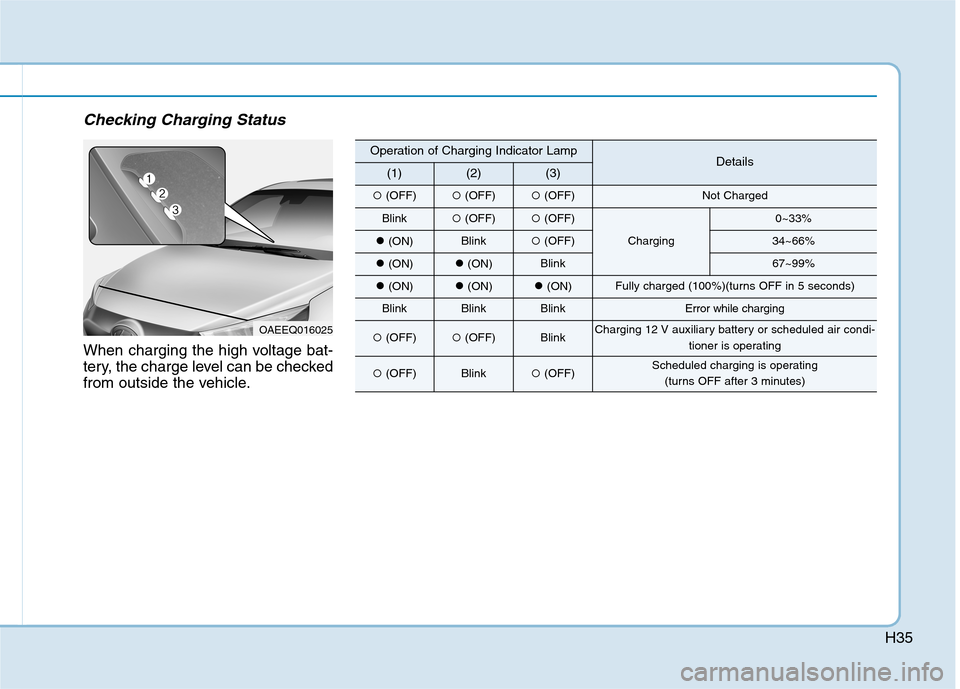
Checking Charging Status
When charging the high voltage bat-
tery, the charge level can be checked
from outside the vehicle.
OAEEQ016025
Operation of Charging Indicator LampDetails(1)(2)(3)
(OFF) (OFF)(OFF)Not Charged
Blink (OFF)(OFF)
Charging
0~33%
(ON)Blink (OFF)34~66%
(ON)(ON)Blink67~99%
(ON)(ON)(ON)Fully charged (100%)(turns OFF in 5 seconds)
BlinkBlinkBlinkError while charging
(OFF) (OFF)BlinkCharging 12 V auxiliary battery or scheduled air condi-
tioner is operating
(OFF)Blink(OFF)Scheduled charging is operating
(turns OFF after 3 minutes)
Page 52 of 582
H45
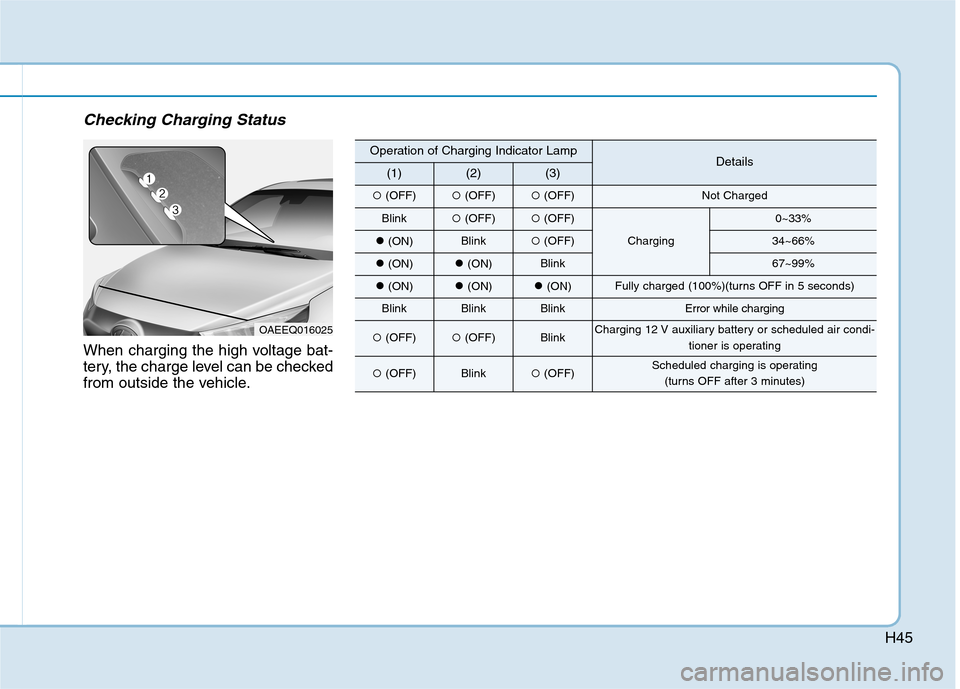
Checking Charging Status
When charging the high voltage bat-
tery, the charge level can be checked
from outside the vehicle.
OAEEQ016025
Operation of Charging Indicator LampDetails(1)(2)(3)
(OFF)(OFF) (OFF)Not Charged
Blink(OFF) (OFF)
Charging
0~33%
(ON)Blink (OFF)34~66%
(ON)(ON)Blink67~99%
(ON)(ON)(ON)Fully charged (100%)(turns OFF in 5 seconds)
BlinkBlinkBlinkError while charging
(OFF)(OFF)BlinkCharging 12 V auxiliary battery or scheduled air condi-
tioner is operating
(OFF)Blink(OFF)Scheduled charging is operating
(turns OFF after 3 minutes)
Page 58 of 582
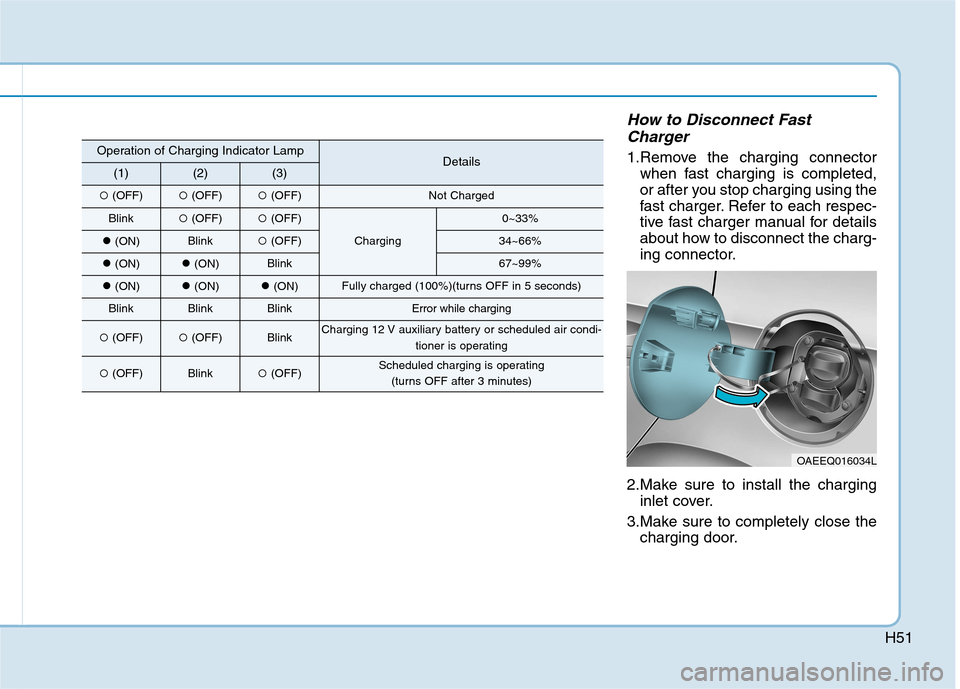
H51
How to Disconnect FastCharger
1.Remove the charging connector when fast charging is completed,
or after you stop charging using the
fast charger. Refer to each respec-
tive fast charger manual for details
about how to disconnect the charg-
ing connector.
2.Make sure to install the charging inlet cover.
3.Make sure to completely close the charging door.Operation of Charging Indicator LampDetails(1)(2)(3)
(OFF)(OFF)(OFF)Not Charged
Blink (OFF)(OFF)
Charging
0~33%
(ON)Blink (OFF)34~66%
(ON)(ON)Blink67~99%
(ON)(ON)(ON)Fully charged (100%)(turns OFF in 5 seconds)
BlinkBlinkBlinkError while charging
(OFF)(OFF)BlinkCharging 12 V auxiliary battery or scheduled air condi-
tioner is operating
(OFF)Blink(OFF)Scheduled charging is operating
(turns OFF after 3 minutes)
OAEEQ016034L