2017 Hyundai Ioniq Electric flat tire
[x] Cancel search: flat tirePage 502 of 582
7-36
Maintenance
Wheel replacement
When replacing the metal wheels for
any reason, make sure the new
wheels are equivalent to the original
factory units in diameter, rim widthand offset.
Tire traction
Tire traction can be reduced if you
drive on worn tires, tires that are
improperly inflated or on slippery
road surfaces. Tires should be
replaced when tread wear indicators
appear. To reduce the possibility of
losing control, slow down whenever
there is rain, snow or ice on the road.
Tire maintenance
In addition to proper inflation, correct wheel alignment helps to decrease
tire wear. If you find a tire is worn
unevenly, have your dealer check thewheel alignment.
When you have new tires installed,
make sure they are balanced. This
will increase vehicle ride comfort and
tire life. Additionally, a tire should
always be rebalanced if it is removedfrom the wheel.
Tire sidewall labeling
This information identifies and
describes the fundamental charac-
teristics of the tire and also provides
the tire identification number (TIN)
for safety standard certification. TheTIN can be used to identify the tire incase of a recall.
(Continued)
When replacing tires (or
wheels), it is recommended to
replace the two front or two
rear tires (or wheels) as a pair.Replacing just one tire can
seriously affect your vehicle’shandling.
Tires degrade over time, even
when they are not being used.
Regardless of the remaining
tread, HYUNDAI recommendsthat tires be replaced after six
(6) years of normal service.
Heat caused by hot climates or frequent high loading condi-
tions can accelerate the aging
process. Failure to follow this
warning may cause sudden
tire failure, which could lead to
a loss of vehicle control result-ing in an accident.
Page 504 of 582
7-38
Maintenance
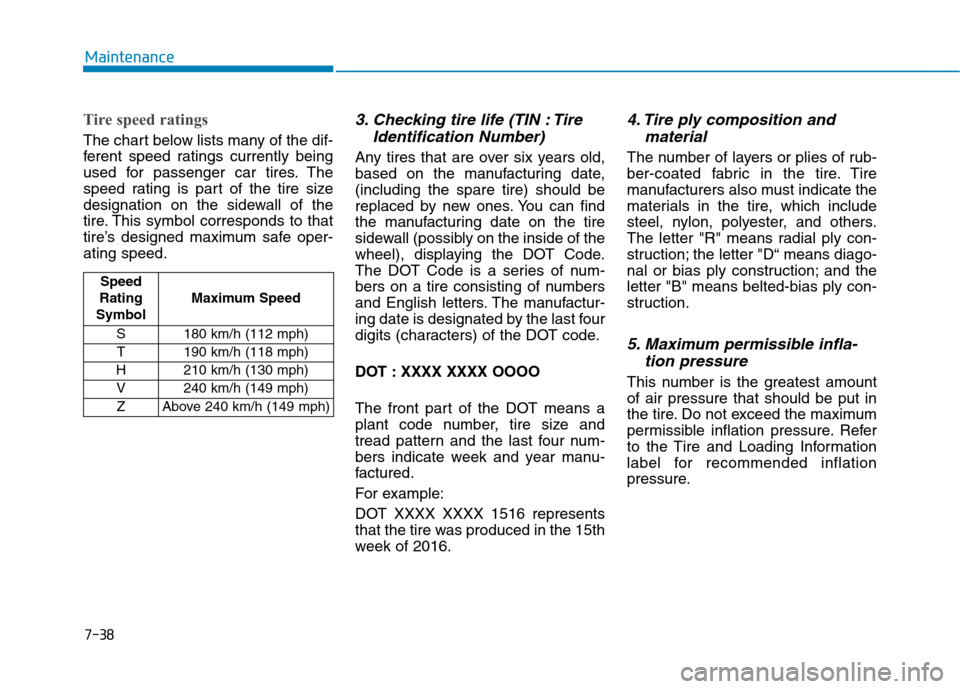
Tire speed ratings
The chart below lists many of the dif-
ferent speed ratings currently being
used for passenger car tires. The
speed rating is part of the tire size
designation on the sidewall of the
tire. This symbol corresponds to that
tire’s designed maximum safe oper-ating speed.
3. Checking tire life (TIN : TireIdentification Number)
Any tires that are over six years old,
based on the manufacturing date,(including the spare tire) should be
replaced by new ones. You can find
the manufacturing date on the tire
sidewall (possibly on the inside of the
wheel), displaying the DOT Code.
The DOT Code is a series of num-
bers on a tire consisting of numbers
and English letters. The manufactur-
ing date is designated by the last four
digits (characters) of the DOT code.
DOT : XXXX XXXX OOOO
The front part of the DOT means a
plant code number, tire size and
tread pattern and the last four num-
bers indicate week and year manu-
factured.
For example:
DOT XXXX XXXX 1516 represents
that the tire was produced in the 15th
week of 2016.
4. Tire ply composition andmaterial
The number of layers or plies of rub-
ber-coated fabric in the tire. Tire
manufacturers also must indicate the
materials in the tire, which include
steel, nylon, polyester, and others.
The letter "R" means radial ply con-
struction; the letter "D“ means diago-
nal or bias ply construction; and theletter "B" means belted-bias ply con-
struction.
5. Maximum permissible infla-tion pressure
This number is the greatest amountof air pressure that should be put in
the tire. Do not exceed the maximum
permissible inflation pressure. Refer
to the Tire and Loading Information
label for recommended inflation
pressure.
Speed
Rating
Symbol Maximum Speed
S 180 km/h (112 mph) T 190 km/h (118 mph)
H 210 km/h (130 mph) V 240 km/h (149 mph) Z Above 240 km/h (149 mph)
Page 506 of 582
7-40
Maintenance
Temperature - A, B & C
The temperature grades are A (the highest), B and C representing the
tire’s resistance to the generation ofheat and its ability to dissipate heatwhen tested under controlled condi-
tions on a specified indoor laboratorytest wheel.
Sustained high temperature can
cause the material of the tire to
degenerate and reduce tire life, and
excessive temperature can lead to
sudden tire failure. Grades B and A
represent higher levels of perform-
ance on the laboratory test wheel
than the minimum required by law.
Low aspect ratio tires
A low aspect ratio tire, of which the
aspect ratio is lower than 50, is
designed for a sporty-look vehicle.
The low aspect ratio is to optimize
handling and braking. Thus, it may
be uncomfortable to ride and it may
generate noises, in comparison with
a normal tire.
The temperature grade for this
tire is established for a tire that
is properly inflated and not
overloaded. Excessive speed,
under-inflation, over-inflation,
or excessive loading, either
separately or in combination,
can cause heat build-up and
possible sudden tire failure.
This may cause loss of vehicle
control resulting in an accident.WARNING
Page 528 of 582
7-62
Maintenance
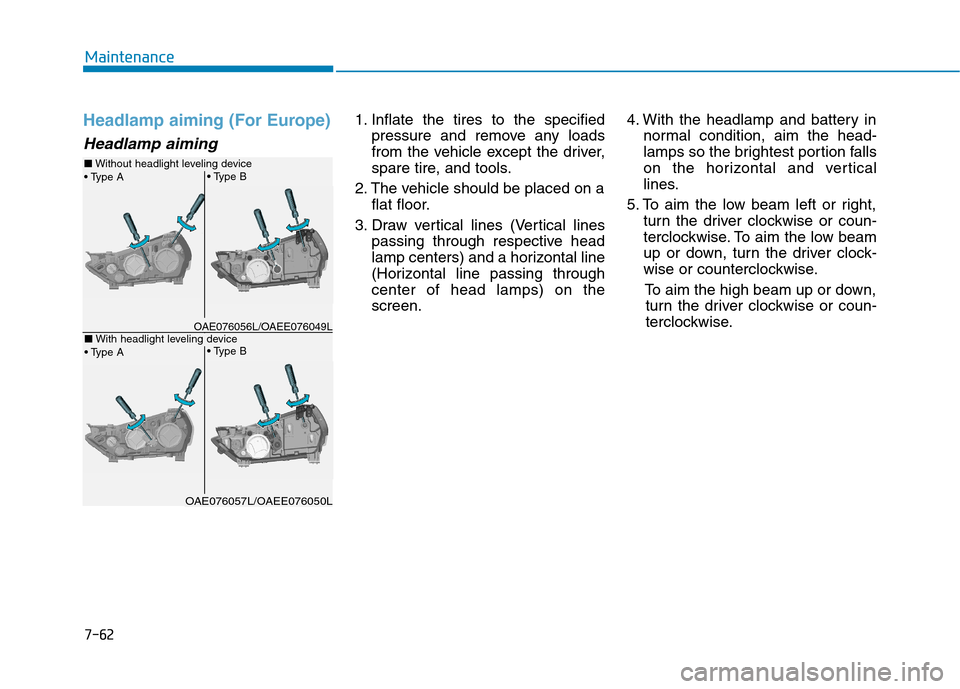
Headlamp aiming (For Europe)
Headlamp aiming
1. Inflate the tires to the specifiedpressure and remove any loads
from the vehicle except the driver,
spare tire, and tools.
2. The vehicle should be placed on a flat floor.
3. Draw vertical lines (Vertical lines passing through respective head
lamp centers) and a horizontal line
(Horizontal line passing throughcenter of head lamps) on thescreen. 4. With the headlamp and battery in
normal condition, aim the head-
lamps so the brightest portion falls
on the horizontal and vertical
lines.
5. To aim the low beam left or right, turn the driver clockwise or coun-
terclockwise. To aim the low beam
up or down, turn the driver clock-
wise or counterclockwise.
To aim the high beam up or down,turn the driver clockwise or coun-
terclockwise.
A B
B
A
OAE076056L/OAEE076049L
■ Without headlight leveling device
OAE076057L/OAEE076050L
■With headlight leveling device
Page 547 of 582
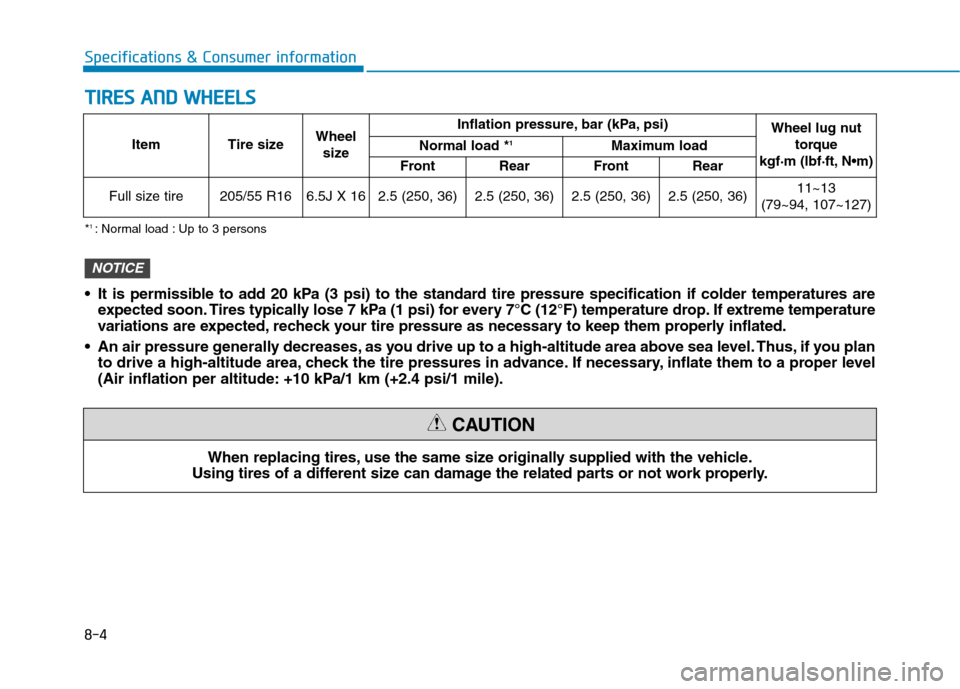
8-4
Specifications & Consumer informationT
T IIRR EESS AA NN DD WW HHEEEELLSS
Item Tire size Wheel
size Inflation pressure, bar (kPa, psi)
Wheel lug nut
torque
kgf·m (lbf·ft, N
Normal load *
1
Maximum load
Front Rear Front Rear
Full size tire 205/55 R16 6.5J X 16 2.5 (250, 36) 2.5 (250, 36) 2.5 (250, 36) 2.5 (250, 36) 11~13
(79~94, 107~127)
When replacing tires, use the same size originally supplied with the vehicle.
Using tires of a different size can damage the related parts or not work properly.
CAUTION
* 1
: Normal load : Up to 3 persons
It is permissible to add 20 kPa (3 psi) to the standard tire pressure specification if colder temperatures are expected soon. Tires typically lose 7 kPa (1 psi) for every 7°C (12°F) temperature drop. If extreme temperature
variations are expected, recheck your tire pressure as necessary to keep them properly inflated.
An air pressure generally decreases, as you drive up to a high-altitude area above sea level. Thus, if you plan to drive a high-altitude area, check the tire pressures in advance. If necessary, inflate them to a proper level
(Air inflation per altitude: +10 kPa/1 km (+2.4 psi/1 mile).
NOTICE
Page 572 of 582
I-3
Battery (12 volt) ...........................................................7-27
Battery recharging......................................................7-29
Battery cooling duct .....................................................2-24
Battery saver function...................................................3-81
Before driving .................................................................5-3
Blind spot detection (BSD) system ..............................5-40
Bluetooth ®
Wireless Technology hands-free..................4-4
Bottle holder ...............................................................3-119
Brake fluid ....................................................................7-21
Brake system.................................................................5-19
Anti-lock brake system (ABS) ..................................5-29
Auto hold ...................................................................5-25
Disc brakes wear indicator ........................................5-20
Electronic parking brake (EPB).................................5-20
Electronic stability control (ESC) .............................5-31
Good braking practices ..............................................5-37
Hill-start assist control (HAC)...................................5-36
Power brakes..............................................................5-19
Vehicle stability management (VSM) .......................5-35
Bulb replacement ..........................................................7-57
Daytime running lamp ...............................................7-66
Front position lamp....................................................7-58
Front turn signal lamp ...............................................7-58
Headlamp ...................................................................7-58
Headlamp aiming .......................................................7-62
High mounted stop lamp ...........................................7-69 Interior light bulb .......................................................7-69
License plate light bulb .............................................7-69
Rear combination light bulb ......................................7-66
Rear fog lamp ............................................................7-69
Side repeater lamp ....................................................7-66
Bulb wattage ...................................................................8-3
Camera (Rear view)......................................................3-90
Capacities (Lubricants) ...................................................3-6
Care Exterior care...............................................................7-71
Interior care................................................................7-76
Tire care .....................................................................7-31
Cargo security screen .................................................3-126
Cellular phone holder .................................................3-122
Center console storage ................................................3-116
Central door lock switch...............................................3-10
Certification label ...........................................................8-7
Chains Tire chains..................................................................5-97
Checking tire inflation pressure ...................................7-33
Child restraint system (CRS)........................................2-37 Booster seats ..............................................................2-39
Forward-facing child restraint system .......................2-39
Installing a child restraint system (CRS)...................2-40
ISOFIX anchorage and top-tether anchorage for children....................................................................2-41
I
Index
B
C
Page 574 of 582
I-5
Easy access function .....................................................3-14
ECO guide ....................................................................3-37
ECO mode ....................................................................5-38
Electric chromic mirror (ECM) ....................................3-18
Electric power steering (EPS) ......................................3-15
Electric vehicle specifications ........................................8-2
Electronic parking brake (EPB) ...................................5-20
Electronic stability control (ESC) ................................5-31
Emergency towing ........................................................6-24
EPB (Electronic Parking Brake)...................................5-20
Explanation of scheduled maintenance items ..............7-16
Exterior care .................................................................7-71
Exterior overview
Front view ....................................................................1-2
Rear view .....................................................................1-4
Flat tire Tire Mobility Kit (TMK) ...........................................6-15
Floor mat anchor(s) ....................................................3-123
Fluid Brake fluid .................................................................7-21
Washer fluid ...............................................................7-22 Front seat adjustment......................................................2-7
Adjusting the height up and down.............................2-17
Forward and rearward adjustment .............................2-18
Manual adjustment.......................................................2-8
Front seat headrests
Power adjustment.......................................................2-10
Removal/Reinstall......................................................2-18
Seatback pocket .........................................................2-13
Fuse switch ...................................................................7-44
Fuse/relay panel description Battery terminal cover ...............................................7-56
Instrument panel fuse panel .......................................7-45
Motor compartment fuse panel ..................................7-51
Fuses .............................................................................7-42 Fuse switch ................................................................7-44
Fuse/relay panel description ......................................7-45
Instrument panel fuse replacement ............................7-43
Motor compartment panel fuse replacement .............7-44
Multi fuse ...................................................................7-45
Gauges and meters........................................................3-37
Glove box....................................................................3-117
Gross vehicle weight ......................................................8-5
I
Index
E
F
G
Page 575 of 582
I-6Hazard warning flasher...................................................6-2
Hazardous driving conditions .......................................5-93
Headlamp delay function..............................................3-81
Headlamp leveling device ............................................3-82
Headlamp position ........................................................3-78
Headlight bulb replacement..........................................7-67
Headrest ........................................................................2-16
Front seat headrests ...................................................2-17
Rear seat headrests.....................................................2-20
Heated steering wheel...................................................3-16
Heater............................................................................3-98
Height adjustment .........................................................2-30
High beam operation ....................................................3-78
Highway driving ...........................................................5-95
Hill-start assist control (HAC) .....................................5-36
Hood .............................................................................3-31
Horn ..............................................................................3-17
How to use this manual ..................................................F-5
If the vehicle doesn't turn over or turns over slowly .....6-4
If the vehicle overheats...................................................6-8
If the vehicle stalls at a crossroad or crossing................6-2
If the vehicle stalls while driving ...................................6-2
If the vehicle turns over normally but doesn't start........6-4
If the vehicle will not start .............................................6-4 If you have a flat tire ....................................................6-16
If you have a flat tire while driving ...............................6-3
Immobilizer system ........................................................3-7
Impact sensing door unlock ..........................................3-11
Important safety precautions ..........................................2-2
Air bag hazards ............................................................2-2
Always wear your seat belt..........................................2-2
Control your speed.......................................................2-3
Driver distraction .........................................................2-2
Keep your vehicle in safe condition ............................2-3
Restrain all children .....................................................2-2
In case of emergency while driving ...............................6-2
Indicator light ...............................................................3-41
Inside rearview mirror ..................................................3-17
Instrument cluster .........................................................3-35 Assist mode................................................................3-68
Gauges and meters .....................................................3-37
Instrument panel illumination....................................3-36
LCD display control ..................................................3-65
LCD display messages...............................................3-52
LCD modes ................................................................3-66
Reduction gear shift indicator ...................................3-40
Regenerative braking rate indicator...........................3-41
Shift indicator pop-up ................................................3-40
Trip computer ............................................................3-73
User settings mode.....................................................3-69
Warning and indicator lights......................................3-41
Instrument panel fuse replacement ...............................7-43
Instrument panel overview .............................................1-8
Index
H
I