2017 HYUNDAI ELANTRA SE parking brake
[x] Cancel search: parking brakePage 478 of 586
7-18
Maintenance
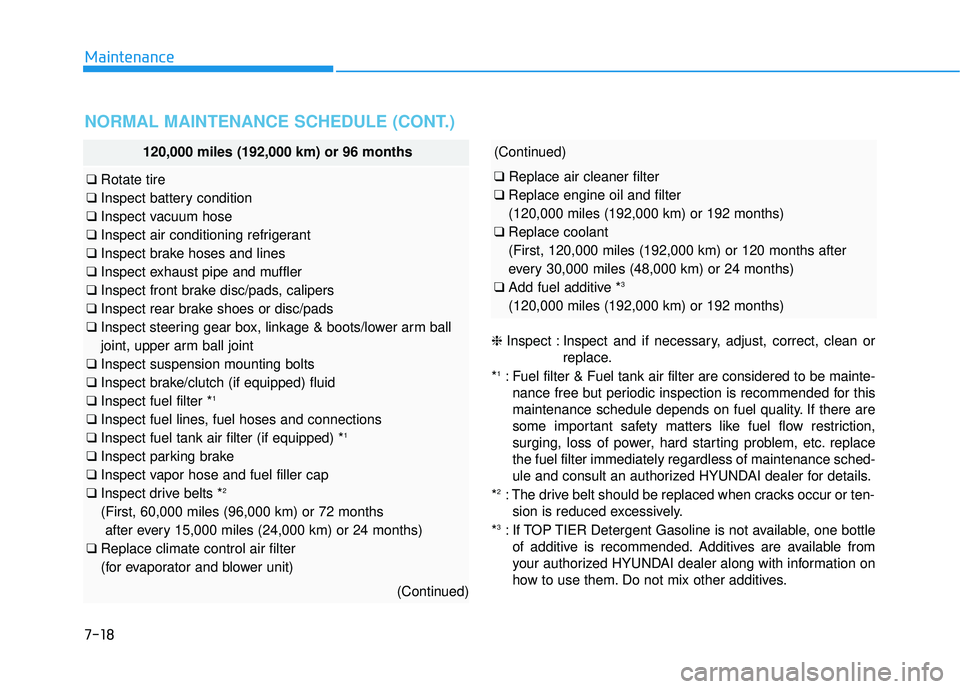
NORMAL MAINTENANCE SCHEDULE (CONT.)
120,000 miles (192,000 km) or 96 months
❑Rotate tire
❑ Inspect battery condition
❑ Inspect vacuum hose
❑ Inspect air conditioning refrigerant
❑ Inspect brake hoses and lines
❑ Inspect exhaust pipe and muffler
❑ Inspect front brake disc/pads, calipers
❑ Inspect rear brake shoes or disc/pads
❑ Inspect steering gear box, linkage & boots/lower arm ball
joint, upper arm ball joint
❑ Inspect suspension mounting bolts
❑ Inspect brake/clutch (if equipped) fluid
❑ Inspect fuel filter *
1
❑Inspect fuel lines, fuel hoses and connections
❑ Inspect fuel tank air filter (if equipped) *1
❑Inspect parking brake
❑ Inspect vapor hose and fuel filler cap
❑ Inspect drive belts *
2
(First, 60,000 miles (96,000 km) or 72 months
after every 15,000 miles (24,000 km) or 24 months)
❑ Replace climate control air filter
(for evaporator and blower unit)
(Continued)
(Continued)
❑ Replace air cleaner filter
❑ Replace engine oil and filter
(120,000 miles (192,000 km) or 192 months)
❑ Replace coolant
(First, 120,000 miles (192,000 km) or 120 months after
every 30,000 miles (48,000 km) or 24 months)
❑ Add fuel additive *
3
(120,000 miles (192,000 km) or 192 months)
❈ Inspect : Inspect and if necessary, adjust, correct, clean or
replace.
*
1: Fuel filter & Fuel tank air filter are considered to be mainte- nance free but periodic inspection is recommended for this
maintenance schedule depends on fuel quality. If there are
some important safety matters like fuel flow restriction,
surging, loss of power, hard starting problem, etc. replace
the fuel filter immediately regardless of maintenance sched-
ule and consult an authorized HYUNDAI dealer for details.
*
2: The drive belt should be replaced when cracks occur or ten- sion is reduced excessively.
*
3: If TOP TIER Detergent Gasoline is not available, one bottle of additive is recommended. Additives are available from
your authorized HYUNDAI dealer along with information on
how to use them. Do not mix other additives.
Page 480 of 586
7-20
Maintenance
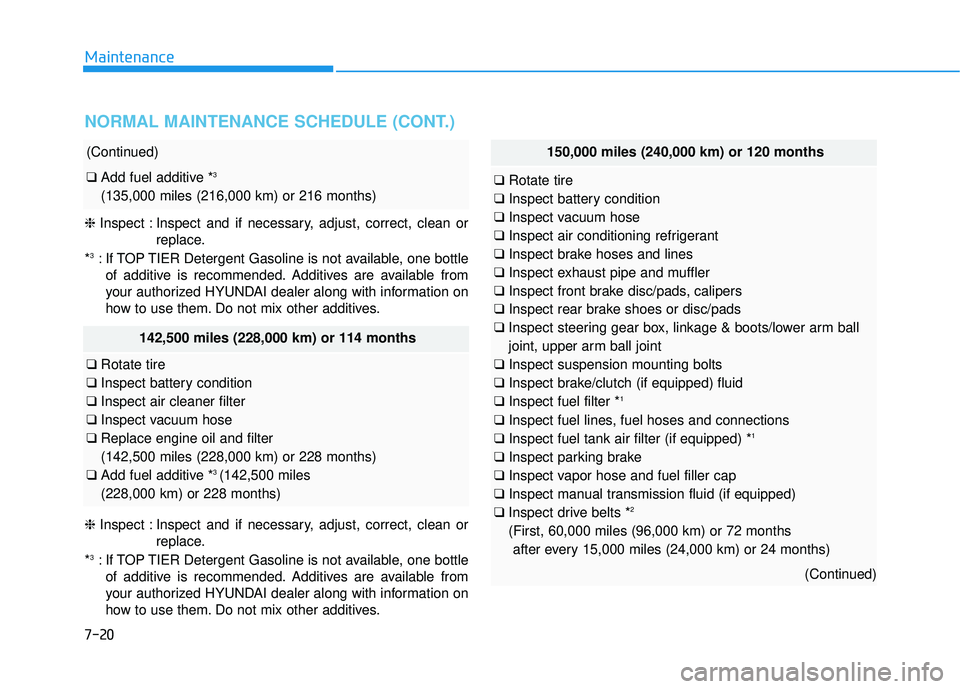
150,000 miles (240,000 km) or 120 months
❑Rotate tire
❑ Inspect battery condition
❑ Inspect vacuum hose
❑ Inspect air conditioning refrigerant
❑ Inspect brake hoses and lines
❑ Inspect exhaust pipe and muffler
❑ Inspect front brake disc/pads, calipers
❑ Inspect rear brake shoes or disc/pads
❑ Inspect steering gear box, linkage & boots/lower arm ball
joint, upper arm ball joint
❑ Inspect suspension mounting bolts
❑ Inspect brake/clutch (if equipped) fluid
❑ Inspect fuel filter *
1
❑Inspect fuel lines, fuel hoses and connections
❑ Inspect fuel tank air filter (if equipped) *1
❑Inspect parking brake
❑ Inspect vapor hose and fuel filler cap
❑ Inspect manual transmission fluid (if equipped)
❑ Inspect drive belts *
2
(First, 60,000 miles (96,000 km) or 72 months
after every 15,000 miles (24,000 km) or 24 months)
(Continued)
NORMAL MAINTENANCE SCHEDULE (CONT.)
(Continued)
❑ Add fuel additive *3
(135,000 miles (216,000 km) or 216 months)
142,500 miles (228,000 km) or 114 months
❑ Rotate tire
❑ Inspect battery condition
❑ Inspect air cleaner filter
❑ Inspect vacuum hose
❑ Replace engine oil and filter
(142,500 miles (228,000 km) or 228 months)
❑ Add fuel additive *
3 (142,500 miles
(228,000 km) or 228 months)
❈ Inspect : Inspect and if necessary, adjust, correct, clean or
replace.
*
3: If TOP TIER Detergent Gasoline is not available, one bottle of additive is recommended. Additives are available from
your authorized HYUNDAI dealer along with information on
how to use them. Do not mix other additives.
❈ Inspect : Inspect and if necessary, adjust, correct, clean or
replace.
*
3: If TOP TIER Detergent Gasoline is not available, one bottle of additive is recommended. Additives are available from
your authorized HYUNDAI dealer along with information on
how to use them. Do not mix other additives.
Page 483 of 586
7-23
7
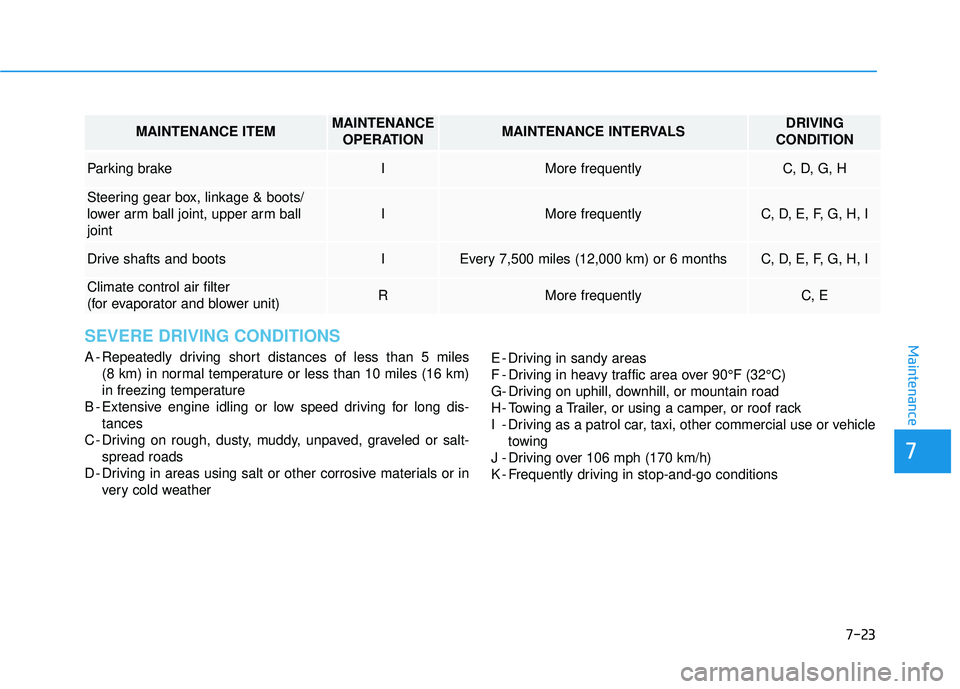
MaintenanceSEVERE DRIVING CONDITIONS
A - Repeatedly driving short distances of less than 5 miles (8 km) in normal temperature or less than 10 miles (16 km)
in freezing temperature
B - Extensive engine idling or low speed driving for long dis- tances
C - Driving on rough, dusty, muddy, unpaved, graveled or salt- spread roads
D - Driving in areas using salt or other corrosive materials or in very cold weather E - Driving in sandy areas
F - Driving in heavy traffic area over 90°F (32°C)
G- Driving on uphill, downhill, or mountain road
H - Towing a Trailer, or using a camper, or roof rack
I - Driving as a patrol car, taxi, other commercial use or vehicle
towing
J - Driving over 106 mph (170 km/h)
K - Frequently driving in stop-and-go conditions
MAINTENANCE ITEMMAINTENANCE OPERATIONMAINTENANCE INTERVALSDRIVING
CONDITION
Parking brakeIMore frequentlyC, D, G, H
Steering gear box, linkage & boots/
lower arm ball joint, upper arm ball
joint
IMore frequentlyC, D, E, F, G, H, I
Drive shafts and bootsIEvery 7,500 miles (12,000 km) or 6 monthsC, D, E, F, G, H, I
Climate control air filter
(for evaporator and blower unit)RMore frequentlyC, E
Page 487 of 586
7-27
7
Maintenance
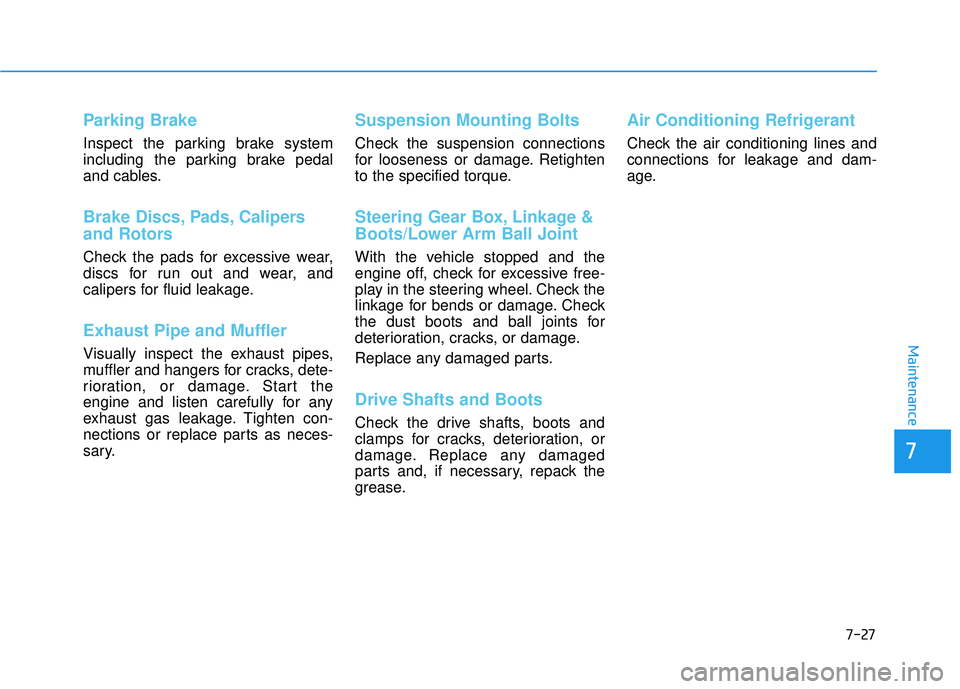
Parking Brake
Inspect the parking brake system
including the parking brake pedal
and cables.
Brake Discs, Pads, Calipers
and Rotors
Check the pads for excessive wear,
discs for run out and wear, and
calipers for fluid leakage.
Exhaust Pipe and Muffler
Visually inspect the exhaust pipes,
muffler and hangers for cracks, dete-
rioration, or damage. Start the
engine and listen carefully for any
exhaust gas leakage. Tighten con-
nections or replace parts as neces-
sary.
Suspension Mounting Bolts
Check the suspension connections
for looseness or damage. Retighten
to the specified torque.
Steering Gear Box, Linkage &
Boots/Lower Arm Ball Joint
With the vehicle stopped and the
engine off, check for excessive free-
play in the steering wheel. Check the
linkage for bends or damage. Check
the dust boots and ball joints for
deterioration, cracks, or damage.
Replace any damaged parts.
Drive Shafts and Boots
Check the drive shafts, boots and
clamps for cracks, deterioration, or
damage. Replace any damaged
parts and, if necessary, repack the
grease.
Air Conditioning Refrigerant
Check the air conditioning lines and
connections for leakage and dam-
age.
Page 488 of 586
7-28
Maintenance
E
EN
N G
GI
IN
N E
E
O
O I
IL
L
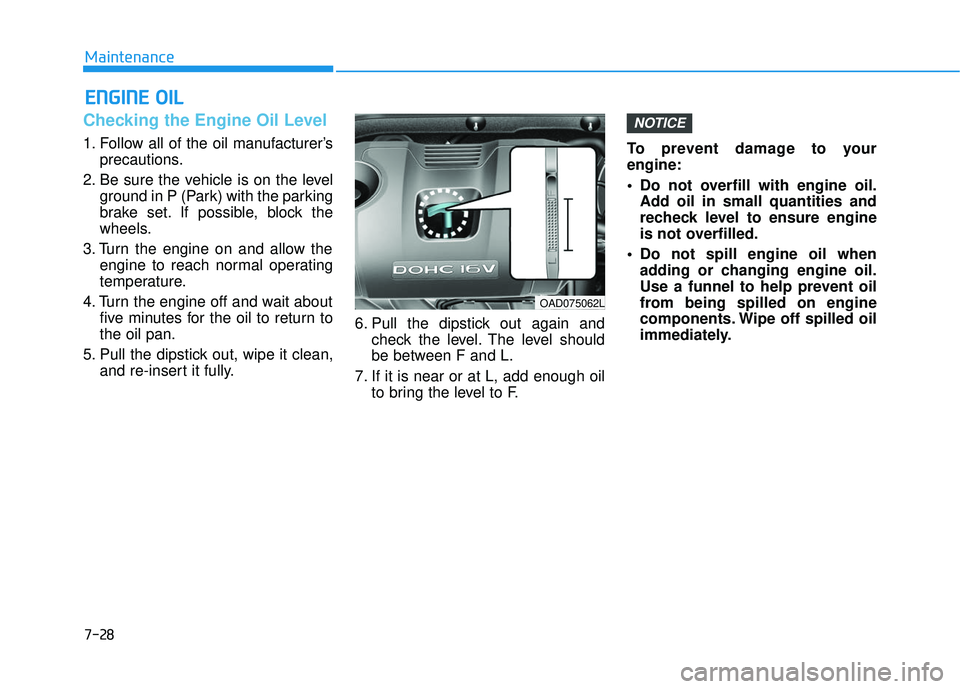
Checking the Engine Oil Level
1. Follow all of the oil manufacturer’s
precautions.
2. Be sure the vehicle is on the level ground in P (Park) with the parking
brake set. If possible, block the
wheels.
3. Turn the engine on and allow the engine to reach normal operating
temperature.
4. Turn the engine off and wait about five minutes for the oil to return to
the oil pan.
5. Pull the dipstick out, wipe it clean, and re-insert it fully. 6. Pull the dipstick out again and
check the level. The level should
be between F and L.
7. If it is near or at L, add enough oil to bring the level to F. To prevent damage to your
engine:
Do not overfill with engine oil.
Add oil in small quantities and
recheck level to ensure engine
is not overfilled.
Do not spill engine oil when adding or changing engine oil.
Use a funnel to help prevent oil
from being spilled on engine
components. Wipe off spilled oil
immediately.
NOTICE
OAD075062L
Page 494 of 586
7-34
Maintenance
W
WA
AS
SH
H E
ER
R
F
F L
LU
U I
ID
D
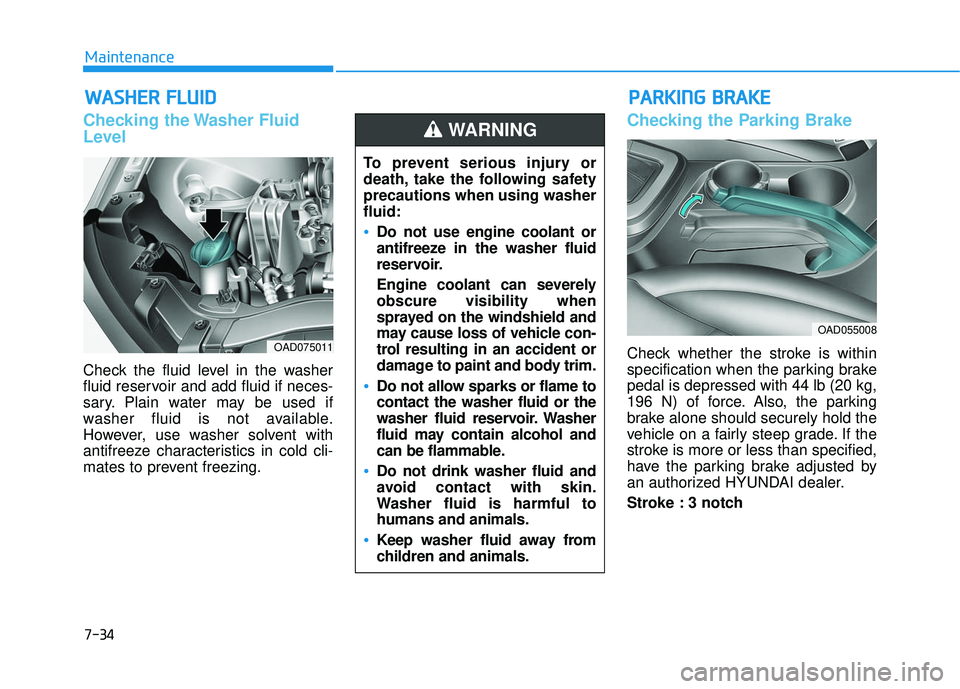
Checking the Washer Fluid
Level
Check the fluid level in the washer
fluid reservoir and add fluid if neces-
sary. Plain water may be used if
washer fluid is not available.
However, use washer solvent with
antifreeze characteristics in cold cli-
mates to prevent freezing.
Checking the Parking Brake
Check whether the stroke is within
specification when the parking brake
pedal is depressed with 44 lb (20 kg,
196 N) of force. Also, the parking
brake alone should securely hold the
vehicle on a fairly steep grade. If the
stroke is more or less than specified,
have the parking brake adjusted by
an authorized HYUNDAI dealer.
Stroke : 3 notchOAD075011
OAD055008
P
P A
A R
RK
K I
IN
N G
G
B
B R
RA
A K
KE
E
To prevent serious injury or
death, take the following safety
precautions when using washer
fluid:
Do not use engine coolant or
antifreeze in the washer fluid
reservoir.
Engine coolant can severely
obscure visibility when
sprayed on the windshield and
may cause loss of vehicle con-
trol resulting in an accident or
damage to paint and body trim.
Do not allow sparks or flame to
contact the washer fluid or the
washer fluid reservoir. Washer
fluid may contain alcohol and
can be flammable.
Do not drink washer fluid and
avoid contact with skin.
Washer fluid is harmful to
humans and animals.
Keep washer fluid away from
children and animals.
WARNING
Page 532 of 586
7-72
Maintenance
L
LI
IG
G H
H T
T
B
B U
U L
LB
B S
S
Consult an authorized HYUNDAI
dealer to replace most vehicle light
bulbs. It is difficult to replace vehicle
light bulbs because other parts of the
vehicle must be removed before you
can get to the bulb. This is especially
true for removing the headlamp
assembly to get to the bulb(s).
Removing/installing the headlamp
assembly can result in damage to
the vehicle.Information
After heavy driving, rain or washing,
headlamp and trunk lenses could
appear frosty. This condition is caused
by the temperature difference
between the lamp inside and the out-
side temperature. This is similar to the
condensation on your windows inside
your vehicle during the rain and does-
n’t indicate a problem with your vehi-
cle. If the water leaks into the lamp
bulb circuitry, have your vehicle
checked by an authorized HYUNDAI
dealer.
i
Prior to replacing a lamp,
depress the foot brake, move
the shift lever into P (Park)
apply the parking brake, place
the igntion switch to the
LOCK/OFF position, and take
the key with you when leaving
the vehicle to avoid sudden
movement of the vehicle and
to prevent possible electric
shock.
Be aware the bulbs may be
hot and may burn your fin-
gers.
WARNING
Page 576 of 586
I-3
Automatic climate control system ................................3-133Air conditioning .......................................................3-140
Air Conditioning refrigerant label............................3-144
Air intake control .....................................................3-139
Automatic heating and air conditioning ...................3-134
Fan speed control .....................................................3-140
Manual heating and air conditioning .......................3-135
Mode selection .........................................................3-136
OFF mode.................................................................3-141
System maintenance .................................................3-143
Temperature control .................................................3-138
Automatic emergency brake (AEB) system ...................5-49
Automatic transmission ..................................................5-20 Good driving practices ...............................................5-25
Manual shift mode......................................................5-23
Parking........................................................................\
5-25
Shift lock system ........................................................5-24
Shift-lock release ........................................................5-24
Automatic Ventilation ...................................................3-149
Aux, USB and iPod ..........................................................4-2 Battery ........................................................................\
.....7-41
Battery
Battery recharging ......................................................7-42
Battery saver function ...................................................3-113
Before driving ...................................................................5-4
Blade type fuse ...............................................................7-65
Blind spot detection (BSD) system ................................5-41
Blue Link
®center ...........................................................3-25
Brake system ...................................................................5-27 Anti-lock brake system (ABS) ...................................5-30
Disc brakes wear indicator .........................................5-28
Electronic stability control (ESC) ..............................5-33
Good braking practices ..............................................5-38
Hill-start assist control (HAC) ...................................5-37
Parking brak ..............................................................5-28
Power brakes ..............................................................5-27
Rear drum brakes .......................................................5-28
Vehicle stability management (VSM) ........................5-36
Brake/clutch fluid ...........................................................7-33
I
Index
B