2017 HONDA RIDGELINE flat tire
[x] Cancel search: flat tirePage 559 of 606

uuIf a Tire Goes Flat uChanging a Flat Tire
558
Handling the Unexpected
1. Remove the wheel nuts and flat tire.
2. Wipe the mounting surfaces of the wheel
with a clean cloth.
3. Mount the compact spare tire.
4. Screw the wheel nuts until they touch the
lips around the mounting holes, then stop
rotating.
5. Lower the vehicle and remove the jack.
Tighten the wheel nuts in the order
indicated in the image. Go around,
tightening the nuts, two to three times in
this order.
Wheel nut torque:
94 lbf∙ft (127 N∙m, 13 kgf∙m)
■Replacing the Flat Tire1Replacing the Flat Tire
Do not over tighten the wheel nuts by applying extra
torque using your foot or a pipe.
Page 560 of 606
Continued559
uuIf a Tire Goes Flat uChanging a Flat Tire
Handling the Unexpected
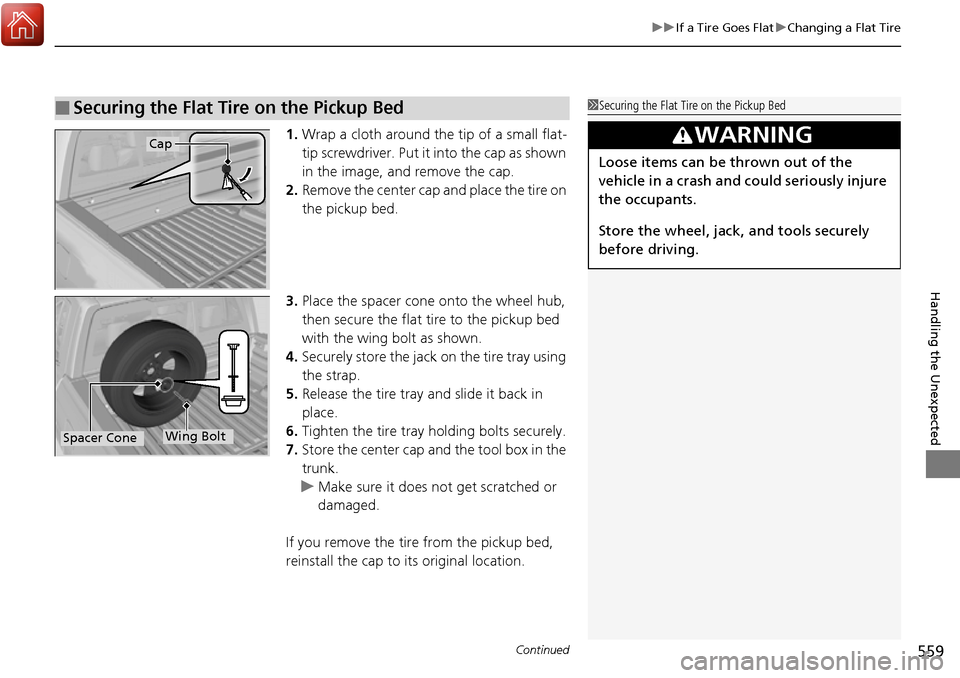
1. Wrap a cloth around the tip of a small flat-
tip screwdriver. Put it into the cap as shown
in the image, and remove the cap.
2. Remove the center cap and place the tire on
the pickup bed.
3. Place the spacer cone onto the wheel hub,
then secure the flat tire to the pickup bed
with the wing bolt as shown.
4. Securely store the jack on the tire tray using
the strap.
5. Release the tire tray and slide it back in
place.
6. Tighten the tire tray holding bolts securely.
7. Store the center cap and the tool box in the
trunk.
u Make sure it does not get scratched or
damaged.
If you remove the tire from the pickup bed,
reinstall the cap to its original location.
■Securing the Flat Tire on the Pickup Bed1 Securing the Flat Tire on the Pickup Bed
3WARNING
Loose items can be thrown out of the
vehicle in a crash and could seriously injure
the occupants.
Store the wheel, jack, and tools securely
before driving.
Cap
Wing BoltSpacer Cone
Page 561 of 606
uuIf a Tire Goes Flat uChanging a Flat Tire
560
Handling the Unexpected
As a temporary mounting location, you ma y secure the compact spare tire on the
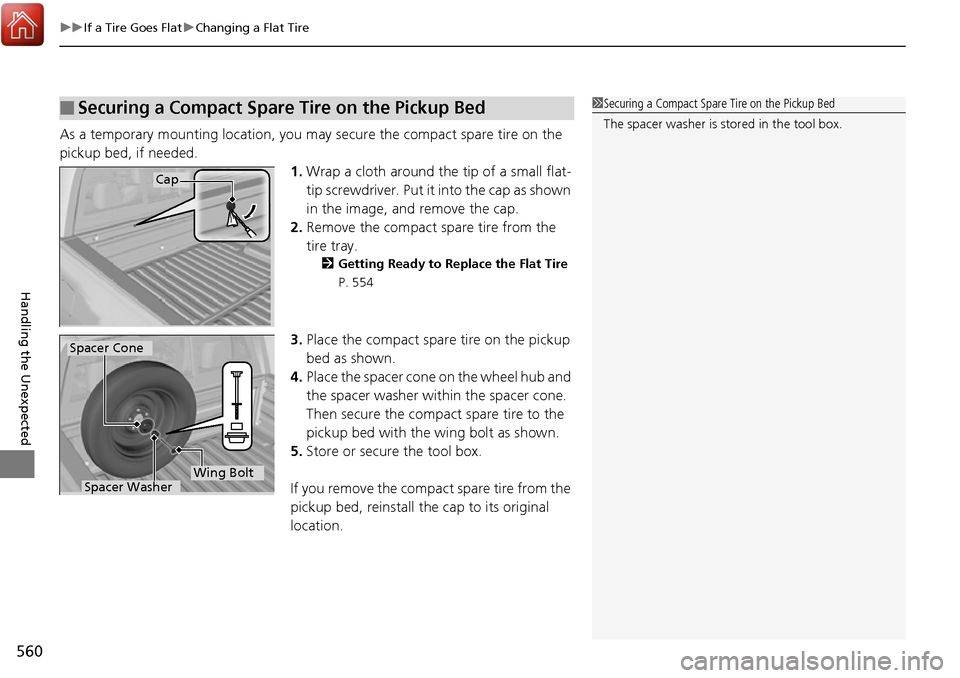
pickup bed, if needed. 1.Wrap a cloth around the tip of a small flat-
tip screwdriver. Put it into the cap as shown
in the image, and remove the cap.
2. Remove the compact spare tire from the
tire tray.
2 Getting Ready to Replace the Flat Tire
P. 554
3. Place the compact spare tire on the pickup
bed as shown.
4. Place the spacer cone on the wheel hub and
the spacer washer within the spacer cone.
Then secure the compact spare tire to the
pickup bed with the wing bolt as shown.
5. Store or secure the tool box.
If you remove the comp act spare tire from the
pickup bed, reinstall th e cap to its original
location.
■Securing a Compact Spare Tire on the Pickup Bed1 Securing a Compact Spare Tire on the Pickup Bed
The spacer washer is stored in the tool box.
Cap
Spacer Cone
Wing BoltSpacer Washer
Page 562 of 606

561
uuIf a Tire Goes Flat uChanging a Flat Tire
Handling the Unexpected
If you replace a flat tire with the spare tire, the low tire pressure/TPMS indicator
comes on while you are driving. After dr iving for a few miles (kilometers), the
indicator will start blinking for a short time and then stay on. Tire Pressure
Monitor Problem appears on the multi-informatio n display, but this is normal.
If you replace the tire with a specified regular tire, the warning message on the
multi-information display and the low tire pressure/TPMS indicator will go off after
a few miles (kilometers).
■TPMS with Tire Fill Assist and the Compact Spare Tire1 TPMS with Tire Fill Assist and the Compact Spare Tire
The system cannot monitor th e pressure of the spare
tire. Manually check the spare tire pressure to be sure
that it is correct.
Use the TPMS specific wheels. Each is equipped with
a tire pressure sensor mount ed inside the tire behind
the valve stem.
Page 575 of 606
574
uuIndicator, Coming On/Blinking uIf the Low Tire Pressure/Tire Pressure Monitoring System (TPMS) Indicator Comes On or Blinks
Handling the Unexpected
If the Low Tire Pressure/Tire Pressure Monitoring
System (TPMS) Indicato r Comes On or Blinks
■Reasons for the indicato r to come on or blink
The pressure of one or more tires is significantly low, or TPMS with Tire
Fill Assist has not been calibrated. If there is a problem with TPMS with
Tire Fill Assist or the compact spare tire is installed, the indicator blinks
for about one minute, and then stays on.
■What to do when the indicator comes on
Drive carefully and avoid abrupt cornering and hard braking.
Stop your vehicle in a safe place. Ch eck the tire pressure and adjust the
pressure to the specified level. The sp ecified tire pressure is on a label on
the driver side doorjamb. u Calibrate TPMS with Tire Fill Assi st after the tire pressure is
adjusted.
■What to do when the indicator blinks, then remains on
Have the tire inspected by a dealer as soon as possible. If the compact
spare tire causes the indicator to blink, change the tire to a full-size tire.
The indicator goes off after driving for a few miles (kilometers).
1 If the Low Tire Pressure/Tire Pressure Monitoring System (TPMS)
Indicator Comes On or Blinks
NOTICE
Driving on an extremely unde rinflated tire can cause
it to overheat. An overheated tire can fail. Always
inflate your tires to the prescribed level.
TPMS with Tire Fill Assist provides visual and audible
assistance during tire pre ssure adjustment. With the
power mode in ON, while y ou adjust tire pressure up
or down, the system alerts you as follows:
Below recommended pressure: The beeper
sounds and exterior lights flash once every five
seconds.
At recommended pressure: The beeper sounds
and exterior lights flash rapidly for five seconds.
Above recommended pressure: The beeper
sounds and lights flash twice every three seconds.
Page 581 of 606

580
Handling the Unexpected
Emergency Towing
Call a professional towing service if you need to tow your vehicle.
■Flat bed equipment
The operator loads your vehicle on the back of a truck.
This is the best way to transport your vehicle.
■Wheel lift equipment
The tow truck uses two pivoti ng arms that go under the front tires and lift them off
the ground. The rear tires remain on the ground. This is an acceptable way to
tow your vehicle.
1 Emergency Towing
NOTICE
Trying to lift or tow your vehicle by the bumpers will
cause serious damage. The bumpers are not designed
to support the vehicle’s weight.
NOTICE
Improper towing such as towing behind a
motorhome or other motor vehicle can damage the
transmission.
Never tow your vehicle with just a rope or chain.
It is very dangerous since ropes or chains may shift
from side to side or break.
All models
2WD models
Page 583 of 606
582
Handling the Unexpected
Refueling
Refueling From a Portable Fuel Container
If you have run out of fuel and need to refuel your vehicle from a portable fuel
container, use the funnel provided with your vehicle.1.Turn off the engine.
2. Press the fuel fill door release button.
u The fuel fill door opens.
3. Open the trunk and pull out the tire tray
with the handles.
2 Getting Ready to Replace the Flat Tire
P. 554
4. Remove the funnel from the tool box.
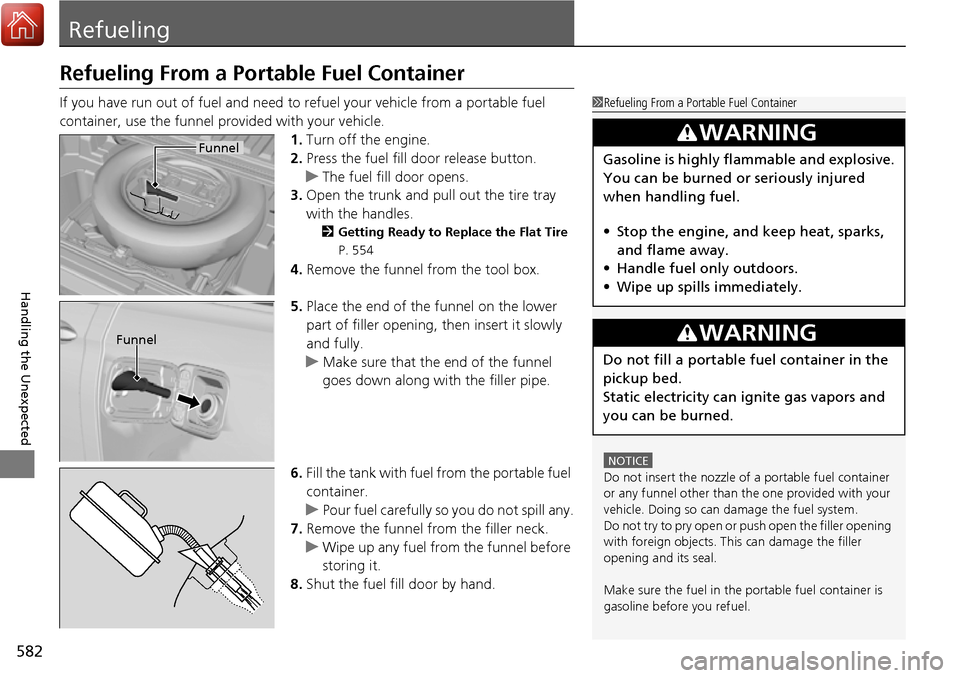
5. Place the end of the funnel on the lower
part of filler opening, then insert it slowly
and fully.
u Make sure that the end of the funnel
goes down along with the filler pipe.
6. Fill the tank with fuel from the portable fuel
container.
u Pour fuel carefully so you do not spill any.
7. Remove the funnel from the filler neck.
u Wipe up any fuel from the funnel before
storing it.
8. Shut the fuel fill door by hand.
1Refueling From a Portable Fuel Container
NOTICE
Do not insert the nozzle of a portable fuel container
or any funnel other than the one provided with your
vehicle. Doing so can damage the fuel system.
Do not try to pry open or push open the filler opening
with foreign objects. This can damage the filler
opening and its seal.
Make sure the fuel in the portable fuel container is
gasoline before you refuel.
3WARNING
Gasoline is highly flammable and explosive.
You can be burned or seriously injured
when handling fuel.
• Stop the engine, and keep heat, sparks,
and flame away.
• Handle fuel only outdoors.
• Wipe up spills immediately.
3WARNING
Do not fill a portable fuel container in the
pickup bed.
Static electricity can ignite gas vapors and
you can be burned.
Funnel
Funnel
Page 601 of 606

600
Index
F
Features..................................................... 197
Filters Dust and Pollen ....................................... 542
Oil ........................................................... 517
Flat Tire ..................................................... 553
Floor Mats ................................................. 544
Fluids
Automatic Transmission ........................... 521
Brake ....................................................... 522
Engine Coolant ........................................ 519
Windshield Washer .................................. 522
FM/AM Radio .................................... 211, 247
Fog Lights .................................................. 147
Indicator .................................................... 79
Folding Up the Rear Seat ......................... 164
Foot Brake ................................................. 475
Front Airbags (SRS) ..................................... 43
Front Seats ................................................ 161
Adjusting ................................................. 161
Front Sensor Camera ................................ 434
Fuel ...................................................... 21, 498
Economy ................................................. 501
Gauge ..................................................... 101
Instant Fuel Economy ............................... 105
Low Fuel Indicator ..................................... 75
Range ...................................................... 105
Recommendation .................................... 498
Refueling ................................................. 498
Fuel Economy and CO
2 Emissions ............ 501 Fuel Fill Door
...................................... 21, 499
Unable to Unlock .................................... 581
Fuses .......................................................... 575
Inspecting and Changing......................... 579
Locations................................. 575, 577, 578
G
Gasoline (Fuel) Economy ................................................. 501
Gauge ..................................................... 101
Information ............................................. 498
Instant Fuel Economy .............................. 105
Low Fuel Indicator ..................................... 75
Refueling................................................. 498
Gauges ...................................................... 101
Glass (care) ................................................ 547
Glove Box .................................................. 171
H
Halogen Bulbs .......................................... 523
Handling the Unexpected ........................ 551
HandsFreeLink ® (HFL) ....................... 337, 362
Automatic Import of Cellular Phonebook and Call History .................................... 351, 375
Caller’s ID Information............................. 349
Displaying Messages................................ 389
HFL Buttons..................................... 337, 362
HFL Menus ...................................... 339, 365
HFL Status Display ........................... 338, 364 In Case of Emergency ............................. 393
Limitations for Manual Operation .... 338, 364
Making a Call ................................. 356, 383
Options During a Call...................... 361, 386
Phone Setup ................................... 343, 370
Phonebook Phonetic M
odification........... 379
Receiving a Call............................... 360, 386
Receiving a Text Message/E-mail ............. 387
Ring Tone ....................................... 349, 374
Selecting a Mail Account......................... 388
Speed Dial ...................................... 352, 376
To Clear the System ................................ 350
To Set Up a Text Message/E-mail Options ................................................. 373
Hazard Warning Button .............................. 4
Hazard Warning Indicator ......................... 78
HD Radio
TM............................................... 247
Head Restraints ................................ 166, 167
Headlights ................................................ 144
Aiming.................................................... 523
Auto High-Beam ..................................... 149
Automatic Operation .............................. 145
Dimming......................................... 144, 148
Operating ............................................... 144
Heated Door Mirrors ............................... 154
Heated Steering Wheel ........................... 178
Heated Windshield Button ...................... 154
Heater (Steering Wheel) .......................... 178
Heaters (Seat) ........................... 179, 180, 181