Page 574 of 606

573
uuIndicator, Comin g On/BlinkinguIf the Brake System Indicator (Red) Comes On
Handling the Unexpected
If the Brake System Indicator (Red) Comes On
■Reasons for the indicator to come on
• The brake fluid is low.
• There is a malfunction in the brake system.
■What to do when the indicator comes on while driving
Depress the brake pedal lightly to check pedal pressure.
• If normal, check the brake fluid level the next time you stop.
• If abnormal, take immediate acti on. If necessary, downshift the
transmission to slow the vehicle using engine braking.
If the Electric Power Steeri ng (EPS) System Indicator
Comes On
■Reasons for the indicator to come on
• Comes on when there is a problem with the EPS system.
• If you depress the accelerator pedal repeatedly to increase the engine
speed while the engine is idling, the indicator comes on, and
sometimes the steering wheel becomes harder to operate.
■What to do when th e indicator comes on
Stop the vehicle in a safe place and restart the engine.
If the indicator comes on and stays on, immediately have your vehicle
inspected by a dealer.
1 If the Brake System Indicator (Red) Comes On
Have your vehicle re paired immediately.
It is dangerous to drive with low brake fluid. If there
is no resistance from the brake pedal, stop
immediately in a safe plac e. If necessary downshift
the gears.
If the brake system indicator and ABS indicator come
on simultaneously, the elec tronic brake distribution
system is not working. Th is can result in vehicle
instability under sudden braking.
Have your vehicle inspecte d by a dealer immediately.
If both red and amber brake system indicators come
on, stop the vehicle in a safe place and have it
inspected by a dealer immediately.U.S.
Canada
Page 576 of 606
575Continued
Handling the Unexpected
Fuses
Fuse Locations
If any electrical devices are not working, set the power mode to VEHICLE OFF (LOCK)
and check to see if any applicable fuse is blown.
Fuse locations are shown on the fuse box
cover. Locate the fuse in question by the fuse
number and box cover number.
Located near the passenger’s side damper
house. Push the tabs to open the box.
■Engine Compartment Fuse Box Type A
Tab
Page 578 of 606
577
uuFuses uFuse Locations
Continued
Handling the Unexpected
Fuse locations are shown on the fuse box
cover. Locate the fuse in question by the
fuse number and box cover number.
Located near the brake fluid reservoir. Push
the tabs to open the box.
■Engine Compartment Fuse
Box Type B
Tab
■Circuit protected and fuse rating
Circuit ProtectedAmps
1
ST CUT140 A
4WD(20 A)
IG MAIN30 A
IG MAIN230 A
−−
F/B MAIN260 A
F/B MAIN60 A
EPS60 A
2−−
3TRL E-BRAKE(20 A)
4BMS 7.5 A
5H/L HI MAIN20 A
6 +B TRL HAZARD (7.5 A)
7+B TRL BACKUP(7.5 A)
8 CTR ACC SOCKET 20 A
9TRAILER SMALL(20 A)
10 ACC/IG2_MAIN 10 A
11TRL CHARGE(20 A)
12−−
13−−
14−−
15FR DE-ICER(15 A)
16RR _HTD SEAT(20 A)
17STRLD7.5 A
Page 580 of 606
579
uuFuses uInspecting and Changing Fuses
Handling the Unexpected
Inspecting and Changing Fuses
1. Set the power mode to VEHICLE OFF
(LOCK). Turn headlights and all accessories
off.
2. Remove the fuse box cover.
3. Check the large fuse in the engine
compartment.
u If the fuse is blown, use a Phillips-head
screwdriver to remove the screw and
replace it with a new one.
4. Inspect the small fuses in the engine
compartment and the vehicle interior.
u If there is a burned out fuse, remove it
with the fuse puller and replace it with a
new one.1 Inspecting and Changing Fuses
NOTICE
Replacing a fuse with on e that has a higher rating
greatly increases the chances of damaging the
electrical system.
Replace fuse with a spare fuse of the same specified
amperage
Confirm the specified amperage using the charts on
P. 575 to P. 578.
There is a fuse puller in the engine compartment fuse
box located on the passenger’s side.
Combined
Fuse Blown Fuse
Fuse Puller
Page 583 of 606
582
Handling the Unexpected
Refueling
Refueling From a Portable Fuel Container
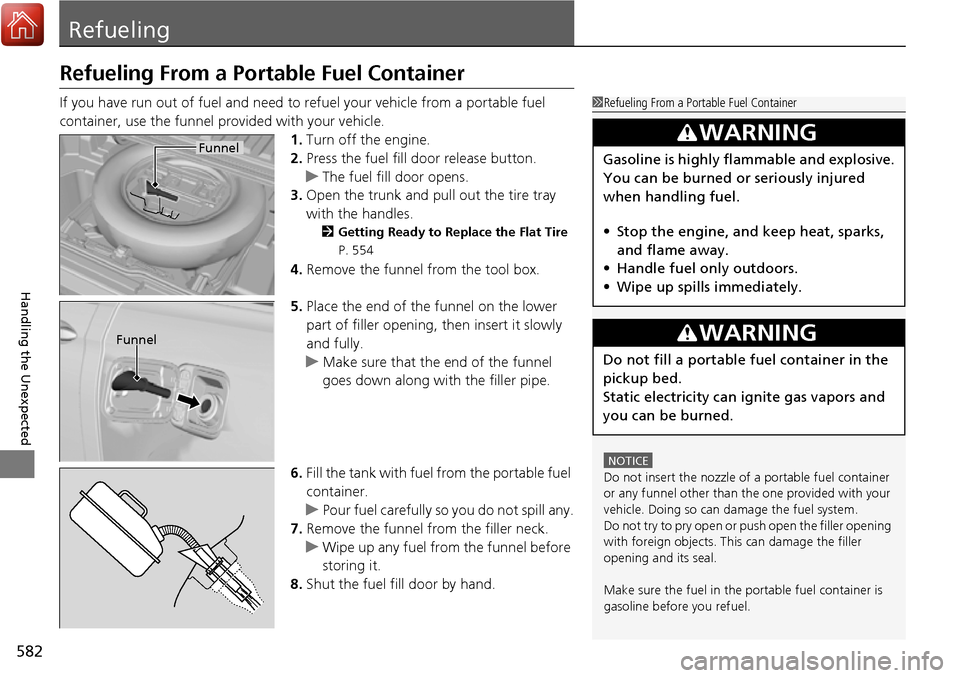
If you have run out of fuel and need to refuel your vehicle from a portable fuel
container, use the funnel provided with your vehicle.1.Turn off the engine.
2. Press the fuel fill door release button.
u The fuel fill door opens.
3. Open the trunk and pull out the tire tray
with the handles.
2 Getting Ready to Replace the Flat Tire
P. 554
4. Remove the funnel from the tool box.
5. Place the end of the funnel on the lower
part of filler opening, then insert it slowly
and fully.
u Make sure that the end of the funnel
goes down along with the filler pipe.
6. Fill the tank with fuel from the portable fuel
container.
u Pour fuel carefully so you do not spill any.
7. Remove the funnel from the filler neck.
u Wipe up any fuel from the funnel before
storing it.
8. Shut the fuel fill door by hand.
1Refueling From a Portable Fuel Container
NOTICE
Do not insert the nozzle of a portable fuel container
or any funnel other than the one provided with your
vehicle. Doing so can damage the fuel system.
Do not try to pry open or push open the filler opening
with foreign objects. This can damage the filler
opening and its seal.
Make sure the fuel in the portable fuel container is
gasoline before you refuel.
3WARNING
Gasoline is highly flammable and explosive.
You can be burned or seriously injured
when handling fuel.
• Stop the engine, and keep heat, sparks,
and flame away.
• Handle fuel only outdoors.
• Wipe up spills immediately.
3WARNING
Do not fill a portable fuel container in the
pickup bed.
Static electricity can ignite gas vapors and
you can be burned.
Funnel
Funnel
Page 586 of 606
585
Information
This chapter includes your vehicle’s specifications, locations of identification numbers, and other
information required by regulation.
Specifications .................................... 586
Identification Numbers Vehicle Identification Number (VIN), Engine Number, and Transmission
Number ......................................... 588
Devices that Emit Radio Waves ....... 589
Reporting Safety Defects ................. 590Emissions Testing
Testing of Readiness Codes.............. 591
Warranty Coverages ........................ 593
Authorized Manuals ......................... 595
Customer Service Information ......... 596
Page 587 of 606

586
Information
Specifications
■Vehicle Specifications
*1: Models with AWD
*2: Models with 2WD
■Air Conditioning
ModelRidgeline
No. of Passengers:
Front 2
Rear 3
Total 5
Weights:Gross Vehicle
Weight Rating6019 lbs (2730 kg)*1
5710 lbs (2590 kg)*2
Gross Axle Weight
Rating (Front)3131 lbs (1420 kg)*1
3042 lbs (1380 kg)*2
Gross Axle Weight
Rating (Rear)3219 lbs (1460 kg)*1
3042 lbs (1380 kg)*2
Gross Combined Weight
Rating 9987 lbs (4530 kg)*1
8201 lbs (3720 kg)*2
Air Conditioning:Refrigerant TypeHFO-1234yf (R-1234yf)Charge Quantity20.3 – 22.0 oz (575 – 625 g)Lubricant TypeRL85HM (POE)Quantity7.5 – 8.7 cu-in (123 – 143 cm3)
■
Engine Specifications
■ Fuel
■ Washer Fluid
Displacement211.8 cu-in (3,471 cm3)
Spark Plugs NGK DILZKR7B11G
TypeUnleaded gasoline, Pump octane number
of 87 or higher
Fuel Tank Capacity 19.5 US gal (73.8 ℓ)
Tank CapacityU.S.: 1.0 US gal (3.8 ℓ)
Canada: 1.4 US gal (5.3 ℓ)
■ Light Bulbs
*1: Models with LED low beam headlights
*2: Models without LED low beam headlights
*3: Models with LED day time running lights
*4: Models without LED day time running lights
*5: Models with moonroof
*6: Models without moonroof
Headlights (Low Beam)LED*1
55 W*2 (H11)
Headlights (High Beam) 60W (HB3)
Fog Lights*35 W (H8)
Front Turn Signal/Parking Lights*28/8 W (Amber)Parking Lights*LED
Front Side Marker Lights LED
Daytime Running LightsLED*3
60W (HB3)*4
Side Turn Signal Lights (on Door Mirrors)*LEDRear Side Marker LightsLED
Brake/Taillights LED
Back-Up Lights21 W
Rear Turn Signal Lights 21 W
High-Mount Brake LightLED
Rear License Plate Lights 5 W
Bed LightsLED*1
3CP*2
Interior Lights
Front Map Lights LED*5
5 W*6
Rear Map Lights
5 W
Vanity Mirror Lights*1.4 W
Door Pocket Lights*LED
Beverage Holder Light*LED
Door Courtesy Lights*3.8 W
Door Inner Handle Lights*LED
Console Compartment Light 1.4 W
Glove Box Light 1.4 W
Foot Lights
*LED
* Not available on all models
Page 588 of 606

587
uuSpecifications u
Information
■Brake Fluid
■ Automatic Transmission Fluid
■ Rear Differential Fluid
*
■Transfer Assembly Fluid*
SpecifiedHonda Heavy Duty Brake Fluid DOT 3
SpecifiedHonda ATF DW-1 (automatic transmission fluid)
Capacity Change 3.3 US qt (3.1 ℓ)
SpecifiedHonda All Wheel Drive Fluid (DPSF-II)
Capacity Change 1.92 US qt (1.82 ℓ)
Specified·Honda Hypoid Gear Oil HGO-1
·Hypoid gear oil SAE 75W-85 or SAE 90 (API
grade GL4 or GL5)
Capacity Change 0.45 US qt (0.43 ℓ)
■ Engine Oil
■ Engine Coolant
Recommended·Genuine Honda Motor Oil 0W-20
·API Premium-grade 0W-20 detergent oil
Capacity Change 5.4 US qt (5.1 ℓ)
Change
including
filter
5.7 US qt (5.4 ℓ)
SpecifiedHonda Long Life Antifreeze/Coolant Type 2
Ratio 50/50 with distilled water
Capacity1.88 US gal (7.13 ℓ)
(change including the remaining 0.19 US gal
(0.72 ℓ) in the reserve tank)
■ Tire
RegularSize245/60R18 105HPressure
psi (kPa [kgf/cm2])35 (240 [2.4])
Compact
Spare Size
T165/90R17 105M
Pressure
psi (kPa [kgf/cm
2]) 60 (420 [4.2])
Wheel SizeRegular18 x 8JCompact Spare17 x 4T
* Not available on all models