2017 HONDA CLARITY ELECTRIC center
[x] Cancel search: centerPage 21 of 543

19
Quick Reference Guide
Drive Cycle Score/Lifetime Points
●Appears when the power mode is in VEHICLE OFF (LOCK).
Eco Drive Display (P124)
The vehicle icon in the display moves forward and back and the background color changes to indicate how energy-efficiently you
are driving.
● When you accelerate and decelerate, the ic on moves forward and back respectively. The greater the acceleration or deceleration,
the greater the icon moves.
● When the icon moves too far in one direct ion, the screen changes from green to blue to indicate that you are driving
inefficiently.
● You can maintain better energy efficiency by keeping the icon in the center.
Aggressive Deceleration Energy-Effici ent Driving Aggressive Acceleration
Blue Blue-Green Green Blue-Green Blue Moderate
Deceleration
Moderate
AccelerationLifetime Points
Drive Cycle Score
17 CLARITY BEV CSS-31TRV6000.book 19 ページ 2017年4月14日 金曜日 午前11時
8分
Page 27 of 543

25
Quick Reference Guide
Climate Control System (P 183)
● Press the AUTO button to activate th e climate control system.
● Press the button to tu rn the system on or off.
● Press the button to defrost the windshield.
The climate control system is voice operable. (P225)
AUTO Button
/ (Fan Control) Buttons
MODE
Control Icon
(Air flows from floor and dashboard
vents, and back of the center console) A/C (Air Conditioning) Icon
MODE Control Icon
(Air flows from floor and
windshield defroster vents)
MODE Control Icon
(Air flows from floor vents)
Passenger’s Side
Temperature Control Dial
SYNC (Synchronization) Button
(Windshield Defroster) Button
(ON/OFF) Button
(Recirculation) Button
(Fresh Air) Button
MODE Control Icon
(Air flows from dashboard vents
and back of the center console)
Driver’s Side Temperature
Control Dial CLIMATE
Button
Fan Control Icon
17 CLARITY BEV CSS-31TRV6000.book 25 ページ 2017年4月14日 金曜日 午前11時 8分
Page 43 of 543

41
uuFor Safe Driving uSafety Checklist
Safe Driving
Safety Checklist
For the safety of you and your passengers, make a habit of checking these items
each time before you drive. Check if the charging cable is connected to the vehicle
and disconnect it if it is. The vehicle will not operate with the cable connected.
• After everyone has entered the vehicle, be sure all doors are closed and locked.
Locking the doors helps prevent an occupant from being ejected and an outsider
from unexpectedly opening a door.
2 Locking/Unlocking the Doors from the Inside P. 137
•Adjust your seat to a position suitable for driving. Be sure the front seats are
adjusted as far to the rear as possible while allowing the driver to control the
vehicle. Sitting too close to a front airbag can result in serious or fatal injury in a
crash.
2 Adjusting the Seats P. 166
•Adjust head restraints to the proper position. Head restraints are most effective
when the center of the head restraint alig ns with the center of your head. Taller
persons should adjust their head restraint to the highest position.
2Adjusting the Front Head Restraints Positions P. 168
•Always wear your seat belt, and make sure you wear it properly. Confirm that any
passengers are properly belted as well.
2 Fastening a Seat Belt P. 45
•Protect children by using seat belts or chil d seats according to a child’s age, height
and weight.
2 Child Safety P. 65
1Safety Checklist
If the door and/or trunk open message appears on
the driver information inte rface, a door and/or the
trunk is not completely cl osed. Close all doors and
the trunk tightly until the message disappears.
2 Driver Information Interface Warning and
Information Messages P. 106
17 CLARITY BEV CSS-31TRV6000.book 41 ページ 2017年4月14日 金曜日 午前11時 8分
Page 48 of 543
uuSeat Belts uFastening a Seat Belt
46
Safe Driving
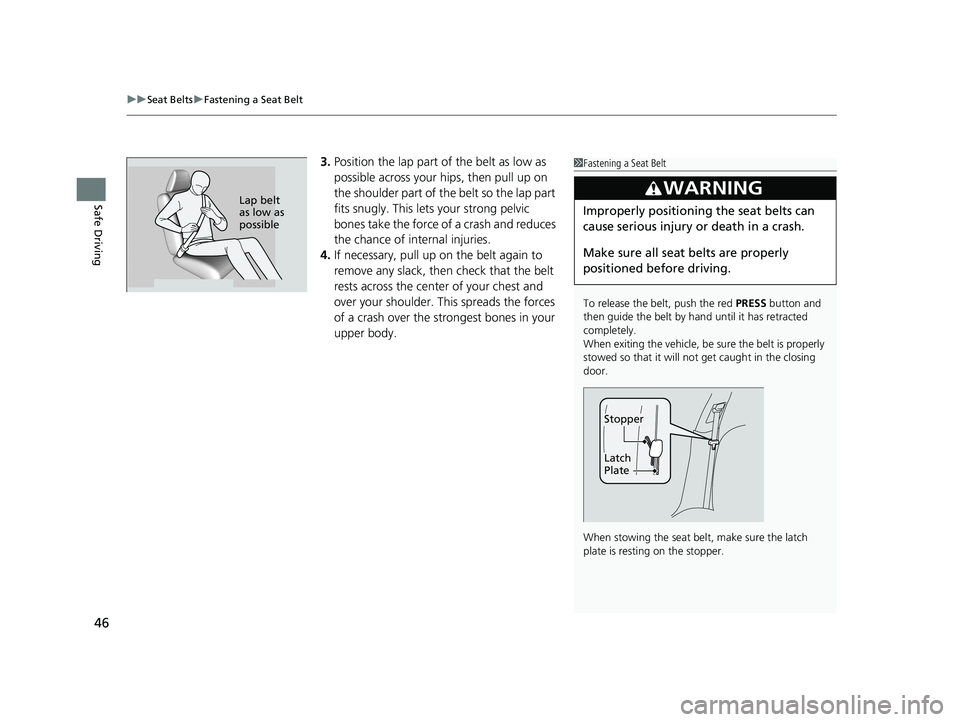
3. Position the lap part of the belt as low as
possible across your hips, then pull up on
the shoulder part of the belt so the lap part
fits snugly. This lets your strong pelvic
bones take the force of a crash and reduces
the chance of internal injuries.
4. If necessary, pull up on the belt again to
remove any slack, then check that the belt
rests across the center of your chest and
over your shoulder. Th is spreads the forces
of a crash over the strongest bones in your
upper body.1 Fastening a Seat Belt
To release the belt, push the red PRESS button and
then guide the belt by hand until it has retracted
completely.
When exiting the vehicle, be sure the belt is properly
stowed so that it will not get caught in the closing
door.
When stowing the seat belt, make sure the latch
plate is resting on the stopper.
3WARNING
Improperly positioning the seat belts can
cause serious injury or death in a crash.
Make sure all seat belts are properly
positioned before driving.
Latch
Plate
Stopper
Lap belt
as low as
possible
17 CLARITY BEV CSS-31TRV6000.book 46 ページ 2017年4月14日 金曜日 午前11時 8分
Page 49 of 543

Continued47
uuSeat Belts uFastening a Seat Belt
Safe DrivingThe front seats have adjustab le shoulder anchors to accommodate taller and shorter
occupants. 1.Move the anchor up and down while
holding the release button.
2. Position the anchor so that the belt rests
across the center of your chest and over
your shoulder.
■Adjusting the Shoulder Anchor1 Adjusting the Shoulder Anchor
The shoulder anchor height can be adjusted to four
levels. If the belt contacts your neck, lower the height
one level at a time.
After an adjustment, make sure that the shoulder
anchor position is secure.
Push
17 CLARITY BEV CSS-31TRV6000.book 47 ページ 2017年4月14日 金曜日 午前11時 8分
Page 53 of 543

51
uuAirbags uAirbag System Components
Continued
Safe Driving
The front, driver’s knee, front side, and side
curtain airbags are de ployed according to
the direction and severity of impact. Both
side curtain airbags are deployed in a
rollover. The airbag system includes:
aTwo SRS (Supplemental Restraint System)
front airbags. The driver’s airbag is stored
in the center of the steering wheel; the
front passenger’s airbag is stored in the
dashboard. Both are marked SRS
AIRBAG.
bDriver’s knee airbag. The knee airbag is
stored under the steer ing column. It is
marked SRS AIRBAG .
cTwo side airbags, one for the driver and
one for a front passenger. The airbags are
stored in the outer edges of the seat-
backs. Both are marked SIDE AIRBAG.
dTwo side curtain ai rbags, one for each
side of the vehicle. The airbags are stored
in the ceiling, abov e the side windows.
The front and rear pillars are marked
SIDE CURTAIN AIRBAG.
eAn electronic control unit that, when the
vehicle is on, continually monitors
information about the various impact
sensors, seat and buckle sensors, rollover
sensor, airbag activators, seat belt
tensioners, seat weight sensor, seat
position sensor, passenger airbag OFF
indicator, and other vehicle information.
During a crash event the unit can record
such information.
fAutomatic front seat belt tensioners. In
addition, the driver’s and front
passenger’s seat belt buckles incorporate
sensors that detect whether or not the
belts are fastened.
gA driver’s seat position sensor. If the seat
is too far forward, the airbag will inflate
with less force.
hWeight sensors in the front passenger’s
seat. The front passenger’s airbag will be
turned off if the weight on the seat is
approximately 65 lbs (29 kg) or less (the
weight of an infant or small child).
iImpact sensors that can detect a
moderate-to-severe front or side impact.
jAn indicator on the dashboard that alerts
you that the front passenger’s front
airbag has been turned off.
kAn indicator on the instrument panel that
alerts you to a possible problem with your
airbag system or seat belt tensioners.
lA rollover sensor that can detect if your
vehicle is about to ro ll over and signal the
control unit to deploy both side curtain
airbags.
17 CLARITY BEV CSS-31TRV6000.book 51 ページ 2017年4月14日 金曜日 午前11時 8分
Page 55 of 543

53
uuAirbags uTypes of Airbags
Continued
Safe Driving
Types of Airbags
Your vehicle is equipped with four types of airbags:
• Front airbags: Airbags in front of the driver’s and front passenger’s seats.
• Driver’s knee airbag: Airbag under the steering column.
• Side airbags: Airbags in the driver’s and front passenger’s seat-backs.
• Side curtain airbags: Airbags above the side windows.
Each is discussed in the following pages.
Front Airbags (SRS)
The front SRS airbags inflate in a moderate-to-severe frontal collision to help protect
the head and chest of the driver and/or front passenger.
SRS (Supplemental Restraint System) indica tes that the airbags are designed to
supplement seat belts, not replace them . Seat belts are the occupant’s primary
restraint system.
The front airbags are housed in the center of the steering wheel for the driver, and
in the dashboard for the front pass enger. Both airbags are marked SRS AIRBAG.
■Housing Locations
1Types of Airbags
The airbags can inflate whenever the power mode is
in ON.
After an airbag inflates in a crash, you may see a
small amount of smoke. This is from the combustion
process of the infl ator material and is not harmful.
People with respiratory pr oblems may experience
some temporary discomfort. If this occurs, get out of
the vehicle as soon as it is safe to do so.
1 Front Airbags (SRS)
During a frontal crash severe enough to cause one or
both front airbags to deploy, the airbags can inflate
at different rates, dependi ng on the severity of the
crash, whether or not the se at belts are latched, and/
or other factors. Frontal airbags are designed to
supplement the seat belts to help reduce the
likelihood of head and chest injuries in frontal
crashes.
17 CLARITY BEV CSS-31TRV6000.book 53 ページ 2017年4月14日 金曜日 午前11時 8分
Page 65 of 543

63
uuAirbags uAirbag System Indicators
Safe Driving■When the passenger front airbag off
indicator comes on
The indicator comes on to alert you that the
passenger’s front airbag has been turned off.
This occurs when the weight sensors detect
about 65 lbs (29 kg) or less, the weight of an
infant or small child, on the seat.
Children age 12 or under shou ld always ride properly restrained in a back seat.
2Child Safety P. 65
If the front passenger seat is empty, the pa ssenger’s front airbag will not deploy and
the indicator will come on.
■Passenger Front Airbag Off Indicator1 Passenger Front Airbag Off Indicator
To ensure the passenger is detected properly, confirm
that:
•There is no child seat or other object pressing
against the rear of the seat-back.
•There is no rear passenger pushing or pulling on
the back of the front passenger’s seat.
•The front seat or seat-b ack is not forced back
against an object on the s eat or floor behind it.
•There is no object placed under or beside the front
passenger’s seat.
•The occupant is sitting in an upright position and
the seat back is not excessively reclined.
•The occupant is not leaning against the door or
center console.
•The occupant’s feet are plac ed on the floor in front
of them.
•There are no objects ha nging from the front
passenger’s seat.
•Only small, lightweight objects are in the seat-back
pocket.
The passenger front airbag off indicator may come
on and go off periodically if the total weight on the
seat is near the airbag cutoff threshold.
Have your vehicle checked by an authorized Honda
Clarity Electric dealer as soon as possible if:
•All of the above conditions are met, and the
indicator comes on with an adult seated in the
front passenger seat.
•The seat is empty and the indicator is off.
Do not allow an adult passe nger to ride in the front
seat when the indicator is on.
17 CLARITY BEV CSS-31TRV6000.book 63 ページ 2017年4月14日 金曜日 午前11時 8分